
 My Inquiry
 My Account


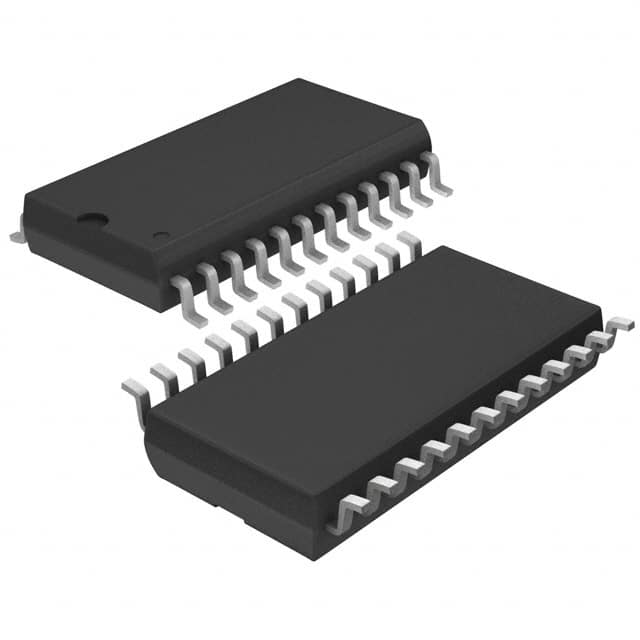
Analog Devices Inc. AD7858LBRZ
- Part No.:
- AD7858LBRZ
- Manufacturer:
- Analog Devices Inc.
- Category:
- Analog to Digital Converters (ADC)
- Package:
- 24-SOIC (0.295", 7.50mm Width)
- Datasheet:
-
 AD7858LBRZ.pdf
- Description:
- IC ADC 12BIT SAR 24SOIC
- Quantity:
- Payment:

- Shipping:

Inventory:3,890
Please send an inquiry. Send us your inquiry, and we will respond immediately.
Product details
Overview
AD7858LBRZ from Analog Devices is a 12-bit, 100 kSPS SAR analog-to-digital converter with eight single-ended or four pseudo-differential analog inputs, internal reference buffer, and flexible SPI/QSPI/μP-compatible serial interface. It operates from a single 3 V to 5.5 V supply, consumes 4.5 mW at 3 V, and features automatic power-down after conversion and on-chip self-calibration. It is used in battery-powered instrumentation and portable medical devices requiring precision, low power, and compact size.
For engineers reviewing the AD7858LBRZ datasheet, AD7858LBRZ pinout, AD7858LBRZ application, or AD7858LBRZ equivalent, this page delivers verified technical context, real-world timing behavior, calibrated DC accuracy specs (±1 LSB INL), true channel isolation (–90 dB), and validated alternative options for low-power 12-bit ADC selection in space- and energy-constrained systems.
Technical Context
The AD7858LBRZ implements a charge-redistribution SAR architecture with integrated track-and-hold, internal 2.5 V reference buffer, and programmable calibration engine supporting both system and self-calibration. Its 500 ns track/hold acquisition time enables accurate sampling of full-scale signals up to 100 kHz.
It uses a 24-pin SOIC package with separate analog/digital supplies (AVDD/DVDD) and grounds (AGND/DGND), supports external clock input (CLKIN = 1 MHz max for –40°C to +85°C), and provides three power management modes-normal, partial, and full power-down-with sub-µW sleep current when CLKIN is off.
Key Specifications
| Parameter | Value and Actual Design Meaning |
|---|---|
| Resolution | 12-bit - guarantees monotonic output and no missing codes across full temperature range |
| Throughput Rate | 100 kSPS - fixed maximum sample rate for AD7858L variant, enabling real-time monitoring of slow-varying sensor signals |
| INL (Integral Nonlinearity) | ±1 LSB max - ensures end-point linearity error ≤ ±0.024% of full scale with 2.5 V reference |
| Power Consumption | 4.5 mW at 3 V - enables >100-hour operation on coin-cell batteries in portable data loggers |
| Channel Configuration | 8 single-ended or 4 pseudo-differential inputs - allows flexible signal routing without external multiplexer hardware |
| Reference Range | 1.2 V to VDD - supports direct use of 3.3 V or 5 V system rails as reference source |
| SNR + Distortion | 71 dB min - delivers effective resolution of ~11.5 bits for 10 kHz sine-wave inputs |
Pinout & Package
AD7858LBRZ is housed in a 24-lead SOIC (R-24) package with 0.3-inch body width, gull-wing leads, and standard JEDEC MS-013AC footprint. Pin 1 is marked by a beveled corner or dot; pin numbering follows counterclockwise convention from top-left.
| Pin/Terminal | Circuit Role | Design Meaning |
|---|---|---|
| CONVST (Pin 1) | Convert Start Input | Edge-triggered control that initiates hold mode and conversion; rising edge starts process; unused must tie to DVDD |
| BUSY (Pin 2) | Conversion Status Output | Active-high open-drain signal indicating active conversion or calibration; used for handshaking in interrupt-driven firmware |
| SLEEP (Pin 3) | Low-Power Mode Control | Logic 0 powers down all circuitry including internal reference; retains calibration data; wake-up latency <1 µs |
| REFIN/REFOUT (Pin 4) | Reference I/O Terminal | Provides 2.5 V buffered reference output; accepts external reference from 1.2 V to AVDD; requires CREF1/CREF2 decoupling |
| AIN1–AIN8 (Pins 9–16) | Analog Input Channels | Configurable via control register for eight single-ended (vs AGND) or four pseudo-differential pairs; input range 0 V to VREF |
| CAL (Pin 17) | Calibration Trigger | Rising edge initiates full self-calibration; internal 0.15 µA pull-up; optional 10 nF capacitor to DGND enables auto-cal on power-up |
| DOUT (Pin 20) | Serial Data Output | 16-bit MSB-first output synchronized to SCLK; three-state controlled by SYNC; compatible with 8051, SPI, QSPI protocols |
| SYNC (Pin 24) | Frame Sync Input | Active-low level-triggered signal framing serial transfers; determines read/write register access and controls DOUT/DIN direction |
Key Features
| Feature | Design Value |
|---|---|
| Autocalibration on power-up | Eliminates need for external calibration routine; completes in 31.25 ms with 1 MHz CLKIN; retains offset/gain correction across temperature |
| Pseudo-differential input architecture | Enables rejection of common-mode noise up to 25 kHz while preserving 12-bit resolution without external op-amps |
| Flexible serial interface | Supports SPI Mode 2 (CPOL=1, CPHA=0), QSPI, and 8051-compatible timing; eliminates need for protocol translation logic |
| Low-power sleep mode | Draws only 5 µA max with external clock disabled - extends battery life in intermittent-sampling applications like environmental sensors |
| On-chip calibration registers | Stores 10 dedicated registers for offset, gain, and DAC calibration coefficients; accessible via serial port for field recalibration |
Applications
| Battery-Powered Medical Instrumentation | Portable Industrial Data Logger |
|---|---|
Use Scenario: Continuous ECG signal digitization in handheld patient monitors powered by CR2032 cells. IC Role / Device Role / Timing Role: Primary 12-bit ADC acquiring 8-channel biopotential signals at 100 Hz per channel with built-in reference stability. Use Value: 4.5 mW power draw at 3 V enables >120 hours of operation; ±1 LSB INL ensures diagnostic-grade amplitude fidelity. |
Use Scenario: Remote temperature/humidity logging in unattended field deployments using solar-charged Li-ion packs. IC Role / Device Role / Timing Role: Low-duty-cycle ADC sampling thermistor and capacitive humidity sensors every 10 seconds with automatic sleep between conversions. Use Value: 5 µA sleep current minimizes quiescent drain; on-chip calibration maintains ±0.5°C accuracy over –40°C to +85°C without factory recalibration. |
| Pen-Based Handheld Computer | High-Speed Modem Analog Front End |
Use Scenario: Digitizing stylus pressure and tilt signals in signature-capture tablets with tight PCB area constraints. IC Role / Device Role / Timing Role: Compact 24-pin SOIC ADC interfacing directly to resistive touch overlay and MEMS tilt sensors via shared serial bus. Use Value: Eight configurable inputs eliminate external MUX; 500 ns acquisition time captures fast stylus transients without external sample-hold circuitry. |
Use Scenario: Baseband signal conditioning in 56 kbps PSTN modems requiring precise analog line-level monitoring. IC Role / Device Role / Timing Role: Dual-role ADC measuring line voltage and echo cancellation feedback paths with simultaneous pseudo-differential sampling. Use Value: –90 dB channel-to-channel isolation prevents crosstalk between transmit/receive paths; straight binary coding simplifies DSP firmware integration. |
Equivalent & Alternatives
The following parts are listed as comparable options for similar 12-bit, low-power SAR ADC applications.
| Alternative Part | Technical Difference | Application Difference | Selection Advice |
|---|---|---|---|
| ADS7822U | 8-bit resolution, 200 kSPS, SPI-only interface, no internal reference | Lacks calibration, lower resolution limits dynamic range in precision sensing | Select only if 8-bit resolution suffices and external reference is already available |
| MAX11131ETE+ | 12-bit, 500 kSPS, internal 4.096 V reference, 10-pin µMAX package | Higher speed and smaller footprint but lacks pseudo-differential mode and system calibration capability | Prefer for space-constrained designs needing faster sampling but not requiring multi-channel isolation or field recalibration |
Compared with ADS7822U and MAX11131ETE+, the AD7858LBRZ uniquely combines 12-bit accuracy, on-chip self/system calibration, pseudo-differential input flexibility, and ultra-low 4.5 mW active power - making it optimal for battery-operated instruments where long-term measurement stability and minimal BOM count are critical.
Availability
AD7858LBRZ is available at Aetrix Electronics and suitable for battery-powered medical instrumentation, portable industrial data loggers, pen-based computing interfaces, and high-speed modem analog front ends requiring stable component supply, long-lifecycle support, and traceable sourcing.
Supply support for AD7858LBRZ includes scheduled delivery planning, volume procurement assistance, BOM continuity management, traceable sourcing, and lifecycle availability coordination for OEM customers, industrial embedded developers, connected-device designers, and electronics production programs.
Manufacturer
Analog Devices is a global leader in high-performance analog, mixed-signal, and digital signal processing semiconductors, founded in 1965 and headquartered in Wilmington, MA.
The AD7858LBRZ belongs to Analog Devices' legacy precision SAR ADC product line, designed specifically for portable, low-power, multi-channel data acquisition systems where calibration integrity, supply flexibility, and small-footprint integration are essential.
FAQ
What is the maximum clock frequency supported by AD7858LBRZ?
The AD7858LBRZ supports a maximum CLKIN frequency of 1 MHz over its full operating temperature range (–40°C to +85°C). At 0°C to +70°C, the B-grade version permits up to 1.8 MHz. This clock sets conversion timing: tCONVERT = 18 × tCLKIN, yielding 10 µs max conversion time at 1 MHz. Exceeding these limits risks timing violations and invalid conversion results in the AD7858LBRZ.
Does AD7858LBRZ require external reference components?
Yes, the AD7858LBRZ requires two external capacitors: a 0.1 µF multilayer ceramic capacitor (CREF1) and a 0.01 µF ceramic disc capacitor (CREF2), both connected between their respective pins (Pins 7 and 8) and AGND. These stabilize the internal reference buffer and DAC charge redistribution network. Omitting either capacitor degrades SNR and causes gain drift in the AD7858LBRZ.
Can AD7858LBRZ perform system calibration with an external reference?
Yes, the AD7858LBRZ supports system calibration using an external reference applied to REFIN/REFOUT (Pin 4). Its calibration engine accommodates offset spans of ±0.05 × VREF and gain spans of +1.025/–0.975 × VREF. When using an external reference, CREF1 and CREF2 remain mandatory, and the system full-scale voltage must fall within the calibrated span to ensure valid correction in the AD7858LBRZ.
What is the function of the CAL pin on AD7858LBRZ?
The CAL pin (Pin 17) is an active-high calibration trigger with internal 0.15 µA pull-up. A rising edge initiates full self-calibration; tying a 10 nF capacitor from CAL to DGND enables automatic calibration on power-up. During calibration, BUSY goes high and remains asserted for ~31.25 ms (at 1 MHz CLKIN). The AD7858LBRZ retains calibration coefficients in nonvolatile memory until next CAL assertion.
How does AD7858LBRZ handle power-down sequencing?
The AD7858LBRZ offers three power-down states controlled by PMGT1/PMGT0 bits in its control register: normal (PMGT=00), partial (PMGT=11), and full (PMGT=10). Full power-down draws 5 µA max with CLKIN off and retains calibration data. SLEEP pin (Pin 3) provides hardware override: logic 0 forces immediate full power-down regardless of register settings, and logic 1 restores normal operation - critical for rapid wake-up in the AD7858LBRZ.
AD7858LBRZ Specifications
- Product attributes
- Attribute value
- Manufacturer:
- Analog Devices Inc.
- Series:
- -
- Package/Case:
- 24-SOIC (0.295", 7.50mm Width)
- Packaging:
- Tube
- Product Status:
- Active
- Number of Bits:
- 12
- Sampling Rate (Per Second):
- 100k
- Number of Inputs:
- 4, 8
- Input Type:
- Pseudo-Differential, Single Ended
- Data Interface:
- SPI
- Configuration:
- MUX-S/H-ADC
- Ratio - S/H:ADC:
- 1:1
- Number of A/D Converters:
- 1
- Architecture:
- SAR
- Reference Type:
- External, Internal
- Voltage - Supply, Analog:
- 3V ~ 5.5V
- Voltage - Supply, Digital:
- 3V ~ 5.5V
- Features:
- -
- Operating Temperature:
- -40°C ~ 85°C
- Supplier Device Package:
- 24-SOIC
- Mounting Type:
- Surface Mount
- Grade:
- -
- Qualification:
- -
AD7858LBRZ FAQ
1.How can I place an order for AD7858LBRZ through Aetrix?
Please submit a Request for Quotation (RFQ) for AD7858LBRZ on Aetrix. Our sales agent will provide a competitive quotation and guide you through the order confirmation once you accept the terms.
2.Are the price and stock information for AD7858LBRZ reliable?
The price and inventory of AD7858LBRZ are updated periodically and may fluctuate due to market conditions. Stock and pricing data are typically refreshed every 24 hours. Quotation validity for AD7858LBRZ is usually 5 days.
3.What payment methods are accepted for AD7858LBRZ?
We accept Wire Transfer, PayPal, Credit Card, Western Union, MoneyGram, and Escrow for AD7858LBRZ transactions.
Note: Certain payment methods may incur a processing fee.
4.How is shipping managed for AD7858LBRZ?
AD7858LBRZ orders can be shipped via leading logistics carriers, including DHL, UPS, FedEx, TNT, or Registered Mail.
Once your AD7858LBRZ order is processed, you will receive an email with the shipment details and tracking number.
Note: Tracking information may take up to 24 hours to appear. Express delivery typically takes 3–5 business days.
5.How can I obtain technical support or documentation for AD7858LBRZ?
For technical support, including AD7858LBRZ datasheets, pinout diagrams, or application guidance, please contact our engineering support team. They can provide detailed documentation and assistance for your AD7858LBRZ requirements.
6.How does Aetrix verify that AD7858LBRZ is sourced from the original manufacturer or authorized distributors?
All AD7858LBRZ products on Aetrix are procured from qualified distributors and authorized channels. Our dedicated quality assurance team conducts strict verification, including traceability checks and, if necessary, third-party testing. This ensures that AD7858LBRZ meets industry standards.
7.What is the process for return or replacement of AD7858LBRZ?
All AD7858LBRZ units undergo pre-shipment inspection (PSI). If there is an issue with AD7858LBRZ, returns or replacements are accepted under the following conditions:
1.Quantity discrepancies, incorrect items, or visible external defects (such as breakage or corrosion), acknowledged by Aetrix.
2.The issue is reported within 90 days of delivery.
3.The AD7858LBRZ part is unused and in its original packaging.
Return procedure for AD7858LBRZ:
1.Submit a request within 90 days.
2.Obtain a Return Material Authorization (RMA) from Aetrix.
AD7858LBRZ Tags
-
ADC081C021CIMKX/NOPB
Texas Instruments
-
MCP3021A5T-E/OT
Microchip Technology
-
TLA2024IRUGR
Texas Instruments
-
MCP3221A5T-E/OT
Microchip Technology
-
MCP3221A5T-I/OT
Microchip Technology
-
MCP3221A4T-E/OT
Microchip Technology
-
MCP3221A6T-E/OT
Microchip Technology
-
MCP3221A0T-E/OT
Microchip Technology
-
MCP3221A1T-E/OT
Microchip Technology

-
ADC121S021CIMFX/NOPB
Texas Instruments
-
MCP3001-I/MS
Microchip Technology

-
MCP3001-I/SN
Microchip Technology
Tech Hub

A practical engineering guide to 3.3V and 5V logic compatibility, input thresholds, resistor dividers, translator ICs, MOSFET level shifting, I2C pull-ups, timing limits and power-sequencing risks.

The 74HC595 uses push-pull logic outputs, while the TPIC6B595 uses 50 V open-drain DMOS sinks for higher-power loads. This guide compares timing, current limits, 3.3 V interfacing, load wiring, thermal…

The 74HC595 converts serial data into eight stable parallel outputs. This guide covers pin functions, shift and storage timing, OE and MR behavior, drive-current limits, cascading, voltage compatibilit…

A technical comparison of level-sensitive latches and edge-triggered flip-flops, covering timing windows, setup and hold limits, master–slave operation, time borrowing, race-through, HDL inference and…

A D latch stores one bit while Enable controls when data can pass. This reference covers gate-level operation, truth tables, transparency, setup and hold timing, LE versus OE, common ICs and practical …

An SR latch stores one bit through cross-coupled feedback. This engineering reference covers NOR and NAND implementations, truth tables, forbidden-state recovery, gated operation, switch debouncing, fa…

Latch circuits retain one bit through feedback. This technical reference covers SR and D latches, truth tables, transparency, timing limits, latch-versus-flip-flop behavior, applications and common log…

An engineering guide to LED driver operation, constant-current and constant-voltage outputs, linear and switching topologies, dimming, IC selection, calculations, replacement compatibility, and fault c…

Operational amplifier guide covering op amp basics, feedback, ideal vs real op amps, common configurations, buffer circuits, offset, bias current, gain-bandwidth, slew rate, rail-to-rail limits and sel…

Jumper cables guide covering safe connection order, red and black clamp placement, final ground connection, cable gauge, length, clamp quality, copper vs CCA cables, jump starter comparison and battery…


