
 My Inquiry
 My Account


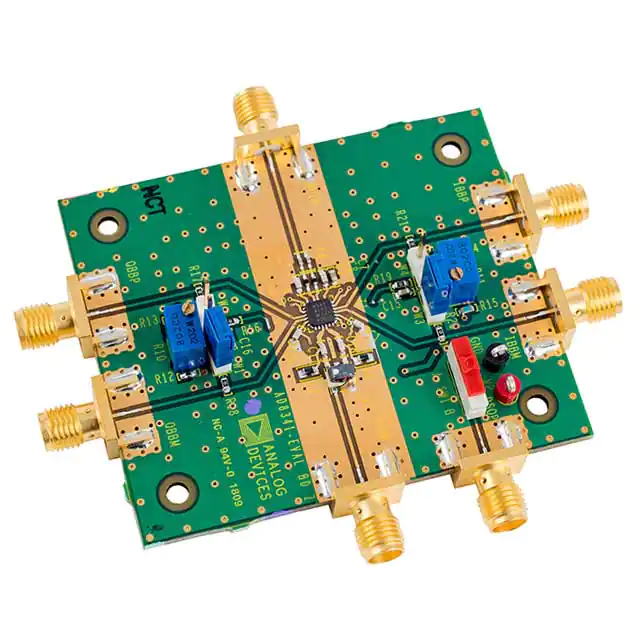
Analog Devices Inc. AD8341-EVALZ
- Part No.:
- AD8341-EVALZ
- Manufacturer:
- Analog Devices Inc.
- Category:
- RF, RFID, Wireless Evaluation Boards
- Package:
- Datasheet:
-
 AD8341-EVALZ.pdf
- Description:
- BOARD EVAL FOR AD8341 VECT MOD
- Quantity:
- Payment:

- Shipping:

Inventory:3,107
Please send an inquiry. Send us your inquiry, and we will respond immediately.
Product details
Overview
AD8341-EVALZ from Analog Devices is an evaluation board for the AD8341 RF vector modulator, enabling characterization of Cartesian amplitude/phase modulation across 1.5 GHz to 2.4 GHz. It supports full differential I/Q baseband drive (±500 mV), delivers −4.5 dB to −34.5 dB gain control and 0°–360° phase shift, and targets RF PA linearization and smart antenna calibration.
For engineers reviewing the AD8341-EVALZ datasheet, AD8341-EVALZ setup guide, AD8341-EVALZ RF interface, or AD8341-EVALZ signal integrity validation, this board provides verified ac-coupled RF input/output paths, matched 50 Ω differential interfaces, on-board biasing for VPRF/VPS2 (4.75–5.25 V), DSOP-controlled fast output disable, and layout-optimized grounding for CMOP/CMRF common pins.
Technical Context
The AD8341-EVALZ implements the AD8341's internal 24-lead LFCSP package in a controlled-impedance PCB environment with calibrated 1.2 nH series inductors on RFIP/RFIM for >10 dB input return loss and 120 nH RF chokes on RFOP/RFOM for proper transimpedance amplifier pull-up. It maintains the AD8341's 230 MHz modulation bandwidth by minimizing parasitic capacitance on IBBP/IBBM/QBBP/QBBM traces and includes optional filter capacitor pads (IFLP/IFLM/QFLP/QFLM) to limit noise bandwidth.
Board-level design enforces strict 50 Ω differential routing for RFIO and single-ended I/Q paths, integrates ETC1-1-13 balun for differential-to-single-ended conversion, and uses 0.1 µF + 100 pF supply decoupling per VPRF/VPS2 pin to suppress supply-induced gain/phase ripple at RF frequencies.
Key Specifications
| Parameter | Value and Actual Design Meaning |
|---|---|
| Supported Device | AD8341 RF vector modulator in 24-lead LFCSP package |
| RF Frequency Range | 1.5 GHz to 2.4 GHz - validated with 1.2 nH matching inductors and ETC1-1-13 balun |
| Baseband Interface | Differential I/Q inputs (IBBP/IBBM/QBBP/QBBM) with ±500 mV full-scale range and 2 V⁻¹ gain scaling |
| Output Disable | DSOP pin support with <15 ns disable response time and 33 dB attenuation at 5 V |
| Supply Decoupling | 0.1 µF ceramic + 100 pF RF capacitor per VPRF/VPS2 pin to maintain <10 mV supply ripple up to 2.4 GHz |
| Grounding Architecture | Low-inductance soldered exposed paddle connection and dedicated CMOP/CMRF ground planes to minimize gain peaking |
Availability
AD8341-EVALZ is available at Aetrix Electronics and suitable for RF PA linearization, smart antenna beamforming, CDMA2000/WCDMA predistortion, and SSB modulation development requiring stable component supply and traceable evaluation hardware.
Supply support for AD8341-EVALZ includes scheduled delivery planning, volume procurement assistance, BOM continuity management, traceable sourcing, and lifecycle availability coordination for OEM customers, industrial embedded developers, connected-device designers, and electronics production programs.
Manufacturer
Analog Devices, Inc. is a global leader in high-performance analog, mixed-signal, and RF ICs, headquartered in Norwood, MA, with design centers worldwide and manufacturing in advanced SOI processes.
The AD8341-EVALZ belongs to Analog Devices' RF & Microwave Evaluation Platform family, engineered to accelerate prototyping of high-frequency Cartesian modulators used in cellular infrastructure, aerospace telemetry, and adaptive RF systems.
FAQ
What is the primary function of the AD8341-EVALZ?
The AD8341-EVALZ is a fully assembled and tested evaluation board designed specifically for the AD8341 RF vector modulator. It enables engineers to validate Cartesian amplitude and phase modulation performance - including gain control (−4.5 dB to −34.5 dB), phase shift (0°–360°), OIP3 (17.5 dBm), and noise floor (−150.5 dBm/Hz) - across 1.5–2.4 GHz under real-world RF and baseband conditions. The AD8341-EVALZ provides all necessary biasing, matching, and interconnects to replicate production-level operation without custom PCB development.
Does the AD8341-EVALZ support both differential and single-ended RF interfaces?
Yes, the AD8341-EVALZ supports both configurations. Its RF input (RFIP/RFIM) and output (RFOP/RFOM) are implemented as differential 50 Ω ports with ac-coupling capacitors and 1.2 nH matching inductors optimized for >10 dB return loss over 1.5–2.4 GHz. For single-ended use, the board includes footprint and routing for an ETC1-1-13 1:1 balun to convert differential output to single-ended, while maintaining impedance integrity and minimizing balance-induced sideband suppression degradation. The AD8341-EVALZ documentation specifies exact component values and layout rules for either mode.
How is power supply decoupling implemented on the AD8341-EVALZ?
The AD8341-EVALZ implements dual-stage decoupling on all VPRF and VPS2 supply pins: a 0.1 µF X7R ceramic capacitor for bulk energy storage and a 100 pF NP0 capacitor for high-frequency noise suppression up to 2.4 GHz. These are placed within 2 mm of each supply pin with direct low-inductance vias to solid ground planes. This configuration ensures supply ripple remains below 10 mV peak-to-peak during fast gain/phase transitions, preserving the AD8341's specified 45 ns step response and preventing modulation distortion. The AD8341-EVALZ schematic and layout files confirm placement compliance with Analog Devices' RF layout guidelines.
Can the AD8341-EVALZ be used to characterize modulation bandwidth?
Yes, the AD8341-EVALZ is explicitly configured to support full 230 MHz modulation bandwidth testing. Its IBBP/IBBM/QBBP/QBBM traces are impedance-controlled (50 Ω single-ended), minimized in length (<8 mm), and routed away from noisy supplies and RF paths to preserve signal integrity. Optional filter capacitor pads (IFLP/IFLM/QFLP/QFLM) allow intentional bandwidth limiting for noise reduction, while leaving the path unpopulated achieves maximum bandwidth. Measured step response on the AD8341-EVALZ matches the datasheet's 45 ns specification, confirming fidelity for wideband baseband signals such as CDMA2000 and WCDMA waveforms.
What thermal and mechanical considerations apply to the AD8341-EVALZ during operation?
The AD8341-EVALZ requires the AD8341's exposed paddle to be soldered to a low-impedance ground plane using recommended reflow profile and solder paste volume to ensure θJA ≤ 59 °C/W. During continuous operation at 125 mA supply current and 8.5 dBm OP1dB, board temperature rise is limited to <15°C above ambient when mounted on a 2-layer 4 × 4 inch test fixture with 1 oz copper. The AD8341-EVALZ manual specifies minimum pad size (3.5 × 3.5 mm), via count (≥4 × 0.3 mm diameter), and thermal relief design to prevent solder joint fatigue or delamination - critical for repeatable RF performance in lab and pre-production environments.
AD8341-EVALZ Specifications
- Product attributes
- Attribute value
- Manufacturer:
- Analog Devices Inc.
- Series:
- -
- Packaging:
- Box
- Product Status:
- Active
- Type:
- Modulator
- Frequency:
- 1.5GHz ~ 2.4GHz
- Contents:
- Board(s)
- Utilized IC / Part:
- AD8341
AD8341-EVALZ FAQ
1.How can I place an order for AD8341-EVALZ through Aetrix?
Please submit a Request for Quotation (RFQ) for AD8341-EVALZ on Aetrix. Our sales agent will provide a competitive quotation and guide you through the order confirmation once you accept the terms.
2.Are the price and stock information for AD8341-EVALZ reliable?
The price and inventory of AD8341-EVALZ are updated periodically and may fluctuate due to market conditions. Stock and pricing data are typically refreshed every 24 hours. Quotation validity for AD8341-EVALZ is usually 5 days.
3.What payment methods are accepted for AD8341-EVALZ?
We accept Wire Transfer, PayPal, Credit Card, Western Union, MoneyGram, and Escrow for AD8341-EVALZ transactions.
Note: Certain payment methods may incur a processing fee.
4.How is shipping managed for AD8341-EVALZ?
AD8341-EVALZ orders can be shipped via leading logistics carriers, including DHL, UPS, FedEx, TNT, or Registered Mail.
Once your AD8341-EVALZ order is processed, you will receive an email with the shipment details and tracking number.
Note: Tracking information may take up to 24 hours to appear. Express delivery typically takes 3–5 business days.
5.How can I obtain technical support or documentation for AD8341-EVALZ?
For technical support, including AD8341-EVALZ datasheets, pinout diagrams, or application guidance, please contact our engineering support team. They can provide detailed documentation and assistance for your AD8341-EVALZ requirements.
6.How does Aetrix verify that AD8341-EVALZ is sourced from the original manufacturer or authorized distributors?
All AD8341-EVALZ products on Aetrix are procured from qualified distributors and authorized channels. Our dedicated quality assurance team conducts strict verification, including traceability checks and, if necessary, third-party testing. This ensures that AD8341-EVALZ meets industry standards.
7.What is the process for return or replacement of AD8341-EVALZ?
All AD8341-EVALZ units undergo pre-shipment inspection (PSI). If there is an issue with AD8341-EVALZ, returns or replacements are accepted under the following conditions:
1.Quantity discrepancies, incorrect items, or visible external defects (such as breakage or corrosion), acknowledged by Aetrix.
2.The issue is reported within 90 days of delivery.
3.The AD8341-EVALZ part is unused and in its original packaging.
Return procedure for AD8341-EVALZ:
1.Submit a request within 90 days.
2.Obtain a Return Material Authorization (RMA) from Aetrix.
AD8341-EVALZ Tags
-
113991054
Seeed Technology Co., Ltd
-
SC0918
Raspberry Pi

-
113991114
Seeed Technology Co., Ltd
-
ESP32-C6-DEVKITM-1-N4
Espressif Systems
-
ESP32-DEVKITM-1
Espressif Systems
-
C008
M5Stack Technology Co., Ltd.
-
ESP32-C3-DEVKITC-02
Espressif Systems
-
ESP32-C6-DEVKITC-1-N8
Espressif Systems
-
DFR0478
DFRobot
-
102010448
Seeed Technology Co., Ltd
-
ESP32-DEVKITC-32E
Espressif Systems
-
ESP32-DEVKITC-32UE
Espressif Systems
Tech Hub

A practical engineering guide to 3.3V and 5V logic compatibility, input thresholds, resistor dividers, translator ICs, MOSFET level shifting, I2C pull-ups, timing limits and power-sequencing risks.

The 74HC595 uses push-pull logic outputs, while the TPIC6B595 uses 50 V open-drain DMOS sinks for higher-power loads. This guide compares timing, current limits, 3.3 V interfacing, load wiring, thermal…

The 74HC595 converts serial data into eight stable parallel outputs. This guide covers pin functions, shift and storage timing, OE and MR behavior, drive-current limits, cascading, voltage compatibilit…

A technical comparison of level-sensitive latches and edge-triggered flip-flops, covering timing windows, setup and hold limits, master–slave operation, time borrowing, race-through, HDL inference and…

A D latch stores one bit while Enable controls when data can pass. This reference covers gate-level operation, truth tables, transparency, setup and hold timing, LE versus OE, common ICs and practical …

An SR latch stores one bit through cross-coupled feedback. This engineering reference covers NOR and NAND implementations, truth tables, forbidden-state recovery, gated operation, switch debouncing, fa…

Latch circuits retain one bit through feedback. This technical reference covers SR and D latches, truth tables, transparency, timing limits, latch-versus-flip-flop behavior, applications and common log…

An engineering guide to LED driver operation, constant-current and constant-voltage outputs, linear and switching topologies, dimming, IC selection, calculations, replacement compatibility, and fault c…

Operational amplifier guide covering op amp basics, feedback, ideal vs real op amps, common configurations, buffer circuits, offset, bias current, gain-bandwidth, slew rate, rail-to-rail limits and sel…

Jumper cables guide covering safe connection order, red and black clamp placement, final ground connection, cable gauge, length, clamp quality, copper vs CCA cables, jump starter comparison and battery…


