
 My Inquiry
 My Account


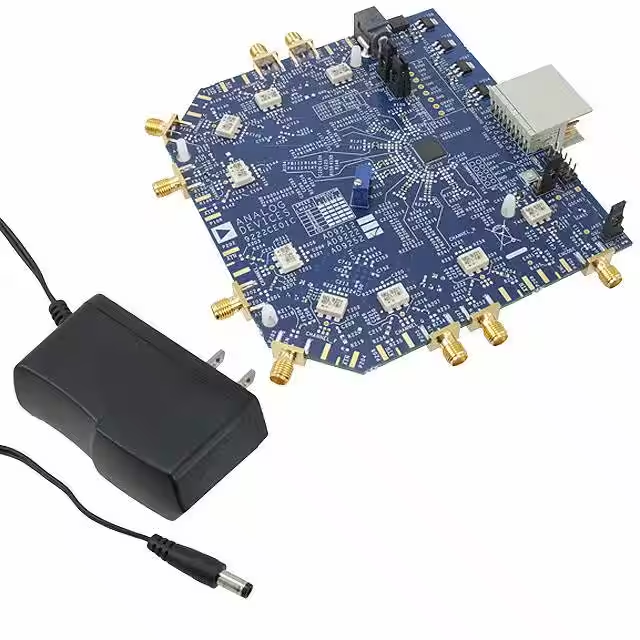
Analog Devices Inc. AD9252-50EBZ
- Part No.:
- AD9252-50EBZ
- Manufacturer:
- Analog Devices Inc.
- Package:
- Datasheet:
-
 AD9252-50EBZ.pdf
- Description:
- BOARD EVALUATION FOR AD9252
- Quantity:
- Payment:

- Shipping:

Inventory:2,273
Please send an inquiry. Send us your inquiry, and we will respond immediately.
Product details
Overview
AD9252-50EBZ from Analog Devices is an octal, 14-bit, 50 MSPS analog-to-digital converter with serial LVDS outputs, 1.8 V supply operation, 325 MHz full-power analog bandwidth, and integrated sample-and-hold-designed for medical ultrasound beamforming and quadrature radio receiver front-ends.
For engineers reviewing the AD9252-50EBZ datasheet, AD9252-50EBZ pinout, AD9252-50EBZ application, or AD9252-50EBZ equivalent, this evaluation board enables rapid validation of high-channel-count, low-power, high-SNR ADC subsystems in portable imaging and diversity RF systems requiring deterministic latency and flexible digital test pattern generation.
Technical Context
The AD9252-50EBZ implements a pipelined ADC architecture with a 4-bit first stage, eight 1.5-bit stages, and a final 3-bit flash stage-enabling 14-bit resolution at 50 MSPS with 8-channel parallel sampling. Each pipeline stage includes redundant bits and interstage residue amplification to correct flash errors digitally.
It supports dual-mode LVDS output (ANSI-644 compliant or low-power reduced-signal option), programmable clock/data alignment, offset binary coding, and configurable output resolution (12- or 14-bit). The on-board SPI interface controls power-down modes, test patterns, and digital output formatting per channel.
Key Specifications
| Parameter | Value and Actual Design Meaning |
|---|---|
| Resolution | 14-bit-guarantees no missing codes across full industrial temperature range (−40°C to +85°C). |
| Sampling Rate | 50 MSPS-supports real-time digitization of wideband signals up to 325 MHz analog bandwidth. |
| SNR | 73 dB (to Nyquist)-enables high-fidelity signal capture in ultrasound and RF applications with low noise floor. |
| SFDR | 84 dBc (to Nyquist)-suppresses spurious content critical for multi-tone RF and beamforming accuracy. |
| Power per Channel | 93.5 mW at 50 MSPS-enables thermally constrained portable systems with eight synchronized ADCs. |
| Digital Interface | Serial LVDS with DCO/FCO clocks-reduces PCB routing complexity vs. parallel CMOS and supports DDR timing alignment. |
| Input Range | 2 V p-p differential-compatible with standard transformer-coupled or balun-driven RF/ultrasound front-ends. |
Pinout & Package
The AD9252-50EBZ evaluation board interfaces with the AD9252 IC housed in a RoHS-compliant, 64-lead LFCSP (9 mm × 9 mm × 0.85 mm) with exposed paddle connected to AGND.
| Pin/Terminal | Circuit Role | Design Meaning |
|---|---|---|
| VIN+ A–H | Analog Input True | Differential input pairs for eight independent ADC channels; require matched trace lengths and common-mode bias at AVDD/2. |
| CLK+, CLK− | Sample Clock Input | Differential LVPECL/LVDS/CMOS-compatible clock input; rising edge triggers sampling; 10–50 MSPS range. |
| D+ A–H, D− A–H | LVDS Data Output | Serialized 14-bit data per channel (MSB-first default); ANSI-644 compliant or low-power mode selectable via SPI. |
| DCO+, DCO− | Data Clock Output | DDR-capable clock synchronized to serialized data; used by FPGA/ASIC to latch LVDS output streams. |
| FCO+, FCO− | Frame Clock Output | Indicates start of new byte/frame; aligns with LSB of each 14-bit word for deterministic data framing. |
| PDWN | Power-Down Control | Active-low digital input enabling per-channel or full-chip power-down (<2 mW total when all channels disabled). |
| CSB, SCLK/DTP, SDIO/ODM | SPI Interface | 3-wire serial port for configuration of test patterns, output resolution, clock alignment, and standby mode. |
Key Features
| Feature | Design Value |
|---|---|
| Octal ADC Integration | Eight synchronized 14-bit ADCs in one package reduce board area and inter-channel skew vs. discrete solutions. |
| Programmable Digital Test Patterns | Built-in deterministic, pseudorandom, and custom user-defined patterns simplify system-level verification without external signal sources. |
| Flexible Clock/Data Alignment | SPI-adjustable phase delay between DCO and data stream enables timing closure on high-speed FPGA receivers. |
| Individual Channel Power-Down | Per-channel disable reduces dynamic power linearly; full shutdown consumes <2 mW-critical for battery-powered ultrasound. |
| Full-Power Analog Bandwidth | 325 MHz supports direct sampling of IF signals in radio receivers up to 160 MHz without external amplification. |
Applications
| Medical Ultrasound Beamforming | Quadrature Radio Receivers |
|---|---|
Use Scenario: Portable handheld ultrasound systems performing real-time digital beam synthesis across 64+ transducer elements. IC Role / Device Role / Timing Role: AD9252-50EBZ hosts eight synchronized ADC channels capturing echo return signals from adjacent transducer groups with sub-ns inter-channel skew. Use Value: 73 dB SNR and 84 dBc SFDR preserve weak tissue contrast; 50 MSPS rate enables 10 cm depth resolution at 1.54 mm/μs sound velocity. |
Use Scenario: Direct-conversion I/Q receivers in LTE base stations or software-defined radios digitizing 20 MHz bandwidth IF signals. IC Role / Device Role / Timing Role: AD9252-50EBZ simultaneously samples I and Q paths across four dual-channel pairs, maintaining phase coherence for accurate demodulation. Use Value: 325 MHz analog bandwidth captures second- and third-order harmonics; LVDS serialization minimizes EMI in dense RF modules. |
| Diversity Radio Receivers | Optical Networking Test Equipment |
Use Scenario: Multi-antenna cellular infrastructure units using spatial diversity to mitigate fading in urban environments. IC Role / Device Role / Timing Role: AD9252-50EBZ digitizes signals from eight physically separated antennas with deterministic pipeline latency (8 clock cycles) for time-aligned correlation processing. Use Value: ±1.5 LSB INL ensures amplitude matching across channels; individual PDWN allows dynamic antenna selection without reconfiguration delay. |
Use Scenario: High-speed optical transceiver characterization systems measuring jitter, eye diagram, and BER at 10+ Gbps data rates. IC Role / Device Role / Timing Role: AD9252-50EBZ captures transient waveform artifacts (e.g., intersymbol interference, reflections) on optical receiver outputs with precise timing alignment via DCO/FCO. Use Value: 1.8 V LVDS outputs interface directly to high-speed logic analyzers; programmable test patterns inject known sequences for error injection analysis. |
Availability
AD9252-50EBZ is available at Aetrix Electronics and suitable for medical imaging equipment, RF test instrumentation, portable ultrasound development, and optical network analyzer design requiring stable component supply and full evaluation support.
Supply support for AD9252-50EBZ includes scheduled delivery planning, volume procurement assistance, BOM continuity management, traceable sourcing, and lifecycle availability coordination for OEM customers, industrial embedded developers, connected-device designers, and electronics production programs.
Manufacturer
Analog Devices is a global leader in high-performance analog, mixed-signal, and DSP technologies, serving precision instrumentation, communications, and industrial markets since 1965.
The AD9252 product line delivers multichannel, high-speed ADCs optimized for space-constrained, low-power applications in medical ultrasound, wireless infrastructure, and test equipment-emphasizing integration, timing determinism, and system-level ease of use.
FAQ
What is the primary function of the AD9252-50EBZ evaluation board?
The AD9252-50EBZ is an evaluation platform for the AD9252 octal 14-bit 50 MSPS ADC. It provides complete signal chain access-including analog inputs, LVDS data outputs, clock interfaces, and SPI control-to validate performance in real-world systems like ultrasound beamformers and RF receivers. The board includes reference designs for power delivery, layout, and timing alignment specific to the AD9252 IC.
Does the AD9252-50EBZ support both 12-bit and 14-bit output resolution?
Yes, the AD9252-50EBZ supports programmable output resolution via its SPI interface. The AD9252 IC can be configured for either 12-bit or 14-bit serialized LVDS output, allowing trade-offs between data throughput, FPGA resource usage, and dynamic range based on application requirements-without hardware changes to the AD9252-50EBZ board.
How does the AD9252-50EBZ handle clock synchronization across its eight ADC channels?
The AD9252-50EBZ uses a single differential clock input (CLK+/CLK−) distributed to all eight ADC cores within the AD9252 IC. This shared clock architecture ensures inherent inter-channel sampling alignment with typical skew <50 ps. The board's layout follows strict length-matching guidelines for clock traces to maintain this precision during evaluation.
Can the AD9252-50EBZ operate with a 1.0 V internal reference, and is external reference support available?
Yes, the AD9252-50EBZ configures the AD9252 IC to use its internal 1.0 V reference by default (SENSE pin tied appropriately). External reference mode is also supported via the VREF, REFT, and REFB pins-allowing connection of precision external references for applications demanding tighter gain matching or temperature stability beyond the ±21 ppm/°C internal reference drift.
What power supply requirements must be met to operate the AD9252-50EBZ correctly?
The AD9252-50EBZ requires two regulated 1.8 V supplies: AVDD for analog circuitry (373.4 mA typical) and DRVDD for LVDS output drivers (58 mA typical). The board includes onboard LDOs and filtering; users must supply clean, low-noise 1.8 V sources capable of ≥500 mA total to ensure specified SNR and SFDR performance across all eight channels.
AD9252-50EBZ Specifications
- Product attributes
- Attribute value
- Manufacturer:
- Analog Devices Inc.
- Series:
- -
- Packaging:
- Box
- Product Status:
- Obsolete
- Number of A/D Converters:
- 8
- Number of Bits:
- 14
- Sampling Rate (Per Second):
- 50M
- Data Interface:
- Serial
- Input Range:
- 2Vpp
- Power (Typ) @ Conditions:
- 748mW @ 50MSPS
- Utilized IC / Part:
- AD9252-50
- Contents:
- Board(s)
AD9252-50EBZ FAQ
1.How can I place an order for AD9252-50EBZ through Aetrix?
Please submit a Request for Quotation (RFQ) for AD9252-50EBZ on Aetrix. Our sales agent will provide a competitive quotation and guide you through the order confirmation once you accept the terms.
2.Are the price and stock information for AD9252-50EBZ reliable?
The price and inventory of AD9252-50EBZ are updated periodically and may fluctuate due to market conditions. Stock and pricing data are typically refreshed every 24 hours. Quotation validity for AD9252-50EBZ is usually 5 days.
3.What payment methods are accepted for AD9252-50EBZ?
We accept Wire Transfer, PayPal, Credit Card, Western Union, MoneyGram, and Escrow for AD9252-50EBZ transactions.
Note: Certain payment methods may incur a processing fee.
4.How is shipping managed for AD9252-50EBZ?
AD9252-50EBZ orders can be shipped via leading logistics carriers, including DHL, UPS, FedEx, TNT, or Registered Mail.
Once your AD9252-50EBZ order is processed, you will receive an email with the shipment details and tracking number.
Note: Tracking information may take up to 24 hours to appear. Express delivery typically takes 3–5 business days.
5.How can I obtain technical support or documentation for AD9252-50EBZ?
For technical support, including AD9252-50EBZ datasheets, pinout diagrams, or application guidance, please contact our engineering support team. They can provide detailed documentation and assistance for your AD9252-50EBZ requirements.
6.How does Aetrix verify that AD9252-50EBZ is sourced from the original manufacturer or authorized distributors?
All AD9252-50EBZ products on Aetrix are procured from qualified distributors and authorized channels. Our dedicated quality assurance team conducts strict verification, including traceability checks and, if necessary, third-party testing. This ensures that AD9252-50EBZ meets industry standards.
7.What is the process for return or replacement of AD9252-50EBZ?
All AD9252-50EBZ units undergo pre-shipment inspection (PSI). If there is an issue with AD9252-50EBZ, returns or replacements are accepted under the following conditions:
1.Quantity discrepancies, incorrect items, or visible external defects (such as breakage or corrosion), acknowledged by Aetrix.
2.The issue is reported within 90 days of delivery.
3.The AD9252-50EBZ part is unused and in its original packaging.
Return procedure for AD9252-50EBZ:
1.Submit a request within 90 days.
2.Obtain a Return Material Authorization (RMA) from Aetrix.
AD9252-50EBZ Tags
-
1083
Adafruit Industries LLC
-
1085
Adafruit Industries LLC
-
ADS7038Q1EVM-PDK
Texas Instruments
-
ADS8688EVM-PDK
Texas Instruments
-
EVAL-AD7606C18FMCZ
Analog Devices Inc.
-
ADS1232REF
Texas Instruments
-
EVAL-AD4134FMCZ
Analog Devices Inc.
-
EVAL-AD7768FMCZ
Analog Devices Inc.
-
ADC128S102EVM
Texas Instruments
-
ADS124S08EVM
Texas Instruments
-
ADC6140EVM-PDK
Texas Instruments
-
ADS7066EVM-PDK
Texas Instruments
Tech Hub

A practical engineering guide to 3.3V and 5V logic compatibility, input thresholds, resistor dividers, translator ICs, MOSFET level shifting, I2C pull-ups, timing limits and power-sequencing risks.

The 74HC595 uses push-pull logic outputs, while the TPIC6B595 uses 50 V open-drain DMOS sinks for higher-power loads. This guide compares timing, current limits, 3.3 V interfacing, load wiring, thermal…

The 74HC595 converts serial data into eight stable parallel outputs. This guide covers pin functions, shift and storage timing, OE and MR behavior, drive-current limits, cascading, voltage compatibilit…

A technical comparison of level-sensitive latches and edge-triggered flip-flops, covering timing windows, setup and hold limits, master–slave operation, time borrowing, race-through, HDL inference and…

A D latch stores one bit while Enable controls when data can pass. This reference covers gate-level operation, truth tables, transparency, setup and hold timing, LE versus OE, common ICs and practical …

An SR latch stores one bit through cross-coupled feedback. This engineering reference covers NOR and NAND implementations, truth tables, forbidden-state recovery, gated operation, switch debouncing, fa…

Latch circuits retain one bit through feedback. This technical reference covers SR and D latches, truth tables, transparency, timing limits, latch-versus-flip-flop behavior, applications and common log…

An engineering guide to LED driver operation, constant-current and constant-voltage outputs, linear and switching topologies, dimming, IC selection, calculations, replacement compatibility, and fault c…

Operational amplifier guide covering op amp basics, feedback, ideal vs real op amps, common configurations, buffer circuits, offset, bias current, gain-bandwidth, slew rate, rail-to-rail limits and sel…

Jumper cables guide covering safe connection order, red and black clamp placement, final ground connection, cable gauge, length, clamp quality, copper vs CCA cables, jump starter comparison and battery…


