
 My Inquiry
 My Account


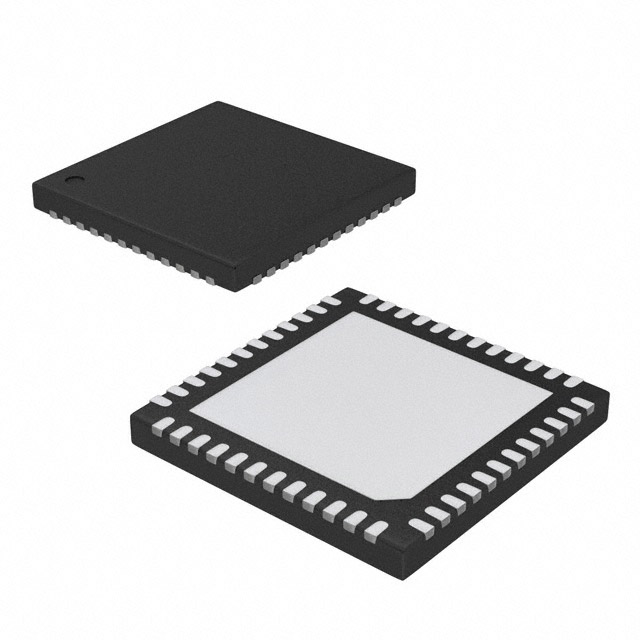
Analog Devices Inc. ADN2847ACP-48
- Part No.:
- ADN2847ACP-48
- Manufacturer:
- Analog Devices Inc.
- Category:
- Laser Drivers
- Package:
- 48-WFQFN Exposed Pad, CSP
- Datasheet:
-
 ADN2847ACP-48.pdf
- Description:
- IC DRVR LASER DIODE 3.3V 48LFCSP
- Quantity:
- Payment:

- Shipping:

Inventory:4,278
Please send an inquiry. Send us your inquiry, and we will respond immediately.
Product details
Overview
ADN2847ACP-48 from Analog Devices is a 3.3 V dual-loop laser diode driver IC for high-speed optical transmitters, supporting 50 Mbps to 3.3 Gbps data rates with closed-loop average power and extinction ratio control. It delivers bias current up to 100 mA, modulation current up to 80 mA, and monitors photodiode current from 50 μA to 1200 μA - enabling SONET OC-48 and DWDM dual-MPD wavelength control in compact 48-lead LFCSP packages.
For engineers reviewing the ADN2847ACP-48 datasheet, ADN2847ACP-48 pinout, ADN2847ACP-48 application, or ADN2847ACP-48 equivalent, key selection considerations include its dual MPD support (48-lead only), 80 ps typical rise/fall time, automatic laser shutdown (ALS), programmable laser fail/degrade alarms, and compatibility with FEC-rate systems requiring stable extinction ratio over temperature and aging.
Technical Context
The ADN2847ACP-48 implements two independent closed-loop control paths: one for average optical power (via PSET and PAVCAP) and another for extinction ratio (via ERSET and ERCAP), both using analog feedback from monitor photodiodes. Its dual MPD architecture - exclusive to the 48-lead LFCSP variant - enables internal summation of IMPD and IMPD2 currents for power control while preserving separate IMPDMON/IMPDMON2 outputs for DWDM wavelength tuning.
It features differential data/clock inputs (DATAP/DATAN, CLKP/CLKN) with 50 Ω single-ended impedance and ac-coupled interface, plus logic-controlled functions including LBWSET for loop bandwidth selection (0.22 s or 2.25 s time constant), CLKSEL for clocked data mode, and ALS for immediate laser current cutoff. All alarm outputs (FAIL, DEGRADE) are active-high with internal 30 kΩ pull-ups.
Key Specifications
| Parameter | Value and Actual Design Meaning |
|---|---|
| Data Rate Range | 50 Mbps to 3.3 Gbps - supports SONET OC-48 (2.488 Gbps) and Gigabit Ethernet physical layer timing margins. |
| Rise/Fall Time | 80 ps typical - ensures <1.5 ps RMS random jitter and preserves optical eye integrity at 3.3 Gbps. |
| Bias Current Range | 2 mA to 100 mA - covers threshold-to-saturation operation for FP/DFB lasers across temperature and aging. |
| Modulation Current Range | 5 mA to 80 mA - enables extinction ratios from 3 dB to >12 dB with precise closed-loop ERSET tuning. |
| MPD Current Monitoring | 50 μA to 1200 μA - supports dual photodiode inputs (IMPD/IMPD2) with mirrored outputs (IMPDMON/IMPDMON2) for DWDM control. |
| Supply Current | 50 mA typical at 3.3 V - includes quiescent draw plus 0.3×IMOD dependency for accurate thermal modeling. |
| Operating Temperature | −40°C to +85°C - qualified for industrial-grade optical module deployment without derating. |
| Package | 48-lead 7 mm × 7 mm LFCSP - exposes thermal pad for direct PCB ground or VCC connection per JEDEC MO-220. |
Pinout & Package
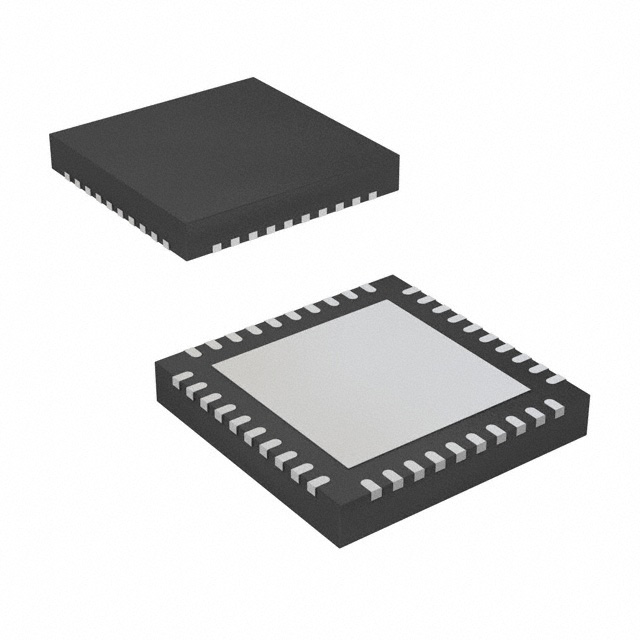
ADN2847ACP-48 is housed in a 48-lead lead-frame chip-scale package (LFCSP), 7 mm × 7 mm, with exposed thermal pad (EPAD) on bottom requiring connection to VCC or ground plane per Analog Devices layout guidelines. Pin 1 is marked by top-side indicator; EPAD must be soldered for thermal and electrical performance.
| Pin/Terminal | Circuit Role | Design Meaning |
|---|---|---|
| IMODP / IMODN | Laser modulation current output pair | Differential drive to laser anode/cathode; IMODP connects directly to LD, IMODN returns via matching resistor to VCC. |
| IBIAS / CCBIAS | Laser bias current source and coupling control | IBIAS supplies DC bias; CCBIAS tied to VCC for dc-coupled LD or to IBIAS for ac-coupled configuration. |
| IMPD / IMPD2 | Dual monitor photodiode current inputs | Primary and secondary MPD current sensing nodes - IMPD2 is functional only in 48-lead variant for DWDM wavelength control. |
| PSET / ERSET / ASET | Analog control voltage setting pins | Resistor-divider interfaces to set average power (1.1–1.3 V), extinction ratio (1.2 kΩ–25 kΩ), and alarm thresholds (same range). |
| FAIL / DEGRADE / ALS | Alarm status and safety control signals | Active-high open-drain outputs with internal 30 kΩ pull-up; ALS forces immediate IBIAS/IMOD shutdown and triggers FAIL. |
| IDTONE | Fiber identification tone modulation input | External current sink (50 μA–4 mA) modulates optical "1" level by 2–10% of IMOD - 48-lead only; causes eye distortion if active during transmission. |
Key Features
| Feature | Design Value |
|---|---|
| Dual-loop closed control | Simultaneous real-time regulation of average optical power and extinction ratio - eliminates need for external compensation circuits across temperature and laser aging. |
| Dual MPD support | Internal summation of IMPD and IMPD2 currents for power loop, plus independent IMPDMON/IMPDMON2 mirror outputs - enables precise wavelength locking in DWDM modules. |
| Programmable laser alarms | Configurable FAIL and DEGRADE thresholds via ASET resistor; DEGRADE asserts at 90% of FAIL level - meets ITU-T G.958 transmitter degrade/fail compliance. |
| Automatic laser shutdown (ALS) | Hardware-level shutdown path cutting IBIAS/IMOD within 5 μs - provides failsafe response to system fault conditions without software intervention. |
| Low-jitter high-speed interface | 80 ps rise/fall time into 25 Ω load with <1.5 ps RMS random jitter - maintains BER <10⁻¹² at 3.3 Gbps with standard optical receivers. |
| Flexible clock/data architecture | CLKSEL-selectable clocked vs. free-running mode; differential DATAP/DATAN and CLKP/CLKN with 50 Ω termination - simplifies integration with FPGA or ASIC serializers. |
Applications
| SONET OC-48 Transmitter | DWDM Dual-MPD Wavelength Control |
|---|---|
Use Scenario: High-reliability long-haul fiber optic link operating at 2.488 Gbps with strict optical power stability requirements over −40°C to +85°C. IC Role / Device Role / Timing Role: Laser diode driver providing closed-loop APC and ERC to maintain SONET-compliant extinction ratio and average power despite laser aging and temperature drift. Use Value: Eliminates manual recalibration; achieves <±0.5 dB power variation and <±0.3 dB ER variation across lifetime - meeting GR-468 reliability standards. |
Use Scenario: Dense wavelength division multiplexing module requiring simultaneous monitoring of two photodiodes for thermal and current-based wavelength stabilization. IC Role / Device Role / Timing Role: Dual-MPD interface IC generating independent mirrored currents (IMPDMON, IMPDMON2) while summing inputs for primary power control loop. Use Value: Enables feedforward + feedback wavelength control algorithms without external op-amps or ADCs - reduces BOM count by ≥3 components per channel. |
| Gigabit Ethernet SFP Module | FEC-Enhanced Optical Link |
Use Scenario: Small form-factor pluggable transceiver for enterprise switches requiring low-power, compact laser drive with robust fault reporting. IC Role / Device Role / Timing Role: Integrated LDD with ALS, FAIL, and DEGRADE outputs directly interfaced to SFP host controller GPIOs for hot-plug diagnostics. Use Value: Reduces time-to-fault detection from seconds to <5 μs; supports SFF-8472 digital diagnostics implementation with no additional supervisor IC. |
Use Scenario: Forward error correction-enabled optical backplane operating at 3.3 Gbps where signal integrity demands tight extinction ratio control under burst-mode traffic. IC Role / Device Role / Timing Role: High-bandwidth laser driver with 80 ps edge control and programmable loop bandwidth (0.22 s or 2.25 s) to match FEC decoder latency profiles. Use Value: Maintains >10 dB optical margin under FEC decoding stress; prevents ER collapse during long CID sequences that trigger burst-mode gain shifts. |
Equivalent & Alternatives
The following parts are listed as comparable options for similar laser diode driver applications.
| Alternative Part | Technical Difference | Application Difference | Selection Advice |
|---|---|---|---|
| MAX3736AETE+ | Single-loop APC only; no extinction ratio control; 2.5 Gbps max; 24-lead TQFN. | Suitable for cost-sensitive GPON ONU designs where ER stability is relaxed. | Select when budget constraints outweigh need for dual-loop precision or DWDM support. |
| LMH6525SD/NOPB | DC-coupled 3.3 Gbps limiting amplifier, not a laser driver; no bias/modulation current sources or MPD interface. | Used post-amplification in receiver paths, not transmitter laser control. | Not functionally equivalent - only consider if redesigning architecture to separate driver and limiting functions. |
Compared with MAX3736AETE+ and LMH6525SD/NOPB, the ADN2847ACP-48 uniquely integrates dual-loop optical control, dual-MPD capability, and hardware ALS in a single 48-lead LFCSP - making it irreplaceable for SONET OC-48 and DWDM modules requiring guaranteed extinction ratio compliance over product lifetime.
Availability
ADN2847ACP-48 is available at Aetrix Electronics and suitable for SONET OC-48 transmitters, DWDM wavelength-stabilized modules, Gigabit Ethernet SFP assemblies, and FEC-enhanced optical backplanes requiring stable component supply across extended temperature ranges and multi-year production cycles.
Supply support for ADN2847ACP-48 includes scheduled delivery planning, volume procurement assistance, BOM continuity management, traceable sourcing, and lifecycle availability coordination for OEM customers, industrial embedded developers, connected-device designers, and electronics production programs.
Manufacturer
Analog Devices is a global leader in high-performance analog, mixed-signal, and digital signal processing semiconductors, headquartered in Norwood, MA, with design centers worldwide and ISO 9001-certified manufacturing.
The ADN2847ACP-48 belongs to Analog Devices' optical networking product line, engineered specifically for high-reliability, high-speed fiber optic transmitter modules requiring closed-loop laser control in telecom and datacom infrastructure.
FAQ
What is the primary function of the ADN2847ACP-48 in optical transmitter design?
The ADN2847ACP-48 serves as a dual-loop laser diode driver IC that simultaneously regulates average optical power and extinction ratio using closed-loop feedback from monitor photodiodes. It integrates bias and modulation current sources, alarm generation, and hardware safety features - enabling compliant SONET OC-48 and DWDM operation without external compensation circuitry. The ADN2847ACP-48 replaces discrete control loops with a single-chip solution optimized for industrial temperature range and long-term stability.
Does the ADN2847ACP-48 support dual monitor photodiodes, and is this feature available in all package variants?
Yes, dual monitor photodiode (MPD) support - including dedicated IMPD2 input and IMPDMON2 mirrored output - is implemented exclusively in the 48-lead LFCSP variant (ADN2847ACP-48). The 32-lead version lacks IMPD2, IMPDMON2, IDTONE, and several ground pins required for dual-MPD functionality. This architectural distinction is confirmed in the datasheet's "Dual MPD DWDM Function (48-Lead LFCSP Only)" section and pin configuration diagrams.
How does the Automatic Laser Shutdown (ALS) feature operate in the ADN2847ACP-48?
The ALS pin on the ADN2847ACP-48 is a logic-input safety control: when driven high, it cuts off both IBIAS and IMOD currents within 5 μs, reducing IBIAS to ≤0.1 mA and asserting the FAIL alarm. This hardware-level response meets ITU-T G.958 Section 9.7 requirements and provides deterministic fault containment. The ADN2847ACP-48 does not require firmware or external timers - ALS activation directly disables laser drive paths and feeds back via FAIL to confirm shutdown state.
What are the key differences between the ADN2847ACP-48 and the 32-lead ADN2847ACP-32 variants?
The ADN2847ACP-48 includes 16 additional pins enabling dual-MPD support (IMPD2, IMPDMON2), IDTONE for fiber identification, extra ground and supply connections (GND2, VCC2–VCC4), and test points (TP1–TP6). Electrically, only the 48-lead variant supports dual-loop DWDM control and IDTONE modulation. Both share identical core specs (50 Mbps–3.3 Gbps, 80 ps rise time, 50 mA ICC), but thermal resistance differs: θJA = 25°C/W for ADN2847ACP-48 vs. 32°C/W for ADN2847ACP-32.
Can the ADN2847ACP-48 be used with forward error correction (FEC) systems, and how does it maintain signal integrity?
Yes, the ADN2847ACP-48 explicitly supports FEC-rate systems per its datasheet FEATURES list. Its 80 ps rise/fall time and <1.5 ps RMS random jitter preserve optical eye opening at 3.3 Gbps, while programmable loop bandwidth (via LBWSET) allows optimization for FEC decoder latency - e.g., 22 nF capacitors yield 0.22 s time constant for fast transient response during burst-mode FEC correction cycles. The ADN2847ACP-48 maintains extinction ratio stability even under long CID patterns that challenge conventional drivers.
ADN2847ACP-48 Specifications
- Product attributes
- Attribute value
- Manufacturer:
- Analog Devices Inc.
- Series:
- -
- Package/Case:
- 48-WFQFN Exposed Pad, CSP
- Packaging:
- Bag
- Product Status:
- Obsolete
- Type:
- Laser Diode Driver (Fiber Optic)
- Data Rate:
- 3.3Gbps
- Number of Channels:
- 1
- Voltage - Supply:
- 3V ~ 3.6V
- Current - Supply:
- 50 mA
- Current - Modulation:
- 80mA
- Current - Bias:
- 100 mA
- Operating Temperature:
- -40°C ~ 85°C
- Grade:
- -
- Qualification:
- -
- Supplier Device Package:
- 48-LFCSP (7x7)
- Mounting Type:
- Surface Mount
ADN2847ACP-48 FAQ
1.How can I place an order for ADN2847ACP-48 through Aetrix?
Please submit a Request for Quotation (RFQ) for ADN2847ACP-48 on Aetrix. Our sales agent will provide a competitive quotation and guide you through the order confirmation once you accept the terms.
2.Are the price and stock information for ADN2847ACP-48 reliable?
The price and inventory of ADN2847ACP-48 are updated periodically and may fluctuate due to market conditions. Stock and pricing data are typically refreshed every 24 hours. Quotation validity for ADN2847ACP-48 is usually 5 days.
3.What payment methods are accepted for ADN2847ACP-48?
We accept Wire Transfer, PayPal, Credit Card, Western Union, MoneyGram, and Escrow for ADN2847ACP-48 transactions.
Note: Certain payment methods may incur a processing fee.
4.How is shipping managed for ADN2847ACP-48?
ADN2847ACP-48 orders can be shipped via leading logistics carriers, including DHL, UPS, FedEx, TNT, or Registered Mail.
Once your ADN2847ACP-48 order is processed, you will receive an email with the shipment details and tracking number.
Note: Tracking information may take up to 24 hours to appear. Express delivery typically takes 3–5 business days.
5.How can I obtain technical support or documentation for ADN2847ACP-48?
For technical support, including ADN2847ACP-48 datasheets, pinout diagrams, or application guidance, please contact our engineering support team. They can provide detailed documentation and assistance for your ADN2847ACP-48 requirements.
6.How does Aetrix verify that ADN2847ACP-48 is sourced from the original manufacturer or authorized distributors?
All ADN2847ACP-48 products on Aetrix are procured from qualified distributors and authorized channels. Our dedicated quality assurance team conducts strict verification, including traceability checks and, if necessary, third-party testing. This ensures that ADN2847ACP-48 meets industry standards.
7.What is the process for return or replacement of ADN2847ACP-48?
All ADN2847ACP-48 units undergo pre-shipment inspection (PSI). If there is an issue with ADN2847ACP-48, returns or replacements are accepted under the following conditions:
1.Quantity discrepancies, incorrect items, or visible external defects (such as breakage or corrosion), acknowledged by Aetrix.
2.The issue is reported within 90 days of delivery.
3.The ADN2847ACP-48 part is unused and in its original packaging.
Return procedure for ADN2847ACP-48:
1.Submit a request within 90 days.
2.Obtain a Return Material Authorization (RMA) from Aetrix.
ADN2847ACP-48 Tags
-
EPC21701
EPC
-
EPC21601
EPC
-
MAX3799ETJ+T
Analog Devices Inc./Maxim Integrated
-
AD9665ACPZ-REEL7
Analog Devices Inc.
-
MAX3740AETG+T
Analog Devices Inc./Maxim Integrated
-
MAX3795ETG+
Analog Devices Inc./Maxim Integrated

-
EPC21603
EPC
-
ONET8501VRGPT
Texas Instruments
-
MAX3738ETG+T
Analog Devices Inc./Maxim Integrated
-
SY88022ALMG-TR
Microchip Technology
-
ISL78365ARZ-T7A
Renesas
-
EPC21603ENGRT
EPC
Tech Hub

A practical engineering guide to 3.3V and 5V logic compatibility, input thresholds, resistor dividers, translator ICs, MOSFET level shifting, I2C pull-ups, timing limits and power-sequencing risks.

The 74HC595 uses push-pull logic outputs, while the TPIC6B595 uses 50 V open-drain DMOS sinks for higher-power loads. This guide compares timing, current limits, 3.3 V interfacing, load wiring, thermal…

The 74HC595 converts serial data into eight stable parallel outputs. This guide covers pin functions, shift and storage timing, OE and MR behavior, drive-current limits, cascading, voltage compatibilit…

A technical comparison of level-sensitive latches and edge-triggered flip-flops, covering timing windows, setup and hold limits, master–slave operation, time borrowing, race-through, HDL inference and…

A D latch stores one bit while Enable controls when data can pass. This reference covers gate-level operation, truth tables, transparency, setup and hold timing, LE versus OE, common ICs and practical …

An SR latch stores one bit through cross-coupled feedback. This engineering reference covers NOR and NAND implementations, truth tables, forbidden-state recovery, gated operation, switch debouncing, fa…

Latch circuits retain one bit through feedback. This technical reference covers SR and D latches, truth tables, transparency, timing limits, latch-versus-flip-flop behavior, applications and common log…

An engineering guide to LED driver operation, constant-current and constant-voltage outputs, linear and switching topologies, dimming, IC selection, calculations, replacement compatibility, and fault c…

Operational amplifier guide covering op amp basics, feedback, ideal vs real op amps, common configurations, buffer circuits, offset, bias current, gain-bandwidth, slew rate, rail-to-rail limits and sel…

Jumper cables guide covering safe connection order, red and black clamp placement, final ground connection, cable gauge, length, clamp quality, copper vs CCA cables, jump starter comparison and battery…


