
 My Inquiry
 My Account


Analog Devices Inc. ADP5520ACPZ-RL
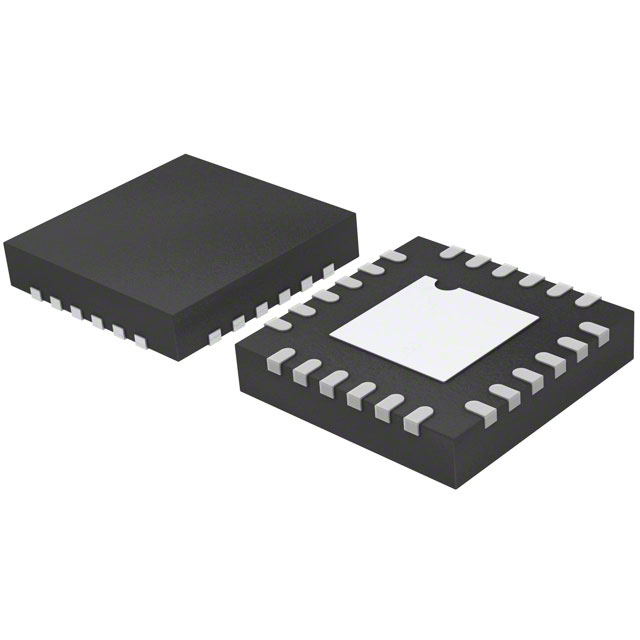
- Part No.:
- ADP5520ACPZ-RL
- Manufacturer:
- Analog Devices Inc.
- Category:
- LED Drivers
- Package:
- 24-VFQFN Exposed Pad, CSP
- Datasheet:
-
 ADP5520ACPZ-RL.pdf
- Description:
- IC LED DRV RGLTR I2C 24LFCSP
- Quantity:
- Payment:

- Shipping:

Inventory:3,111
Please send an inquiry. Send us your inquiry, and we will respond immediately.
Product details
Overview
ADP5520ACPZ-RL from Analog Devices is a single-chip white LED backlight driver with integrated 8-pin I/O expander and ambient light sensing. It delivers up to 30 mA backlight current across 128 programmable levels, supports autonomous fade-in/fade-out timing (0.3–5.5 s), and drives up to 6-series white LEDs via an asynchronous boost converter (24.5 V OVP). It targets flip/slide mobile phone displays requiring coordinated keypad detection, auxiliary LED control, and battery-efficient lighting.
For engineers reviewing the ADP5520ACPZ-RL datasheet, ADP5520ACPZ-RL pinout, ADP5520ACPZ-RL application, or ADP5520ACPZ-RL equivalent, key selection considerations include its dual-role I/O architecture (keypad matrix or GPIO), programmable ambient-light-triggered backlight adjustment, integrated 2.7 V LDO (CAP_OUT), thermal shutdown (150°C), and I²C-compatible interface with interrupt signaling (INT) for hinge-flex-constrained handset designs.
Technical Context
The ADP5520ACPZ-RL integrates a 24.5 V overvoltage-protected asynchronous boost converter driving a single BL_SNK current sink (0–30 mA, 128-step resolution) and three auxiliary LED sinks (ILED, R3, C3; each 0–14 mA, 64-step resolution). Its internal state machine executes autonomous backlight sequencing-fade-in/fade-out, dim/off timers (10 s–2 min), and level switching (daylight/office/dark)-without host processor intervention.
It embeds an ambient light sensor input (CMP_IN) with comparator-based auto-brightness control, eight configurable I/O pins supporting keypad matrix (4×4), digital input/output, or auxiliary LED sink roles, and a dedicated 2.7 V LDO (CAP_OUT) for internal biasing. All logic operates from VDDIO (1.7–3.3 V), while power conversion runs from VBAT (2.7–5.5 V).
Key Specifications
| Parameter | Value and Actual Design Meaning |
|---|---|
| Backlight Current Range | 0–30 mA in 128 discrete steps; enables precise brightness grading for display uniformity and eye comfort. |
| Boost Output Voltage Limit | 24.5–29.5 V OVP threshold; protects LED string and IC during transient overvoltage events. |
| Ambient Light Sensing Input | CMP_IN pin accepts photodiode current; enables closed-loop automatic backlight adaptation to ambient conditions. |
| Fade Timing Resolution | Fade-in/fade-out timers programmable from 0.3 s to 5.5 s in 15 steps; eliminates visual flicker during backlight transitions. |
| I/O Configuration Flexibility | 8 pins (R0–R3, C0–C3) support keypad matrix, GPIO input/output, or auxiliary LED sink modes; reduces external component count. |
| Thermal Protection | 150°C shutdown with 10°C hysteresis; prevents permanent damage under sustained high-power operation. |
| Supply Voltage Ranges | VBAT: 2.7–5.5 V; VDDIO: 1.7–3.3 V (or VBAT, whichever smaller); supports dual-rail system integration. |
Pinout & Package
ADP5520ACPZ-RL is housed in a 4.0 mm × 4.0 mm, 24-lead LFCSP package with exposed pad (EPAD) requiring connection to GND for thermal and electrical integrity.
| Pin/Terminal | Circuit Role | Design Meaning |
|---|---|---|
| PGND (1) | Power switch ground return | Low-inductance path for boost switch current; must be tied directly to PCB ground plane. |
| SW (2) | Boost switch node | Connects to inductor and Schottky rectifier; carries high di/dt switching current. |
| INT (3) | Open-drain interrupt output | Signals keypad press/release, ambient light threshold crossing, or overvoltage event to host processor. |
| SDA (4) | I²C data line | Open-drain bidirectional bus; requires external pull-up to VDDIO for communication. |
| SCL (5) | I²C clock line | Open-drain input; synchronizes register reads/writes at up to 400 kHz. |
| R2–R0, C0–C3 (6–13) | Configurable I/O pins | Support keypad scan, GPIO, or auxiliary LED sink (R3/C3/ILED); each has programmable pull-up (50–80 kΩ). |
| ILED (14) | Dedicated auxiliary LED sink | Drives first auxiliary LED with 0–14 mA, 64-step current control and fade timing. |
| RST (15) | Active-low reset input | Pulse low ≥75 µs to restore power-on defaults; asynchronous to I²C interface. |
| VDDIO (16) | I/O supply rail | Defines logic thresholds (VIL = 0.3×VDDIO, VIH = 0.7×VDDIO); powers digital blocks and I²C interface. |
| CMP_IN (17) | Ambient light sensor input | Accepts photodiode current; internal comparator triggers backlight level changes based on ambient intensity. |
| GND (18,19,24) | Ground reference | Three separate GND pins minimize noise coupling between analog, digital, and power sections. |
| CAP_OUT (20) | 2.7 V LDO capacitor terminal | Requires 1 µF ceramic capacitor to GND; supplies internal bias rails-no external load allowed. |
| VBAT (21) | Main power input | Supplies boost converter and internal regulators; UVLO activates at 2.1 V (falling) / 2.4 V (rising). |
| BST (22) | Boost voltage monitor | Monitors BST node for overvoltage protection; not a power output pin. |
| BL_SNK (23) | Main backlight current sink | Sinks full LED string current (0–30 mA); connects directly to cathode of series-connected white LEDs. |
Key Features
| Feature | Design Value |
|---|---|
| Autonomous backlight sequencing | Internal state machine executes fade-in/fade-out, dim/off timers, and level switching without host CPU involvement-reducing system power and firmware overhead. |
| Configurable 4×4 keypad matrix support | R0–R3 and C0–C3 pins form scan rows/columns; debounced inputs detect keypresses and generate INT pulses-eliminating external keypad controller. |
| Triple auxiliary LED control | ILED + R3 + C3 operate as independent current sinks (0–14 mA, 64-step), each with programmable fade and blink timing-enabling status indicators and UI feedback. |
| Ambient light-adaptive brightness | CMP_IN input interfaces with photodiode to dynamically shift backlight operating level (L1/L2/L3) and adjust max/dim currents-extending battery life in variable lighting. |
| Integrated 2.7 V LDO with CAP_OUT | On-chip regulator stabilizes internal bias; CAP_OUT pin requires 1 µF decoupling-ensures robust operation across VBAT range without external LDO. |
Applications
| Mobile Phone Flip/Slider Display Backlight | Keypad Status Indicator System |
|---|---|
Use Scenario: Backlighting LCD displays in clamshell or slider phones where mechanical hinge limits trace routing between baseband and display modules. IC Role / Device Role / Timing Role: ADP5520ACPZ-RL acts as centralized backlight driver, I/O expander, and ambient light manager-replacing multiple discrete ICs and reducing flex-cable pin count via I²C + INT interface. Use Value: Reduces interconnect complexity by consolidating backlight control, keypad scanning, and auxiliary LED drive into one chip-cutting BOM cost and PCB area in space-constrained handsets. | Use Scenario: Providing visual feedback for keypresses, battery status, and notification alerts using discrete LEDs adjacent to physical keypad buttons. IC Role / Device Role / Timing Role: ADP5520ACPZ-RL serves as auxiliary LED current sink (ILED, R3, C3) with independent fade-in/fade-out and blink timing-enabling smooth UI transitions without host processor polling. Use Value: Delivers perceptually consistent LED behavior (e.g., 2 s fade-in + 0.5 s hold + 1 s fade-out) using on-chip timers-freeing main CPU from real-time LED waveform generation. |
| Smartphone Ambient Light Adaptive UI | Low-Power Handheld Device Power Management |
Use Scenario: Dynamically adjusting display brightness in response to changing ambient illumination-from direct sunlight to dark room-to maintain readability and conserve battery. IC Role / Device Role / Timing Role: ADP5520ACPZ-RL functions as ambient light sensor front-end and backlight controller-converting photodiode current into backlight level decisions (L1/L2/L3) and executing corresponding current settings autonomously. Use Value: Achieves >30% battery runtime extension in typical usage by eliminating constant host-driven brightness polling and enabling hardware-level adaptive response. | Use Scenario: Managing power states in portable medical monitors or industrial handhelds where display backlight must respond to user interaction (key press) without waking the main application processor. IC Role / Device Role / Timing Role: ADP5520ACPZ-RL operates as autonomous subsystem-activating backlight on keypad event (KP_BL_EN), executing fade sequences, and signaling completion via INT-keeping host MCU in deep sleep. Use Value: Enables sub-50 µA system standby current by offloading backlight timing and event response to ADP5520ACPZ-RL-critical for multi-week battery life in always-ready devices. |
Equivalent & Alternatives
The following parts are listed as comparable options for similar backlight driver with I/O expander applications.
| Alternative Part | Technical Difference | Application Difference | Selection Advice |
|---|---|---|---|
| LM3530TMX/NOPB | 4-channel I²C LED driver (no I/O expander); 30 mA per channel; no ambient light sensing or keypad support. | Limited to pure LED driving; requires external GPIO expander and ALS IC for equivalent functionality. | Select when only multi-string backlight control is needed and system already includes I/O/ALS resources. |
| MAX8649ETE+T | Single-output WLED driver (30 mA); no I/O expansion, no ALS, no fade timers; integrates charge pump instead of boost. | Suitable for basic backlight-only systems with low forward-voltage LED strings (<12 V). | Choose for cost-sensitive designs where keypad, ambient sensing, and autonomous fading are unnecessary. |
Compared with LM3530TMX/NOPB and MAX8649ETE+T, the ADP5520ACPZ-RL uniquely combines backlight driving, 8-pin I/O expansion, ambient light sensing, and autonomous fade/timer control in one die-making it the only single-chip solution for hinge-constrained mobile UI subsystems requiring coordinated lighting and input handling.
Availability
ADP5520ACPZ-RL is available at Aetrix Electronics and suitable for mobile handset design, portable medical device UIs, and industrial handheld HMI applications requiring stable component supply, long-term lifecycle support, and guaranteed authenticity.
Supply support for ADP5520ACPZ-RL includes scheduled delivery planning, volume procurement assistance, BOM continuity management, traceable sourcing, and lifecycle availability coordination for OEM customers, industrial embedded developers, connected-device designers, and electronics production programs.
Manufacturer
Analog Devices is a global leader in high-performance analog, mixed-signal, and digital signal processing semiconductors, serving precision instrumentation, communications, and industrial markets.
The ADP5520ACPZ-RL belongs to Analog Devices' power management and interface IC product line, engineered specifically for space-constrained portable electronics requiring intelligent, low-power display and user interface subsystem integration.
FAQ
What is the maximum number of white LEDs the ADP5520ACPZ-RL can drive in series?
The ADP5520ACPZ-RL supports up to 6 white LEDs connected in series, enabled by its asynchronous boost converter with 24.5 V minimum overvoltage protection. This allows sufficient headroom for typical white LED forward voltages (3.0–3.6 V each) across temperature and aging variations, ensuring reliable operation even at end-of-life LED VF drift.
Does the ADP5520ACPZ-RL require external components for ambient light sensing?
Yes-the ADP5520ACPZ-RL requires an external photodiode connected to the CMP_IN pin to perform ambient light sensing. The device provides the comparator and control logic but does not integrate the photosensor; the photodiode's current is converted internally to trigger backlight level changes based on programmable thresholds.
Can the ADP5520ACPZ-RL drive auxiliary LEDs independently of the main backlight?
Yes-the ADP5520ACPZ-RL provides three independent auxiliary LED current sinks (ILED, R3, C3), each programmable from 0–14 mA in 64 steps with dedicated fade-in/fade-out and blink timing registers. These operate fully independently of the BL_SNK backlight sink and can be controlled via separate I²C commands.
What is the function of the CAP_OUT pin on the ADP5520ACPZ-RL?
The CAP_OUT pin on the ADP5520ACPZ-RL connects to a mandatory 1 µF ceramic capacitor to GND and supplies the internal 2.7 V LDO that powers bias circuitry. It is not intended for external loads-connecting any external circuitry to CAP_OUT violates the datasheet specification and may destabilize internal regulation.
How does the ADP5520ACPZ-RL reduce host processor involvement in backlight control?
The ADP5520ACPZ-RL reduces host processor involvement by executing all backlight sequencing-including fade-in/fade-out, dim/off timers, level switching (L1/L2/L3), and ambient light adaptation-in hardware via its internal state machine. Once configured via I²C, it operates autonomously and signals status changes only through the INT pin, minimizing CPU wake-ups and firmware overhead.
ADP5520ACPZ-RL Specifications
- Product attributes
- Attribute value
- Manufacturer:
- Analog Devices Inc.
- Series:
- -
- Package/Case:
- 24-VFQFN Exposed Pad, CSP
- Packaging:
- Tape & Reel (TR)
- Product Status:
- Active
- Type:
- DC DC Regulator
- Topology:
- Step-Up (Boost)
- Internal Switch(s):
- Yes
- Number of Outputs:
- 4
- Voltage - Supply (Min):
- 2.7V
- Voltage - Supply (Max):
- 5.5V
- Voltage - Output:
- 27V
- Current - Output / Channel:
- 14mA, 30mA
- Frequency:
- -
- Dimming:
- I2C
- Applications:
- Backlight
- Operating Temperature:
- -40°C ~ 85°C (TA)
- Grade:
- -
- Qualification:
- -
- Mounting Type:
- Surface Mount
- Supplier Device Package:
- 24-LFCSP-VQ (4x4)
ADP5520ACPZ-RL FAQ
1.How can I place an order for ADP5520ACPZ-RL through Aetrix?
Please submit a Request for Quotation (RFQ) for ADP5520ACPZ-RL on Aetrix. Our sales agent will provide a competitive quotation and guide you through the order confirmation once you accept the terms.
2.Are the price and stock information for ADP5520ACPZ-RL reliable?
The price and inventory of ADP5520ACPZ-RL are updated periodically and may fluctuate due to market conditions. Stock and pricing data are typically refreshed every 24 hours. Quotation validity for ADP5520ACPZ-RL is usually 5 days.
3.What payment methods are accepted for ADP5520ACPZ-RL?
We accept Wire Transfer, PayPal, Credit Card, Western Union, MoneyGram, and Escrow for ADP5520ACPZ-RL transactions.
Note: Certain payment methods may incur a processing fee.
4.How is shipping managed for ADP5520ACPZ-RL?
ADP5520ACPZ-RL orders can be shipped via leading logistics carriers, including DHL, UPS, FedEx, TNT, or Registered Mail.
Once your ADP5520ACPZ-RL order is processed, you will receive an email with the shipment details and tracking number.
Note: Tracking information may take up to 24 hours to appear. Express delivery typically takes 3–5 business days.
5.How can I obtain technical support or documentation for ADP5520ACPZ-RL?
For technical support, including ADP5520ACPZ-RL datasheets, pinout diagrams, or application guidance, please contact our engineering support team. They can provide detailed documentation and assistance for your ADP5520ACPZ-RL requirements.
6.How does Aetrix verify that ADP5520ACPZ-RL is sourced from the original manufacturer or authorized distributors?
All ADP5520ACPZ-RL products on Aetrix are procured from qualified distributors and authorized channels. Our dedicated quality assurance team conducts strict verification, including traceability checks and, if necessary, third-party testing. This ensures that ADP5520ACPZ-RL meets industry standards.
7.What is the process for return or replacement of ADP5520ACPZ-RL?
All ADP5520ACPZ-RL units undergo pre-shipment inspection (PSI). If there is an issue with ADP5520ACPZ-RL, returns or replacements are accepted under the following conditions:
1.Quantity discrepancies, incorrect items, or visible external defects (such as breakage or corrosion), acknowledged by Aetrix.
2.The issue is reported within 90 days of delivery.
3.The ADP5520ACPZ-RL part is unused and in its original packaging.
Return procedure for ADP5520ACPZ-RL:
1.Submit a request within 90 days.
2.Obtain a Return Material Authorization (RMA) from Aetrix.
ADP5520ACPZ-RL Tags
-
BCR402RE6327HTSA1
Infineon Technologies

-
BCR430UXTSA2
Infineon Technologies
-
BCR420UE6433HTMA1
Infineon Technologies
-
BCR420UE6327HTSA1
Infineon Technologies
-
BCR421UE6327HTSA1
Infineon Technologies
-
LYT1604D-TL
Power Integrations

-
HV9910CLG-G
Microchip Technology

-
CL2N8-G
Microchip Technology
-
BCR420UW6-7
Diodes Incorporated
-
BCR421UW6-7
Diodes Incorporated
-
BCR420UFD-7
Diodes Incorporated
-
BCR421UFD-7
Diodes Incorporated
Tech Hub

A practical engineering guide to 3.3V and 5V logic compatibility, input thresholds, resistor dividers, translator ICs, MOSFET level shifting, I2C pull-ups, timing limits and power-sequencing risks.

The 74HC595 uses push-pull logic outputs, while the TPIC6B595 uses 50 V open-drain DMOS sinks for higher-power loads. This guide compares timing, current limits, 3.3 V interfacing, load wiring, thermal…

The 74HC595 converts serial data into eight stable parallel outputs. This guide covers pin functions, shift and storage timing, OE and MR behavior, drive-current limits, cascading, voltage compatibilit…

A technical comparison of level-sensitive latches and edge-triggered flip-flops, covering timing windows, setup and hold limits, master–slave operation, time borrowing, race-through, HDL inference and…

A D latch stores one bit while Enable controls when data can pass. This reference covers gate-level operation, truth tables, transparency, setup and hold timing, LE versus OE, common ICs and practical …

An SR latch stores one bit through cross-coupled feedback. This engineering reference covers NOR and NAND implementations, truth tables, forbidden-state recovery, gated operation, switch debouncing, fa…

Latch circuits retain one bit through feedback. This technical reference covers SR and D latches, truth tables, transparency, timing limits, latch-versus-flip-flop behavior, applications and common log…

An engineering guide to LED driver operation, constant-current and constant-voltage outputs, linear and switching topologies, dimming, IC selection, calculations, replacement compatibility, and fault c…

Operational amplifier guide covering op amp basics, feedback, ideal vs real op amps, common configurations, buffer circuits, offset, bias current, gain-bandwidth, slew rate, rail-to-rail limits and sel…

Jumper cables guide covering safe connection order, red and black clamp placement, final ground connection, cable gauge, length, clamp quality, copper vs CCA cables, jump starter comparison and battery…


