
 My Inquiry
 My Account


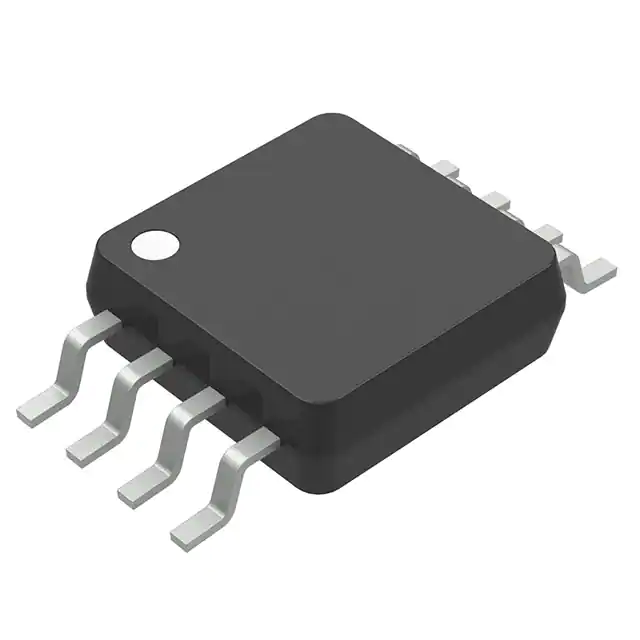
Texas Instruments ADS1606IPAPR
- Part No.:
- ADS1606IPAPR
- Manufacturer:
- Texas Instruments
- Category:
- Analog to Digital Converters (ADC)
- Package:
- 64-PowerTQFP
- Datasheet:
-
 ADS1606IPAPR.pdf
- Description:
- IC ADC 16BIT SIGMA-DELTA 64HTQFP
- Quantity:
- Payment:

- Shipping:

Inventory:4,583
Please send an inquiry. Send us your inquiry, and we will respond immediately.
Product details
Overview
ADS1606IPAPR from Texas Instruments is a 16-bit, 5MSPS delta-sigma analog-to-digital converter (ADC) with integrated FIFO buffer, 2.45MHz bandwidth, ±0.0025dB passband ripple, and selectable on-chip reference. It operates from +5V analog, +3V digital, and +2.7V to +5.25V I/O supplies, and targets high-fidelity data acquisition in scientific instrumentation and medical imaging systems.
For engineers reviewing the ADS1606IPAPR datasheet, ADS1606IPAPR pinout, ADS1606IPAPR application, or ADS1606IPAPR equivalent, key selection criteria include its 88dB SNR at 100kHz, −99dB THD, 101dB SFDR, FIFO-level control via three dedicated pins, and compatibility with TMS320C6000 DSPs via parallel 16-bit interface.
Technical Context
The ADS1606IPAPR employs a stable 2-1-1 pipelined delta-sigma modulator sampling at 40MSPS (fCLK = 40MHz), decimated by a linear-phase digital filter to deliver 5MSPS output with 2.45MHz −3dB bandwidth. Its 2X mode reduces oversampling ratio from 8 to 4, doubling data rate to 10MSPS while maintaining performance integrity.
It measures differential input (AINP–AINN) against scalable reference (VREFP–VREFN), supports internal/external reference selection (REFEN), and features out-of-range detection (OTR), power-down control (PD), and reset synchronization (RESET). The adjustable FIFO buffer-enabled only on ADS1606-uses FIFO_LEV[2:0] to set depth, distinguishing it from the ADS1605.
Key Specifications
| Parameter | Value and Actual Design Meaning |
|---|---|
| Data Rate | 5MSPS standard; 10MSPS in 2X mode - enables real-time capture of wideband signals up to 2.45MHz without undersampling. |
| SNR / THD / SFDR | 88dB / −99dB / 101dB at fIN = 100kHz, −6dBFS - ensures high-resolution spectral fidelity for vibration analysis and medical imaging. |
| Passband Ripple | ±0.0025dB to 2.2MHz - preserves amplitude accuracy across critical measurement bands without post-processing correction. |
| Input Range | ±1.467VREF full-scale; ±4.4V with 3V reference - accommodates high-voltage sensor outputs while minimizing clipping risk. |
| Power Dissipation | 315–570mW adjustable via RBIAS resistor - allows thermal optimization for embedded systems with strict power budgets. |
| Digital Interface | 16-bit parallel DOUT[15:0], DRDY, RD, CS, OTR - provides deterministic, low-latency connection to TI C6000 DSPs without protocol overhead. |
| Supply Voltages | AVDD = 4.75–5.25V; DVDD = 2.7–3.3V; IOVDD = 2.7–5.25V - supports mixed-voltage system integration and logic-family flexibility. |
Pinout & Package
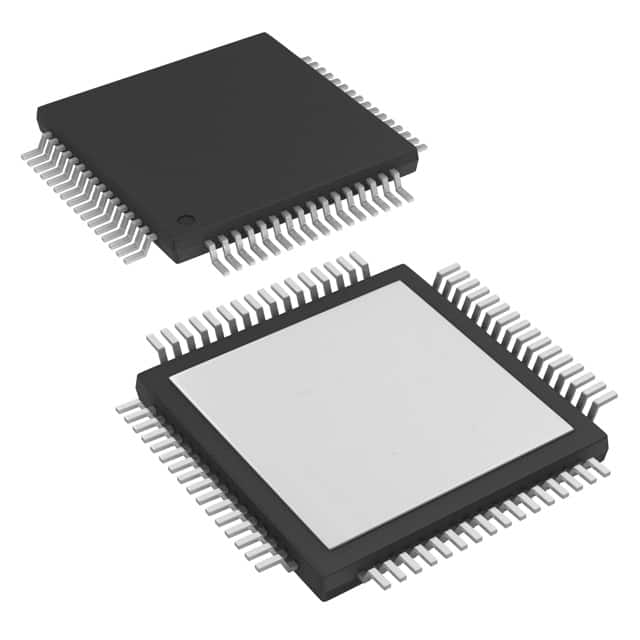
ADS1606IPAPR is housed in a thermally enhanced HTQFP-64 package with PowerPAD™ technology (θJA = 25°C/W), optimized for high-speed ADC thermal management in dense PCB layouts.
| Pin/Terminal | Circuit Role | Design Meaning |
|---|---|---|
| AINP / AINN | Differential analog input | Accepts ±1.467VREF signal; requires 2.0V common-mode bias (VMID) for optimal linearity and SNR. |
| VREFP / VREFN / REFEN | Reference voltage interface | VREFP/VREFN set full-scale range; REFEN low enables internal 3V reference, eliminating external reference component. |
| FIFO_LEV[2:0] | FIFO depth configuration | Three dedicated inputs select FIFO level (0–7) - unique to ADS1606, enabling burst-mode data buffering without host intervention. |
| DOUT[15:0] / DRDY / RD / CS | Parallel digital output interface | 16-bit MSB-first data bus synchronized to DRDY falling edge; RD/CS enable handshaked read timing compatible with C6000 EMIF. |
| PD / RESET / 2XMODE | Functional control | PD (active-low) cuts power to <5mW; RESET clears digital filter state; 2XMODE doubles throughput by halving decimation ratio. |
| AVDD / DVDD / IOVDD / AGND / DGND | Power and ground domains | Separate analog/digital/I/O supplies suppress noise coupling; PowerPAD under die improves thermal resistance by >95% vs standard QFP. |
Key Features
| Feature | Design Value |
|---|---|
| Adjustable FIFO buffer | Configurable depth (0–7 levels) via FIFO_LEV[2:0] - absorbs timing jitter between ADC and host processor, reducing DMA overhead in real-time systems. |
| Linear-phase digital filter | 2.45MHz −3dB bandwidth with ±0.0025dB ripple - preserves phase coherence for time-domain analysis in vibration monitoring and ultrasound beamforming. |
| Selectably enabled internal reference | 3.0V ±0.25V internal VREF with 50ppm/°C drift - eliminates external reference IC and associated layout complexity while meeting 16-bit INL/DNL specs. |
| Multi-supply I/O interface | IOVDD range 2.7–5.25V - permits direct interfacing to 3.3V FPGA, 5V microcontroller, or 1.8V ASIC without level shifters. |
| Out-of-range monitoring | Dedicated OTR pin asserts high when |AINP−AINN| > 1.467VREF - enables immediate fault response in safety-critical medical or test equipment. |
Applications
| Scientific Instrumentation | Automated Test Equipment |
|---|---|
Use Scenario: High-precision spectral analysis in benchtop oscilloscopes and spectrum analyzers requiring >85dB SFDR. IC Role / Device Role / Timing Role: Primary digitizer capturing wideband RF and baseband signals at 5MSPS with linear-phase filtering. Use Value: 101dB SFDR at 100kHz prevents harmonic masking of weak signals; ±0.0025dB passband ripple ensures flat frequency response for calibration-grade measurements. |
Use Scenario: Multi-channel parametric testing of analog ICs and sensors using synchronized sampling across 16+ channels. IC Role / Device Role / Timing Role: Channel-specific ADC with FIFO buffering to absorb inter-channel skew and enable batch data transfer. Use Value: Adjustable FIFO_LEV[2:0] allows tuning buffer depth per channel load; 2X mode supports 10MSPS transient capture during stress testing. |
| Data Acquisition Systems | Medical Imaging |
Use Scenario: Portable environmental monitoring systems logging vibration, acoustic emission, and strain gauge data over extended periods. IC Role / Device Role / Timing Role: Low-power, high-SNR ADC operating in intermittent acquisition mode with PD pin control. Use Value: 315–570mW adjustable dissipation via RBIAS resistor extends battery life; −40°C to +85°C operation ensures field reliability. |
Use Scenario: Ultrasound front-end digitizing echo return signals with sub-microsecond timing precision and minimal group delay variation. IC Role / Device Role / Timing Role: Time-critical ADC providing deterministic 5.2µs group delay and <4ns aperture uncertainty for beam alignment. Use Value: Linear-phase filter and 5.2µs fixed group delay enable coherent beamforming; 88dB SNR resolves low-amplitude tissue boundaries. |
Equivalent & Alternatives
The following parts are listed as comparable options for similar high-speed, high-precision ADC applications.
| Alternative Part | Technical Difference | Application Difference | Selection Advice |
|---|---|---|---|
| ADS1605IPAPR | No FIFO buffer; identical core ADC architecture, pinout, and electrical specs except FIFO_LEV[2:0] pins are NC. | Suitable where host processor handles continuous streaming without burst buffering needs. | Select ADS1605IPAPR when FIFO functionality is unnecessary and BOM cost reduction is prioritized. |
| ADS1626IPAPR | 18-bit resolution, 1.25MSPS, same FIFO and interface; lower data rate but 4× higher resolution and improved SNR (92dB typical). | Better suited for static or low-frequency high-accuracy applications like precision weigh scales or chromatography detectors. | Choose ADS1626IPAPR when resolution > speed, and 1.25MSPS satisfies Nyquist requirements for target signal bandwidth. |
Compared with ADS1605IPAPR, the ADS1606IPAPR adds deterministic FIFO buffering for jitter-tolerant data capture; compared with ADS1626IPAPR, it trades 2 bits of resolution for 4× higher throughput-making it optimal for real-time wideband signal analysis where timing determinism and bandwidth dominate.
Availability
ADS1606IPAPR is available at Aetrix Electronics and suitable for scientific instrumentation, automated test equipment, and medical imaging systems requiring stable component supply, long-term lifecycle support, and traceable sourcing.
Supply support for ADS1606IPAPR includes scheduled delivery planning, volume procurement assistance, BOM continuity management, traceable sourcing, and lifecycle availability coordination for OEM customers, industrial embedded developers, connected-device designers, and electronics production programs.
Manufacturer
Texas Instruments is a global semiconductor leader specializing in analog, embedded processing, and high-performance data conversion technologies.
The ADS1606IPAPR belongs to TI's precision delta-sigma ADC product line, engineered for demanding measurement applications where SNR, SFDR, and timing determinism are critical-especially in test, measurement, and medical signal chains.
FAQ
What is the maximum clock frequency supported by the ADS1606IPAPR?
The ADS1606IPAPR supports a maximum CLK frequency of 50MHz, with typical operation at 40MHz. At 40MHz, it achieves 5MSPS output in standard mode and 10MSPS in 2X mode. Exceeding 50MHz violates absolute maximum ratings and may cause timing violations or permanent damage to the ADS1606IPAPR.
Does the ADS1606IPAPR require an external reference voltage?
No-the ADS1606IPAPR includes a selectable on-chip 3.0V reference activated by pulling REFEN low. When REFEN is high, it accepts external VREFP/VREFN. The internal reference delivers 50ppm/°C drift and 15ms startup time, making it viable for many applications without external components-though high-accuracy systems may still prefer a precision external reference for the ADS1606IPAPR.
How does the FIFO function in the ADS1606IPAPR differ from the ADS1605IPAPR?
The ADS1606IPAPR integrates an adjustable first-in-first-out buffer controlled by FIFO_LEV[2:0] pins, allowing programmable depth (0–7 levels); the ADS1605IPAPR has no FIFO and its FIFO_LEV pins are unconnected (NC). This FIFO enables the ADS1606IPAPR to absorb host latency variations and support burst-mode acquisition, which is essential for real-time systems with non-deterministic interrupt response.
What is the purpose of the RBIAS pin on the ADS1606IPAPR?
The RBIAS pin connects to an external resistor that sets analog supply current and thus total power dissipation (315–570mW). Lower RBIAS values increase current and performance; higher values reduce power at the cost of slightly degraded SNR. For example, 37kΩ yields 135mA IAVDD at 5V, while 60kΩ reduces it to ~105mA-enabling thermal/power trade-offs specific to the ADS1606IPAPR's deployment environment.
Can the ADS1606IPAPR interface directly with a 5V microcontroller?
Yes-the ADS1606IPAPR supports IOVDD from +2.7V to +5.25V, so setting IOVDD = 5V enables direct connection to 5V logic families. Digital outputs (DOUT[15:0], DRDY, RD, etc.) meet VOH ≥ 4.5V and VOL ≤ 0.5V under 50µA load, satisfying standard 5V TTL/CMOS thresholds without level-shifting circuitry for the ADS1606IPAPR.
ADS1606IPAPR Specifications
- Product attributes
- Attribute value
- Manufacturer:
- Texas Instruments
- Series:
- -
- Package/Case:
- 64-PowerTQFP
- Packaging:
- Tape & Reel (TR)
- Product Status:
- Obsolete
- Number of Bits:
- 16
- Sampling Rate (Per Second):
- 5M
- Number of Inputs:
- 1
- Input Type:
- Differential
- Data Interface:
- Parallel
- Configuration:
- ADC
- Ratio - S/H:ADC:
- -
- Number of A/D Converters:
- 1
- Architecture:
- Sigma-Delta
- Reference Type:
- External, Internal
- Voltage - Supply, Analog:
- 5V
- Voltage - Supply, Digital:
- 2.7V ~ 3.3V
- Features:
- -
- Operating Temperature:
- -40°C ~ 85°C
- Supplier Device Package:
- 64-HTQFP (10x10)
- Mounting Type:
- Surface Mount
- Grade:
- -
- Qualification:
- -
ADS1606IPAPR FAQ
1.How can I place an order for ADS1606IPAPR through Aetrix?
Please submit a Request for Quotation (RFQ) for ADS1606IPAPR on Aetrix. Our sales agent will provide a competitive quotation and guide you through the order confirmation once you accept the terms.
2.Are the price and stock information for ADS1606IPAPR reliable?
The price and inventory of ADS1606IPAPR are updated periodically and may fluctuate due to market conditions. Stock and pricing data are typically refreshed every 24 hours. Quotation validity for ADS1606IPAPR is usually 5 days.
3.What payment methods are accepted for ADS1606IPAPR?
We accept Wire Transfer, PayPal, Credit Card, Western Union, MoneyGram, and Escrow for ADS1606IPAPR transactions.
Note: Certain payment methods may incur a processing fee.
4.How is shipping managed for ADS1606IPAPR?
ADS1606IPAPR orders can be shipped via leading logistics carriers, including DHL, UPS, FedEx, TNT, or Registered Mail.
Once your ADS1606IPAPR order is processed, you will receive an email with the shipment details and tracking number.
Note: Tracking information may take up to 24 hours to appear. Express delivery typically takes 3–5 business days.
5.How can I obtain technical support or documentation for ADS1606IPAPR?
For technical support, including ADS1606IPAPR datasheets, pinout diagrams, or application guidance, please contact our engineering support team. They can provide detailed documentation and assistance for your ADS1606IPAPR requirements.
6.How does Aetrix verify that ADS1606IPAPR is sourced from the original manufacturer or authorized distributors?
All ADS1606IPAPR products on Aetrix are procured from qualified distributors and authorized channels. Our dedicated quality assurance team conducts strict verification, including traceability checks and, if necessary, third-party testing. This ensures that ADS1606IPAPR meets industry standards.
7.What is the process for return or replacement of ADS1606IPAPR?
All ADS1606IPAPR units undergo pre-shipment inspection (PSI). If there is an issue with ADS1606IPAPR, returns or replacements are accepted under the following conditions:
1.Quantity discrepancies, incorrect items, or visible external defects (such as breakage or corrosion), acknowledged by Aetrix.
2.The issue is reported within 90 days of delivery.
3.The ADS1606IPAPR part is unused and in its original packaging.
Return procedure for ADS1606IPAPR:
1.Submit a request within 90 days.
2.Obtain a Return Material Authorization (RMA) from Aetrix.
ADS1606IPAPR Tags
-
ADC081C021CIMKX/NOPB
Texas Instruments
-
MCP3021A5T-E/OT
Microchip Technology
-
TLA2024IRUGR
Texas Instruments
-
MCP3221A5T-E/OT
Microchip Technology
-
MCP3221A5T-I/OT
Microchip Technology
-
MCP3221A4T-E/OT
Microchip Technology
-
MCP3221A6T-E/OT
Microchip Technology
-
MCP3221A0T-E/OT
Microchip Technology
-
MCP3221A1T-E/OT
Microchip Technology

-
ADC121S021CIMFX/NOPB
Texas Instruments
-
MCP3001-I/MS
Microchip Technology

-
MCP3001-I/SN
Microchip Technology
Tech Hub

A practical engineering guide to 3.3V and 5V logic compatibility, input thresholds, resistor dividers, translator ICs, MOSFET level shifting, I2C pull-ups, timing limits and power-sequencing risks.

The 74HC595 uses push-pull logic outputs, while the TPIC6B595 uses 50 V open-drain DMOS sinks for higher-power loads. This guide compares timing, current limits, 3.3 V interfacing, load wiring, thermal…

The 74HC595 converts serial data into eight stable parallel outputs. This guide covers pin functions, shift and storage timing, OE and MR behavior, drive-current limits, cascading, voltage compatibilit…

A technical comparison of level-sensitive latches and edge-triggered flip-flops, covering timing windows, setup and hold limits, master–slave operation, time borrowing, race-through, HDL inference and…

A D latch stores one bit while Enable controls when data can pass. This reference covers gate-level operation, truth tables, transparency, setup and hold timing, LE versus OE, common ICs and practical …

An SR latch stores one bit through cross-coupled feedback. This engineering reference covers NOR and NAND implementations, truth tables, forbidden-state recovery, gated operation, switch debouncing, fa…

Latch circuits retain one bit through feedback. This technical reference covers SR and D latches, truth tables, transparency, timing limits, latch-versus-flip-flop behavior, applications and common log…

An engineering guide to LED driver operation, constant-current and constant-voltage outputs, linear and switching topologies, dimming, IC selection, calculations, replacement compatibility, and fault c…

Operational amplifier guide covering op amp basics, feedback, ideal vs real op amps, common configurations, buffer circuits, offset, bias current, gain-bandwidth, slew rate, rail-to-rail limits and sel…

Jumper cables guide covering safe connection order, red and black clamp placement, final ground connection, cable gauge, length, clamp quality, copper vs CCA cables, jump starter comparison and battery…


