
 My Inquiry
 My Account


Analog Devices Inc. ADSP-21562BSWZ4
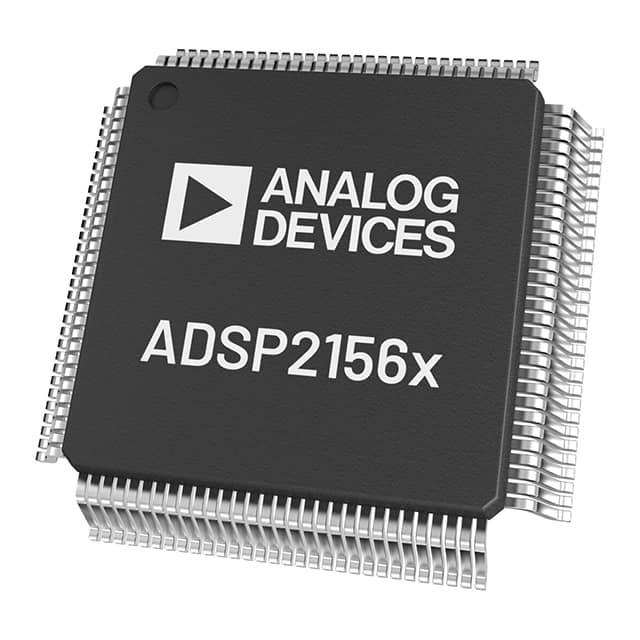
- Part No.:
- ADSP-21562BSWZ4
- Manufacturer:
- Analog Devices Inc.
- Category:
- DSP (Digital Signal Processors)
- Package:
- 120-LQFP Exposed Pad
- Datasheet:
-
 ADSP-21562BSWZ4.pdf
- Description:
- 400 MHZ SHARC IN AN LQFP PACKAGE
- Quantity:
- Payment:

- Shipping:

Inventory:4,212
Please send an inquiry. Send us your inquiry, and we will respond immediately.
Product details
Overview
ADSP-21562BSWZ4 from Analog Devices is a SHARC+ single-core floating-point DSP operating at 400 MHz, featuring 5 Mb (640 kB) L1 SRAM with parity, 256 kB L2 SRAM with ECC, and integrated FIR/IIR accelerators. It supports 32-/40-/64-bit floating-point and 32-bit fixed-point arithmetic, and targets automotive audio amplifier and head unit applications requiring deterministic real-time signal processing.
For engineers reviewing the ADSP-21562BSWZ4 datasheet, ADSP-21562BSWZ4 pinout, ADSP-21562BSWZ4 application, or ADSP-21562BSWZ4 equivalent, key selection criteria include core clock speed (400 MHz), L1 SRAM configuration (640 kB with parity), L2 memory size (256 kB ECC), package type (120-lead LQFP_EP), and AEC-Q100 qualification for automotive use.
Technical Context
The ADSP-21562BSWZ4 implements a SIMD SHARC+ core with dual processing elements (PEx/PEy), enabling parallel ALU/multiplier operations per cycle and full IEEE 32/40/64-bit floating-point support. Its memory architecture includes four configurable L1 SRAM blocks (total 5 Mb), each accessible via dedicated PM/DM buses for single-cycle core access.
It integrates a 120-lead LQFP_EP package with 0.4 mm pitch, supports DDR3/DDR3L via L3 interface (BGA-only), and includes on-chip safety features (memory protection, fault management unit) and security accelerators (crypto engine, secure boot). The device lacks link ports and full SPORTs compared to higher-grade variants.
Key Specifications
| Parameter | Value and Actual Design Meaning |
|---|---|
| Core Architecture | SHARC+ single-core SIMD processor with PEx/PEy computational units and branch prediction |
| Max Core Frequency | 400 MHz - defines real-time processing throughput for audio algorithms like ANC/RNC |
| L1 SRAM | 5 Mb (640 kB) with parity - configurable as SRAM/cache; enables zero-wait-state execution of critical code/data |
| L2 SRAM | 256 kB with ECC - provides error-correcting storage for coefficient tables and DMA descriptors |
| Floating-Point Support | 32-bit, 40-bit, and 64-bit IEEE formats - ensures precision in high-dynamic-range audio processing |
| Fixed-Point Support | 32-bit - maintains compatibility with legacy SHARC firmware and control loops |
| Package | 120-lead LQFP_EP, 0.4 mm pitch, RoHS compliant - suitable for cost-sensitive automotive PCB layouts |
| AEC-Q100 Grade | Qualified for automotive applications - validated for operation across −40°C to +125°C junction temperature |
Pinout & Package
ADSP-21562BSWZ4 uses a 120-lead LQFP_EP (exposed pad) package with 0.4 mm lead pitch. Pin assignments are defined in Analog Devices' ADSP-2156x datasheet Rev. D, Section "120-Lead LQFP Lead Assignments" (pp. 96–98).
| Pin/Terminal | Circuit Role | Design Meaning |
|---|---|---|
| VDD_IO | I/O power supply | 1.8 V supply for all digital I/O banks; requires local decoupling for signal integrity |
| VDD_CORE | Core power supply | 1.0 V supply for SHARC+ core; tight regulation required for 400 MHz stability |
| CLKIN | External clock input | Accepts 1–50 MHz crystal or oscillator; feeds Clock Generation Unit (CGU) for internal PLL |
| RESET | Active-low reset input | Synchronous deassertion required; initiates boot sequence from internal ROM or external SPI flash |
| BOOT_CFG[2:0] | Boot mode configuration | Three-pin strapping to select boot source (SPI, UART, or internal ROM) |
| DAI0_PB0–PB7 | Digital Audio Interface port B | Configurable as I2S, TDM, or left-justified; supports up to 8 channels at 192 kHz |
| GPIO_A0–A7 | General-purpose I/O bank A | Programmable as inputs/outputs with interrupt capability; used for system control signaling |
Key Features
| Feature | Design Value |
|---|---|
| Enhanced SHARC+ core | 400 MHz operation with instruction cache, branch predictor, and BTB for reduced loop overhead in FFT/filter kernels |
| Memory protection | On-chip SMPU enforces access rights across L1/L2 memory spaces, preventing accidental corruption in multitask environments |
| Hardware accelerators | FIR/IIR engines run at full CCLK speed (400 MHz), offloading 100% of coefficient-based filtering from main core |
| Security crypto engine | Accelerates AES-128/256, SHA-256, and RSA operations; enables secure firmware updates and IP protection |
| Automotive qualification | AEC-Q100 Grade 2 compliance ensures reliability in vehicle cabin environments with thermal cycling and EMI exposure |
Applications
| Automotive Audio Amplifier | Automotive Head Unit |
|---|---|
Use Scenario: High-fidelity Class-D amplifier subsystem in electric vehicles requiring real-time speaker protection, EQ, and active noise cancellation. IC Role / Device Role / Timing Role: Primary DSP executing multi-band parametric EQ, dynamic range compression, and FIR-based speaker linearization at 96 kHz sample rate. Use Value: 400 MHz SHARC+ core delivers >1.2 GMAC/s sustained performance, enabling 128-tap FIR filters per channel without latency penalty. | Use Scenario: Central infotainment head unit processing audio streams from Bluetooth, USB, and tuner sources while managing voice UI and navigation alerts. IC Role / Device Role / Timing Role: Dedicated audio DSP handling ASRC conversion, mixing, and spatial audio rendering independent of main ARM application processor. Use Value: Dual 2×4 ASRC pairs enable seamless sample-rate translation between 44.1 kHz (CD), 48 kHz (Bluetooth), and 96 kHz (HD radio) domains. |
| Rear Seat Entertainment | Digital Cockpit Audio Hub |
Use Scenario: Multi-zone audio distribution system delivering independent content to rear passengers via wireless headphones or seatback displays. IC Role / Device Role / Timing Role: Audio routing and format conversion DSP managing up to 8 concurrent I2S/TDM streams with low-jitter clock generation. Use Value: Two precision clock generators (2×2) provide independent 44.1/48/96/192 kHz clocks with <100 ps jitter, eliminating audible artifacts in wireless audio links. | Use Scenario: Integrated cockpit domain controller aggregating audio from ADAS alerts, telematics, and media sources into unified 3D audio output. IC Role / Device Role / Timing Role: Safety-critical audio processing node performing real-time mixing with guaranteed latency ≤2 ms for collision warnings. Use Value: On-chip memory protection (SMPU) and fault management unit (FMU) ensure deterministic response under EMI stress or voltage droop conditions. |
Equivalent & Alternatives
The following parts are listed as comparable options for similar DSP applications.
| Alternative Part | Technical Difference | Application Difference | Selection Advice |
|---|---|---|---|
| ADSP-21563BSWZ6 | Higher speed grade (600/800 MHz), 512 kB L2 SRAM, adds 2× UARTs and 6× timers | Supports more complex ANC algorithms and additional peripheral control in premium head units | Select when >400 MHz processing headroom or extra serial interfaces are required |
| ADSP-21565BSWZ8 | 1 GHz core, 1 MB L2 SRAM, adds link ports and full SPORTs, BGA-only package | Enables multi-processor SHARC clusters and high-bandwidth inter-DSP communication | Select for scalable systems needing inter-processor data streaming or DDR3 memory expansion |
Compared with ADSP-21562BSWZ4, ADSP-21563BSWZ6 offers higher compute density for feature-rich audio stacks, while ADSP-21565BSWZ8 enables system-level scalability via link ports and DDR3 - neither is pin-compatible, and both require PCB redesign due to different packages and peripheral sets.
Availability
ADSP-21562BSWZ4 is available at Aetrix Electronics and suitable for automotive audio amplifier, head unit, and rear seat entertainment systems requiring stable component supply across extended temperature ranges and long production lifecycles.
Supply support for ADSP-21562BSWZ4 includes scheduled delivery planning, volume procurement assistance, BOM continuity management, traceable sourcing, and lifecycle availability coordination for OEM customers, industrial embedded developers, connected-device designers, and electronics production programs.
Manufacturer
Analog Devices, Inc. is a global semiconductor company specializing in high-performance analog, mixed-signal, and digital signal processing technologies for precision engineering applications.
The ADSP-21562BSWZ4 belongs to the SHARC+ DSP product line, designed specifically for deterministic, low-latency audio and industrial signal processing where floating-point accuracy and real-time predictability are critical.
FAQ
What is the maximum operating frequency of the ADSP-21562BSWZ4?
The ADSP-21562BSWZ4 is rated for a maximum core frequency of 400 MHz. This speed grade is confirmed in Table 1 of the ADSP-2156x datasheet Rev. D (page 3) and defines its real-time processing capability for audio algorithms such as FIR filtering and FFT computation. The device achieves this frequency with 1.0 V core supply and proper thermal management within the automotive temperature range.
Does the ADSP-21562BSWZ4 support DDR3 memory interfacing?
No, the ADSP-21562BSWZ4 does not support DDR3/DDR3L memory. According to the ADSP-2156x datasheet Rev. D (page 1), DDR3/DDR3L controller support is marked "N/A" for ADSP-21562 in Table 1. That interface is only available on BGA-packaged variants (e.g., ADSP-21563/21565/21569) and is absent in the 120-lead LQFP_EP package used by ADSP-21562BSWZ4.
What package type is used for the ADSP-21562BSWZ4?
The ADSP-21562BSWZ4 uses a 120-lead LQFP_EP (exposed pad) package with 0.4 mm lead pitch and RoHS compliance. This is explicitly stated in the "Package Options" row of Table 1 (page 3) and confirmed in the "Outline Dimensions" section (page 99) of the ADSP-2156x datasheet Rev. D. It is distinct from the 400-ball CSP_BGA option used by higher-tier variants.
Is the ADSP-21562BSWZ4 qualified for automotive applications?
Yes, the ADSP-21562BSWZ4 is AEC-Q100 qualified for automotive applications. The datasheet states "AEC-Q100 qualified for automotive applications" under "Additional Features" (page 1) and specifies Grade 2 temperature range (−40°C to +105°C ambient, or +125°C junction) in the "Automotive Products" section (page 101). This qualification covers thermal, vibration, and ESD robustness required for vehicle cabin deployment.
How much on-chip SRAM does the ADSP-21562BSWZ4 include?
The ADSP-21562BSWZ4 includes 5 Mb (640 kB) of Level 1 (L1) SRAM with parity protection and 256 kB of Level 2 (L2) SRAM with ECC. These values are specified in the "System Features" section (page 1) and Table 1 (page 3) of the ADSP-2156x datasheet Rev. D. The L1 SRAM is configurable as SRAM or cache; the L2 SRAM is fixed-function with error correction.
ADSP-21562BSWZ4 Specifications
- Product attributes
- Attribute value
- Manufacturer:
- Analog Devices Inc.
- Series:
- SHARC®
- Package/Case:
- 120-LQFP Exposed Pad
- Packaging:
- Tray
- Product Status:
- Active
- Type:
- Fixed/Floating Point
- Interface:
- DDR3, DDR3L, I2C, Link Port, QSPI, SPDIF, SPI, SPORT, UART/USART
- Clock Rate:
- 400MHz
- Non-Volatile Memory:
- OTP (896B)
- On-Chip RAM:
- 896kB
- Voltage - I/O:
- 3.30V
- Voltage - Core:
- 1.00V
- Operating Temperature:
- -40°C ~ 85°C (TA)
- Grade:
- Automotive
- Qualification:
- -
- Mounting Type:
- Surface Mount
- Supplier Device Package:
- 120-LQFP-EP (14x14)
ADSP-21562BSWZ4 FAQ
1.How can I place an order for ADSP-21562BSWZ4 through Aetrix?
Please submit a Request for Quotation (RFQ) for ADSP-21562BSWZ4 on Aetrix. Our sales agent will provide a competitive quotation and guide you through the order confirmation once you accept the terms.
2.Are the price and stock information for ADSP-21562BSWZ4 reliable?
The price and inventory of ADSP-21562BSWZ4 are updated periodically and may fluctuate due to market conditions. Stock and pricing data are typically refreshed every 24 hours. Quotation validity for ADSP-21562BSWZ4 is usually 5 days.
3.What payment methods are accepted for ADSP-21562BSWZ4?
We accept Wire Transfer, PayPal, Credit Card, Western Union, MoneyGram, and Escrow for ADSP-21562BSWZ4 transactions.
Note: Certain payment methods may incur a processing fee.
4.How is shipping managed for ADSP-21562BSWZ4?
ADSP-21562BSWZ4 orders can be shipped via leading logistics carriers, including DHL, UPS, FedEx, TNT, or Registered Mail.
Once your ADSP-21562BSWZ4 order is processed, you will receive an email with the shipment details and tracking number.
Note: Tracking information may take up to 24 hours to appear. Express delivery typically takes 3–5 business days.
5.How can I obtain technical support or documentation for ADSP-21562BSWZ4?
For technical support, including ADSP-21562BSWZ4 datasheets, pinout diagrams, or application guidance, please contact our engineering support team. They can provide detailed documentation and assistance for your ADSP-21562BSWZ4 requirements.
6.How does Aetrix verify that ADSP-21562BSWZ4 is sourced from the original manufacturer or authorized distributors?
All ADSP-21562BSWZ4 products on Aetrix are procured from qualified distributors and authorized channels. Our dedicated quality assurance team conducts strict verification, including traceability checks and, if necessary, third-party testing. This ensures that ADSP-21562BSWZ4 meets industry standards.
7.What is the process for return or replacement of ADSP-21562BSWZ4?
All ADSP-21562BSWZ4 units undergo pre-shipment inspection (PSI). If there is an issue with ADSP-21562BSWZ4, returns or replacements are accepted under the following conditions:
1.Quantity discrepancies, incorrect items, or visible external defects (such as breakage or corrosion), acknowledged by Aetrix.
2.The issue is reported within 90 days of delivery.
3.The ADSP-21562BSWZ4 part is unused and in its original packaging.
Return procedure for ADSP-21562BSWZ4:
1.Submit a request within 90 days.
2.Obtain a Return Material Authorization (RMA) from Aetrix.
ADSP-21562BSWZ4 Tags
-
TMS320C5535AZAY10
Texas Instruments
-
TMS320VC5501PGF300
Texas Instruments
-
ADSP-BF592KCPZ
Analog Devices Inc.
-
ADAU1463WBCPZ150
Analog Devices Inc.
-
TMS320VC5402PGE100
Texas Instruments
-
ADAU1701JSTZ-RL
Analog Devices Inc.
-
ADAU1701JSTZ
Analog Devices Inc.
-
TMS320VC5502PGF300
Texas Instruments
-
ADAU1462WBCPZ300RL
Analog Devices Inc.
-
ADAU1452KCPZRL
Analog Devices Inc.
-
ADAU1452WBCPZ-RL
Analog Devices Inc.
-
TMS320C6747DZKB3
Texas Instruments
Tech Hub

A practical engineering guide to 3.3V and 5V logic compatibility, input thresholds, resistor dividers, translator ICs, MOSFET level shifting, I2C pull-ups, timing limits and power-sequencing risks.

The 74HC595 uses push-pull logic outputs, while the TPIC6B595 uses 50 V open-drain DMOS sinks for higher-power loads. This guide compares timing, current limits, 3.3 V interfacing, load wiring, thermal…

The 74HC595 converts serial data into eight stable parallel outputs. This guide covers pin functions, shift and storage timing, OE and MR behavior, drive-current limits, cascading, voltage compatibilit…

A technical comparison of level-sensitive latches and edge-triggered flip-flops, covering timing windows, setup and hold limits, master–slave operation, time borrowing, race-through, HDL inference and…

A D latch stores one bit while Enable controls when data can pass. This reference covers gate-level operation, truth tables, transparency, setup and hold timing, LE versus OE, common ICs and practical …

An SR latch stores one bit through cross-coupled feedback. This engineering reference covers NOR and NAND implementations, truth tables, forbidden-state recovery, gated operation, switch debouncing, fa…

Latch circuits retain one bit through feedback. This technical reference covers SR and D latches, truth tables, transparency, timing limits, latch-versus-flip-flop behavior, applications and common log…

An engineering guide to LED driver operation, constant-current and constant-voltage outputs, linear and switching topologies, dimming, IC selection, calculations, replacement compatibility, and fault c…

Operational amplifier guide covering op amp basics, feedback, ideal vs real op amps, common configurations, buffer circuits, offset, bias current, gain-bandwidth, slew rate, rail-to-rail limits and sel…

Jumper cables guide covering safe connection order, red and black clamp placement, final ground connection, cable gauge, length, clamp quality, copper vs CCA cables, jump starter comparison and battery…


