
 My Inquiry
 My Account


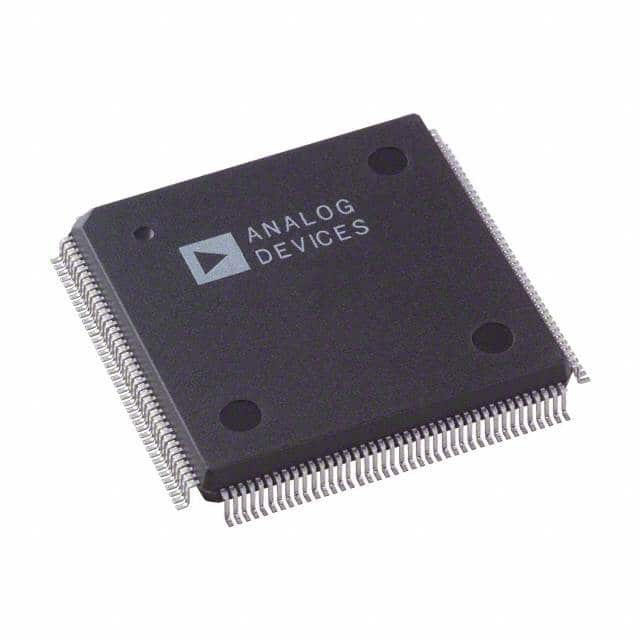
Analog Devices Inc. ADV601JS12
- Part No.:
- ADV601JS12
- Manufacturer:
- Analog Devices Inc.
- Category:
- CODECS
- Package:
- 160-BQFP
- Datasheet:
-
 ADV601JS12.pdf
- Description:
- IC CODEC VIDEO DSP/SRL 160-MQFP
- Quantity:
- Payment:

- Shipping:

Inventory:2,330
Please send an inquiry. Send us your inquiry, and we will respond immediately.
Product details
Overview
ADV601JS12 from Analog Devices is a single-chip, all-digital CMOS VLSI video codec optimized for real-time interlaced video compression and decompression using bi-orthogonal (7,9) wavelet transforms. It supports CCIR-601/656 digital component video I/O, delivers visually loss-less compression at 4:1 on natural images, achieves up to 350:1 compression ratio, and operates at pixel rates up to 14.75 MHz - enabling PAL/NTSC field-rate processing in broadcast-quality surveillance and camcorder systems.
For engineers reviewing the ADV601JS12 datasheet, ADV601JS12 pinout, ADV601JS12 application, or ADV601JS12 equivalent, this page provides verified technical context on its sub-band coding architecture, field-independent compression engine, 512-deep 32-bit host FIFO, DRAM-managed transform buffer, and adaptive quantizer with external DSP support for bin-width calculation - all critical for selecting a multiformat video codec for embedded real-time video systems.
Technical Context
The ADV601JS12 implements a five-stage wavelet filter tree (Mallat structure) with separable horizontal/vertical bi-orthogonal (7,9) transforms, producing 14 sub-band blocks (A–N) plus low-pass residual (block N). Its programmable quantizer applies per-block bin-width factors (e.g., 0x007F to 0xC62B) derived from human visual system modeling, enabling precise bit-rate control via external DSP or host.
Encoding and decoding paths are fully symmetric but functionally distinct: encode mode accepts uncompressed CCIR-656 video and outputs compressed bit streams via the 32-bit host interface; decode mode reverses the path. The on-chip 256K × 16-bit DRAM manager handles field-store buffering, while the 512-entry FIFO decouples host bus timing from real-time video throughput.
Key Specifications
| Parameter | Value and Actual Design Meaning |
|---|---|
| Compression Algorithm | Bi-orthogonal (7,9) wavelet transform with field-independent sub-band coding - eliminates DCT block artifacts and enables graceful degradation at high ratios. |
| Max Pixel Rate | 14.75 MHz - supports 768 × 288 @ 50 Hz (Sq. Pixel/625) and full CCIR-601 resolution without external clock scaling. |
| Video Interface | Glueless CCIR-656-compatible digital component video I/O - accepts luminance/chroma separately with no external formatter required. |
| Host Interface | 8-/16-/32-bit parallel with 512 × 32-bit FIFO - enables direct connection to PCI, ISA, or custom microcontroller buses without glue logic. |
| Quantization Control | External DSP or host-calculated bin-width parameters (16-bit per Mallat block) - allows real-time adaptive bit-rate tuning based on field statistics. |
| DRAM Support | Integrated DRAM manager for 256K × 16-bit external DRAM - handles refresh, reordering, and transform buffer access transparently. |
| Compression Range | Visually loss-less to 350:1 - validated on natural imagery at 4:1; higher ratios trade fidelity for bandwidth reduction in archival or low-bitrate streaming. |
Pinout & Package
ADV601JS12 is housed in a 144-pin plastic quad flat pack (PQFP) with 0.5 mm pitch, thermally enhanced for sustained video processing. Pin functions are defined per Analog Devices REV. 0 datasheet Section "PIN FUNCTION DESCRIPTIONS" (pp. 16–26), supporting three primary interface domains: digital video I/O (pins 1–32, 113–144), host processor bus (pins 33–64, 81–112), and auxiliary control/DRAM/DSP signals (pins 65–80).
| Pin/Terminal | Circuit Role | Design Meaning |
|---|---|---|
| HCLK | Host Interface Clock Input | Synchronizes host bus transactions; supports up to 33 MHz operation for 32-bit FIFO throughput matching video data rate. |
| VCLK | Video Clock Input | Drives CCIR-656 video sampling; must match input pixel rate (e.g., 13.5 MHz for CCIR-601/525) with ±50 ppm stability. |
| HD[31:0] | Host Data Bus | 32-bit bidirectional data path for compressed stream transfer and register access; enables burst-mode writes to FIFO. |
| VD[15:0] | Video Data Bus | 16-bit multiplexed Y/Cb/Cr interface compliant with CCIR-656 timing; supports 8-bit or 16-bit pixel packing modes. |
| HIRQ | Host Interrupt Output | Open-drain active-low interrupt signaling FIFO status (FIFOSRQ), statistics ready (STATSR), or error conditions (FIFOERR, CCIRER). |
| STATS_R | Statistics Ready Output | Indicates availability of current-field wavelet statistics for external bin-width calculation - used only in encode mode with DSP. |
Key Features
| Feature | Design Value |
|---|---|
| Field-Independent Compression | Processes each video field as an independent unit - enables seamless editing, frame-accurate insertion, and robust error resilience in CCTV links. |
| On-Chip Transform Buffer | Internal SRAM eliminates need for ultra-fast external memory during wavelet transform - reduces BOM cost and layout complexity. |
| Adaptive Quantizer Interface | DSP serial port (SPORT) transfers field statistics and receives bin-width packets - offloads real-time computation from host CPU in embedded systems. |
| Three Huffman Tables | ROM-coded entropy tables optimized for wavelet coefficient distributions - deliver consistent 20–30% additional compression beyond run-length coding alone. |
| CCIR-656 Glueless Interface | Direct connection to standard video decoders (e.g., ADV7170) or encoders without FIFOs or format converters - simplifies system integration. |
Applications
| Nonlinear Video Editing | Remote CCTV Surveillance |
|---|---|
Use Scenario: Real-time capture and timeline-based editing of broadcast-quality footage with frame-accurate splicing and effects overlay. IC Role / Device Role / Timing Role: ADV601JS12 acts as the core compression/decompression engine, accepting uncompressed CCIR-601 video from capture hardware and outputting compressed streams to disk or memory buffers. Use Value: Field-independent encoding preserves edit point integrity; visually loss-less 4:1 mode maintains color fidelity and edge sharpness for professional grading. | Use Scenario: Low-bandwidth transmission of high-resolution interlaced video over leased lines or cellular backhaul in perimeter monitoring systems. IC Role / Device Role / Timing Role: ADV601JS12 performs real-time encode of PAL/NTSC camera feeds, adapting bit rate dynamically via DSP-controlled quantization to match available upstream bandwidth. Use Value: Sub-band coding enables graceful quality degradation under constrained bit rates - avoids macroblocking seen in DCT codecs during motion bursts. |
| Digital Camcorders | Broadcast-Quality Distribution |
Use Scenario: On-device compression of 720×288 PAL video for storage on miniDV tapes or flash memory with minimal power consumption. IC Role / Device Role / Timing Role: ADV601JS12 serves as the dedicated video codec, interfacing directly with image sensor pipeline and tape controller via parallel host and video buses. Use Value: Integrated DRAM manager and 512-deep FIFO reduce external memory requirements - lowers PCB layer count and thermal load in portable form factors. | Use Scenario: Centralized encoding of studio camera feeds for distribution across fiber or satellite links with strict latency and quality requirements. IC Role / Device Role / Timing Role: ADV601JS12 operates in encode mode with fixed quantization tables, delivering constant-bit-rate streams synchronized to house sync for genlock-compliant infrastructure. Use Value: Precise compressed bit-rate control ensures predictable network loading; CCIR-601 compliance guarantees interoperability with legacy broadcast equipment. |
Equivalent & Alternatives
The following parts are listed as comparable options for similar video codec applications.
| Alternative Part | Technical Difference | Application Difference | Selection Advice |
|---|---|---|---|
| ADV602JSTZ | Same die, 128-pin TQFP package; lacks DRAM manager pins and supports only internal SRAM buffer - no external 256K×16 DRAM interface. | Targeted at lower-cost, lower-resolution systems where field-store depth is reduced; unsuitable for full CCIR-601 field buffering. | Select ADV602JSTZ only when BOM cost reduction outweighs need for full-resolution field storage and DRAM flexibility. |
| SAA7113H | Video decoder (not codec); outputs CCIR-656 but performs no compression - requires external encoder like ADV601JS12 for compression functionality. | Used upstream of ADV601JS12 to digitize analog composite/S-video; not a functional replacement. | SAA7113H complements rather than replaces ADV601JS12 - it is a signal acquisition front-end, not a compression alternative. |
Compared with ADV601JS12, ADV602JSTZ offers identical wavelet processing but sacrifices DRAM-managed field storage scalability, while SAA7113H serves a fundamentally different signal chain role - making ADV601JS12 uniquely positioned as a self-contained, multiformat, real-time video codec with integrated memory management.
Availability
ADV601JS12 is available at Aetrix Electronics and suitable for remote CCTV surveillance, digital camcorders, and broadcast-quality video distribution systems requiring stable component supply and long-term design-in support.
Supply support for ADV601JS12 includes scheduled delivery planning, volume procurement assistance, BOM continuity management, traceable sourcing, and lifecycle availability coordination for OEM customers, industrial embedded developers, connected-device designers, and electronics production programs.
Manufacturer
Analog Devices, Inc. is a global semiconductor company specializing in high-performance analog, mixed-signal, and digital signal processing technologies for precision instrumentation, communications, and industrial applications.
The ADV601JS12 belongs to Analog Devices' dedicated video processing product line, designed specifically for cost-sensitive, real-time multiformat video compression in embedded systems where DCT-based artifacts and inflexible bit-rate control are unacceptable.
FAQ
What video standards does the ADV601JS12 support natively?
The ADV601JS12 natively supports CCIR-601 and CCIR-656 digital component video formats, including PAL (720×288 @ 50 Hz), NTSC (720×243 @ 59.94 Hz), square-pixel variants (640×243, 768×288), and field sizes up to 768×288. It does not support analog inputs or HDMI/SDI - those require external digitizers. All timing adheres strictly to ITU-R BT.601 and BT.656 specifications as verified in the REV. 0 datasheet timing tables.
Does the ADV601JS12 require an external DSP to operate?
No, the ADV601JS12 does not require an external DSP to operate. Its host processor can calculate bin-width parameters for the programmable quantizer, especially in computer-based applications. However, the DSP serial port (SPORT) is provided to offload real-time bin-width computation - for example, using an ADSP-2105 - which improves host CPU efficiency in resource-constrained embedded systems running the ADV601JS12.
What is the function of the DRAM manager in the ADV601JS12?
The DRAM manager in the ADV601JS12 autonomously controls a 256K × 16-bit external DRAM used for field-store buffering and wavelet coefficient reordering. It handles address generation, refresh cycles, and read/write arbitration - eliminating the need for external DRAM controllers or complex glue logic. This capability is essential for sustaining real-time processing of full CCIR-601 fields and is explicitly enabled only in the ADV601JS12 package variant.
Can the ADV601JS12 perform both encode and decode simultaneously?
No, the ADV601JS12 operates in either encode mode or decode mode, selected at power-up via the MODE CONTROL register. It cannot perform simultaneous encode and decode. Mode switching requires full reset and reinitialization of internal state, registers, and FIFO pointers. This unidirectional operation is inherent to its dedicated hardware architecture and confirmed in the "Encoding vs. Decoding" section of the REV. 0 datasheet.
What is the maximum compression ratio achievable with the ADV601JS12?
The ADV601JS12 achieves compression ratios from visually loss-less (typically 4:1 on natural images) up to 350:1, as specified in the "PERFORMANCE" section of the REV. 0 datasheet. At 350:1, image fidelity degrades significantly but remains usable for archival indexing or motion detection - not for display. The actual ratio depends on scene content, quantization table selection, and bin-width adaptation; it is not a fixed hardware limit but a validated operational range.
ADV601JS12 Specifications
- Product attributes
- Attribute value
- Manufacturer:
- Analog Devices Inc.
- Series:
- -
- Package/Case:
- 160-BQFP
- Packaging:
- Tube
- Product Status:
- Obsolete
- Type:
- Video Codec
- Data Interface:
- DSP, Serial
- Resolution (Bits):
- 10 b
- Number of ADCs / DACs:
- -
- Sigma Delta:
- No
- S/N Ratio, ADCs / DACs (db) Typ:
- -
- Dynamic Range, ADCs / DACs (db) Typ:
- -
- Voltage - Supply, Analog:
- 4.5V ~ 5.5V
- Voltage - Supply, Digital:
- 4.5V ~ 5.5V
- Operating Temperature:
- 0°C ~ 70°C
- Grade:
- -
- Qualification:
- -
- Mounting Type:
- Surface Mount
- Supplier Device Package:
- 160-PQFP (28x28)
ADV601JS12 FAQ
1.How can I place an order for ADV601JS12 through Aetrix?
Please submit a Request for Quotation (RFQ) for ADV601JS12 on Aetrix. Our sales agent will provide a competitive quotation and guide you through the order confirmation once you accept the terms.
2.Are the price and stock information for ADV601JS12 reliable?
The price and inventory of ADV601JS12 are updated periodically and may fluctuate due to market conditions. Stock and pricing data are typically refreshed every 24 hours. Quotation validity for ADV601JS12 is usually 5 days.
3.What payment methods are accepted for ADV601JS12?
We accept Wire Transfer, PayPal, Credit Card, Western Union, MoneyGram, and Escrow for ADV601JS12 transactions.
Note: Certain payment methods may incur a processing fee.
4.How is shipping managed for ADV601JS12?
ADV601JS12 orders can be shipped via leading logistics carriers, including DHL, UPS, FedEx, TNT, or Registered Mail.
Once your ADV601JS12 order is processed, you will receive an email with the shipment details and tracking number.
Note: Tracking information may take up to 24 hours to appear. Express delivery typically takes 3–5 business days.
5.How can I obtain technical support or documentation for ADV601JS12?
For technical support, including ADV601JS12 datasheets, pinout diagrams, or application guidance, please contact our engineering support team. They can provide detailed documentation and assistance for your ADV601JS12 requirements.
6.How does Aetrix verify that ADV601JS12 is sourced from the original manufacturer or authorized distributors?
All ADV601JS12 products on Aetrix are procured from qualified distributors and authorized channels. Our dedicated quality assurance team conducts strict verification, including traceability checks and, if necessary, third-party testing. This ensures that ADV601JS12 meets industry standards.
7.What is the process for return or replacement of ADV601JS12?
All ADV601JS12 units undergo pre-shipment inspection (PSI). If there is an issue with ADV601JS12, returns or replacements are accepted under the following conditions:
1.Quantity discrepancies, incorrect items, or visible external defects (such as breakage or corrosion), acknowledged by Aetrix.
2.The issue is reported within 90 days of delivery.
3.The ADV601JS12 part is unused and in its original packaging.
Return procedure for ADV601JS12:
1.Submit a request within 90 days.
2.Obtain a Return Material Authorization (RMA) from Aetrix.
ADV601JS12 Tags
-
NAU88C22YG
Nuvoton Technology Corporation
-
TLV320AIC3100IRHBR
Texas Instruments
-
DA7212-01UM2
Renesas Electronics Corporation
-
NAU8810YG
Nuvoton Technology Corporation
-
DA7218-00U32
Renesas Electronics Corporation
-
CMX655DQ6-TR1K
CML Micro
-
SGTL5000XNLA3
NXP Semiconductors
-
TLV320AIC3104IRHBR
Texas Instruments
-
MAX9867EWV+T
Analog Devices Inc./Maxim Integrated
-
MAX9860ETG+T
Analog Devices Inc./Maxim Integrated
-
TLV320AIC3106IRGZR
Texas Instruments
-
SGTL5000XNLA3R2
NXP Semiconductors
Tech Hub

A practical engineering guide to 3.3V and 5V logic compatibility, input thresholds, resistor dividers, translator ICs, MOSFET level shifting, I2C pull-ups, timing limits and power-sequencing risks.

The 74HC595 uses push-pull logic outputs, while the TPIC6B595 uses 50 V open-drain DMOS sinks for higher-power loads. This guide compares timing, current limits, 3.3 V interfacing, load wiring, thermal…

The 74HC595 converts serial data into eight stable parallel outputs. This guide covers pin functions, shift and storage timing, OE and MR behavior, drive-current limits, cascading, voltage compatibilit…

A technical comparison of level-sensitive latches and edge-triggered flip-flops, covering timing windows, setup and hold limits, master–slave operation, time borrowing, race-through, HDL inference and…

A D latch stores one bit while Enable controls when data can pass. This reference covers gate-level operation, truth tables, transparency, setup and hold timing, LE versus OE, common ICs and practical …

An SR latch stores one bit through cross-coupled feedback. This engineering reference covers NOR and NAND implementations, truth tables, forbidden-state recovery, gated operation, switch debouncing, fa…

Latch circuits retain one bit through feedback. This technical reference covers SR and D latches, truth tables, transparency, timing limits, latch-versus-flip-flop behavior, applications and common log…

An engineering guide to LED driver operation, constant-current and constant-voltage outputs, linear and switching topologies, dimming, IC selection, calculations, replacement compatibility, and fault c…

Operational amplifier guide covering op amp basics, feedback, ideal vs real op amps, common configurations, buffer circuits, offset, bias current, gain-bandwidth, slew rate, rail-to-rail limits and sel…

Jumper cables guide covering safe connection order, red and black clamp placement, final ground connection, cable gauge, length, clamp quality, copper vs CCA cables, jump starter comparison and battery…


