
 My Inquiry
 My Account


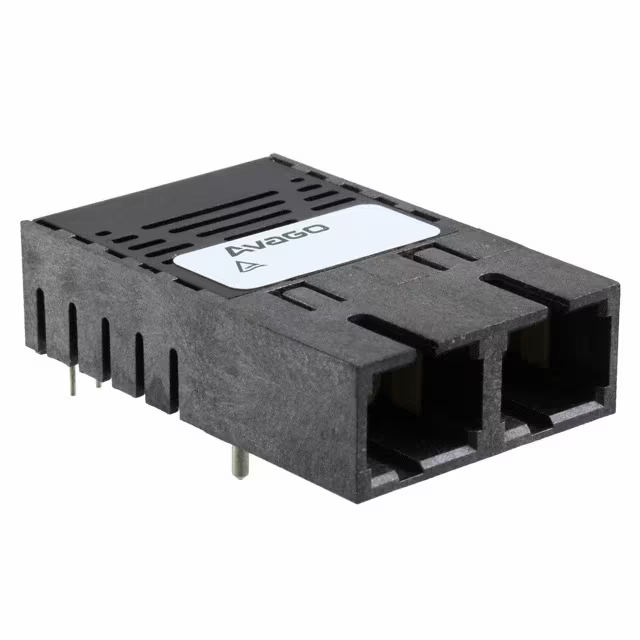
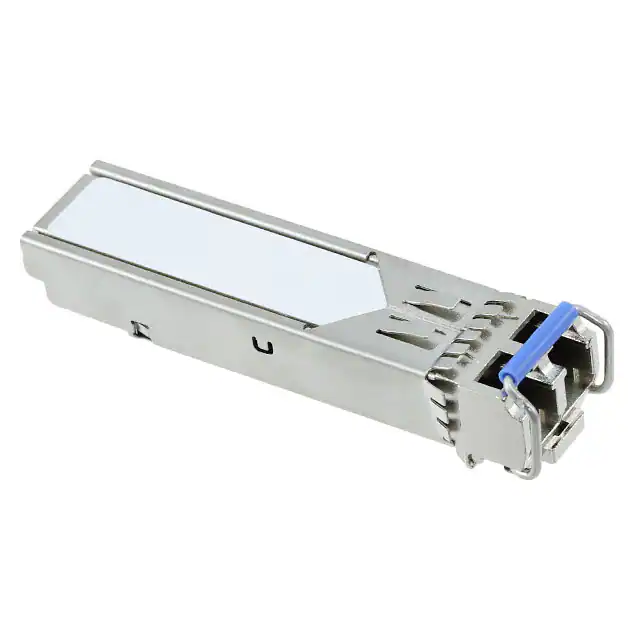
Broadcom Limited AFBR-5805AZ
- Part No.:
- AFBR-5805AZ
- Manufacturer:
- Broadcom Limited
- Category:
- Fiber Optic Transceiver Modules
- Package:
- Datasheet:
-
 AFBR-5805AZ.pdf
- Description:
- TXRX ATM SONET OC3 3V SC 1X9
- Quantity:
- Payment:

- Shipping:

Inventory:161
Please send an inquiry. Send us your inquiry, and we will respond immediately.
Product details
Overview
AFBR-5805AZ from Broadcom (formerly Avago Technologies) is a SONET OC-3 / SDH STM-1 ATM optical transceiver with 1300 nm InGaAsP LED transmitter and InGaAs PIN photodiode receiver, operating at 155.52 MBd over multimode fiber. It supports dual supply voltages (3.135–3.5 V or 4.75–5.25 V), delivers –19 dBm min BOL output power into 62.5/125 µm fiber, and is rated for –10°C to +85°C ambient operation. It is used in telecom backbone and wiring closet-to-desktop ATM links.
For engineers reviewing the AFBR-5805AZ datasheet, pinout, applications, or equivalent options, key selection considerations include its 1×9 SIP package with SC/ST receptacle options, PECL-compatible differential data I/O, signal detect functionality, optical power budget compliance with ANSI T1E1.2 for 2 km multimode links, and ESD robustness per MIL-STD-883C Class 2.
Technical Context
The AFBR-5805AZ implements a full SONET OC-3 physical layer interface using a custom silicon driver IC that converts differential PECL inputs (ECL-referenced to +3.3 V or +5.0 V) into analog LED drive current, and a transimpedance preamplifier + quantizer IC chain delivering differential PECL data output and single-ended signal detect. Its optical subsystem uses low-aging 1300 nm LEDs and optimized lensing for stable BOL-to-EOL performance.
It complies with ATM Forum UNI SONET OC-3 multimode fiber specification and ANSI T1E1.2 Annex B system jitter allocations-contributing ≤1.2 ns p-p systematic jitter and ≤0.69 ns p-p random jitter at transmitter, ≤1.2 ns p-p and ≤1.91 ns p-p respectively at receiver-enabling BER ≤1×10⁻¹⁰ over defined optical input power ranges.
Key Specifications
| Parameter | Value and Actual Design Meaning |
|---|---|
| Operating Rate | 155.52 MBd - matches SONET OC-3 / SDH STM-1 line rate; enables direct interface to compliant PHYs without retiming. |
| Supply Voltage | 3.135–3.5 V or 4.75–5.25 V - dual-voltage support allows integration into legacy +5 V or modern +3.3 V telecom systems. |
| Optical Output Power (BOL) | –19 dBm min into 62.5/125 µm fiber - provides ≥12 dB optical power budget for 2 km multimode links per ANSI T1E1.2. |
| Receiver Sensitivity (BER ≤1×10⁻¹⁰) | –35 dBm min at eye center - ensures reliable detection under worst-case modal dispersion and aging conditions. |
| Signal Detect Threshold | –31 dBm asserted / –45 dBm deasserted with 1.5 dB hysteresis - enables robust link fault isolation without false toggling near sensitivity limit. |
| Jitter Contribution (Tx) | ≤1.2 ns p-p systematic + ≤0.69 ns p-p random - meets ANSI T1E1.2 Annex B allocation, preserving system-level timing margin. |
| Package | 1×9 SIP with duplex SC or ST receptacle - industry-standard footprint enables multisourced board design and mechanical interchangeability. |
Pinout & Package
The AFBR-5805AZ uses a 1×9 single-in-line package (SIP) with two solder posts for mechanical anchoring and nine electrical pins arranged linearly. The housing accommodates either a duplex SC or duplex ST optical receptacle. Pin 1 (VEE) and Pin 9 (VEE) are ground references; Pins 2–3 (RD) and 7–8 (TD) are differential receiver and transmitter data lines; Pin 4 (SD) is single-ended signal detect; Pins 5–6 (VCC) are dual power supply inputs.
| Pin/Terminal | Circuit Role | Design Meaning |
|---|---|---|
| 1, 9 | VEE | Ground reference for PECL I/O; must be connected to local low-inductance ground plane. |
| 2, 3 | RD | Differential receiver data output (PECL); requires 50 Ω termination to VCC – 2 V at receiving PHY. |
| 4 | SD | Single-ended signal detect output (PECL); asserts high when optical input ≥ –31 dBm. |
| 5, 6 | VCC | Positive supply inputs; accept 3.135–3.5 V or 4.75–5.25 V; require local 0.1 µF + 10 µF decoupling. |
| 7, 8 | TD | Differential transmitter data input (PECL); driven by PHY with ECL-referenced logic. |
Key Features
| Feature | Design Value |
|---|---|
| SONET OC-3 Physical Layer Compliance | Fully satisfies ATM Forum UNI v3.0 and ANSI T1E1.2 for 2 km multimode fiber links - eliminates need for external retiming or protocol adaptation. |
| Low-Aging 1300 nm LED Transmitter | Specified <1 dB optical power degradation over commercial equipment life - exceeds industry standard (1.5 dB), reducing long-term link margin erosion. |
| Dual-Voltage PECL Interface | Operates natively from +3.3 V or +5.0 V supplies with ECL-referenced I/O - simplifies integration across mixed-voltage telecom platforms. |
| EMI-Optimized 1×9 SIP Construction | Internal shielding + nonconductive plastic housing provides ≥9 dB margin to FCC Class B/CISPR 22 - reduces board-level filtering requirements. |
| Wave Solder & Aqueous Wash Compatible | Lead-free plating (SnCu/Ni on posts, pure Sn/Ni on pins) and process plug protection - enables high-yield automated assembly without optical damage. |
Applications
| ATM Backbone Link | Wiring Closet-to-Desktop Link |
|---|---|
Use Scenario: Interconnecting ATM switches across building-wide fiber plant using 62.5/125 µm OM1 multimode fiber up to 2 km. IC Role / Device Role / Timing Role: SONET OC-3 physical layer transceiver providing optical-electrical conversion and jitter-constrained data recovery. Use Value: Delivers guaranteed –19 dBm BOL output and –35 dBm sensitivity to sustain ≥12 dB power budget - meets ANSI T1E1.2 for zero-error operation over installed base fiber. | Use Scenario: Extending ATM connectivity from telecom wiring closets to end-user workstations via short-haul 50/125 µm OM2 fiber runs (<500 m). IC Role / Device Role / Timing Role: Optical front-end for ATM UNI interface, handling PECL-level signaling and signal presence monitoring. Use Value: Signal detect hysteresis (1.5 dB) prevents flapping during marginal link conditions; dual-voltage support eases migration from legacy +5 V to +3.3 V switch designs. |
| SONET OC-3 Add-Drop Multiplexer | SDH STM-1 Network Interface Card |
Use Scenario: Optical line interface in modular add-drop multiplexers requiring hot-pluggable, field-replaceable OC-3 ports. IC Role / Device Role / Timing Role: Pluggable transceiver implementing full physical layer per ITU-T G.957 - handles clock recovery, data slicing, and loss-of-signal assertion. Use Value: 1×9 SIP footprint with SC/ST receptacle options enables standardized card layout; RoHS compliance supports global deployment. | Use Scenario: Line-side interface on carrier-grade SDH STM-1 interface cards deployed in central office equipment. IC Role / Device Role / Timing Role: SONET/SDH-compliant optical transceiver performing electrical-to-optical and optical-to-electrical conversion with deterministic jitter behavior. Use Value: Meets MIL-STD-883C Class 2 ESD rating (2000–3999 V) and withstands ≥25 kV HBM discharge at SC receptacle - enhances field reliability in high-handling environments. |
Equivalent & Alternatives
The following parts are listed as comparable options for similar SONET OC-3 optical transceiver applications.
| Alternative Part | Technical Difference | Application Difference | Selection Advice |
|---|---|---|---|
| AFBR-5805Z | Narrower temperature range (0°C to +70°C ambient); otherwise identical optical/electrical specs and pinout. | Suitable only for controlled-environment indoor telecom gear; not rated for extended industrial or outdoor chassis operation. | Select AFBR-5805AZ when ambient operating temperature may fall below 0°C or exceed +70°C - no PCB or firmware changes required. |
| AFBR-5805TZ | Same temp range as AFBR-5805AZ but specified with ST receptacle instead of SC; identical electrical interface and performance. | Used where ST connectorization is mandated by existing fiber infrastructure or panel cutout constraints. | Choose AFBR-5805TZ only if ST mechanical interface is required; SC/ST variants share same footprint and pinout. |
Compared with AFBR-5805Z and AFBR-5805TZ, the AFBR-5805AZ uniquely combines extended –10°C to +85°C operation with SC receptacle compatibility - making it the sole option for thermally demanding ATM edge deployments requiring duplex SC connectivity and full SONET OC-3 compliance.
Availability
AFBR-5805AZ is available at Aetrix Electronics and suitable for ATM backbone links, SDH network interface cards, and SONET add-drop multiplexers requiring stable component supply across extended temperature ranges and long production lifecycles.
Supply support for AFBR-5805AZ includes scheduled delivery planning, volume procurement assistance, BOM continuity management, traceable sourcing, and lifecycle availability coordination for OEM customers, industrial embedded developers, connected-device designers, and electronics production programs.
Manufacturer
Broadcom Inc. (acquired Avago Technologies in 2016) is a global semiconductor leader specializing in wired infrastructure, optical networking, and enterprise connectivity solutions.
The AFBR-5800Z family was designed specifically for cost-sensitive, high-volume SONET OC-3/SDH STM-1 multimode fiber applications - emphasizing manufacturability, thermal robustness, and multisource 1×9 SIP compatibility.
FAQ
What is the operating temperature range of the AFBR-5805AZ?
The AFBR-5805AZ is rated for ambient operating temperatures from –10°C to +85°C, corresponding to a transceiver case temperature range of –10°C to +100°C with adequate airflow. This extended range distinguishes it from the AFBR-5805Z (0°C to +70°C) and supports deployment in uncontrolled telecom enclosures or industrial edge locations where thermal margins are critical. The AFBR-5805AZ maintains full SONET OC-3 compliance across this entire range.
Does the AFBR-5805AZ support both +3.3 V and +5.0 V supply voltages?
Yes, the AFBR-5805AZ operates with either 3.135–3.5 V or 4.75–5.25 V supply voltage, and all I/O (TD, RD, SD) are PECL-compatible with ECL referencing shifted to the applied VCC. No external level-shifting circuitry is needed. The AFBR-5805AZ's internal driver and quantizer ICs auto-adapt to the selected rail, maintaining consistent rise/fall times and jitter performance across both voltage modes.
What optical fiber types and distances is the AFBR-5805AZ qualified for?
The AFBR-5805AZ is fully compliant with ANSI T1E1.2 for 2 km multimode fiber links using 62.5/125 µm (OM1) or 50/125 µm (OM2) fiber. Its BOL optical power (–19 dBm min into 62.5/125 µm) and receiver sensitivity (–35 dBm min) deliver ≥12 dB power budget - sufficient to cover fiber attenuation, connector loss, splice loss, and 1 dB aging margin. It is not qualified for single-mode fiber or distances beyond 2 km.
How does the signal detect (SD) function work on the AFBR-5805AZ?
The AFBR-5805AZ provides a single-ended PECL signal detect (SD) output that asserts high when received optical power exceeds –31 dBm and deasserts low below –45 dBm, with 1.5 dB hysteresis to prevent chatter near threshold. SD is referenced to VCC and terminated to VCC – 2 V with 50 Ω. This function enables link-up/down status monitoring in ATM PHYs without requiring full data recovery - a key diagnostic feature used in network management and fault isolation.
Is the AFBR-5805AZ pin-compatible with other members of the AFBR-5800Z family?
Yes, the AFBR-5805AZ shares identical 1×9 SIP pinout, mechanical footprint, and electrical interface with AFBR-5805Z, AFBR-5805TZ, and AFBR-5805ATZ. All use Pins 1/9 (VEE), 2/3 (RD), 4 (SD), 5/6 (VCC), and 7/8 (TD). Differences are limited to operating temperature range and optical receptacle type (SC vs. ST), allowing drop-in replacement in existing layouts - provided thermal and mechanical interface requirements are met.
AFBR-5805AZ Specifications
- Product attributes
- Attribute value
- Manufacturer:
- Broadcom Limited
- Series:
- -
- Packaging:
- Bulk
- Product Status:
- Active
- Data Rate:
- -
- Wavelength:
- 1300nm
- Applications:
- General Purpose
- Voltage - Supply:
- 3.3V
- Connector Type:
- SC
- Mounting Type:
- Through Hole
AFBR-5805AZ FAQ
1.How can I place an order for AFBR-5805AZ through Aetrix?
Please submit a Request for Quotation (RFQ) for AFBR-5805AZ on Aetrix. Our sales agent will provide a competitive quotation and guide you through the order confirmation once you accept the terms.
2.Are the price and stock information for AFBR-5805AZ reliable?
The price and inventory of AFBR-5805AZ are updated periodically and may fluctuate due to market conditions. Stock and pricing data are typically refreshed every 24 hours. Quotation validity for AFBR-5805AZ is usually 5 days.
3.What payment methods are accepted for AFBR-5805AZ?
We accept Wire Transfer, PayPal, Credit Card, Western Union, MoneyGram, and Escrow for AFBR-5805AZ transactions.
Note: Certain payment methods may incur a processing fee.
4.How is shipping managed for AFBR-5805AZ?
AFBR-5805AZ orders can be shipped via leading logistics carriers, including DHL, UPS, FedEx, TNT, or Registered Mail.
Once your AFBR-5805AZ order is processed, you will receive an email with the shipment details and tracking number.
Note: Tracking information may take up to 24 hours to appear. Express delivery typically takes 3–5 business days.
5.How can I obtain technical support or documentation for AFBR-5805AZ?
For technical support, including AFBR-5805AZ datasheets, pinout diagrams, or application guidance, please contact our engineering support team. They can provide detailed documentation and assistance for your AFBR-5805AZ requirements.
6.How does Aetrix verify that AFBR-5805AZ is sourced from the original manufacturer or authorized distributors?
All AFBR-5805AZ products on Aetrix are procured from qualified distributors and authorized channels. Our dedicated quality assurance team conducts strict verification, including traceability checks and, if necessary, third-party testing. This ensures that AFBR-5805AZ meets industry standards.
7.What is the process for return or replacement of AFBR-5805AZ?
All AFBR-5805AZ units undergo pre-shipment inspection (PSI). If there is an issue with AFBR-5805AZ, returns or replacements are accepted under the following conditions:
1.Quantity discrepancies, incorrect items, or visible external defects (such as breakage or corrosion), acknowledged by Aetrix.
2.The issue is reported within 90 days of delivery.
3.The AFBR-5805AZ part is unused and in its original packaging.
Return procedure for AFBR-5805AZ:
1.Submit a request within 90 days.
2.Obtain a Return Material Authorization (RMA) from Aetrix.
AFBR-5805AZ Tags
-
AFBR-5972EZ
Broadcom Limited
-
AFBR-5972BZ
Broadcom Limited
-
FTLF8519P3BNL
Coherent
-
AFBR-5803Z
Broadcom Limited
-
AFBR-5803TZ
Broadcom Limited
-
FTLF8519P3BTL
Coherent
-
AFBR-5803ATZ
Broadcom Limited
-
AFBR-5803ATQZ
Broadcom Limited
-
FTLX8574D3BCV
Coherent
-
FTLF8526P3BNL
Coherent
-
FTLF8519F2GCL
Coherent
-
FTLF1318P3BTL
Coherent
Tech Hub

Counterfeit components can hide behind convincing markings and passing basic function tests. This engineering reference covers source traceability, external inspection, X-ray, XRF, electrical testing, …

A practical engineering and sourcing framework covering lifecycle verification, lifetime-buy calculations, replacement qualification, supplier checks and counterfeit-risk controls.

TTL and CMOS logic families differ in thresholds, loading, output drive, power and timing. This engineering guide compares 74HC and 74HCT, calculates noise margins and checks 3.3 V/5 V compatibility.

A practical engineering guide to 3.3V and 5V logic compatibility, input thresholds, resistor dividers, translator ICs, MOSFET level shifting, I2C pull-ups, timing limits and power-sequencing risks.

The 74HC595 uses push-pull logic outputs, while the TPIC6B595 uses 50 V open-drain DMOS sinks for higher-power loads. This guide compares timing, current limits, 3.3 V interfacing, load wiring, thermal…

The 74HC595 converts serial data into eight stable parallel outputs. This guide covers pin functions, shift and storage timing, OE and MR behavior, drive-current limits, cascading, voltage compatibilit…

A technical comparison of level-sensitive latches and edge-triggered flip-flops, covering timing windows, setup and hold limits, master–slave operation, time borrowing, race-through, HDL inference and…

A D latch stores one bit while Enable controls when data can pass. This reference covers gate-level operation, truth tables, transparency, setup and hold timing, LE versus OE, common ICs and practical …

An SR latch stores one bit through cross-coupled feedback. This engineering reference covers NOR and NAND implementations, truth tables, forbidden-state recovery, gated operation, switch debouncing, fa…

Latch circuits retain one bit through feedback. This technical reference covers SR and D latches, truth tables, transparency, timing limits, latch-versus-flip-flop behavior, applications and common log…


