
 My Inquiry
 My Account


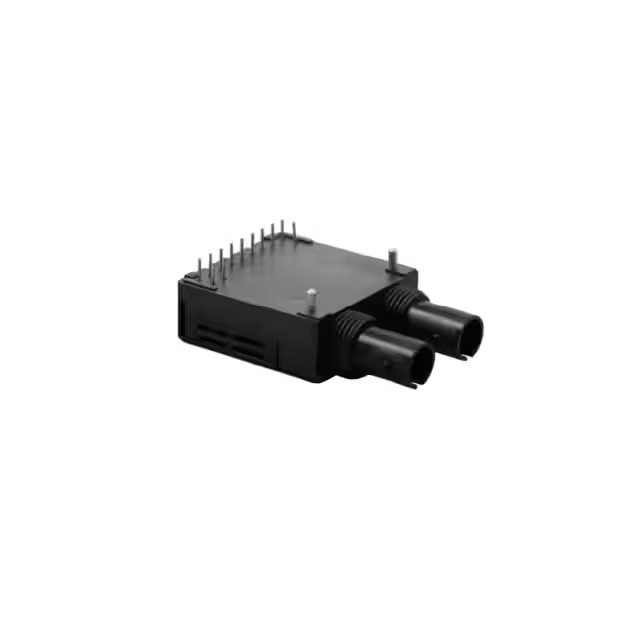
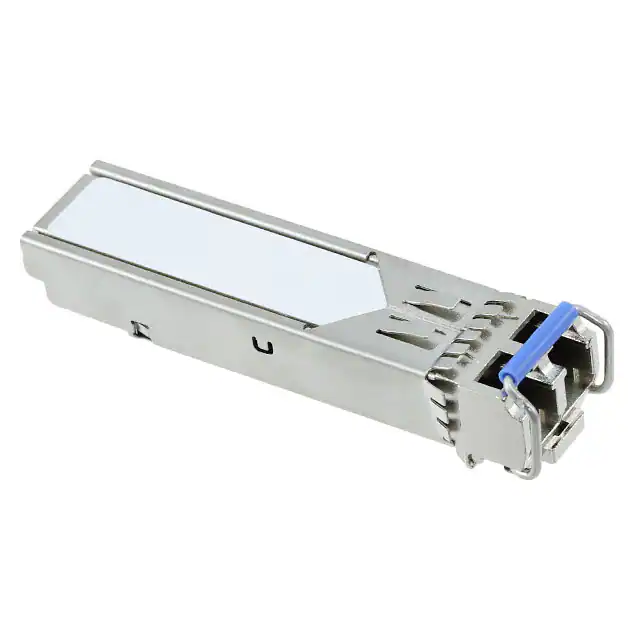
Broadcom Limited AFBR-5823TQZ
- Part No.:
- AFBR-5823TQZ
- Manufacturer:
- Broadcom Limited
- Category:
- Fiber Optic Transceiver Modules
- Package:
- Datasheet:
-
 AFBR-5823TQZ.pdf
- Description:
- FE TRX ST-TYPE DUPLEX 2X9
- Quantity:
- Payment:

- Shipping:

Inventory:1,311
Please send an inquiry. Send us your inquiry, and we will respond immediately.
Product details
Overview
AFBR-5823TQZ from Broadcom is a 2×9-form-factor digital diagnostic-enabled optical transceiver for 125-Mbaud Fast Ethernet and FDDI over multimode fiber, featuring 1300-nm InGaP LED transmitter, InGaAs PIN photodiode receiver, –31 dBm receiver sensitivity, 3.3 V single-supply operation, and industrial temperature range (–40°C to +85°C), deployed in ST-connectorized backbone and wiring-closet-to-desktop links.
For engineers reviewing the AFBR-5823TQZ datasheet, pinout, applications, or equivalent options, this page delivers verified electrical/optical specs, SFF-8472 DMI interface details, ST-connector 2×9 package mapping, real-time monitoring capabilities (temperature, bias current, Tx/Rx power, Rx_LOS), and validated alternatives for 100BASE-FX/FDDI/ATM optical interconnects.
Technical Context
The AFBR-5823TQZ integrates ACPECL differential data input with internal 100 Ω termination and DCPECL differential output, supporting PRBS7-patterned 125-Mbaud signaling at 1300 nm with ≤0.6 ns transmitter DCD and ≤2.14 ns receiver RJ. Its receiver employs a transimpedance amplifier + quantizer architecture delivering LVPECL-compatible RD+/RD− outputs and single-ended SD signal detect with hardware assert/deassert times ≤100 μs.
This 2×9 transceiver implements full SFF-8472 compliance via dedicated SDA/SCL pins (A2h address), enabling real-time readout of calibrated analog parameters-including ±3.0 dB accuracy for Tx/Rx optical power and ±5.0 °C for internal temperature-alongside software-controllable Tx_Disable and Rx_LOS flags, all accessible through a 400 kHz I²C interface with EEPROM-based memory maps at 0xA0 and 0xA2.
Key Specifications
| Parameter | Value and Actual Design Meaning |
|---|---|
| Signaling Rate | 125 Mbaud - supports IEEE 802.3u 100BASE-FX and FDDI physical layer timing |
| Transmitter Wavelength | 1270–1380 nm - centered at 1308 nm for optimal coupling into 50/62.5-μm multimode fiber |
| Receiver Sensitivity | –31 dBm - minimum average optical input power required for BER < 1×10⁻¹⁰ on 62.5/125-μm fiber |
| Supply Voltage | 3.13–3.47 V - single 3.3 V rail with ±3% tolerance, requiring local decoupling per VCCT/VCCR pins |
| Digital Diagnostics | SFF-8472 compliant - real-time monitoring of temperature, Tx bias current, Tx/Rx optical power, Rx_LOS via I²C (0xA2) |
| Operating Temperature | –40°C to +85°C - qualified for industrial environments without derating |
| Optical Connector | Duplex ST - mechanically threaded interface compatible with DIN EN 61754-2 standard |
| Package Form Factor | 2×9 - includes dedicated TX_Disable, SDA, SCL, and two NC pins beyond standard 1×9 pinout |
Pinout & Package
AFBR-5823TQZ uses a 2×9 industry-standard SIP package with 20-pin footprint (9 signal pins + 2 solder posts + 9 extended pins), molded nonconductive housing with duplex ST receptacle, and mechanical height compliance for ST connector mating. Dimensions per Figure 6: 42.6 mm × 12.7 mm × 10.2 mm (L×W×H).
| Pin/Terminal | Circuit Role | Design Meaning |
|---|---|---|
| 1, 9, 19, 20 | VEER / VEET / N.C. | Receiver ground (Pin 1), transmitter ground (Pin 9), and two mechanical stabilization pins (19–20) - all require direct connection to host PCB ground plane |
| 2–3, 7–8 | RD+, RD− / TD+, TD− | Differential LVPECL receiver output (2–3) and transmitter input (7–8) - internally AC-coupled and terminated; require external 50 Ω microstrip routing |
| 4, 5, 6 | SD / VCCR / VCCT | Signal detect logic output (4), +3.3 V receiver supply (5), +3.3 V transmitter supply (6) - each requires localized 0.1 μF + 10 μF decoupling |
| 10, 17–18 | TX_Disable / SDA / SCL | Hardware Tx disable control (10), I²C data (17), I²C clock (18) - enable SFF-8472 diagnostics and software-controlled laser shutdown |
Key Features
| Feature | Design Value |
|---|---|
| FDDI & 100BASE-FX Compliance | Full IEEE 802.3u and ANSI X3.263-1995 conformance - interoperable with legacy FDDI and Fast Ethernet infrastructure |
| SFF-8472 Digital Diagnostics | Real-time access to calibrated temperature, Tx bias current, Tx/Rx optical power, and Rx_LOS status via I²C - enables predictive maintenance and fault isolation |
| Industrial Temperature Range | –40°C to +85°C operation without performance degradation - validated across thermal cycling and long-term burn-in |
| Duplex ST Connector Interface | Mechanically robust threaded coupling compliant with DIN EN 61754-2 - ensures repeatable insertion loss and vibration resistance in rack-mounted systems |
| Wave-Solder Compatible | Withstands 260°C peak soldering temperature for 10 s (MSL1) - supports high-volume automated PCB assembly without rework |
| RoHS & Laser Class 1 Safety | Compliant with EU RoHS Directive 2011/65/EU and EN 60825-1:2014 - certified TÜV R 50377267 for eye-safe LED emission only |
Applications
| Enterprise Fiber Backbone | Industrial Media Converter |
|---|---|
|
Use Scenario: Multimode fiber backbone links spanning up to 2 km between building floors or campus buildings using 62.5-μm fiber. IC Role / Device Role / Timing Role: Optical-electrical conversion node providing 125-Mbaud serial data transport with deterministic latency and jitter < 2.14 ns (RJ). Use Value: Enables cost-effective upgrade of legacy FDDI infrastructure while maintaining compatibility with existing 100BASE-FX switches and repeaters. |
Use Scenario: Protocol-transparent media conversion between copper-based Ethernet switches and fiber-optic cabling in factory automation cabinets. IC Role / Device Role / Timing Role: Standalone transceiver module converting 3.3 V LVPECL differential signals to 1300-nm optical pulses with –31 dBm sensitivity. Use Value: Eliminates need for custom PHY-level design by integrating AC-coupled PECL I/O, power filtering, and ST connector interface in one package. |
| Wiring Closet to Desktop | Low-Cost Fiber Extension |
|
Use Scenario: Horizontal cabling from telecom closets to end-user workstations over 50-μm multimode fiber with ≤2 km reach. IC Role / Device Role / Timing Role: Full-duplex optical transceiver implementing SFF-8472 DMI for remote health monitoring of link margin and temperature drift. Use Value: Reduces field service visits via real-time Rx power tracking and Rx_LOS flagging, improving network uptime in distributed office deployments. |
Use Scenario: Cost-sensitive point-to-point fiber extensions replacing copper runs in EMI-heavy environments like motor control panels. IC Role / Device Role / Timing Role: Low-power (≤300 mW total dissipation), single-3.3V optical interface with integrated Tx/Rx signal conditioning and squelch-mode receiver. Use Value: Achieves < $15 BOM cost per link while meeting FCC Class B and EN 55022 radiated emissions limits without additional shielding. |
Equivalent & Alternatives
The following parts are listed as comparable options for similar optical transceiver applications.
| Alternative Part | Technical Difference | Application Difference | Selection Advice |
|---|---|---|---|
| AFBR-5823QZ | Identical electrical/optical specs and 2×9 form factor, but uses duplex SC connector instead of ST; same SFF-8472 DMI capability and pinout except connector interface | Preferred where SC's push-pull latching suits higher-density patch panels or where existing infrastructure uses SC terminations | Select AFBR-5823QZ when SC connectivity is required; no changes to host board layout or firmware needed beyond connector footprint |
| AFBR-5813TQZ | 1×9 package with identical ST connector and optical performance, but lacks SDA/SCL/TX_Disable pins and SFF-8472 diagnostics; 9-pin vs 20-pin footprint | Suitable for cost-sensitive, non-diagnostic applications where Rx_LOS monitoring and real-time parameter readout are unnecessary | Choose AFBR-5813TQZ only if diagnostics are omitted from system requirements; requires different PCB footprint and no software DMI integration |
Compared with AFBR-5823QZ, AFBR-5823TQZ offers identical diagnostic functionality but mandates ST-connectorized chassis design; versus AFBR-5813TQZ, it adds critical DMI capability at the cost of larger footprint and higher component count - justifying its use in managed enterprise or industrial networks requiring link health telemetry.
Availability
AFBR-5823TQZ is available at Aetrix Electronics and suitable for enterprise fiber backbone, industrial media converter, and wiring closet-to-desktop applications requiring stable component supply, long-lifecycle support, and RoHS-compliant optical interconnects.
Supply support for AFBR-5823TQZ includes scheduled delivery planning, volume procurement assistance, BOM continuity management, traceable sourcing, and lifecycle availability coordination for OEM customers, industrial embedded developers, connected-device designers, and electronics production programs.
Manufacturer
Broadcom Inc. is a global semiconductor leader designing and manufacturing high-performance connectivity, networking, and optical components for data center, enterprise, and industrial infrastructure.
The AFBR-58x3xxZ product line was engineered specifically for cost-optimized, standards-compliant 100BASE-FX and FDDI optical links over multimode fiber, emphasizing industrial reliability, plug-and-play interoperability, and diagnostic readiness.
FAQ
What is the maximum supported fiber distance for AFBR-5823TQZ?
AFBR-5823TQZ supports up to 2 km over 62.5/125-μm multimode fiber with NA = 0.275 and up to 2 km over 50/125-μm fiber with NA = 0.2, per IEEE 802.3u 100BASE-FX specifications. Link budget calculations must account for worst-case –20 dBm minimum launch power and –31 dBm receiver sensitivity, yielding ≥11 dB optical margin.
Does AFBR-5823TQZ support hot-plug detection or automatic link negotiation?
No, AFBR-5823TQZ does not implement auto-negotiation or hot-plug detection. It operates as a fixed-rate 125-Mbaud transceiver compliant with IEEE 802.3u Clause 25 and ANSI X3.263-1995 FDDI PMD, requiring external PHY or MAC layer to manage link establishment and error recovery.
How is the Tx_Disable function implemented on AFBR-5823TQZ?
AFBR-5823TQZ provides dual-mode Tx_Disable: hardware control via Pin 10 (active-high, ≤10 μs response) and software control via SFF-8472 register A2h byte 110 bit 6. Both methods disable the LED driver, reducing power consumption and eliminating optical output while preserving receiver functionality.
What are the I²C timing requirements for reading real-time parameters from AFBR-5823TQZ?
AFBR-5823TQZ supports I²C clock rates up to 400 kHz, but requires ≥5 μs (preferably 10 μs) pause between bytes during A2h reads. Continuous polling of the digital diagnostic map (A2h) must include ≥20 ms idle intervals every 20 ms to prevent EEPROM wear or bus lockup.
Is AFBR-5823TQZ compatible with SFP or SFP+ host interfaces?
No, AFBR-5823TQZ uses a legacy 2×9 SIP package with ST connector and is not mechanically or electrically compatible with SFP/SFP+ cages or protocols. It requires a dedicated PCB footprint matching Figure 6 and discrete 3.3 V power/ground routing per VCCT/VCCR pins.
AFBR-5823TQZ Specifications
- Product attributes
- Attribute value
- Manufacturer:
- Broadcom Limited
- Series:
- AFBR-58x3xxZ
- Packaging:
- Tray
- Product Status:
- Active
- Data Rate:
- 125MBd
- Wavelength:
- 1308nm
- Applications:
- Ethernet
- Voltage - Supply:
- 3.13V ~ 3.47V
- Connector Type:
- ST
- Mounting Type:
- Through Hole
AFBR-5823TQZ FAQ
1.How can I place an order for AFBR-5823TQZ through Aetrix?
Please submit a Request for Quotation (RFQ) for AFBR-5823TQZ on Aetrix. Our sales agent will provide a competitive quotation and guide you through the order confirmation once you accept the terms.
2.Are the price and stock information for AFBR-5823TQZ reliable?
The price and inventory of AFBR-5823TQZ are updated periodically and may fluctuate due to market conditions. Stock and pricing data are typically refreshed every 24 hours. Quotation validity for AFBR-5823TQZ is usually 5 days.
3.What payment methods are accepted for AFBR-5823TQZ?
We accept Wire Transfer, PayPal, Credit Card, Western Union, MoneyGram, and Escrow for AFBR-5823TQZ transactions.
Note: Certain payment methods may incur a processing fee.
4.How is shipping managed for AFBR-5823TQZ?
AFBR-5823TQZ orders can be shipped via leading logistics carriers, including DHL, UPS, FedEx, TNT, or Registered Mail.
Once your AFBR-5823TQZ order is processed, you will receive an email with the shipment details and tracking number.
Note: Tracking information may take up to 24 hours to appear. Express delivery typically takes 3–5 business days.
5.How can I obtain technical support or documentation for AFBR-5823TQZ?
For technical support, including AFBR-5823TQZ datasheets, pinout diagrams, or application guidance, please contact our engineering support team. They can provide detailed documentation and assistance for your AFBR-5823TQZ requirements.
6.How does Aetrix verify that AFBR-5823TQZ is sourced from the original manufacturer or authorized distributors?
All AFBR-5823TQZ products on Aetrix are procured from qualified distributors and authorized channels. Our dedicated quality assurance team conducts strict verification, including traceability checks and, if necessary, third-party testing. This ensures that AFBR-5823TQZ meets industry standards.
7.What is the process for return or replacement of AFBR-5823TQZ?
All AFBR-5823TQZ units undergo pre-shipment inspection (PSI). If there is an issue with AFBR-5823TQZ, returns or replacements are accepted under the following conditions:
1.Quantity discrepancies, incorrect items, or visible external defects (such as breakage or corrosion), acknowledged by Aetrix.
2.The issue is reported within 90 days of delivery.
3.The AFBR-5823TQZ part is unused and in its original packaging.
Return procedure for AFBR-5823TQZ:
1.Submit a request within 90 days.
2.Obtain a Return Material Authorization (RMA) from Aetrix.
AFBR-5823TQZ Tags
-
AFBR-5972EZ
Broadcom Limited
-
AFBR-5972BZ
Broadcom Limited
-
FTLF8519P3BNL
Coherent
-
AFBR-5803Z
Broadcom Limited
-
AFBR-5803TZ
Broadcom Limited
-
FTLF8519P3BTL
Coherent
-
AFBR-5803ATZ
Broadcom Limited
-
AFBR-5803ATQZ
Broadcom Limited
-
FTLX8574D3BCV
Coherent
-
FTLF8526P3BNL
Coherent
-
FTLF8519F2GCL
Coherent
-
FTLF1318P3BTL
Coherent
Tech Hub
Counterfeit components can hide behind convincing markings and passing basic function tests. This engineering reference covers source traceability, external inspection, X-ray, XRF, electrical testing, …

A practical engineering and sourcing framework covering lifecycle verification, lifetime-buy calculations, replacement qualification, supplier checks and counterfeit-risk controls.

TTL and CMOS logic families differ in thresholds, loading, output drive, power and timing. This engineering guide compares 74HC and 74HCT, calculates noise margins and checks 3.3 V/5 V compatibility.

A practical engineering guide to 3.3V and 5V logic compatibility, input thresholds, resistor dividers, translator ICs, MOSFET level shifting, I2C pull-ups, timing limits and power-sequencing risks.

The 74HC595 uses push-pull logic outputs, while the TPIC6B595 uses 50 V open-drain DMOS sinks for higher-power loads. This guide compares timing, current limits, 3.3 V interfacing, load wiring, thermal…

The 74HC595 converts serial data into eight stable parallel outputs. This guide covers pin functions, shift and storage timing, OE and MR behavior, drive-current limits, cascading, voltage compatibilit…

A technical comparison of level-sensitive latches and edge-triggered flip-flops, covering timing windows, setup and hold limits, master–slave operation, time borrowing, race-through, HDL inference and…

A D latch stores one bit while Enable controls when data can pass. This reference covers gate-level operation, truth tables, transparency, setup and hold timing, LE versus OE, common ICs and practical …

An SR latch stores one bit through cross-coupled feedback. This engineering reference covers NOR and NAND implementations, truth tables, forbidden-state recovery, gated operation, switch debouncing, fa…

Latch circuits retain one bit through feedback. This technical reference covers SR and D latches, truth tables, transparency, timing limits, latch-versus-flip-flop behavior, applications and common log…


