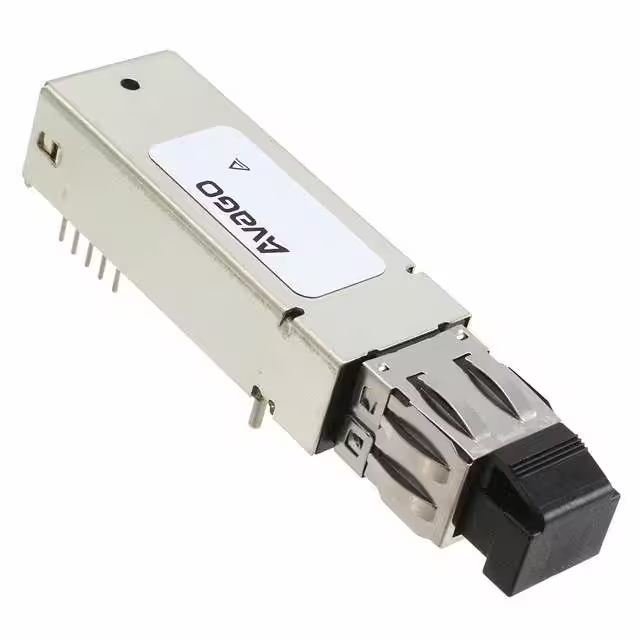
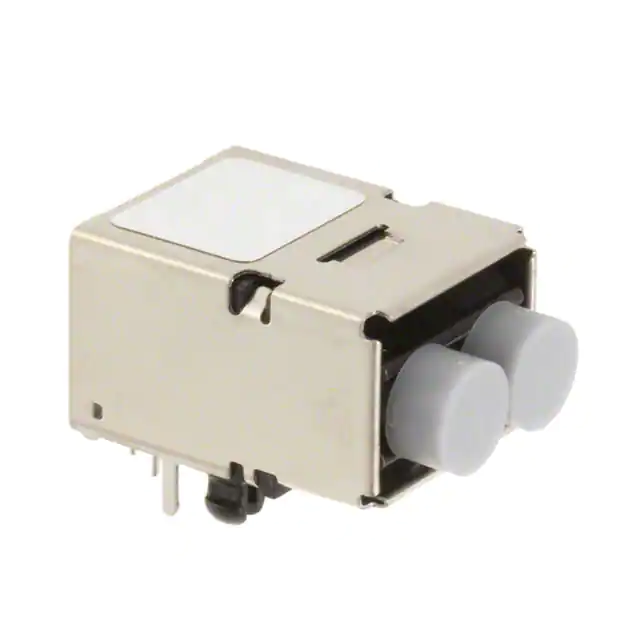
Broadcom Limited AFBR-5903EZ
- Part No.:
- AFBR-5903EZ
- Manufacturer:
- Broadcom Limited
- Category:
- Fiber Optic Transceiver Modules
- Package:
- Datasheet:
-
AFBR-5903EZ.pdf
- Description:
- TXRX ETHERNET 125MBD MMF 2X5
- Quantity:
- Payment:

- Shipping:

Inventory:1,150
Please send an inquiry. Send us your inquiry, and we will respond immediately.
Product details
Overview
AFBR-5903EZ from Avago Technologies is a 1300 nm FDDI/ATM/Fast Ethernet transceiver in a 2×5 MT-RJ package, operating from 0°C to +70°C with extended EMI shielding. It delivers -19 dBm typical output optical power (62.5/125 µm fiber), -34.5 dBm receiver sensitivity at eye center, and PECL-compatible differential data I/O with squelch-enabled Signal Detect. It is used in multimode fiber backbone and wiring closet-to-desktop links compliant with FDDI PMD, ATM 100 Mb/s, and IEEE 802.3u 100BASE-FX standards.
For engineers reviewing the AFBR-5903EZ datasheet, pinout, applications, or equivalent options, this page provides verified technical context, real-world optical power budget behavior, confirmed RoHS-compliant 2×5 MT-RJ package mapping, validated receiver squelch timing (ASMax ≤ 100 µs, ANSMax ≤ 350 µs), and precise transmitter jitter compliance per FDDI PMD Annex E Table E1.
Technical Context
The AFBR-5903EZ integrates a 1300 nm InGaAsP LED transmitter driven by a custom PECL-shifted silicon driver IC and an InGaAs PIN photodiode receiver coupled to a transimpedance preamplifier and quantizer IC. Its optical subassembly uses low-cost lens elements and high-volume assembly for cost-effective performance.
It implements full FDDI PMD (ISO/IEC 9314-3:1990), LCF-PMD, ATM Forum UNI v3.0 100 Mb/s MMF, and IEEE 802.3u 100BASE-FX physical layer compliance - all mapped to a single 2×5 DIP footprint with MT-RJ receptacle. The receiver outputs (RD+, RD−) are differential PECL; Signal Detect (SD) is single-ended PECL with hysteresis (PA − PD = 1.5–2.4 dB) and deassertion at ≤ −45 dBm.
Key Specifications
| Parameter | Value and Actual Design Meaning |
|---|---|
| Operating Temp | 0°C to +70°C ambient - defines thermal derating envelope for stable BER over commercial equipment life |
| Supply Voltage | +3.3 V ±3.5% - requires local 1 µH + 10 nF decoupling per supply pin to meet jitter specs |
| Transmit Power (BOL) | −19 dBm avg (62.5/125 µm) - enables 2 km multimode links per FDDI PMD with ≥1.5 dB aging margin |
| Receiver Sensitivity | −34.5 dBm avg at eye center - sets minimum link budget for 10⁻¹² BER under PRBS2⁷⁻¹, 125 MBd |
| Signal Detect Threshold | Assert: ≥ −33 dBm; Deassert: ≤ −45 dBm - provides 12 dB hysteresis to prevent false LOS toggling |
| Data Interface | Differential PECL (ECL-referenced to +3.3 V) - mandates 50 Ω termination at both transceiver and PHY ends |
| Jitter Compliance | Meets FDDI PMD Annex E Table E1 worst-case allocations - ensures system-level jitter budget adherence |
Pinout & Package
AFBR-5903EZ uses a 2×5 dual-in-line package with MT-RJ fiber receptacle, 12-pin configuration (10 signal pins + 2 solder posts), 13.97 mm min height, and conductive housing grounded to RX signal ground. Mounting studs provide mechanical retention and chassis grounding.
| Pin/Terminal | Circuit Role | Design Meaning |
|---|---|---|
| Pin 1 | VEE RX | Receiver signal ground - must connect directly to low-inductance receiver ground plane |
| Pin 2 | VCC RX | +3.3 V receiver supply - requires localized 1 µH + 10 nF filter adjacent to pin |
| Pin 3 | SD | Signal Detect output - PECL logic "1" = valid light; "0" = loss of signal (LOS); drives upstream LOS-bar inputs |
| Pin 4 | RD− | Receiver differential data out (bar) - no internal termination; external 50 Ω to VCC required |
| Pin 5 | RD+ | Receiver differential data out - no internal termination; external 50 Ω to VCC required |
| Pin 6 | VCC TX | +3.3 V transmitter supply - requires localized 1 µH + 10 nF filter adjacent to pin |
| Pin 7 | VEE TX | Transmitter signal ground - must connect directly to low-inductance transmitter ground plane |
| Pin 8 | TDIS | Transmitter disable - NC for LED-based AFBR-5903EZ; reserved for laser variants only |
| Pin 9 | TD+ | Transmitter differential data in - no internal termination; external 50 Ω to VCC required |
| Pin 10 | TD− | Transmitter differential data in (bar) - no internal termination; external 50 Ω to VCC required |
Key Features
| Feature | Design Value |
|---|---|
| MT-RJ 2×5 multisource package | Industry-standard footprint enabling drop-in compatibility across Avago and multi-source transceivers |
| Extended EMI shielding | Internal receiver shield + conductive housing reduces susceptibility to >10 V/m RF fields up to 450 MHz |
| Squelch-enabled Signal Detect | Guaranteed deassertion at ≤ −45 dBm with ≤350 µs delay - prevents false link-down during marginal optical conditions |
| FDDI/ATM/Fast Ethernet triple compliance | Single device satisfies ISO/IEC 9314-3, ATM Forum UNI v3.0, and IEEE 802.3u physical layer requirements |
| RoHS & Class 1 laser safety | EU Directive 2002/95/EC compliant; certified Class 1 per IEC 60825-1 under single-fault conditions |
Applications
| FDDI Backbone Links | ATM 100 Mb/s Access Networks |
|---|---|
Use Scenario: 2 km multimode fiber interconnection between FDDI concentrators in enterprise campus networks. IC Role / Device Role / Timing Role: Full-duplex optical transceiver implementing FDDI PMD Layer 1 physical interface with guaranteed jitter and extinction ratio. Use Value: Enables deterministic 125 MBd symbol rate operation with ≤100 µs Signal Detect assertion - critical for FDDI station acquisition timing (ASMax). | Use Scenario: Fiber uplink from ATM edge switch to central office aggregation node using 62.5/125 µm OM1 cable. IC Role / Device Role / Timing Role: Physical layer transceiver conforming to ATM Forum UNI v3.0 Section 2.3 for 100 Mb/s multimode fiber interfaces. Use Value: Delivers −34.5 dBm receiver sensitivity at eye center - supports 2 km links with ≥3 dB design margin over worst-case FDDI PMD loss budget. |
| 100BASE-FX Enterprise LANs | Wiring Closet-to-Desktop Fiber Drops |
Use Scenario: Horizontal cabling from telecom closet to departmental hubs in IEEE 802.3u-compliant Fast Ethernet infrastructure. IC Role / Device Role / Timing Role: 100BASE-FX PHY transceiver meeting IEEE 802.3u Clause 25 optical specifications including spectral width and rise/fall times. Use Value: Optical pulse envelope fits within FDDI PMD-defined boundaries - ensures interoperability with legacy and standards-compliant 100BASE-FX media systems. | Use Scenario: Short-reach (<500 m) fiber runs from building MDF to individual workstations using 50/125 µm OM2 cable. IC Role / Device Role / Timing Role: Low-cost, high-immunity transceiver optimized for noise-prone office environments with extended EMI shielding. Use Value: Conductive housing + internal receiver shield provides ≥10 dB EMI margin - maintains BER <10⁻¹² in electrically noisy telecom closets. |
Equivalent & Alternatives
The following parts are listed as comparable options for similar FDDI/ATM/Fast Ethernet transceiver applications.
| Alternative Part | Technical Difference | Application Difference | Selection Advice |
|---|---|---|---|
| AFBR-5903Z | No extended EMI shielding; identical optical/electrical specs and 2×5 MT-RJ pinout | Same FDDI/ATM/100BASE-FX compliance; lower EMI immunity in high-noise industrial enclosures | Select AFBR-5903Z when board-level shielding suffices and cost optimization is prioritized |
| HFBR-5903Z | Same 1300 nm LED architecture but older 1×9 package; lacks MT-RJ receptacle and 2×5 footprint | Requires PCB redesign due to different pin count, layout, and connector interface | Choose HFBR-5903Z only for legacy 1×9 socket compatibility; not a drop-in replacement |
Compared with AFBR-5903Z, the AFBR-5903EZ adds extended shielding without altering optical performance or pinout - making it ideal for unshielded enclosures. Compared with HFBR-5903Z, it enables direct MT-RJ integration and eliminates connector adapters, reducing insertion loss and system BOM count.
Availability
AFBR-5903EZ is available at Aetrix Electronics and suitable for FDDI backbone links, ATM 100 Mb/s access networks, and 100BASE-FX enterprise LANs requiring stable component supply across commercial temperature ranges and long-term production cycles.
Supply support for AFBR-5903EZ includes scheduled delivery planning, volume procurement assistance, BOM continuity management, traceable sourcing, and lifecycle availability coordination for OEM customers, industrial embedded developers, connected-device designers, and electronics production programs.
Manufacturer
Avago Technologies (now Broadcom) is a global leader in semiconductor optoelectronics, specializing in high-speed fiber optic components for datacom and telecom infrastructure.
The AFBR-5903EZ belongs to Avago's FDDI/ATM transceiver product line, engineered specifically for cost-sensitive, standards-compliant multimode fiber links in enterprise networking equipment where reliability, EMI resilience, and MT-RJ interoperability are critical.
FAQ
What is the maximum allowable ambient temperature for continuous operation of the AFBR-5903EZ?
The AFBR-5903EZ is rated for continuous operation from 0°C to +70°C ambient temperature. This range corresponds to a transceiver case temperature of 0°C minimum to +85°C maximum when adequate airflow is applied, as specified in the recommended case temperature measurement point shown in Figure 2 of the datasheet. Operation outside this range may degrade BER performance or accelerate LED aging beyond the guaranteed <1 dB over commercial mission life.
Does the AFBR-5903EZ support laser-based transmitters or is it LED-only?
The AFBR-5903EZ is an LED-based transceiver using a 1300 nm surface-emitting InGaAsP LED. Pin 8 (TDIS) is explicitly marked "No internal connection" and designated for laser-based products only - confirming that AFBR-5903EZ does not incorporate or support laser diodes. Its optical characteristics (e.g., spectral width ≥63 nm FWHM, rise/fall times ≥0.6 ns) are consistent with LED technology and fully aligned with FDDI PMD and 100BASE-FX LED-specific requirements.
How does the Signal Detect function behave on the AFBR-5903EZ, and what are its timing limits?
The AFBR-5903EZ Signal Detect (Pin 3) asserts logic "1" when input optical power exceeds −33 dBm and deasserts to logic "0" when power falls to ≤ −45 dBm, providing 1.5–2.4 dB hysteresis. Its assertion time (ASMax) is guaranteed ≤100 µs, and deassertion time (ANSMax) is ≤350 µs - both measured under full operating conditions (TA = 0°C to +70°C, VCC = 3.135–3.465 V). These values ensure reliable link status reporting in FDDI station acquisition and ATM UNI fault detection protocols.
What termination scheme is required for the differential PECL I/O of the AFBR-5903EZ?
The AFBR-5903EZ differential data I/O (TD+, TD−, RD+, RD−) requires external 50 Ω terminations referenced to +3.3 V, as shown in Figures 7 and 8 of the datasheet. No internal terminations are provided. Recommended practice is 130 Ω pull-up + 82 Ω AC-coupled termination at the PHY side and 50 Ω Thevenin termination at the transceiver side. Failure to implement proper PECL termination results in signal integrity degradation, increased jitter, and potential BER violations above 10⁻¹².
Is the AFBR-5903EZ RoHS compliant and certified for laser safety?
Yes, the AFBR-5903EZ is RoHS compliant per EU Directive 2002/95/EC and certified as Class 1 laser product per IEC 60825-1 and CENELEC EN60825, verified under single-fault conditions. Its 1300 nm LED source emits non-hazardous optical radiation at all operating points, eliminating user-accessible laser safety interlocks. This certification is documented in Avago's Regulatory Compliance Table and supported by TÜV certification for LED Class 1.
AFBR-5903EZ Specifications
- Product attributes
- Attribute value
- Manufacturer:
- Broadcom Limited
- Series:
- -
- Packaging:
- Bulk
- Product Status:
- Obsolete
- Data Rate:
- 100Mbps
- Wavelength:
- 1308nm
- Applications:
- Ethernet
- Voltage - Supply:
- 3.3V
- Connector Type:
- MTRJ
- Mounting Type:
- Through Hole
AFBR-5903EZ FAQ
1.How can I place an order for AFBR-5903EZ through Aetrix?
Please submit a Request for Quotation (RFQ) for AFBR-5903EZ on Aetrix. Our sales agent will provide a competitive quotation and guide you through the order confirmation once you accept the terms.
2.Are the price and stock information for AFBR-5903EZ reliable?
The price and inventory of AFBR-5903EZ are updated periodically and may fluctuate due to market conditions. Stock and pricing data are typically refreshed every 24 hours. Quotation validity for AFBR-5903EZ is usually 5 days.
3.What payment methods are accepted for AFBR-5903EZ?
We accept Wire Transfer, PayPal, Credit Card, Western Union, MoneyGram, and Escrow for AFBR-5903EZ transactions.
Note: Certain payment methods may incur a processing fee.
4.How is shipping managed for AFBR-5903EZ?
AFBR-5903EZ orders can be shipped via leading logistics carriers, including DHL, UPS, FedEx, TNT, or Registered Mail.
Once your AFBR-5903EZ order is processed, you will receive an email with the shipment details and tracking number.
Note: Tracking information may take up to 24 hours to appear. Express delivery typically takes 3–5 business days.
5.How can I obtain technical support or documentation for AFBR-5903EZ?
For technical support, including AFBR-5903EZ datasheets, pinout diagrams, or application guidance, please contact our engineering support team. They can provide detailed documentation and assistance for your AFBR-5903EZ requirements.
6.How does Aetrix verify that AFBR-5903EZ is sourced from the original manufacturer or authorized distributors?
All AFBR-5903EZ products on Aetrix are procured from qualified distributors and authorized channels. Our dedicated quality assurance team conducts strict verification, including traceability checks and, if necessary, third-party testing. This ensures that AFBR-5903EZ meets industry standards.
7.What is the process for return or replacement of AFBR-5903EZ?
All AFBR-5903EZ units undergo pre-shipment inspection (PSI). If there is an issue with AFBR-5903EZ, returns or replacements are accepted under the following conditions:
1.Quantity discrepancies, incorrect items, or visible external defects (such as breakage or corrosion), acknowledged by Aetrix.
2.The issue is reported within 90 days of delivery.
3.The AFBR-5903EZ part is unused and in its original packaging.
Return procedure for AFBR-5903EZ:
1.Submit a request within 90 days.
2.Obtain a Return Material Authorization (RMA) from Aetrix.
AFBR-5903EZ Tags
-
AFBR-5972EZ
Broadcom Limited
-
AFBR-5972BZ
Broadcom Limited
-
FTLF8519P3BNL
Coherent
-
AFBR-5803Z
Broadcom Limited
-
AFBR-5803TZ
Broadcom Limited
-
FTLF8519P3BTL
Coherent
-
AFBR-5803ATZ
Broadcom Limited
-
AFBR-5803ATQZ
Broadcom Limited
-
FTLX8574D3BCV
Coherent
-
FTLF8526P3BNL
Coherent
-
FTLF8519F2GCL
Coherent
-
FTLF1318P3BTL
Coherent
Tech Hub

Schmitt triggers use separate rising and falling thresholds to stabilize slow or noisy signals. This guide covers hysteresis, 74HC14 and 74HCT14 selection, comparator calculations, RC oscillators and p…
Counterfeit components can hide behind convincing markings and passing basic function tests. This engineering reference covers source traceability, external inspection, X-ray, XRF, electrical testing, …
A practical engineering and sourcing framework covering lifecycle verification, lifetime-buy calculations, replacement qualification, supplier checks and counterfeit-risk controls.
TTL and CMOS logic families differ in thresholds, loading, output drive, power and timing. This engineering guide compares 74HC and 74HCT, calculates noise margins and checks 3.3 V/5 V compatibility.
A practical engineering guide to 3.3V and 5V logic compatibility, input thresholds, resistor dividers, translator ICs, MOSFET level shifting, I2C pull-ups, timing limits and power-sequencing risks.
The 74HC595 uses push-pull logic outputs, while the TPIC6B595 uses 50 V open-drain DMOS sinks for higher-power loads. This guide compares timing, current limits, 3.3 V interfacing, load wiring, thermal…
The 74HC595 converts serial data into eight stable parallel outputs. This guide covers pin functions, shift and storage timing, OE and MR behavior, drive-current limits, cascading, voltage compatibilit…
A technical comparison of level-sensitive latches and edge-triggered flip-flops, covering timing windows, setup and hold limits, master–slave operation, time borrowing, race-through, HDL inference and…
A D latch stores one bit while Enable controls when data can pass. This reference covers gate-level operation, truth tables, transparency, setup and hold timing, LE versus OE, common ICs and practical …
An SR latch stores one bit through cross-coupled feedback. This engineering reference covers NOR and NAND implementations, truth tables, forbidden-state recovery, gated operation, switch debouncing, fa…