
 My Inquiry
 My Account


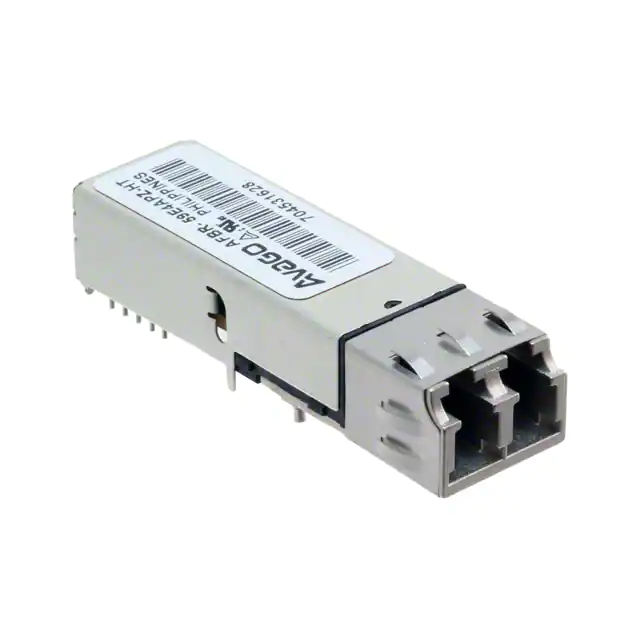
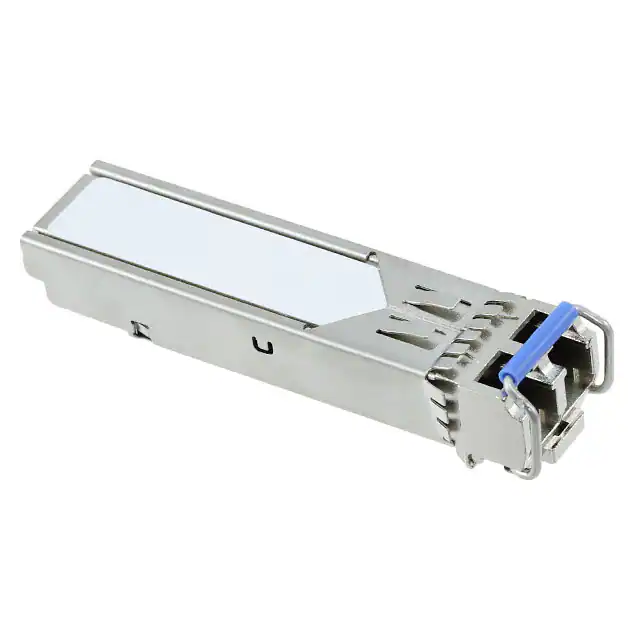
Broadcom Limited AFBR-59E4APZ-HT
- Part No.:
- AFBR-59E4APZ-HT
- Manufacturer:
- Broadcom Limited
- Category:
- Fiber Optic Transceiver Modules
- Package:
- Datasheet:
-
 AFBR-59E4APZ-HT.pdf
- Description:
- TXRX 1210NM MULTIMODE SFF
- Quantity:
- Payment:

- Shipping:

Inventory:153
Please send an inquiry. Send us your inquiry, and we will respond immediately.
Product details
Overview
AFBR-59E4APZ-HT from Broadcom is a multimode SFF transceiver for Fast Ethernet (100BASE-FX) operating over 62.5/125-μm and 50/125-μm fiber, featuring a 1310-nm LED transmitter, InGaAs PIN photodiode receiver, differential LVPECL I/O, single +3.3V supply, and –40°C to +95°C industrial temperature range.
For engineers reviewing the AFBR-59E4APZ-HT datasheet, pinout, applications, or equivalent options, key selection criteria include optical power budget (–20.0 to –14.0 dBm TX, –31 to –14 dBm RX), signal detect hysteresis (0.5–1.9 dB), LVPECL AC-coupled interface compatibility, and LC connector integration in a 2×5 DIP package.
Technical Context
The AFBR-59E4APZ-HT implements a fully integrated optical subassembly with an LED driver IC converting differential LVPECL inputs into analog LED current, and a receiver chain comprising an InGaAs PIN photodiode, transimpedance preamplifier, and quantizer IC delivering LVPECL data and single-ended signal detect outputs.
Its electrical subassembly uses a multilayer PCB with internal EMI shielding, isolated solder posts for mechanical anchoring, and housing leads tied to signal ground-designed to meet FCC Class B and CENELEC EN55022 radiated emissions limits with ≥10 dB margin while maintaining immunity to 10 V/m RF fields (80 MHz–1 GHz).
Key Specifications
| Parameter | Value and Actual Design Meaning |
|---|---|
| Operating Standard | IEEE 802.3u 100BASE-FX compliant - ensures interoperability in Fast Ethernet networks using multimode fiber. |
| Optical Wavelength | 1270–1380 nm center - supports broad spectral tolerance across legacy and upgraded multimode links. |
| TX Output Power | –20.0 to –14.0 dBm (62.5/125 μm) - provides sufficient link budget for ≤2 km multimode reach at 100 Mbps. |
| RX Sensitivity | –31 dBm minimum input - enables reliable detection under low-light conditions including aging and splice loss. |
| Data Rate | 125 Mbaud (4B/5B encoded) - matches Fast Ethernet line rate with deterministic jitter performance (RJ < 0.69 ns TX, < 2.14 ns RX). |
| Supply Voltage | +3.0 to +3.6 V - compatible with standard 3.3V logic rails and tolerant of board-level regulation variation. |
| Signal Detect Hysteresis | 0.5–1.9 dB - prevents output chatter during marginal optical input transitions near –33 dBm assert level. |
Pinout & Package
AFBR-59E4APZ-HT uses a 2×5 DIP package with 10 signal pins and two isolated solder posts for mechanical mounting. The housing is molded nonconductive plastic; LC connector height complies with industry-standard panel cutouts.
| Pin/Terminal | Circuit Role | Design Meaning |
|---|---|---|
| Pin 1 | Receiver Signal Ground (VEE RX) | Direct connection to receiver ground plane - minimizes noise coupling into high-gain transimpedance amplifier. |
| Pin 2 | Receiver Power Supply (VCC RX) | +3.3V supply filtered close to pin - critical for low-noise operation of PIN/preamplifier/quantizer chain. |
| Pin 3 | Signal Detect (SD) | LVPECL-compatible single-ended output - asserts high when optical input ≥ –33 dBm, deasserts low below –45 dBm. |
| Pin 4 / Pin 5 | RD− / RD+ | Differential LVPECL data output - AC-coupled, terminated internally; requires external 100Ω differential load. |
| Pin 6 | Transmitter Power Supply (VCC TX) | +3.3V supply filtered close to pin - stabilizes LED driver IC against supply-induced modulation noise. |
| Pin 7 | Transmitter Signal Ground (VEE TX) | Direct connection to transmitter ground plane - isolates high-current LED switching from sensitive receiver paths. |
| Pin 8 | NC | No internal connection - must remain unconnected per design; no pull-up/down or routing required. |
| Pin 9 / Pin 10 | TD+ / TD− | Differential LVPECL data input - AC-coupled; accepts 125-Mbaud signals with 0.4–1.6 Vpp differential swing. |
Key Features
| Feature | Design Value |
|---|---|
| 1310-nm LED Transmitter | Low-aging (<1 dB over life) multimode source enabling stable link budgets without recalibration. |
| InGaAs PIN + TIA Receiver | High-sensitivity –31 dBm minimum input with integrated transimpedance amplification and quantization. |
| LVPECL I/O Interface | Fully AC-coupled differential signaling eliminates DC bias dependency and simplifies SerDes interfacing. |
| Industrial Temperature Range | –40°C to +95°C case operation - validated for extended deployment in uncontrolled environments. |
| RoHS & Regulatory Compliance | Meets FCC Class B, CENELEC EN55022, IEC 61000-4-2/3, and UL/CSA component recognition. |
Applications
| Industrial Ethernet Switches | Factory Automation Controllers |
|---|---|
|
Use Scenario: Connecting PLCs, HMIs, and I/O modules over multimode fiber in noisy factory floors. IC Role / Device Role / Timing Role: Full-duplex optical transceiver providing galvanic isolation and EMI-immune 100 Mbps data transport. Use Value: Enables >2 km link distances on existing 62.5/125 μm infrastructure while surviving –40°C cold starts and 95°C cabinet temperatures. |
Use Scenario: Backplane interconnect between motion control units and centralized safety logic systems. IC Role / Device Role / Timing Role: Low-jitter (RJ < 0.69 ns TX) optical PHY ensuring deterministic timing for synchronized servo loops. Use Value: Maintains <1×10⁻¹⁰ BER under vibration and thermal cycling, eliminating packet retransmission in real-time control. |
| Medical Imaging Equipment | Transportation Signaling Systems |
|
Use Scenario: Transmitting DICOM image streams from MRI/PET scanners to PACS servers via fiber trunk lines. IC Role / Device Role / Timing Role: High-reliability optical interface with ESD-hardened LC receptacle (≥9 kV contact discharge). Use Value: Prevents data corruption during electrostatic events common in clinical environments with wheeled equipment. |
Use Scenario: Interfacing trackside signaling controllers with central traffic management systems over outdoor fiber runs. IC Role / Device Role / Timing Role: Ruggedized transceiver with wave-solder process compatibility and chassis-grounded mounting studs. Use Value: Survives repeated thermal cycling (–40°C to +95°C), aqueous wash, and mechanical stress from rail vibration. |
Equivalent & Alternatives
The following parts are listed as comparable options for similar multimode Fast Ethernet transceiver applications.
| Alternative Part | Technical Difference | Application Difference | Selection Advice |
|---|---|---|---|
| AFBR-59E4APZ | Same optical/electrical specs but rated for 0°C to +70°C commercial temperature range. | Limited to climate-controlled indoor networking gear; not qualified for extended industrial ambient. | Select AFBR-59E4APZ-HT when operating outside 0–70°C or requiring full industrial qualification. |
| AFBR-59E5APZ-HT | Identical package and pinout, but uses VCSEL instead of LED - higher speed margin and lower power (ICC TX typ. 65 mA vs. 80 mA). | Better suited for future-proofing or margin-critical links; not drop-in due to different optical rise/fall time (0.3 ns vs. 1.0 ns typical). | Choose AFBR-59E4APZ-HT where LED reliability, cost, and legacy multimode compatibility are prioritized over peak speed headroom. |
Compared with AFBR-59E4APZ-HT, AFBR-59E4APZ lacks extended temperature validation and fails under sustained thermal stress, while AFBR-59E5APZ-HT offers faster edge rates but introduces VCSEL-specific aging and modal noise considerations unsuitable for all 62.5/125-μm installations.
Availability
AFBR-59E4APZ-HT is available at Aetrix Electronics and suitable for industrial Ethernet switches, factory automation controllers, medical imaging backhauls, and transportation signaling systems requiring stable component supply across extended temperature ranges and long production lifecycles.
Supply support for AFBR-59E4APZ-HT includes scheduled delivery planning, volume procurement assistance, BOM continuity management, traceable sourcing, and lifecycle availability coordination for OEM customers, industrial embedded developers, connected-device designers, and electronics production programs.
Manufacturer
Broadcom Inc. is a global semiconductor leader designing connectivity, networking, and optical components for enterprise, industrial, and communications infrastructure.
The AFBR-59E4APZ-HT belongs to Broadcom's SFF multimode transceiver product line, engineered specifically for cost-sensitive, high-reliability Fast Ethernet deployments over legacy multimode fiber plant.
FAQ
What is the maximum supported fiber distance for AFBR-59E4APZ-HT in Fast Ethernet applications?
The AFBR-59E4APZ-HT supports up to 2 km over 62.5/125-μm multimode fiber and up to 500 m over 50/125-μm fiber at 100BASE-FX speeds, based on its optical power budget (–20.0 to –14.0 dBm TX, –31 dBm RX sensitivity) and IEEE 802.3u compliance. Link margin accounts for connector loss, splice degradation, and 1 dB LED aging over lifetime. Actual distance depends on installed fiber quality and splice count.
Does AFBR-59E4APZ-HT require external termination resistors for LVPECL interfaces?
Yes, AFBR-59E4APZ-HT requires external 100 Ω differential termination for both TD+/TD− inputs and RD+/RD− outputs, as its LVPECL signals are AC-coupled and lack internal termination. The datasheet recommends 2.7 kΩ pull-downs on TD+/TD− and 150 Ω series resistors on RD+/RD− when interfacing with common SerDes ICs. Improper termination causes signal integrity issues including jitter and BER degradation.
How does the signal detect (SD) function behave on AFBR-59E4APZ-HT?
The AFBR-59E4APZ-HT signal detect (SD) output is a single-ended LVPECL signal that asserts high (VCC – 0.88 to VCC – 1.02 V) when received optical power exceeds –33 dBm and deasserts low (VCC – 1.62 to VCC – 1.81 V) below –45 dBm, with 0.5–1.9 dB hysteresis to prevent oscillation. SD response time is ≤100 μs on assert and ≤350 μs on deassert, enabling fast link fault detection in network management systems.
Can AFBR-59E4APZ-HT be wave-soldered without damage?
Yes, AFBR-59E4APZ-HT is qualified for wave soldering at up to +260°C for 10 seconds (MSL-1), with protective LC receptacle plugs installed during processing. Its plastic housing, isolated solder posts, and internal EMI shielding maintain integrity through aqueous wash and thermal cycling. Post-solder cleaning must avoid solvent exposure to optical surfaces, and LC plugs must be removed only after full cool-down.
What regulatory certifications apply to AFBR-59E4APZ-HT?
AFBR-59E4APZ-HT carries UL/CSA Component Recognition (File E173874), TÜV certification (R 50236535 0003), RoHS Directive 2011/65/EU compliance, and meets FCC Class B and CENELEC EN55022 radiated emissions limits with ≥10 dB margin. It also passes JEDEC JESD22-A114 Class 2 ESD testing (2000–3999 V) and IEC 61000-4-2/3 immunity standards for system-level deployment.
AFBR-59E4APZ-HT Specifications
- Product attributes
- Attribute value
- Manufacturer:
- Broadcom Limited
- Series:
- -
- Packaging:
- Bulk
- Product Status:
- Active
- Data Rate:
- 125MBd
- Wavelength:
- 1308nm
- Applications:
- Ethernet
- Voltage - Supply:
- 3V ~ 3.6V
- Connector Type:
- LC
- Mounting Type:
- Pluggable, SFP
AFBR-59E4APZ-HT FAQ
1.How can I place an order for AFBR-59E4APZ-HT through Aetrix?
Please submit a Request for Quotation (RFQ) for AFBR-59E4APZ-HT on Aetrix. Our sales agent will provide a competitive quotation and guide you through the order confirmation once you accept the terms.
2.Are the price and stock information for AFBR-59E4APZ-HT reliable?
The price and inventory of AFBR-59E4APZ-HT are updated periodically and may fluctuate due to market conditions. Stock and pricing data are typically refreshed every 24 hours. Quotation validity for AFBR-59E4APZ-HT is usually 5 days.
3.What payment methods are accepted for AFBR-59E4APZ-HT?
We accept Wire Transfer, PayPal, Credit Card, Western Union, MoneyGram, and Escrow for AFBR-59E4APZ-HT transactions.
Note: Certain payment methods may incur a processing fee.
4.How is shipping managed for AFBR-59E4APZ-HT?
AFBR-59E4APZ-HT orders can be shipped via leading logistics carriers, including DHL, UPS, FedEx, TNT, or Registered Mail.
Once your AFBR-59E4APZ-HT order is processed, you will receive an email with the shipment details and tracking number.
Note: Tracking information may take up to 24 hours to appear. Express delivery typically takes 3–5 business days.
5.How can I obtain technical support or documentation for AFBR-59E4APZ-HT?
For technical support, including AFBR-59E4APZ-HT datasheets, pinout diagrams, or application guidance, please contact our engineering support team. They can provide detailed documentation and assistance for your AFBR-59E4APZ-HT requirements.
6.How does Aetrix verify that AFBR-59E4APZ-HT is sourced from the original manufacturer or authorized distributors?
All AFBR-59E4APZ-HT products on Aetrix are procured from qualified distributors and authorized channels. Our dedicated quality assurance team conducts strict verification, including traceability checks and, if necessary, third-party testing. This ensures that AFBR-59E4APZ-HT meets industry standards.
7.What is the process for return or replacement of AFBR-59E4APZ-HT?
All AFBR-59E4APZ-HT units undergo pre-shipment inspection (PSI). If there is an issue with AFBR-59E4APZ-HT, returns or replacements are accepted under the following conditions:
1.Quantity discrepancies, incorrect items, or visible external defects (such as breakage or corrosion), acknowledged by Aetrix.
2.The issue is reported within 90 days of delivery.
3.The AFBR-59E4APZ-HT part is unused and in its original packaging.
Return procedure for AFBR-59E4APZ-HT:
1.Submit a request within 90 days.
2.Obtain a Return Material Authorization (RMA) from Aetrix.
AFBR-59E4APZ-HT Tags
-
AFBR-5972EZ
Broadcom Limited
-
AFBR-5972BZ
Broadcom Limited
-
FTLF8519P3BNL
Coherent
-
AFBR-5803Z
Broadcom Limited
-
AFBR-5803TZ
Broadcom Limited
-
FTLF8519P3BTL
Coherent
-
AFBR-5803ATZ
Broadcom Limited
-
AFBR-5803ATQZ
Broadcom Limited
-
FTLX8574D3BCV
Coherent
-
FTLF8526P3BNL
Coherent
-
FTLF8519F2GCL
Coherent
-
FTLF1318P3BTL
Coherent
Tech Hub

Counterfeit components can hide behind convincing markings and passing basic function tests. This engineering reference covers source traceability, external inspection, X-ray, XRF, electrical testing, …

A practical engineering and sourcing framework covering lifecycle verification, lifetime-buy calculations, replacement qualification, supplier checks and counterfeit-risk controls.

TTL and CMOS logic families differ in thresholds, loading, output drive, power and timing. This engineering guide compares 74HC and 74HCT, calculates noise margins and checks 3.3 V/5 V compatibility.

A practical engineering guide to 3.3V and 5V logic compatibility, input thresholds, resistor dividers, translator ICs, MOSFET level shifting, I2C pull-ups, timing limits and power-sequencing risks.

The 74HC595 uses push-pull logic outputs, while the TPIC6B595 uses 50 V open-drain DMOS sinks for higher-power loads. This guide compares timing, current limits, 3.3 V interfacing, load wiring, thermal…

The 74HC595 converts serial data into eight stable parallel outputs. This guide covers pin functions, shift and storage timing, OE and MR behavior, drive-current limits, cascading, voltage compatibilit…

A technical comparison of level-sensitive latches and edge-triggered flip-flops, covering timing windows, setup and hold limits, master–slave operation, time borrowing, race-through, HDL inference and…

A D latch stores one bit while Enable controls when data can pass. This reference covers gate-level operation, truth tables, transparency, setup and hold timing, LE versus OE, common ICs and practical …

An SR latch stores one bit through cross-coupled feedback. This engineering reference covers NOR and NAND implementations, truth tables, forbidden-state recovery, gated operation, switch debouncing, fa…

Latch circuits retain one bit through feedback. This technical reference covers SR and D latches, truth tables, transparency, timing limits, latch-versus-flip-flop behavior, applications and common log…


