
 My Inquiry
 My Account


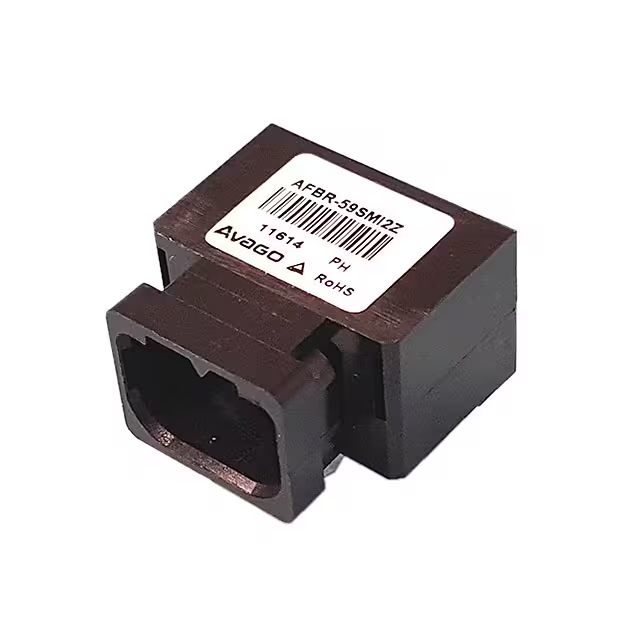
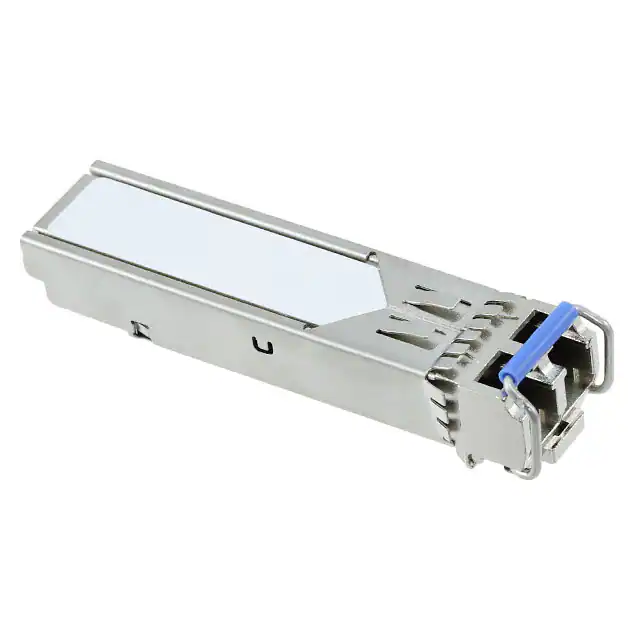
Broadcom Limited AFBR-59SMI2Z
- Part No.:
- AFBR-59SMI2Z
- Manufacturer:
- Broadcom Limited
- Category:
- Fiber Optic Transceiver Modules
- Package:
- Datasheet:
-
 AFBR-59SMI2Z.pdf
- Description:
- 250 MBD TRANSCEIVER POF, SMI
- Quantity:
- Payment:

- Shipping:

Inventory:2,106
Please send an inquiry. Send us your inquiry, and we will respond immediately.
Product details
Overview
AFBR-59SMI2Z from Broadcom is a 250-MBd full-duplex POF transceiver with integrated 650-nm LED transmitter and PIN photodiode receiver, operating at 3.3 V, supporting LVDS I/O, analog RSSI monitoring, and EMI-shielded SMI connector interface for industrial and medical data links up to 50 m over 1-mm-core polymer optical fiber.
For engineers reviewing the AFBR-59SMI2Z datasheet, pinout, applications, or equivalent options, key selection considerations include its 250-MBd data rate, –21 dBm receiver sensitivity, 3.3-V LVDS compatibility, RSSI analog monitor output, and EMI shield solder post grounding requirements.
Technical Context
The AFBR-59SMI2Z implements a fully integrated optical link architecture: the transmitter uses an LVDS-input driver IC modulating a 650-nm LED with typical 1.2-ns optical rise/fall times and 12-dB extinction ratio; the receiver delivers LVDS output with 500–800-mV differential swing and includes a linear RSSI current output proportional to average optical input power.
It operates across –40°C to +85°C, features automatic low-power sleep mode (wakes in ≤1.0 ms on valid optical signal), and achieves high EMI immunity via conductive plastic housing, dual EMI shield posts, and optimized ground return paths-validated per IEC 61000-4-3 (15 V/m, 8 MHz–1 GHz) and ESD22-A114 (2-kV HBM).
Key Specifications
| Parameter | Value and Actual Design Meaning |
|---|---|
| Data Rate | 250 MBd - supports Fast Ethernet over POF with 8b/10b coding |
| Optical Wavelength | 635–675 nm (typ. 650 nm) - matched to 1-mm-core POF transmission window |
| Receiver Sensitivity | –21 dBm min. - enables reliable link operation at 50 m over standard POF |
| Supply Voltage | 3.0–3.6 V (typ. 3.3 V) - compatible with industrial 3.3-V LVDS PHY interfaces |
| RSSI Output | 0.65 A/W current gain - provides linear analog voltage across 2-kΩ shunt resistor |
| Operating Temp | –40°C to +85°C - qualified for harsh industrial and medical environments |
| EMI Shield Posts | 2 isolated solder terminals - must connect to chassis or signal ground for EMC compliance |
Pinout & Package
AFBR-59SMI2Z uses a black SMI-connectorized housing with conductive plastic inner enclosure for EMI suppression. The package includes two optical subassemblies (transmitter and receiver) and mounts directly to PCB with 12-terminal footprint (10 active signal pins + 2 EMI shield posts).
| Pin/Terminal | Circuit Role | Design Meaning |
|---|---|---|
| 1, 12 | EMI Shield GND | Isolated mechanical ground terminals - connect to chassis or signal ground to suppress radiated emissions |
| 2, 3 | TD–, TD+ | LVDS differential transmitter input - accepts 200–1200-mV differential swing from PHY |
| 4, 6 | TGND | Transmitter ground reference - separate from receiver ground to minimize crosstalk |
| 5 | TVCC | Transmitter 3.3-V supply - requires local 10-μF + 10-nF decoupling |
| 7 | RVCC | Receiver 3.3-V supply - independent rail for noise isolation |
| 8 | RGND | Receiver ground reference - kept contiguous under module for low-inductance return path |
| 9 | RSSI | Analog monitor output - delivers current proportional to avg. optical input power (0.65 A/W) |
| 10, 11 | RD–, RD+ | LVDS differential receiver output - drives 500–800-mV swing into 100-Ω termination |
Key Features
| Feature | Design Value |
|---|---|
| SMI push-pull latching connector | Secure, tool-free mating/de-mating with safe-release mechanism - reduces field service time in medical devices |
| Integrated RSSI monitoring | Linear analog output enables real-time link health diagnostics without external ADC or firmware overhead |
| Automatic sleep/wake mode | Zero static power draw during idle; <1.0-ms wake latency ensures responsive link reactivation |
| Laser Class 1 safety | No eye hazard - certified per EN 60825-1:2007 with TÜV certificate R50217706 |
| RoHS-compliant & Pb-free | Wave-solderable per JEDEC J-STD-020D MSL2a - supports lead-free manufacturing flow |
Applications
| Industrial Control Networks | Medical Imaging Equipment |
|---|---|
Use Scenario: High-noise factory floor communication between PLCs and remote I/O modules over 30-m POF runs. IC Role / Device Role / Timing Role: Full-duplex optical transceiver providing galvanic isolation and EMI-immune serial data transport. Use Value: Eliminates ground loops and cable-induced noise errors; maintains 250-MBd throughput where copper fails due to EMI. | Use Scenario: Data acquisition link between MRI scanner sensor array and control console using flexible POF inside shielded enclosures. IC Role / Device Role / Timing Role: Optical interface enabling safe, low-jitter, radiation-tolerant data transfer in high-field magnetic environments. Use Value: Laser Class 1 safety and non-metallic POF eliminate RF interference and meet IEC 60601-1 leakage current limits. |
| Automated Test Equipment | Building Management Systems |
Use Scenario: High-speed stimulus/response channel between test head and controller in semiconductor ATE racks with dense digital switching. IC Role / Device Role / Timing Role: Low-jitter (≤0.7 ns random jitter) LVDS-to-POF bridge ensuring timing-critical command integrity. Use Value: Maintains sub-nanosecond edge fidelity over 50-m POF - avoids bit errors caused by copper skew and crosstalk. | Use Scenario: Interconnecting HVAC controllers, fire panels, and lighting systems across multi-floor commercial buildings using existing POF infrastructure. IC Role / Device Role / Timing Role: Robust, low-cost optical physical layer enabling interoperability between legacy and modern BMS nodes. Use Value: 50-m reach and SMI connector durability reduce installation labor and support hot-swappable node replacement. |
Equivalent & Alternatives
The following parts are listed as comparable options for similar optical transceiver applications.
| Alternative Part | Technical Difference | Application Difference | Selection Advice |
|---|---|---|---|
| AFBR-59R5Z | Same SMI package but 125-MBd max rate; no RSSI output; lower ICC (18 mA typ.) | Suitable for cost-sensitive industrial networks with <125-MBd bandwidth needs | Select when RSSI monitoring and 250-MBd are not required - lower power and BOM cost |
| HFBR-5962L | Legacy Avago POF transceiver; 250-MBd; no EMI shield posts; different SMT footprint (14-pin) | Compatible with legacy board designs using HFBR-59xx footprint | Choose only for drop-in replacement on existing HFBR-5962L layouts - lacks EMI shield posts and RSSI |
Compared with AFBR-59R5Z and HFBR-5962L, the AFBR-59SMI2Z uniquely combines 250-MBd performance, integrated RSSI, EMI shield posts, and SMI connector - making it optimal for new industrial and medical designs requiring diagnostics, EMC robustness, and ease of service.
Availability
AFBR-59SMI2Z is available at Aetrix Electronics and suitable for industrial control networks, medical imaging equipment, and automated test equipment requiring stable component supply, long-term lifecycle support, and RoHS-compliant optical interconnects.
Supply support for AFBR-59SMI2Z includes scheduled delivery planning, volume procurement assistance, BOM continuity management, traceable sourcing, and lifecycle availability coordination for OEM customers, industrial embedded developers, connected-device designers, and electronics production programs.
Manufacturer
Broadcom is a global semiconductor leader delivering end-to-end connectivity solutions, with deep expertise in optical interconnects, networking, and embedded communications.
The AFBR-59SMI2Z belongs to Broadcom's SMI-series POF transceivers, designed specifically for EMI-critical industrial and medical applications requiring robust, easy-to-service optical links over polymer fiber.
FAQ
What is the maximum supported link distance for AFBR-59SMI2Z?
The AFBR-59SMI2Z supports up to 50 meters over standard 1-mm-core polymer optical fiber (POF) with 2.2-mm jacket, verified at 250 MBd under industrial temperature conditions (–40°C to +85°C). Performance assumes use of compliant POF cable and proper RSSI monitoring to confirm optical power margin.
Does AFBR-59SMI2Z require external biasing or termination resistors?
The AFBR-59SMI2Z integrates all necessary biasing circuitry. External 100-Ω differential termination is required on both TD+/- and RD+/- lines per LVDS standards. A 2-kΩ shunt resistor is recommended on the RSSI pin to convert current output to measurable voltage; no additional biasing components are needed for basic operation.
How does the RSSI output of AFBR-59SMI2Z function in practice?
The AFBR-59SMI2Z RSSI pin delivers a current output proportional to average optical input power (0.65 A/W). When loaded with a 2-kΩ resistor, it yields a linear voltage from 0 V to VCC – 1.5 V. For stable readings, a 100-nF capacitor across the resistor is recommended to filter high-frequency noise without affecting response time.
Can AFBR-59SMI2Z operate with 2.5-V or 5-V supply rails?
No - the AFBR-59SMI2Z is specified only for 3.0–3.6 V operation (typ. 3.3 V) on both TVCC and RVCC. Operation outside this range violates absolute maximum ratings and may cause permanent damage or undefined behavior. It is not compatible with 2.5-V or 5-V logic families without level-shifting.
What mechanical mounting requirements apply to AFBR-59SMI2Z?
The AFBR-59SMI2Z requires a PCB thickness of 1.57 mm ± 0.08 mm and recommends connecting both EMI shield solder posts (pins 1 and 12) directly to chassis or signal ground. The SMI connector must remain unobstructed; dust plug clearance is intentional and does not affect optical performance.
AFBR-59SMI2Z Specifications
- Product attributes
- Attribute value
- Manufacturer:
- Broadcom Limited
- Series:
- -
- Packaging:
- Bulk
- Product Status:
- Obsolete
- Data Rate:
- 250MBd
- Wavelength:
- 650nm
- Applications:
- Ethernet
- Voltage - Supply:
- 3V ~ 3.6V
- Connector Type:
- SMI
- Mounting Type:
- Through Hole
AFBR-59SMI2Z FAQ
1.How can I place an order for AFBR-59SMI2Z through Aetrix?
Please submit a Request for Quotation (RFQ) for AFBR-59SMI2Z on Aetrix. Our sales agent will provide a competitive quotation and guide you through the order confirmation once you accept the terms.
2.Are the price and stock information for AFBR-59SMI2Z reliable?
The price and inventory of AFBR-59SMI2Z are updated periodically and may fluctuate due to market conditions. Stock and pricing data are typically refreshed every 24 hours. Quotation validity for AFBR-59SMI2Z is usually 5 days.
3.What payment methods are accepted for AFBR-59SMI2Z?
We accept Wire Transfer, PayPal, Credit Card, Western Union, MoneyGram, and Escrow for AFBR-59SMI2Z transactions.
Note: Certain payment methods may incur a processing fee.
4.How is shipping managed for AFBR-59SMI2Z?
AFBR-59SMI2Z orders can be shipped via leading logistics carriers, including DHL, UPS, FedEx, TNT, or Registered Mail.
Once your AFBR-59SMI2Z order is processed, you will receive an email with the shipment details and tracking number.
Note: Tracking information may take up to 24 hours to appear. Express delivery typically takes 3–5 business days.
5.How can I obtain technical support or documentation for AFBR-59SMI2Z?
For technical support, including AFBR-59SMI2Z datasheets, pinout diagrams, or application guidance, please contact our engineering support team. They can provide detailed documentation and assistance for your AFBR-59SMI2Z requirements.
6.How does Aetrix verify that AFBR-59SMI2Z is sourced from the original manufacturer or authorized distributors?
All AFBR-59SMI2Z products on Aetrix are procured from qualified distributors and authorized channels. Our dedicated quality assurance team conducts strict verification, including traceability checks and, if necessary, third-party testing. This ensures that AFBR-59SMI2Z meets industry standards.
7.What is the process for return or replacement of AFBR-59SMI2Z?
All AFBR-59SMI2Z units undergo pre-shipment inspection (PSI). If there is an issue with AFBR-59SMI2Z, returns or replacements are accepted under the following conditions:
1.Quantity discrepancies, incorrect items, or visible external defects (such as breakage or corrosion), acknowledged by Aetrix.
2.The issue is reported within 90 days of delivery.
3.The AFBR-59SMI2Z part is unused and in its original packaging.
Return procedure for AFBR-59SMI2Z:
1.Submit a request within 90 days.
2.Obtain a Return Material Authorization (RMA) from Aetrix.
AFBR-59SMI2Z Tags
-
AFBR-5972EZ
Broadcom Limited
-
AFBR-5972BZ
Broadcom Limited
-
FTLF8519P3BNL
Coherent
-
AFBR-5803Z
Broadcom Limited
-
AFBR-5803TZ
Broadcom Limited
-
FTLF8519P3BTL
Coherent
-
AFBR-5803ATZ
Broadcom Limited
-
AFBR-5803ATQZ
Broadcom Limited
-
FTLX8574D3BCV
Coherent
-
FTLF8526P3BNL
Coherent
-
FTLF8519F2GCL
Coherent
-
FTLF1318P3BTL
Coherent
Tech Hub
Counterfeit components can hide behind convincing markings and passing basic function tests. This engineering reference covers source traceability, external inspection, X-ray, XRF, electrical testing, …

A practical engineering and sourcing framework covering lifecycle verification, lifetime-buy calculations, replacement qualification, supplier checks and counterfeit-risk controls.

TTL and CMOS logic families differ in thresholds, loading, output drive, power and timing. This engineering guide compares 74HC and 74HCT, calculates noise margins and checks 3.3 V/5 V compatibility.

A practical engineering guide to 3.3V and 5V logic compatibility, input thresholds, resistor dividers, translator ICs, MOSFET level shifting, I2C pull-ups, timing limits and power-sequencing risks.

The 74HC595 uses push-pull logic outputs, while the TPIC6B595 uses 50 V open-drain DMOS sinks for higher-power loads. This guide compares timing, current limits, 3.3 V interfacing, load wiring, thermal…

The 74HC595 converts serial data into eight stable parallel outputs. This guide covers pin functions, shift and storage timing, OE and MR behavior, drive-current limits, cascading, voltage compatibilit…

A technical comparison of level-sensitive latches and edge-triggered flip-flops, covering timing windows, setup and hold limits, master–slave operation, time borrowing, race-through, HDL inference and…

A D latch stores one bit while Enable controls when data can pass. This reference covers gate-level operation, truth tables, transparency, setup and hold timing, LE versus OE, common ICs and practical …

An SR latch stores one bit through cross-coupled feedback. This engineering reference covers NOR and NAND implementations, truth tables, forbidden-state recovery, gated operation, switch debouncing, fa…

Latch circuits retain one bit through feedback. This technical reference covers SR and D latches, truth tables, transparency, timing limits, latch-versus-flip-flop behavior, applications and common log…


