
 My Inquiry
 My Account


Asahi Kasei Microdevices/AKM AK4115VQ
- Part No.:
- AK4115VQ
- Manufacturer:
- Asahi Kasei Microdevices/AKM
- Category:
- Encoders, Decoders, Converters
- Package:
- 64-QFP
- Datasheet:
-
 AK4115VQ.pdf
- Description:
- IC AUDIO DECODER 24BIT 64LQFP
- Quantity:
- Payment:

- Shipping:

Inventory:2,610
Please send an inquiry. Send us your inquiry, and we will respond immediately.
Product details
Overview
AK4115VQ from Asahi Kasei Microdevices (AKM) is a 24-bit stereo digital audio transceiver supporting AES3/IEC60958/S/PDIF/EIAJ CP1201 standards, sampling rates up to 216 kHz, differential RS422 transmit output, and dual crystal oscillator support. It performs automatic Non-PCM (Dolby Digital, MPEG, DTS-CD) bitstream detection and operates in synchronous or asynchronous mode for studio-grade audio routing in professional mixing consoles.
For engineers reviewing the AK4115VQ datasheet, AK4115VQ pinout, AK4115VQ application, or AK4115VQ equivalent, this page delivers verified technical context on PLL jitter performance (≤100 ps RMS), channel status buffer depth (192-bit), master clock outputs (64fs/128fs/256fs/512fs), and dual-mode control interface (4-wire serial or I²C at 400 kHz).
Technical Context
The AK4115VQ integrates a low-jitter analog PLL with lock range 22–216 kHz, supporting both bi-phase (RX input) and word clock (ELRCK pin) reference sources. Its clock recovery engine detects sampling frequencies including 44.1 kHz, 48 kHz, 88.2 kHz, 96 kHz, 176.4 kHz, and 192 kHz using either crystal oscillator comparison or channel status data.
It features two independent crystal oscillator circuits (XTI1/XTO1 and XTI2/XTO2), selectable via XSEL pin or register, enabling robust clock source redundancy. The device supports eight-channel receiver input (RX0–RX7), with RX0 as differential (RXP0/RXN0), and dual transmit paths: single-ended TX0 and RS422-differential TXP1/TXN1 - configurable for consumer (0.5 V) or professional (5 V) line levels via TVDD.
Key Specifications
| Parameter | Value and Actual Design Meaning |
|---|---|
| Sampling Rate Support | Up to 216 kHz - enables high-resolution audio transport in mastering and broadcast systems. |
| Audio Data Width | 24-bit - preserves dynamic range and SNR for professional digital audio interfaces. |
| PLL Jitter (RX input) | ≤100 ps RMS - ensures low phase noise for clean clock recovery in sensitive DAC/ADC timing chains. |
| Transmit Output Type | Dual-mode: TX0 (single-ended, 0.5 V) + TXP1/TXN1 (RS422 differential, 5 V compliant) - supports both consumer S/PDIF and pro AES3 cabling. |
| Control Interface | 4-wire serial or I²C (max 400 kHz) - enables flexible microcontroller integration without dedicated audio bus controllers. |
| Operating Voltage | AVDD/DVDD/OVDD = 2.7–3.6 V; TVDD = 2.7–5.5 V - allows mixed-voltage system design with 5 V tolerant logic buffers. |
| Temperature Range | −20 °C to +85 °C - qualified for industrial and broadcast equipment operating in non-climate-controlled environments. |
Pinout & Package
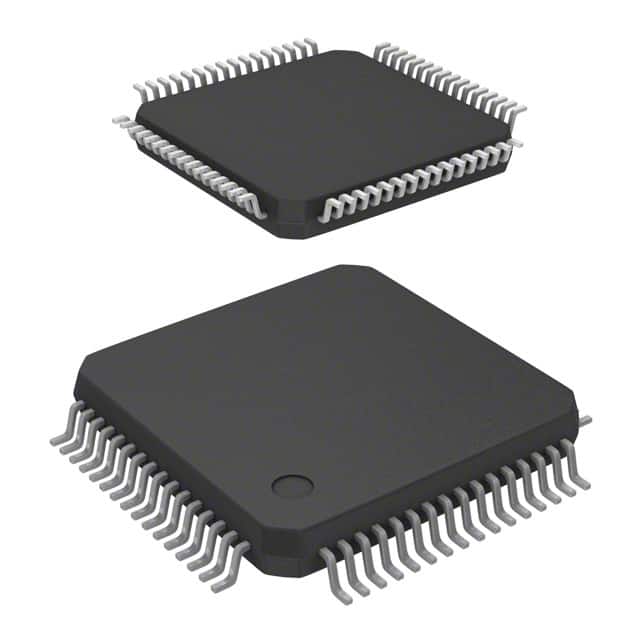
AK4115VQ is housed in a 64-pin LQFP package (0.5 mm pitch) with exposed thermal pad, optimized for audio PCB layout isolation between analog (AVDD/AVSS), digital (DVDD/DVSS), and output buffer (TVDD/TVSS) domains.
| Pin/Terminal | Circuit Role | Design Meaning |
|---|---|---|
| RXP0 / RXN0 | Differential Receiver Input #0 | Internal-biased balanced input for low-noise AES3 reception; requires no external termination resistors. |
| TXP1 / TXN1 | Differential Transmitter Output #1 | RS422-compliant output driving 110 Ω characteristic impedance; supports professional 5 V line-level operation. |
| ELRCK | External Word Clock Input | Accepts 22–216 kHz AC-coupled word clock (≥0.5 Vpp) for studio sync; used as PLL reference when PSEL = "H". |
| MCKO1 / MCKO2 | Master Clock Outputs | Programmable outputs at 64fs/128fs/256fs/512fs - directly drive external DACs or ADCs without additional clock dividers. |
| P/SN | Parallel/Serial Mode Select | "L" = serial mode (I²C/4-wire); "H" = parallel mode - determines pin function mapping (e.g., DIF0 vs RX5). |
| FILT | PLL Loop Filter Output | Connects to external RC filter (recommended 4.7 kΩ + 10 nF) to set PLL bandwidth and stability. |
Key Features
| Feature | Design Value |
|---|---|
| Non-PCM Bitstream Detection | Automatically identifies Dolby Digital, MPEG, and DTS-CD sync patterns (e.g., 0xF872/0x4E1F) and sets NPCM/DTSCD flags for downstream format-aware processing. |
| Dual Crystal Oscillators | Independent XTI1/XTO1 and XTI2/XTO2 circuits allow failover clocking or simultaneous use for RX/TX domain separation. |
| De-emphasis Support | Hardware-enabled de-emphasis for 32 kHz, 44.1 kHz, and 48 kHz - eliminates need for external DSP or FPGA-based filtering. |
| 192-bit Channel Status Buffer | Full AES3 channel status capture across 24 frames - enables real-time monitoring of source metadata (e.g., sample rate, emphasis, category code). |
| Asynchronous Sample Rate Conversion | Enables independent RX/TX operation at non-multiple sampling frequencies (e.g., 48 kHz RX → 96 kHz TX) without external SRC ICs. |
| 5 V Tolerant Logic I/O | TVDD-supplied pins (TX0, TXP1, TXN1, B, C, U) accept 5 V signals - simplifies interface to legacy pro-audio gear with 5 V logic levels. |
Applications
| Professional Audio Mixing Console | Digital Broadcast Encoder |
|---|---|
Use Scenario: Routing AES3 streams between multichannel mic preamps, DSP engines, and redundant output cards in live broadcast trucks. IC Role / Device Role / Timing Role: Transceiver handling simultaneous 8-channel RX and 2-channel TX with frame-accurate channel status parsing and word clock synchronization. Use Value: Eliminates external clock cleaners and format translators; dual crystal oscillators ensure uninterrupted operation during source switching. |
Use Scenario: Embedding Dolby Digital bitstreams into SDI or ASI transport streams for satellite/cable headend encoding. IC Role / Device Role / Timing Role: Non-PCM detector identifying AC-3 sync words and forwarding burst preamble (Pc/Pd) to encoder firmware via status registers. Use Value: Reduces host MCU overhead by offloading bitstream classification - enables real-time format adaptation without latency penalties. |
| High-Resolution Studio DAC | Automotive Infotainment Head Unit |
Use Scenario: Accepting 192 kHz PCM from USB audio interface and converting to low-jitter I²S for premium DAC chips. IC Role / Device Role / Timing Role: PLL-based clock recovery generating ultra-low-jitter MCLK (64fs) synchronized to incoming S/PDIF stream. Use Value: Achieves ≤100 ps RMS jitter - critical for >120 dB SNR DAC performance and THD+N below −110 dB. |
Use Scenario: Bridging infotainment SoC's I²S output to amplifier modules requiring AES3 input with automotive-grade temperature tolerance. IC Role / Device Role / Timing Role: Format converter translating I²S to AES3 with embedded channel status and de-emphasis for CD playback compatibility. Use Value: Enables seamless integration of consumer-grade audio processors into AEC-Q200-compliant vehicle systems without custom logic. |
Equivalent & Alternatives
The following parts are listed as comparable options for similar digital audio transceiver applications.
| Alternative Part | Technical Difference | Application Difference | Selection Advice |
|---|---|---|---|
| Cirrus Logic CS8416-CZZ | Single crystal oscillator; no built-in Non-PCM detection; supports only up to 192 kHz; no RS422 output. | Lacks Dolby/MPEG auto-detection and professional differential output - suitable for cost-sensitive consumer audio, not broadcast. | Choose for basic S/PDIF receiver needs where format transparency suffices and 5 V line drive is unnecessary. |
| Texas Instruments TAS6424EVM | Integrated Class-D amplifier driver; no transceiver function; lacks channel status buffer and PLL clock recovery. | Designed for direct speaker drive, not digital interface bridging - incompatible as drop-in replacement. | Not a functional alternative; only relevant if system-level redesign includes replacing transceiver with power stage. |
Compared with CS8416-CZZ and TAS6424EVM, the AK4115VQ uniquely combines 216 kHz capability, hardware Non-PCM identification, dual crystal support, and RS422 output - making it irreplaceable in studio and broadcast applications demanding format awareness and signal integrity.
Availability
AK4115VQ is available at Aetrix Electronics and suitable for professional audio mixing consoles, digital broadcast encoders, high-resolution studio DACs, and automotive infotainment head units requiring stable component supply across extended temperature ranges and long production lifecycles.
Supply support for AK4115VQ includes scheduled delivery planning, volume procurement assistance, BOM continuity management, traceable sourcing, and lifecycle availability coordination for OEM customers, industrial embedded developers, connected-device designers, and electronics production programs.
Manufacturer
Asahi Kasei Microdevices (AKM) is a Japanese semiconductor company specializing in high-precision analog and mixed-signal ICs for audio, sensor, and power applications.
The AK4115VQ belongs to AKM's professional digital audio interface product line, designed specifically for studio, broadcast, and high-end consumer equipment requiring robust clock recovery, format flexibility, and low-jitter performance.
FAQ
What is the maximum sampling frequency supported by the AK4115VQ?
The AK4115VQ supports sampling rates up to 216 kHz, verified per its S/PDIF receiver characteristics table and operational overview. This enables full-bandwidth transport of ultra-high-resolution audio formats used in mastering and next-generation broadcast standards. The PLL maintains lock across the entire 22–216 kHz range, and the AK4115VQ correctly decodes channel status and recovers clocks even at the upper limit.
Does the AK4115VQ support Dolby Digital and DTS-CD bitstream detection?
Yes, the AK4115VQ includes hardware-based Non-PCM bitstream detection for Dolby Digital (AC-3), MPEG, and DTS-CD. It identifies the 96-bit sync pattern (0xF872/0x4E1F) for Dolby Digital and detects both 14-bit and 16-bit DTS-CD sync words. Detected status is latched in NPCM and DTSCD bits, and the ORed result appears on the AUTO flag - all confirmed in the OPERATION OVERVIEW section of the datasheet.
Can the AK4115VQ operate in asynchronous mode with different RX and TX sampling rates?
Yes, the AK4115VQ supports true asynchronous operation via the ASYNC bit. When enabled, the receiver and transmitter can run at independent, non-multiple sampling frequencies (e.g., 44.1 kHz RX → 96 kHz TX). The datasheet explicitly states "DIT and DIR can operate at different sample rates (non-multiples)" and details clock source selection per mode in Tables 4 and 5 - confirming full SRC capability without external components.
What are the voltage requirements for the AK4115VQ's output drivers?
The AK4115VQ's TX0, TXP1, and TXN1 outputs are powered by TVDD, which accepts 2.7–5.5 V. For professional AES3 compliance, TVDD must be set to 4.5–5.5 V to achieve RS422 output impedance (88–132 Ω) and level (0.4–0.6 V). Consumer S/PDIF operation uses TVDD = 2.7–5.5 V with 0.4–0.6 V output - all specified in the DC CHARACTERISTICS table on page 9.
How does the AK4115VQ handle channel status data?
The AK4115VQ provides a 192-bit channel status buffer storing 24 consecutive frames of AES3 channel status data. It decodes consumer/professional modes, sampling frequency, emphasis, and category codes. Status is accessible via serial interface registers and optionally output on C/U/VOUT pins in serial mode - detailed in the FEATURES list and PIN/FUNCTION table (pins 17–20, 37–40).
AK4115VQ Specifications
- Product attributes
- Attribute value
- Manufacturer:
- Asahi Kasei Microdevices/AKM
- Series:
- -
- Package/Case:
- 64-QFP
- Packaging:
- Tray
- Product Status:
- Obsolete
- Type:
- Digital Audio Interface Transceiver (DIX)
- Applications:
- Dolby Digital
- Voltage - Supply, Analog:
- 2.7V ~ 3.6V
- Voltage - Supply, Digital:
- 2.7V ~ 3.6V
- Grade:
- -
- Qualification:
- -
- Mounting Type:
- Surface Mount
- Supplier Device Package:
- 64-LQFP (10x10)
AK4115VQ FAQ
1.How can I place an order for AK4115VQ through Aetrix?
Please submit a Request for Quotation (RFQ) for AK4115VQ on Aetrix. Our sales agent will provide a competitive quotation and guide you through the order confirmation once you accept the terms.
2.Are the price and stock information for AK4115VQ reliable?
The price and inventory of AK4115VQ are updated periodically and may fluctuate due to market conditions. Stock and pricing data are typically refreshed every 24 hours. Quotation validity for AK4115VQ is usually 5 days.
3.What payment methods are accepted for AK4115VQ?
We accept Wire Transfer, PayPal, Credit Card, Western Union, MoneyGram, and Escrow for AK4115VQ transactions.
Note: Certain payment methods may incur a processing fee.
4.How is shipping managed for AK4115VQ?
AK4115VQ orders can be shipped via leading logistics carriers, including DHL, UPS, FedEx, TNT, or Registered Mail.
Once your AK4115VQ order is processed, you will receive an email with the shipment details and tracking number.
Note: Tracking information may take up to 24 hours to appear. Express delivery typically takes 3–5 business days.
5.How can I obtain technical support or documentation for AK4115VQ?
For technical support, including AK4115VQ datasheets, pinout diagrams, or application guidance, please contact our engineering support team. They can provide detailed documentation and assistance for your AK4115VQ requirements.
6.How does Aetrix verify that AK4115VQ is sourced from the original manufacturer or authorized distributors?
All AK4115VQ products on Aetrix are procured from qualified distributors and authorized channels. Our dedicated quality assurance team conducts strict verification, including traceability checks and, if necessary, third-party testing. This ensures that AK4115VQ meets industry standards.
7.What is the process for return or replacement of AK4115VQ?
All AK4115VQ units undergo pre-shipment inspection (PSI). If there is an issue with AK4115VQ, returns or replacements are accepted under the following conditions:
1.Quantity discrepancies, incorrect items, or visible external defects (such as breakage or corrosion), acknowledged by Aetrix.
2.The issue is reported within 90 days of delivery.
3.The AK4115VQ part is unused and in its original packaging.
Return procedure for AK4115VQ:
1.Submit a request within 90 days.
2.Obtain a Return Material Authorization (RMA) from Aetrix.
AK4115VQ Tags
-
MCP2120T-I/SL
Microchip Technology

-
LICAL-ENC-MS001
TE Connectivity Linx
-
TW9990AT-NA1-GR
Renesas
-
TVP5151IPBSR
Texas Instruments
-
TVP5150AM1IPBSR
Texas Instruments
-
LICAL-DEC-MS001-T
TE Connectivity Linx
-
ADV7391BCPZ
Analog Devices Inc.
-
ADV7393BCPZ-REEL
Analog Devices Inc.
-
ADV7393BCPZ
Analog Devices Inc.
-
ADV7391WBCPZ
Analog Devices Inc.
-
ADV7181DBCPZ
Analog Devices Inc.
-
ADV7181CBSTZ-REEL
Analog Devices Inc.
Tech Hub

A practical engineering and sourcing framework covering lifecycle verification, lifetime-buy calculations, replacement qualification, supplier checks and counterfeit-risk controls.

TTL and CMOS logic families differ in thresholds, loading, output drive, power and timing. This engineering guide compares 74HC and 74HCT, calculates noise margins and checks 3.3 V/5 V compatibility.

A practical engineering guide to 3.3V and 5V logic compatibility, input thresholds, resistor dividers, translator ICs, MOSFET level shifting, I2C pull-ups, timing limits and power-sequencing risks.

The 74HC595 uses push-pull logic outputs, while the TPIC6B595 uses 50 V open-drain DMOS sinks for higher-power loads. This guide compares timing, current limits, 3.3 V interfacing, load wiring, thermal…

The 74HC595 converts serial data into eight stable parallel outputs. This guide covers pin functions, shift and storage timing, OE and MR behavior, drive-current limits, cascading, voltage compatibilit…

A technical comparison of level-sensitive latches and edge-triggered flip-flops, covering timing windows, setup and hold limits, master–slave operation, time borrowing, race-through, HDL inference and…

A D latch stores one bit while Enable controls when data can pass. This reference covers gate-level operation, truth tables, transparency, setup and hold timing, LE versus OE, common ICs and practical …

An SR latch stores one bit through cross-coupled feedback. This engineering reference covers NOR and NAND implementations, truth tables, forbidden-state recovery, gated operation, switch debouncing, fa…

Latch circuits retain one bit through feedback. This technical reference covers SR and D latches, truth tables, transparency, timing limits, latch-versus-flip-flop behavior, applications and common log…

An engineering guide to LED driver operation, constant-current and constant-voltage outputs, linear and switching topologies, dimming, IC selection, calculations, replacement compatibility, and fault c…


