
 My Inquiry
 My Account


STMicroelectronics ALED8102SXTTR
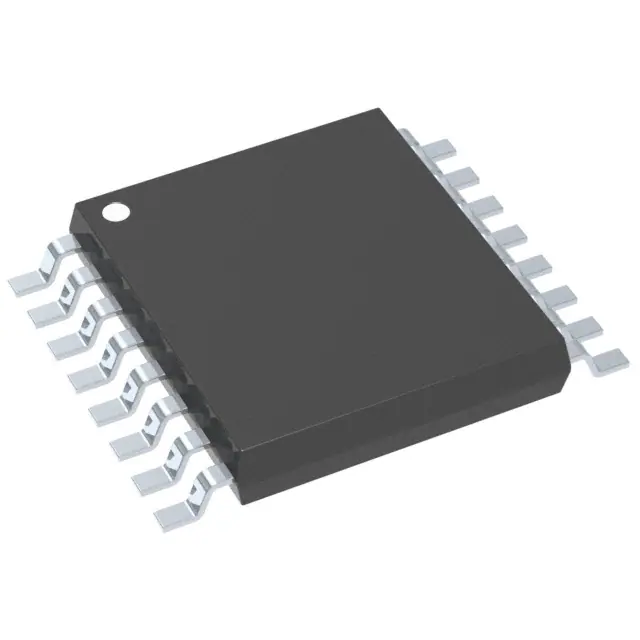
- Part No.:
- ALED8102SXTTR
- Manufacturer:
- STMicroelectronics
- Category:
- LED Drivers
- Package:
- 16-PowerTSSOP (0.173", 4.40mm Width)
- Datasheet:
-
 ALED8102SXTTR.pdf
- Description:
- IC LED DRV LIN PWM 16HTSSOP
- Quantity:
- Payment:

- Shipping:

Inventory:2,500
Please send an inquiry. Send us your inquiry, and we will respond immediately.
Product details
Overview
ALED8102SXTTR from STMicroelectronics is an AEC-Q100 Grade 1 qualified 8-channel low-side LED driver IC for automotive lighting, delivering 5–100 mA per channel via external resistor programming, supporting up to 19 V output voltage headroom, and operating from 3 V to 5.5 V supply across −40 °C to +150 °C junction temperature.
For engineers reviewing the ALED8102SXTTR datasheet, ALED8102SXTTR pinout, ALED8102SXTTR application, or ALED8102SXTTR equivalent, this page provides verified pin functions, thermal shutdown behavior (170 °C trip with 15 °C hysteresis), switch-controlled local dimming logic, global PWM brightness control via OE, and HTSSOP16 package layout guidance for automotive-grade thermal reliability.
Technical Context
The ALED8102SXTTR integrates eight independent low-side current sinks with matched regulation-channel-to-channel current mismatch ≤ ±3.5%-and supports local dimming via four dedicated SWx inputs that each toggle two outputs simultaneously (e.g., SW1 controls OUT0/OUT1). Its internal architecture uses MOSFET-based current generators requiring ≥0.85 V headroom at 50 mA and tolerating up to 19 V output voltage swing.
Global brightness control is implemented through the OE pin, which accepts PWM signals for synchronized dimming across all active channels; OE must be tied to GND if unused. Input pins feature integrated 300 kΩ pull-downs (SWx) and 300 kΩ pull-ups (OE), eliminating external biasing components in most configurations.
Key Specifications
| Parameter | Value and Actual Design Meaning |
|---|---|
| Output channels | 8 low-side constant-current sinks, each programmable 5–100 mA via single REXT |
| Supply voltage | 3.0 V to 5.5 V - compatible with automotive 3.3 V and 5 V rails without level-shifting |
| Output voltage rating | Up to 19 V - enables series connection of multiple LEDs per channel (e.g., 5× white LEDs @ 3.2 V) |
| Junction temperature range | −40 °C to +150 °C - AEC-Q100 Grade 1 qualification for under-hood and cabin lighting |
| Thermal shutdown | 170 °C trip point with 15 °C hysteresis - protects only output stage, preserving logic functionality |
| Propagation delay | ≤500 ns (SWx→OUT, OE→OUT) - ensures tight timing alignment for synchronized local/global dimming |
| Current precision | ±6.5% device-to-device, ±3.5% channel-to-channel - reduces binning requirements in production |
Pinout & Package
Supplied in HTSSOP16 exposed pad package (5.0 mm × 6.4 mm × 1.05 mm), optimized for automotive thermal management: exposed pad must be soldered to PCB ground plane with ≥9 vias (e.g., 3×3 array) connecting to inner-layer copper pours to achieve 37.5 °C/W junction-to-ambient thermal resistance.
| Pin/Terminal | Circuit Role | Design Meaning |
|---|---|---|
| 1 GND | Ground reference | Primary return path for all output currents and internal logic; must connect directly to thermal pad |
| 2–4,13 SW1–SW4 | Local dimming control inputs | Each toggles two outputs (e.g., SW1 = OUT0/OUT1); internally pulled down - drive high to enable |
| 5–12 OUT0–OUT7 | Low-side current sink outputs | Individually regulated current sources; can be paralleled or left floating when unused |
| 14 OE | Global PWM enable input | Accepts PWM signal for synchronized brightness control; must tie to GND if not used |
| 15 R-EXT | Current programming node | Connects external resistor to GND; sets all 8 channels identically using IOUT = 1.22 V / (REXT × 16) |
| 16 VDD | Power supply input | 3–5.5 V logic and analog supply; must power up before VLED to prevent LED flash on startup |
Key Features
| Feature | Design Value |
|---|---|
| AEC-Q100 Grade 1 qualification | Validated for automotive environments: −40 °C to +150 °C operation with full electrical specs guaranteed |
| Four-switch local dimming control | SW1–SW4 each activate two outputs simultaneously, enabling grouped LED zones without MCU GPIO expansion |
| Single-resistor current programming | One external REXT sets identical current across all 8 channels - simplifies BOM and calibration |
| Thermal shutdown with selective action | Shuts down only output stage at 170 °C, preserving OE/SWx logic state for safe recovery |
| Integrated input biasing | SWx pins have 300 kΩ pull-downs; OE has 300 kΩ pull-up - eliminates external resistors in standard configurations |
Applications
| Instrument Cluster Lighting | LCD Backlight Zones |
|---|---|
Use Scenario: Driving segmented LED arrays behind analog gauges and digital TFT displays in vehicle instrument clusters. IC Role / Device Role / Timing Role: Low-side current sink providing stable per-segment brightness under varying battery voltage and ambient temperature. Use Value: Eliminates need for individual current-setting resistors per segment; SWx grouping matches common cluster zone layouts (e.g., speedometer + tachometer). |
Use Scenario: Powering edge-lit LED strings behind automotive infotainment and navigation LCD panels with dynamic local dimming. IC Role / Device Role / Timing Role: Eight-channel current regulator enabling independent control of backlight zones for contrast enhancement and power savings. Use Value: 19 V output capability supports 5–6 white LEDs in series per string; OE PWM allows frame-synchronized dimming with display controller. |
| Ambient Interior Lighting | Rear Combination Lamp |
Use Scenario: Controlling multi-color RGBW ambient lighting strips along door sills, footwells, and overhead consoles. IC Role / Device Role / Timing Role: Constant-current driver for mixed-color LED strings, with SWx enabling scene-based grouping (e.g., entry/exit sequences). Use Value: ±3.5% channel matching ensures uniform color mixing; thermal shutdown prevents overheating during prolonged cabin lighting use. |
Use Scenario: Driving brake, tail, turn, and reverse LED arrays in rear lamp modules where space and thermal density are constrained. IC Role / Device Role / Timing Role: High-voltage-tolerant low-side driver enabling compact PCB layout with minimal external components. Use Value: HTSSOP16 exposed pad + 37.5 °C/W thermal resistance sustains 100 mA per channel at 85 °C ambient without derating. |
Equivalent & Alternatives
The following parts are listed as comparable options for similar 8-channel automotive LED driver applications.
| Alternative Part | Technical Difference | Application Difference | Selection Advice |
|---|---|---|---|
| TLC59284PWR | 16-bit PWM resolution per channel vs. ALED8102SXTTR's binary ON/OFF + global PWM; no thermal shutdown; max 17 V output | Requires MCU PWM generation per channel; better suited for non-automotive displays needing fine-grained dimming | Select when per-channel PWM depth > 8-bit is required and AEC-Q100 qualification is not mandatory |
| ASL2216SHN | High-side configuration; integrated diagnostics (open-load, short-to-battery); 60 V absolute max output | Designed for direct battery-connected loads (e.g., exterior lamps); includes fault reporting via SPI | Select for high-side driving or diagnostic-critical applications like brake lights where open-load detection is required |
Compared with TLC59284PWR and ASL2216SHN, the ALED8102SXTTR offers optimal balance of AEC-Q100 compliance, thermal robustness, and minimal external component count for cost-sensitive interior lighting-without sacrificing channel count or output voltage headroom.
Availability
ALED8102SXTTR is available at Aetrix Electronics and suitable for automotive instrument clusters, LCD backlights, ambient interior lighting, and rear combination lamps requiring stable component supply across extended temperature ranges and long production lifecycles.
Supply support for ALED8102SXTTR includes scheduled delivery planning, volume procurement assistance, BOM continuity management, traceable sourcing, and lifecycle availability coordination for OEM customers, industrial embedded developers, connected-device designers, and electronics production programs.
Manufacturer
STMicroelectronics is a global semiconductor leader headquartered in Geneva, Switzerland, designing and manufacturing microcontrollers, power management ICs, sensors, and automotive-grade analog products.
The ALED8102SXTTR belongs to ST's automotive LED driver product line, engineered specifically for interior and exterior lighting systems demanding AEC-Q100 qualification, high-voltage tolerance, and thermal resilience in space-constrained modules.
FAQ
What is the minimum headroom voltage required for accurate current regulation?
The ALED8102SXTTR requires ≥0.85 V headroom across each current generator at 50 mA output (per DS12430 Rev 2, Table 4). Below this, regulation degrades linearly: at 1 V output voltage, current error is ≤0.04 %/V; at 3 V, it rises to ≤0.1 %/V. This headroom must be maintained between OUTn and GND regardless of LED forward voltage stack.
Can unused output channels be left floating?
Yes - unused OUT0–OUT7 pins may be left unconnected without risk of latch-up or leakage issues. The datasheet explicitly states outputs "can be connected in parallel, or left unconnected if not used." No pull-up/down is required, as each channel is independently disabled by its associated SWx input or global OE signal.
How does the thermal shutdown behave during operation?
Thermal shutdown activates at TJ ≈ 170 °C (typical), disabling only the eight output current sinks while leaving SWx and OE logic functional. Recovery occurs after junction temperature falls by ≥15 °C hysteresis. This selective shutdown preserves system visibility (e.g., cluster remains lit at reduced brightness) and avoids full MCU reinitialization.
What is the recommended power-up sequence?
VDD must be applied before or simultaneously with the LED supply rail (VLED). If VLED rises before VDD, the output stage may briefly activate due to undefined internal logic states, causing visible LED flash. The datasheet mandates this sequencing to ensure reliable startup in automotive battery environments where rail ramp rates vary.
ALED8102SXTTR Specifications
- Product attributes
- Attribute value
- Manufacturer:
- STMicroelectronics
- Series:
- -
- Package/Case:
- 16-PowerTSSOP (0.173", 4.40mm Width)
- Packaging:
- Tape & Reel (TR)
- Product Status:
- Active
- Type:
- Linear
- Topology:
- -
- Internal Switch(s):
- Yes
- Number of Outputs:
- 8
- Voltage - Supply (Min):
- 3V
- Voltage - Supply (Max):
- 5.5V
- Voltage - Output:
- 0.85V ~ 19V
- Current - Output / Channel:
- 100mA
- Frequency:
- -
- Dimming:
- PWM
- Applications:
- Lighting
- Operating Temperature:
- -40°C ~ 150°C (TJ)
- Grade:
- Automotive
- Qualification:
- -
- Mounting Type:
- Surface Mount
- Supplier Device Package:
- 16-HTSSOP
ALED8102SXTTR FAQ
1.How can I place an order for ALED8102SXTTR through Aetrix?
Please submit a Request for Quotation (RFQ) for ALED8102SXTTR on Aetrix. Our sales agent will provide a competitive quotation and guide you through the order confirmation once you accept the terms.
2.Are the price and stock information for ALED8102SXTTR reliable?
The price and inventory of ALED8102SXTTR are updated periodically and may fluctuate due to market conditions. Stock and pricing data are typically refreshed every 24 hours. Quotation validity for ALED8102SXTTR is usually 5 days.
3.What payment methods are accepted for ALED8102SXTTR?
We accept Wire Transfer, PayPal, Credit Card, Western Union, MoneyGram, and Escrow for ALED8102SXTTR transactions.
Note: Certain payment methods may incur a processing fee.
4.How is shipping managed for ALED8102SXTTR?
ALED8102SXTTR orders can be shipped via leading logistics carriers, including DHL, UPS, FedEx, TNT, or Registered Mail.
Once your ALED8102SXTTR order is processed, you will receive an email with the shipment details and tracking number.
Note: Tracking information may take up to 24 hours to appear. Express delivery typically takes 3–5 business days.
5.How can I obtain technical support or documentation for ALED8102SXTTR?
For technical support, including ALED8102SXTTR datasheets, pinout diagrams, or application guidance, please contact our engineering support team. They can provide detailed documentation and assistance for your ALED8102SXTTR requirements.
6.How does Aetrix verify that ALED8102SXTTR is sourced from the original manufacturer or authorized distributors?
All ALED8102SXTTR products on Aetrix are procured from qualified distributors and authorized channels. Our dedicated quality assurance team conducts strict verification, including traceability checks and, if necessary, third-party testing. This ensures that ALED8102SXTTR meets industry standards.
7.What is the process for return or replacement of ALED8102SXTTR?
All ALED8102SXTTR units undergo pre-shipment inspection (PSI). If there is an issue with ALED8102SXTTR, returns or replacements are accepted under the following conditions:
1.Quantity discrepancies, incorrect items, or visible external defects (such as breakage or corrosion), acknowledged by Aetrix.
2.The issue is reported within 90 days of delivery.
3.The ALED8102SXTTR part is unused and in its original packaging.
Return procedure for ALED8102SXTTR:
1.Submit a request within 90 days.
2.Obtain a Return Material Authorization (RMA) from Aetrix.
ALED8102SXTTR Tags
-
BCR402RE6327HTSA1
Infineon Technologies

-
BCR430UXTSA2
Infineon Technologies
-
BCR420UE6433HTMA1
Infineon Technologies
-
BCR420UE6327HTSA1
Infineon Technologies
-
BCR421UE6327HTSA1
Infineon Technologies
-
LYT1604D-TL
Power Integrations

-
HV9910CLG-G
Microchip Technology

-
CL2N8-G
Microchip Technology
-
BCR420UW6-7
Diodes Incorporated
-
BCR421UW6-7
Diodes Incorporated
-
BCR420UFD-7
Diodes Incorporated
-
BCR421UFD-7
Diodes Incorporated
Tech Hub

A practical engineering and sourcing framework covering lifecycle verification, lifetime-buy calculations, replacement qualification, supplier checks and counterfeit-risk controls.

TTL and CMOS logic families differ in thresholds, loading, output drive, power and timing. This engineering guide compares 74HC and 74HCT, calculates noise margins and checks 3.3 V/5 V compatibility.

A practical engineering guide to 3.3V and 5V logic compatibility, input thresholds, resistor dividers, translator ICs, MOSFET level shifting, I2C pull-ups, timing limits and power-sequencing risks.

The 74HC595 uses push-pull logic outputs, while the TPIC6B595 uses 50 V open-drain DMOS sinks for higher-power loads. This guide compares timing, current limits, 3.3 V interfacing, load wiring, thermal…

The 74HC595 converts serial data into eight stable parallel outputs. This guide covers pin functions, shift and storage timing, OE and MR behavior, drive-current limits, cascading, voltage compatibilit…

A technical comparison of level-sensitive latches and edge-triggered flip-flops, covering timing windows, setup and hold limits, master–slave operation, time borrowing, race-through, HDL inference and…

A D latch stores one bit while Enable controls when data can pass. This reference covers gate-level operation, truth tables, transparency, setup and hold timing, LE versus OE, common ICs and practical …

An SR latch stores one bit through cross-coupled feedback. This engineering reference covers NOR and NAND implementations, truth tables, forbidden-state recovery, gated operation, switch debouncing, fa…

Latch circuits retain one bit through feedback. This technical reference covers SR and D latches, truth tables, transparency, timing limits, latch-versus-flip-flop behavior, applications and common log…

An engineering guide to LED driver operation, constant-current and constant-voltage outputs, linear and switching topologies, dimming, IC selection, calculations, replacement compatibility, and fault c…


