
 My Inquiry
 My Account


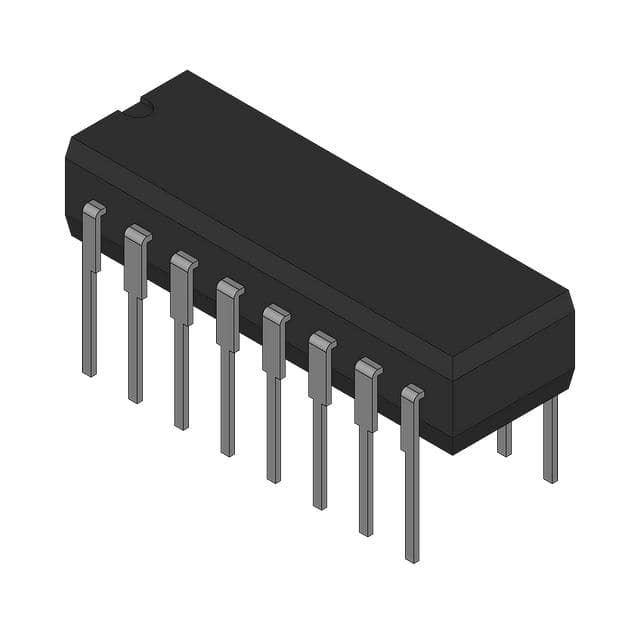
Texas Instruments AM26LS32AMJ
- Part No.:
- AM26LS32AMJ
- Manufacturer:
- Texas Instruments
- Category:
- Drivers, Receivers, Transceivers
- Package:
- 16-CDIP (0.300", 7.62mm)
- Datasheet:
-
 AM26LS32AMJ.pdf
- Description:
- IC TRANSCEIVER HALF 0/4 16CDIP
- Quantity:
- Payment:

- Shipping:

Inventory:2,009
Please send an inquiry. Send us your inquiry, and we will respond immediately.
Product details
Overview
AM26LS32AMJ from Texas Instruments is a military-grade quadruple differential line receiver compliant with ANSI TIA/EIA-422-B, TIA/EIA-423-B, and ITU V.10/V.11 standards. It operates from a single 5-V supply, delivers ±7-V common-mode input range with ±200-mV sensitivity, features 50-mV typical input hysteresis, and provides 3-state outputs for bus interfacing in long-wire industrial communication systems.
For engineers reviewing the AM26LS32AMJ datasheet, AM26LS32AMJ pinout, AM26LS32AMJ application, or AM26LS32AMJ equivalent, this page delivers verified technical context, military-temperature-range specifications (–55°C to 125°C), CDIP-16 package details, fail-safe open-input behavior, and validated alternative options for RS-422 receiver selection.
Technical Context
The AM26LS32AMJ implements four independent differential receivers with complementary active-high (G) and active-low (G) enable inputs shared across all channels. Its fail-safe design ensures high outputs when inputs are open, and its low-power Schottky circuitry enables direct connection to TTL/CMOS logic without level-shifting.
It uses a two-stage amplification architecture to improve sensitivity over legacy AM26LS32 devices, increasing input impedance to ≥12 kΩ while maintaining compatibility with RS-422 signaling up to 1000 m. Propagation delay is 20–35 ns per channel at 5 V and 25°C.
Key Specifications
| Parameter | Value and Actual Design Meaning |
|---|---|
| Supply Voltage | 4.5 V to 5.5 V - supports wide-margin 5-V rail operation in harsh environments |
| Common-Mode Range | ±7 V - rejects noise on long cables in factory automation and motor drive applications |
| Differential Sensitivity | ±200 mV - reliably detects valid RS-422 signals under degraded line conditions |
| Input Hysteresis | 50 mV typical - prevents output oscillation near threshold during slow or noisy edge transitions |
| Operating Temperature | –55°C to +125°C - qualified for full military temperature range per MIL-PRF-38535 |
| Output Type | 3-State TTL-compatible - enables multi-receiver bus sharing without contention |
| Input Impedance | ≥12 kΩ - minimizes loading on terminated RS-422 transmission lines |
Pinout & Package
AM26LS32AMJ is supplied in a 16-pin Ceramic Dual In-line Package (CDIP-J), hermetically sealed and qualified for military applications. Package dimensions are 19.56 mm × 6.92 mm (length × width), with through-hole mounting and SNPB (tin-lead) lead finish.
| Pin/Terminal | Circuit Role | Design Meaning |
|---|---|---|
| 1A, 2A, 3A, 4A | Noninverting differential input | Accepts positive-side RS-422 signal; paired with corresponding B pin |
| 1B, 2B, 3B, 4B | Inverting differential input | Accepts negative-side RS-422 signal; forms differential pair with A pin |
| 1Y, 2Y, 3Y, 4Y | Logic-level output | TTL-compatible 3-state output; high/low/Hi-Z controlled by G/G enables |
| G | Active-high enable input | Drives all four receivers active when logic high; tied to VCC for always-on use |
| G | Active-low enable input | Drives all four receivers active when logic low; tied to GND for always-on use |
| VCC | Power supply | Single 5-V supply pin; requires local 0.1-µF ceramic bypass capacitor |
| GND | Ground reference | System ground return; must be low-impedance for noise immunity |
Key Features
| Feature | Design Value |
|---|---|
| Fail-safe open-input operation | Outputs default high when inputs float - eliminates need for external pull-ups in unconnected ports |
| Complementary enable logic | Supports both active-high (G) and active-low (G) control - simplifies interface to diverse MCU GPIO configurations |
| ±7-V common-mode rejection | Rejects ground offset and noise up to ±7 V - essential for reliable data recovery across electrically noisy machinery interfaces |
| 50-mV input hysteresis | Suppresses chatter on slow-rising/falling or noisy differential edges - improves robustness in industrial EMI environments |
| MIL-PRF-38535 Class V qualification | Manufactured and tested to military reliability standards - suitable for avionics, defense, and critical infrastructure systems |
Applications
| Factory Automation | AC Motor Drives |
|---|---|
|
Use Scenario: Interfacing PLC I/O modules to distributed field sensors over 500-m twisted-pair cabling in high-noise manufacturing cells. IC Role / Device Role / Timing Role: Differential receiver converting RS-422 bus signals into clean TTL logic for microcontroller input capture. Use Value: ±7-V common-mode range suppresses ground-loop noise from variable-frequency drives, ensuring error-free data acquisition. |
Use Scenario: Receiving position feedback and command signals between servo controllers and motor-mounted encoders in closed-loop motion systems. IC Role / Device Role / Timing Role: High-speed line receiver translating differential encoder outputs into deterministic timing-aligned digital pulses. Use Value: 20–35 ns propagation delay and 50-mV hysteresis maintain timing integrity and prevent metastability in real-time control loops. |
| Smart Grid Substations | Military Vehicle Data Networks |
|
Use Scenario: Isolating and conditioning IEC 61850 GOOSE message traffic between protection relays and bay controllers in outdoor substations. IC Role / Device Role / Timing Role: Robust RS-422 receiver providing galvanically isolated, noise-immune data reception in high-voltage EM environments. Use Value: –55°C to +125°C operation and hermetic CDIP packaging ensure uninterrupted performance during extreme ambient thermal cycling. |
Use Scenario: Enabling serial telemetry links between vehicle health monitoring units and central avionics computers in armored ground vehicles. IC Role / Device Role / Timing Role: Military-qualified line receiver handling MIL-STD-188-114A-compliant differential data streams in vibration-prone platforms. Use Value: SNPB leads and Class V screening guarantee solder joint integrity and long-term reliability under shock, vibration, and thermal stress. |
Equivalent & Alternatives
The following parts are listed as comparable options for similar differential line receiver applications.
| Alternative Part | Technical Difference | Application Difference | Selection Advice |
|---|---|---|---|
| AM26LS32AI | Same functionality but rated for –40°C to +85°C; SOIC/PDIP packaging only | Lacks military temperature range and hermetic sealing; unsuitable for aerospace or defense deployments | Select AM26LS32AI only for commercial/industrial designs where extended temperature and rugged packaging are not required. |
| SN65LBC179D | RS-485/RS-422 receiver with integrated transient protection; 3.3-V/5-V compatible; SOIC-8 | Smaller footprint and built-in ESD protection (±15-kV HBM); lower common-mode range (±12 V) | Choose SN65LBC179D for space-constrained, cost-sensitive 5-V or 3.3-V systems requiring enhanced ESD robustness but not military qualification. |
Compared with AM26LS32AI, AM26LS32AMJ offers guaranteed operation down to –55°C and hermetic CDIP reliability, while SN65LBC179D trades military qualification for smaller size, dual-voltage support, and integrated ESD protection - making each optimal for distinct environmental and integration requirements.
Availability
AM26LS32AMJ is available at Aetrix Electronics and suitable for factory automation, smart grid substation controls, and military vehicle data networks requiring stable component supply across extended lifecycle programs.
Supply support for AM26LS32AMJ includes scheduled delivery planning, volume procurement assistance, BOM continuity management, traceable sourcing, and lifecycle availability coordination for OEM customers, industrial embedded developers, connected-device designers, and electronics production programs.
Manufacturer
Texas Instruments is a global semiconductor leader delivering analog, embedded processing, and connectivity solutions with deep expertise in industrial, automotive, and defense markets.
The AM26LS32A family was designed specifically for high-reliability RS-422 differential data reception in electrically noisy, thermally extreme environments - targeting factory floors, power infrastructure, and military platforms.
FAQ
What is the operating temperature range of the AM26LS32AMJ?
The AM26LS32AMJ is specified for continuous operation from –55°C to +125°C. This full military temperature range is validated per MIL-PRF-38535 requirements and applies to the CDIP (J) package variant. The device maintains all electrical specifications-including ±7-V common-mode range and 50-mV hysteresis-across this entire range, making it suitable for avionics, ground vehicle, and outdoor infrastructure applications.
Does the AM26LS32AMJ support both active-high and active-low enable control?
Yes, the AM26LS32AMJ provides complementary enable inputs: G (active-high) and G (active-low). Either input can independently activate all four receivers; tying one to its inactive state (e.g., G to GND or G to VCC) while driving the other allows flexible logic-level matching to host controllers. This dual-enable architecture eliminates the need for external inverters in mixed-signal system designs.
What is the purpose of the 50-mV input hysteresis in the AM26LS32AMJ?
The 50-mV typical input hysteresis in the AM26LS32AMJ prevents output oscillation during slow or noisy transitions at the differential input threshold. It creates separate positive-going (VIT+ = +0.2 V) and negative-going (VIT– = –0.2 V) switching points, ensuring clean, chatter-free TTL-level outputs even when input signals degrade due to cable loss, EMI, or ground bounce-critical in long-distance industrial networks.
Can the AM26LS32AMJ be used without external termination resistors?
The AM26LS32AMJ itself does not include internal termination; however, it is designed to operate with or without external termination depending on cable length and data rate. For short runs (<30 m) or low speeds (<100 kbps), termination may be omitted. For longer distances or higher rates, a 100-Ω resistor matching the cable's characteristic impedance should be placed at the receiver end-either on-board or externally-to suppress reflections and preserve signal integrity.
How does the fail-safe feature of the AM26LS32AMJ behave with open inputs?
When all differential inputs (1A/1B through 4A/4B) are left unconnected, the AM26LS32AMJ's internal fail-safe circuitry forces all four Y outputs to a logic-high state. This behavior eliminates undefined output states and removes the need for external pull-up resistors in unused or undriven ports-reducing BOM count and improving system reliability in modular or reconfigurable industrial hardware.
AM26LS32AMJ Specifications
- Product attributes
- Attribute value
- Manufacturer:
- Texas Instruments
- Series:
- -
- Package/Case:
- 16-CDIP (0.300", 7.62mm)
- Packaging:
- Tube
- Product Status:
- Active
- Type:
- Receiver
- Protocol:
- RS422, RS423
- Number of Drivers/Receivers:
- 0/4
- Duplex:
- Half
- Receiver Hysteresis:
- 50 mV
- Data Rate:
- -
- Voltage - Supply:
- 4.5V ~ 5.5V
- Operating Temperature:
- -55°C ~ 125°C (TA)
- Grade:
- -
- Qualification:
- -
- Mounting Type:
- Through Hole
- Supplier Device Package:
- 16-CDIP
AM26LS32AMJ FAQ
1.How can I place an order for AM26LS32AMJ through Aetrix?
Please submit a Request for Quotation (RFQ) for AM26LS32AMJ on Aetrix. Our sales agent will provide a competitive quotation and guide you through the order confirmation once you accept the terms.
2.Are the price and stock information for AM26LS32AMJ reliable?
The price and inventory of AM26LS32AMJ are updated periodically and may fluctuate due to market conditions. Stock and pricing data are typically refreshed every 24 hours. Quotation validity for AM26LS32AMJ is usually 5 days.
3.What payment methods are accepted for AM26LS32AMJ?
We accept Wire Transfer, PayPal, Credit Card, Western Union, MoneyGram, and Escrow for AM26LS32AMJ transactions.
Note: Certain payment methods may incur a processing fee.
4.How is shipping managed for AM26LS32AMJ?
AM26LS32AMJ orders can be shipped via leading logistics carriers, including DHL, UPS, FedEx, TNT, or Registered Mail.
Once your AM26LS32AMJ order is processed, you will receive an email with the shipment details and tracking number.
Note: Tracking information may take up to 24 hours to appear. Express delivery typically takes 3–5 business days.
5.How can I obtain technical support or documentation for AM26LS32AMJ?
For technical support, including AM26LS32AMJ datasheets, pinout diagrams, or application guidance, please contact our engineering support team. They can provide detailed documentation and assistance for your AM26LS32AMJ requirements.
6.How does Aetrix verify that AM26LS32AMJ is sourced from the original manufacturer or authorized distributors?
All AM26LS32AMJ products on Aetrix are procured from qualified distributors and authorized channels. Our dedicated quality assurance team conducts strict verification, including traceability checks and, if necessary, third-party testing. This ensures that AM26LS32AMJ meets industry standards.
7.What is the process for return or replacement of AM26LS32AMJ?
All AM26LS32AMJ units undergo pre-shipment inspection (PSI). If there is an issue with AM26LS32AMJ, returns or replacements are accepted under the following conditions:
1.Quantity discrepancies, incorrect items, or visible external defects (such as breakage or corrosion), acknowledged by Aetrix.
2.The issue is reported within 90 days of delivery.
3.The AM26LS32AMJ part is unused and in its original packaging.
Return procedure for AM26LS32AMJ:
1.Submit a request within 90 days.
2.Obtain a Return Material Authorization (RMA) from Aetrix.
AM26LS32AMJ Tags

-
ATA6561-GAQW-N
Microchip Technology
-
ATA6561-GBQW-N
Microchip Technology
-
AM26LS32ACDR
Texas Instruments

-
SP485CN-L/TR
MaxLinear, Inc.
-
SP485EN-L/TR
MaxLinear, Inc.
-
SP485EEN-L/TR
MaxLinear, Inc.
-
SP485ECN-L/TR
MaxLinear, Inc.
-
THVD1400DR
Texas Instruments
-
AM26C31IDR
Texas Instruments

-
TLIN1021ADRQ1
Texas Instruments
-
MAX232IDR
Texas Instruments
-
AM26C32IDR
Texas Instruments
Tech Hub

A practical engineering guide to 3.3V and 5V logic compatibility, input thresholds, resistor dividers, translator ICs, MOSFET level shifting, I2C pull-ups, timing limits and power-sequencing risks.

The 74HC595 uses push-pull logic outputs, while the TPIC6B595 uses 50 V open-drain DMOS sinks for higher-power loads. This guide compares timing, current limits, 3.3 V interfacing, load wiring, thermal…

The 74HC595 converts serial data into eight stable parallel outputs. This guide covers pin functions, shift and storage timing, OE and MR behavior, drive-current limits, cascading, voltage compatibilit…

A technical comparison of level-sensitive latches and edge-triggered flip-flops, covering timing windows, setup and hold limits, master–slave operation, time borrowing, race-through, HDL inference and…

A D latch stores one bit while Enable controls when data can pass. This reference covers gate-level operation, truth tables, transparency, setup and hold timing, LE versus OE, common ICs and practical …

An SR latch stores one bit through cross-coupled feedback. This engineering reference covers NOR and NAND implementations, truth tables, forbidden-state recovery, gated operation, switch debouncing, fa…

Latch circuits retain one bit through feedback. This technical reference covers SR and D latches, truth tables, transparency, timing limits, latch-versus-flip-flop behavior, applications and common log…

An engineering guide to LED driver operation, constant-current and constant-voltage outputs, linear and switching topologies, dimming, IC selection, calculations, replacement compatibility, and fault c…

Operational amplifier guide covering op amp basics, feedback, ideal vs real op amps, common configurations, buffer circuits, offset, bias current, gain-bandwidth, slew rate, rail-to-rail limits and sel…

Jumper cables guide covering safe connection order, red and black clamp placement, final ground connection, cable gauge, length, clamp quality, copper vs CCA cables, jump starter comparison and battery…


