
 My Inquiry
 My Account


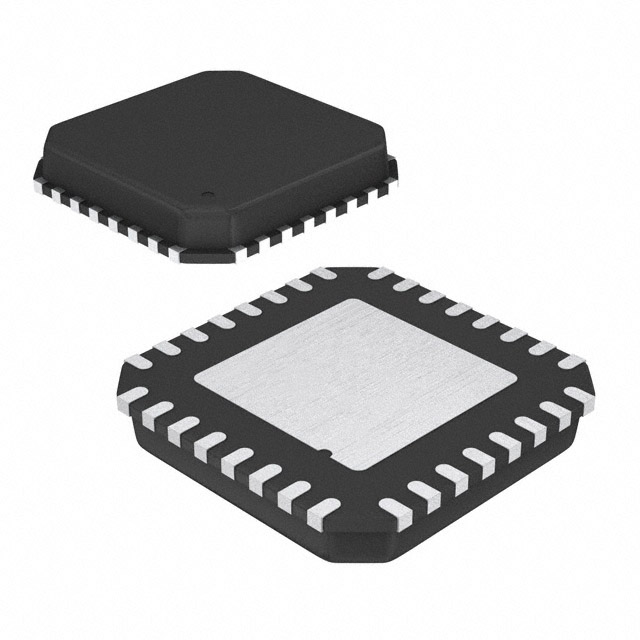
Microchip Technology AT42QT1110-MUR
- Part No.:
- AT42QT1110-MUR
- Manufacturer:
- Microchip Technology
- Category:
- Sensor, Capacitive Touch
- Package:
- 32-VFQFN Exposed Pad
- Datasheet:
-
 AT42QT1110-MUR.pdf
- Description:
- QTOUCH 11 KEY TOUCH SENSOR IC
- Quantity:
- Payment:

- Shipping:

Inventory:3,626
Please send an inquiry. Send us your inquiry, and we will respond immediately.
Product details
Overview
AT42QT1110-MUR from Microchip Technology (formerly Atmel) is an 11-channel QTouch® capacitive touch sensor IC designed for robust, noise-immune human interface sensing in consumer and industrial electronics. It features spread-spectrum charge-transfer technology, 3–5.5 V operation, SPI slave interface up to 1.5 MHz, and supports both 11-key burst-mode sensing and 7-key stand-alone mode with discrete PWM detect outputs - deployed in TV front panels, media player controls, and appliance interfaces.
For engineers reviewing the AT42QT1110-MUR datasheet, AT42QT1110-MUR pinout, AT42QT1110-MUR application, or AT42QT1110-MUR equivalent, key selection considerations include its dual-mode configuration (11-key vs. 7-key), programmable key sensitivity per channel, Adjacent Key Suppression® (AKS®), moisture-tolerant firmware tuning, and EEPROM-stored setup persistence across power cycles.
Technical Context
The AT42QT1110-MUR implements patented burst-mode spread-spectrum charge-transfer sensing with self-calibration, auto-drift compensation, and hardware-accelerated AKS® to reject crosstalk between adjacent electrodes. Its acquisition engine supports sequential or parallel group measurement, triggered either by internal clock (free-run or timed cycle) or external SYNC input.
It operates as a full-duplex SPI slave (CPOL=1, CPHA=1) with 1.5 MHz max SCK, CRC-optional command/report protocol, and dedicated CHANGE pin for event-driven host wake-up. Stand-alone 7-key mode bypasses SPI entirely, driving six configurable PWM DETECT outputs (DETECT0–DETECT6) plus one additional detect line on pin 30.
Key Specifications
| Parameter | Value and Actual Design Meaning |
|---|---|
| Touch Channels | Up to 11 independent capacitive sense channels; 7-key mode enables discrete PWM detect outputs on pins 22–27 and 30. |
| Supply Voltage | 3.0 V to 5.5 V - compatible with standard logic rails; brownout detection threshold at 2.7 V ±10% triggers reset. |
| SPI Interface | Full-duplex slave mode, 1.5 MHz max clock (SCK), CPOL=1/CPHA=1; supports CRC-verified commands and reports. |
| Sensing Technology | Patented spread-spectrum charge-transfer (direct mode) with self-calibration, noise filtering, and AKS® suppression. |
| Key Sensitivity | Individually settable per channel via SPI; supports electrode sizes ≥6 mm × 6 mm on panels up to 10 mm glass / 5 mm plastic. |
| Package | 32-pin 5 × 5 mm QFN (RoHS-compliant); exposed thermal pad must be connected to ground. |
| Power Consumption | Typical sleep current <2 µA; active measurement current depends on acquisition rate and channel count. |
Pinout & Package
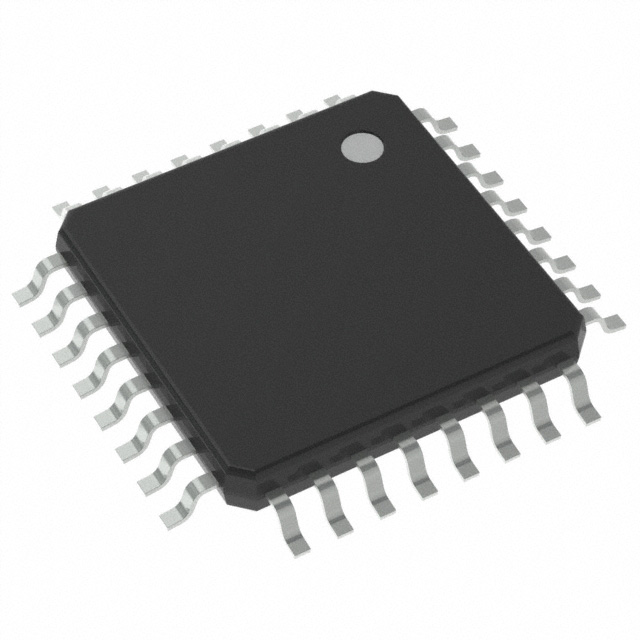
AT42QT1110-MUR is housed in a 32-pin, 5 mm × 5 mm QFN package with exposed thermal pad (must be soldered to GND plane). Pin 1 is located at top-left corner adjacent to notch or mark; pin numbering proceeds counter-clockwise.
| Pin/Terminal | Circuit Role | Design Meaning |
|---|---|---|
| SNS0–SNS10K | Sense I/O | Capacitive electrode connections; each pair (e.g., SNS0/SNS0K) forms a differential sense node for noise rejection. |
| SS, MOSI, MISO, SCK | SPI Interface | Standard SPI slave signals; SS active-low enables communication; supports 1.5 MHz full-duplex transfers. |
| CHANGE | Open-drain Event Output | Asserts low on key state change (data mode) or presence (touch mode); used for interrupt-driven host wake-up. |
| RESET | Active-low Reset Input | Hardware reset; tied to VDD if unused; initiates full startup sequence including EEPROM load and self-test. |
| DETECT0–DETECT6 | Configurable PWM Outputs | Available only in 7-key mode; drive LEDs or logic with user-defined duty cycle (0–100%) per key. |
| VDD / VSS | Power & Ground | Dual VDD pins (pins 4, 18) and three VSS pins (5, 21, ?) ensure low-impedance supply routing; 0.1 µF ceramic bypass required near pins. |
Key Features
| Feature | Design Value |
|---|---|
| Spread-spectrum charge-transfer | Reduces EMI emissions and improves immunity to RF interference and power supply noise without external shielding. |
| Adjacent Key Suppression® (AKS®) | Hardware-accelerated algorithm prevents false triggers when multiple keys are touched simultaneously or in proximity. |
| EEPROM-based configuration storage | Retains device setup (key thresholds, timing, modes) across power cycles - eliminates host re-initialization overhead. |
| Dual operational modes | 11-key SPI-controlled mode for flexible UIs; 7-key stand-alone mode enables plug-and-play LED-driven interfaces without MCU. |
| Moisture-tolerant firmware tuning | Enables reliable operation under condensation, sweat, or light liquid exposure via adaptive baseline tracking and signal filtering. |
Applications
| Consumer Media Controls | Industrial HMI Panels |
|---|---|
|
Use Scenario: Front-panel touch keys on flat-panel TVs, Blu-ray players, and streaming devices with non-metallic overlays. IC Role / Device Role / Timing Role: Primary capacitive touch controller managing up to 11 keys; handles raw data acquisition, debouncing, and status reporting over SPI. Use Value: Enables sleek, sealed bezel designs with no mechanical switches; supports varied electrode shapes (rings, rectangles) on 5 mm plastic overlays. |
Use Scenario: Operator interface on factory HMIs, medical equipment control surfaces, and building automation panels. IC Role / Device Role / Timing Role: Robust touch sensor with AKS® and moisture tolerance for environments with humidity, cleaning agents, or occasional splashes. Use Value: Maintains stable key detection despite temperature drift and panel contamination - reduces field failures in uncontrolled settings. |
| Appliance Control Interfaces | Smart Home Devices |
|
Use Scenario: Touch-sensitive cooktops, ovens, and washing machine control panels with painted or laminated glass fronts. IC Role / Device Role / Timing Role: Stand-alone 7-key mode drives PWM-connected status LEDs while detecting touch through 8 mm glass. Use Value: Eliminates need for external microcontroller in basic appliances; reduces BOM cost and firmware complexity. |
Use Scenario: Voice assistant remotes, smart thermostats, and lighting controllers requiring compact, low-power touch interfaces. IC Role / Device Role / Timing Role: Low-power sensor operating in deep sleep (<2 µA) until CHANGE pin interrupt wakes host MCU. Use Value: Extends battery life in coin-cell-powered devices; fast 100 µs wake time ensures responsive user interaction. |
Equivalent & Alternatives
The following parts are listed as comparable options for similar capacitive touch sensor applications.
| Alternative Part | Technical Difference | Application Difference | Selection Advice |
|---|---|---|---|
| AT42QT1070-MU | 7-channel version; lacks SYNC pin and 11-key mode; smaller 20-pin QFN package. | Targeted for simpler UIs with ≤7 keys; no external trigger capability or guard channel support. | Select when board space is constrained and full 11-key flexibility is unnecessary. |
| CY8CMBR2016-LQXI | Cypress CapSense® device; 16-channel, I²C interface; integrated proximity sensing; higher integration but no discrete DETECT outputs. | Requires host MCU for all configuration; no stand-alone PWM output mode; different calibration architecture. | Choose for I²C-based systems needing more channels and proximity detection, accepting added software dependency. |
Compared with AT42QT1110-MUR, AT42QT1070-MU reduces channel count and feature set for cost-sensitive 7-key designs, while CY8CMBR2016-LQXI shifts to I²C and removes stand-alone operation - making AT42QT1110-MUR uniquely suited for hybrid SPI/standalone deployments requiring AKS®, moisture resilience, and EEPROM-persistent setup.
Availability
AT42QT1110-MUR is available at Aetrix Electronics and suitable for consumer media controls, industrial HMI panels, and appliance interfaces requiring stable component supply, long-term lifecycle support, and RoHS-compliant QFN packaging.
Supply support for AT42QT1110-MUR includes scheduled delivery planning, volume procurement assistance, BOM continuity management, traceable sourcing, and lifecycle availability coordination for OEM customers, industrial embedded developers, connected-device designers, and electronics production programs.
Manufacturer
Microchip Technology acquired Atmel in 2016 and maintains full support for the QTouch® product family, delivering high-reliability analog/mixed-signal ICs for embedded sensing and control.
The AT42QT1110-MUR belongs to Microchip's QTouch® capacitive touch sensor line, engineered specifically for noise-immune, low-power, and moisture-tolerant human interface applications in cost-sensitive consumer and industrial products.
FAQ
What is the primary function of the AT42QT1110-MUR in a touch interface design?
The AT42QT1110-MUR serves as a dedicated capacitive touch sensor controller that acquires raw electrode signals, applies spread-spectrum charge-transfer sensing, performs real-time AKS® crosstalk suppression, and delivers debounced key status via SPI or discrete PWM outputs. Its role is to replace mechanical switches with reliable, sealed-touch interfaces - and it does so without requiring host MCU intervention for core sensing tasks in 7-key stand-alone mode.
Does the AT42QT1110-MUR support both SPI communication and stand-alone operation?
Yes, the AT42QT1110-MUR supports two distinct operational modes: full SPI-controlled 11-key mode for flexible UIs with host MCU coordination, and 7-key stand-alone mode where it loads configuration from internal EEPROM and drives six PWM DETECT outputs (plus one extra) directly - enabling touch functionality without any SPI connection or host firmware.
How does the AT42QT1110-MUR handle environmental challenges like moisture or EMI?
The AT42QT1110-MUR combats moisture via adaptive baseline tracking and firmware-tunable signal filtering, allowing reliable operation under condensation or light liquid exposure. For EMI, its patented spread-spectrum charge-transfer technique spreads energy across frequency bands, reducing peak emissions and improving immunity to RF interference and power supply noise - validated per IEC 61000-4-3 and -4-6 standards.
What are the key differences between the AT42QT1110-MUR and AT42QT1070-MU?
The AT42QT1110-MUR offers 11 sense channels, SYNC pin for external triggering, guard channel capability, and full EEPROM-based configuration storage - while the AT42QT1070-MU is limited to 7 channels, lacks SYNC/guard features, and uses a smaller 20-pin QFN. Both share QTouch® core algorithms, but AT42QT1110-MUR targets more complex, future-proofed UIs requiring scalability and flexibility.
Can the AT42QT1110-MUR drive LEDs directly, and how is PWM configured?
Yes - in 7-key mode, the AT42QT1110-MUR drives six dedicated DETECT outputs (pins 22–27) and one additional DETECT line (pin 30) with user-configurable PWM. Each output's duty cycle (0–100% in nine steps) is set via SPI setup addresses 9–15; enabling the corresponding bit in the Key to LED setup byte activates PWM output synchronized to key detect state.
AT42QT1110-MUR Specifications
- Product attributes
- Attribute value
- Manufacturer:
- Microchip Technology
- Package/Case:
- 32-VFQFN Exposed Pad
- Series:
- QTouch™
- Packaging:
- Tape & Reel (TR)
- Product Status:
- Active
- Programmable:
- Not Verified
- Type:
- Buttons
- Proximity Detection:
- No
- Number of Inputs:
- Up to 11
- LED Driver Channels:
- -
- Interface:
- SPI
- Resolution:
- 10 b
- Voltage - Supply:
- 3V ~ 5.5V
- Current - Supply:
- 10mA
- Operating Temperature:
- -40°C ~ 85°C
- Grade:
- -
- Qualification:
- -
- Mounting Type:
- Surface Mount
- Supplier Device Package:
- 32-VQFN (5x5)
AT42QT1110-MUR FAQ
1.How can I place an order for AT42QT1110-MUR through Aetrix?
Please submit a Request for Quotation (RFQ) for AT42QT1110-MUR on Aetrix. Our sales agent will provide a competitive quotation and guide you through the order confirmation once you accept the terms.
2.Are the price and stock information for AT42QT1110-MUR reliable?
The price and inventory of AT42QT1110-MUR are updated periodically and may fluctuate due to market conditions. Stock and pricing data are typically refreshed every 24 hours. Quotation validity for AT42QT1110-MUR is usually 5 days.
3.What payment methods are accepted for AT42QT1110-MUR?
We accept Wire Transfer, PayPal, Credit Card, Western Union, MoneyGram, and Escrow for AT42QT1110-MUR transactions.
Note: Certain payment methods may incur a processing fee.
4.How is shipping managed for AT42QT1110-MUR?
AT42QT1110-MUR orders can be shipped via leading logistics carriers, including DHL, UPS, FedEx, TNT, or Registered Mail.
Once your AT42QT1110-MUR order is processed, you will receive an email with the shipment details and tracking number.
Note: Tracking information may take up to 24 hours to appear. Express delivery typically takes 3–5 business days.
5.How can I obtain technical support or documentation for AT42QT1110-MUR?
For technical support, including AT42QT1110-MUR datasheets, pinout diagrams, or application guidance, please contact our engineering support team. They can provide detailed documentation and assistance for your AT42QT1110-MUR requirements.
6.How does Aetrix verify that AT42QT1110-MUR is sourced from the original manufacturer or authorized distributors?
All AT42QT1110-MUR products on Aetrix are procured from qualified distributors and authorized channels. Our dedicated quality assurance team conducts strict verification, including traceability checks and, if necessary, third-party testing. This ensures that AT42QT1110-MUR meets industry standards.
7.What is the process for return or replacement of AT42QT1110-MUR?
All AT42QT1110-MUR units undergo pre-shipment inspection (PSI). If there is an issue with AT42QT1110-MUR, returns or replacements are accepted under the following conditions:
1.Quantity discrepancies, incorrect items, or visible external defects (such as breakage or corrosion), acknowledged by Aetrix.
2.The issue is reported within 90 days of delivery.
3.The AT42QT1110-MUR part is unused and in its original packaging.
Return procedure for AT42QT1110-MUR:
1.Submit a request within 90 days.
2.Obtain a Return Material Authorization (RMA) from Aetrix.
AT42QT1110-MUR Tags

-
IQS228B00000000TSR
Azoteq (Pty) Ltd

-
MTCH101T-I/OT
Microchip Technology
-
IQS323001CSR
Azoteq (Pty) Ltd

-
AT42QT1010-TSHR
Microchip Technology
-
AT42QT1012-TSHR
Microchip Technology
-
AT42QT1011-TSHR
Microchip Technology
-
CAP1206-1-SL-TR
Microchip Technology
-
MTCH102T-I/MS
Microchip Technology
-
IQS323001DNR
Azoteq (Pty) Ltd
-
AT42QT1070-SSUR
Microchip Technology
-
CAP1188-1-CP-TR
Microchip Technology
-
AT42QT1110-AUR
Microchip Technology
Tech Hub

TTL and CMOS logic families differ in thresholds, loading, output drive, power and timing. This engineering guide compares 74HC and 74HCT, calculates noise margins and checks 3.3 V/5 V compatibility.

A practical engineering guide to 3.3V and 5V logic compatibility, input thresholds, resistor dividers, translator ICs, MOSFET level shifting, I2C pull-ups, timing limits and power-sequencing risks.

The 74HC595 uses push-pull logic outputs, while the TPIC6B595 uses 50 V open-drain DMOS sinks for higher-power loads. This guide compares timing, current limits, 3.3 V interfacing, load wiring, thermal…

The 74HC595 converts serial data into eight stable parallel outputs. This guide covers pin functions, shift and storage timing, OE and MR behavior, drive-current limits, cascading, voltage compatibilit…

A technical comparison of level-sensitive latches and edge-triggered flip-flops, covering timing windows, setup and hold limits, master–slave operation, time borrowing, race-through, HDL inference and…

A D latch stores one bit while Enable controls when data can pass. This reference covers gate-level operation, truth tables, transparency, setup and hold timing, LE versus OE, common ICs and practical …

An SR latch stores one bit through cross-coupled feedback. This engineering reference covers NOR and NAND implementations, truth tables, forbidden-state recovery, gated operation, switch debouncing, fa…

Latch circuits retain one bit through feedback. This technical reference covers SR and D latches, truth tables, transparency, timing limits, latch-versus-flip-flop behavior, applications and common log…

An engineering guide to LED driver operation, constant-current and constant-voltage outputs, linear and switching topologies, dimming, IC selection, calculations, replacement compatibility, and fault c…

Operational amplifier guide covering op amp basics, feedback, ideal vs real op amps, common configurations, buffer circuits, offset, bias current, gain-bandwidth, slew rate, rail-to-rail limits and sel…


