
 My Inquiry
 My Account


Microchip Technology AT42QT2100-MUR
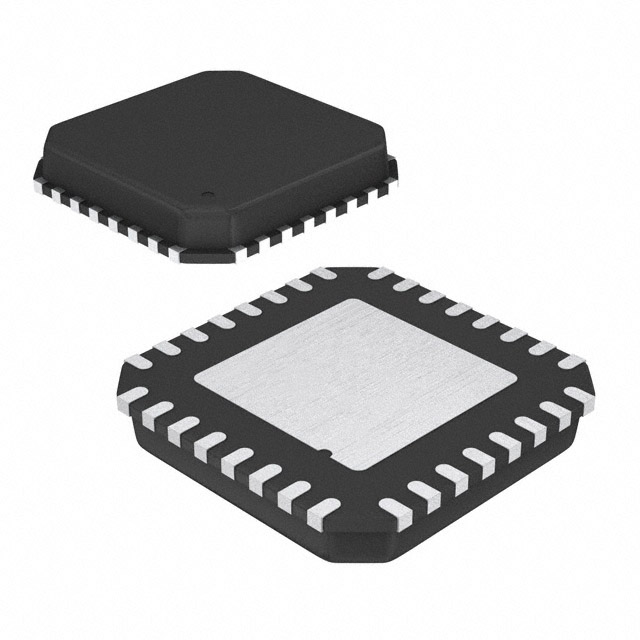
- Part No.:
- AT42QT2100-MUR
- Manufacturer:
- Microchip Technology
- Category:
- Sensor, Capacitive Touch
- Package:
- 32-VFQFN Exposed Pad
- Datasheet:
-
 AT42QT2100-MUR.pdf
- Description:
- IC TOUCH SENSOR 7KEY 32QFN
- Quantity:
- Payment:

- Shipping:

Inventory:11,174
Please send an inquiry. Send us your inquiry, and we will respond immediately.
Product details
Overview
AT42QT2100-MUR from Microchip Technology (formerly Atmel) is a QTouch® capacitive touch sensor IC supporting up to 7 discrete keys plus one slider or rotary wheel, operating via patented spread-spectrum charge-transfer technology. It delivers robust proximity and touch detection through glass up to 10 mm or plastic up to 15 mm, with SPI interface, adjustable sensitivity per channel via external Cs capacitors, and integrated drift compensation for stable operation in varying environmental conditions.
For engineers reviewing the AT42QT2100-MUR datasheet, AT42QT2100-MUR pinout, AT42QT2100-MUR application, or AT42QT2100-MUR equivalent, key selection considerations include burst-mode timing alignment, AKS group configuration for multi-key suppression, Cs capacitor tuning for electrode-specific sensitivity, and SPREAD pin control for noise-immune operation in EMI-prone environments.
Technical Context
The AT42QT2100-MUR acquires touch data in three sequential bursts: Burst 1 (B1–B3), Burst 2 (B4–B7), and Burst 3 (A1–A3), with DRDY held low during acquisition and high for 500 µs between bursts to enable synchronized SPI transfers. Each burst group supports independent sensitivity tuning via discrete Cs capacitors (CsB1–CsB7 for keys; CsA1–CsA3 for slider/wheel).
It implements patented Adjacent Key Suppression (AKS®) to prevent false multi-key activation, autodrift compensation that limits reference drift to ≤1 count/3 s toward touch and ≤1 count/0.5 s away, and Detect Integrator (DI) filtering requiring either 2 or 6 consecutive qualifying measurements before reporting touch or release - all executed without external oscillator or firmware intervention.
Key Specifications
| Parameter | Value and Actual Design Meaning |
|---|---|
| Supply Voltage | 2.0 V to 5.5 V - supports direct connection to common logic rails without dedicated LDO in many applications |
| Sensing Channels | 10 total: 7 key channels (B1–B7) + 3 slider/wheel channels (A1–A3) - enables simultaneous discrete + continuous position sensing |
| SPI Interface | 4-wire full-duplex @ 750 kHz - transfers 3-byte config/data packets; DRDY and CHANGE pins reduce host polling overhead |
| Key Sensitivity Control | Per-channel via external Cs capacitor (1 nF–100 nF) - allows fine-tuned response across varied electrode sizes and cover thicknesses |
| Slider/Wheel Resolution | 7-bit absolute position (0–127) - provides linear or rotary position tracking with no interpolation circuitry required |
| Operating Modes | Free Run, LP (4 selectable intervals), Sleep, Sync - balances response time (≤350 ms calibration) and power consumption down to µA-level sleep current |
| Moisture Tolerance | Hardware- and firmware-tunable - mitigates false triggers from condensation or surface moisture via signal processing and layout guidance |
Pinout & Package
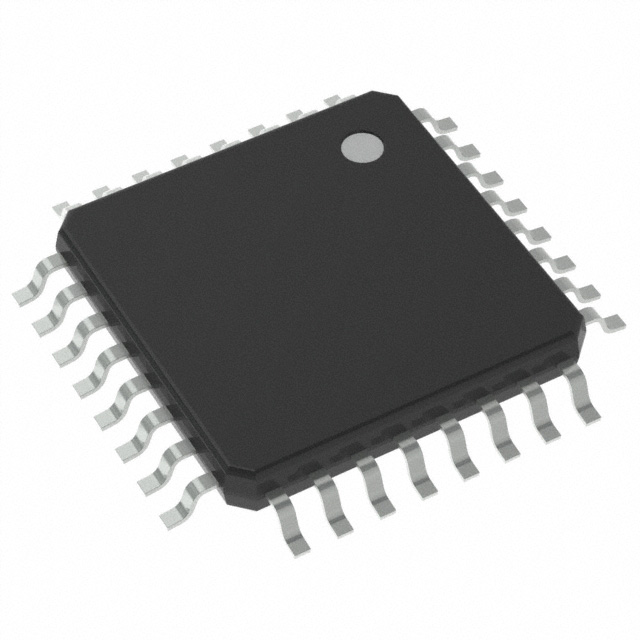
AT42QT2100-MUR is housed in a 32-pin 5 × 5 mm MLF (Micro Lead Frame) RoHS-compliant package with exposed thermal pad connected to VSS. The central ground pad must be soldered directly to PCB ground plane; no signal traces permitted underneath the die area.
| Pin/Terminal | Circuit Role | Design Meaning |
|---|---|---|
| SNSKB1–SNSKB7 | Key sense I/O | Connect to individual key electrodes + corresponding CsB capacitor; unused pins left open |
| SNSA1–SNSA3 | Slider/wheel sense I/O | Connect to A-group electrodes (e.g., triangle tips); determine position resolution and linearity |
| SNSKA1–SNSKA3 | Slider/wheel common I/O | Paired with SNSAx to form resistive or spatially interpolated slider/wheel topology |
| SS, SCK, MOSI, MISO | SPI interface | Standard 4-wire slave interface; SS active-low enables communication windowing via DRDY timing |
| DRDY / CHANGE | Status outputs | DRDY low = burst active; CHANGE high = new key/slider state available - eliminates polling |
| SPREAD | Noise control input | Pull to VDD to enable spread-spectrum burst modulation; pull to VSS to disable for deterministic timing |
| RESET | Active-low reset | Resets internal state and forces Free Run mode with AKS disabled; requires external pull-up |
Key Features
| Feature | Design Value |
|---|---|
| Patented charge-transfer sensing | Enables reliable touch detection through thick dielectrics (up to 15 mm plastic) without mechanical wear or contact degradation |
| Adjacent Key Suppression (AKS®) | Prevents false multi-key activation by dynamically suppressing weaker signals within defined groups - critical for compact key layouts |
| Self-calibrating drift compensation | Maintains baseline stability over temperature/humidity shifts without host intervention; pauses during touch to avoid interference |
| Configurable Detect Integrator (DI) | Requires 2 or 6 consecutive valid measurements before reporting touch/release - suppresses ESD-induced glitches and transient noise |
| Proximity-enabled keys | Any key channel can be tuned for hand/body proximity detection using larger Cs values - enables wake-on-approach functionality |
Applications
| Home Appliance Control Panel | Industrial HMI Touch Interface |
|---|---|
Use Scenario: Glass-front microwave oven or induction cooktop with sealed capacitive controls resistant to splashes and cleaning agents. IC Role / Device Role / Timing Role: Primary touch sensor IC managing 5 function keys + 1 rotary wheel for power/timer adjustment; operates at 3.3 V with 5 mm glass overlay. Use Value: Eliminates membrane switches and mechanical encoders; enables IP65-rated front panels with no moving parts or sealing gaskets required. | Use Scenario: Factory-floor programmable logic controller (PLC) operator panel exposed to dust, vibration, and wide ambient temperature swings. IC Role / Device Role / Timing Role: Core touch controller interfacing to ARM Cortex-M host MCU via SPI; uses LP Mode 2 for 250 ms response with <100 µA average current draw. Use Value: Maintains reliable key actuation despite condensation and conductive dust accumulation - validated per IEC 60529 IP54 requirements. |
| PC Peripheral Scroll Wheel | Medical Device Proximity Wake |
Use Scenario: USB-connected ergonomic keyboard with integrated capacitive scroll strip replacing mechanical roller. IC Role / Device Role / Timing Role: Slider/wheel sensor delivering 7-bit absolute position (0–127) over 80 mm arc; communicates via 750 kHz SPI to on-board microcontroller. Use Value: Enables smooth, silent, wear-free scrolling with no encoder jitter or tactile feedback limitations - supports both linear and curved PCB layouts. | Use Scenario: Portable ultrasound scanner that powers up display and initializes transducer when user's hand approaches within 8 cm. IC Role / Device Role / Timing Role: Dedicated proximity channel (Key B7) configured with 47 nF Cs capacitor and AKS=101 to avoid interfering with diagnostic UI keys. Use Value: Reduces standby power by >90% versus always-on display; achieves <300 ms wake latency with no false triggers from ambient humidity. |
Equivalent & Alternatives
The following parts are listed as comparable options for similar capacitive touch sensor applications.
| Alternative Part | Technical Difference | Application Difference | Selection Advice |
|---|---|---|---|
| AT42QT1070-MAHR | 7-key-only variant (no slider/wheel support); 20-pin TSSOP; lower pin count and cost | Limited to discrete button interfaces; unsuitable for position-sensitive controls | Select when only key sensing is needed and board space is constrained |
| CY8CMBR2016-LQXI | Cypress CapSense® device with 16-channel capacity; supports mutual capacitance; requires PSoC host integration | Better SNR in high-noise environments but demands more complex firmware stack and layout validation | Select for designs already using Cypress ecosystem or requiring >10 sensing nodes |
Compared with AT42QT2100-MUR, AT42QT1070-MAHR offers reduced footprint and BOM cost for pure key applications, while CY8CMBR2016-LQXI provides higher channel density and mutual-capacitance immunity at the expense of design complexity and toolchain dependency.
Availability
AT42QT2100-MUR is available at Aetrix Electronics and suitable for home appliance control panels, industrial HMI interfaces, PC peripheral scroll wheels, and medical device proximity wake systems requiring stable component supply, long-term lifecycle assurance, and RoHS-compliant MLF packaging.
Supply support for AT42QT2100-MUR includes scheduled delivery planning, volume procurement assistance, BOM continuity management, traceable sourcing, and lifecycle availability coordination for OEM customers, industrial embedded developers, connected-device designers, and electronics production programs.
Manufacturer
Microchip Technology acquired Atmel in 2016 and maintains its QTouch® portfolio for robust, low-power capacitive sensing solutions targeting cost-sensitive consumer and industrial markets.
The AT42QT2100 product line was designed specifically for single-chip implementation of sealed, dielectric-overlaid touch interfaces - emphasizing ease of layout, minimal external components, and field-proven noise immunity in real-world EMI environments.
FAQ
What is the maximum panel thickness supported by AT42QT2100-MUR for key and slider/wheel operation?
The AT42QT2100-MUR supports up to 15 mm of glass or 10 mm of plastic for discrete key sensing, and up to 4 mm of glass or 3 mm of plastic for slider/wheel operation. These limits assume standard electrode sizing and Cs capacitor selection; thicker overlays require larger Cs values and may reduce signal-to-noise ratio. Performance validation is recommended for each mechanical stack-up using the QT2100 evaluation kit and Atmel Studio QTouch Library.
How does the AT42QT2100-MUR handle adjacent key interference during multi-finger touch?
The AT42QT2100-MUR implements patented Adjacent Key Suppression (AKS®) to suppress weaker signals within predefined key groups, allowing only the dominant touch to register. When AKS is enabled globally, only one key or the slider/wheel reports activation at a time. Group assignments are configurable via SPI; for example, setting AKS bits to 101 reserves Key B7 exclusively for proximity while permitting full multi-key operation elsewhere.
Can AT42QT2100-MUR operate without an external voltage regulator?
Yes, AT42QT2100-MUR operates directly from 2.0 V to 5.5 V and tolerates slow supply fluctuations via internal drift compensation. However, rapid voltage shifts (e.g., from digital switching noise) may cause false detections; in such cases, a local 0.1 µF bypass capacitor between VDD and VSS is mandatory, and a dedicated LDO is recommended if shared rail noise exceeds ±50 mV peak-to-peak.
What is the role of the SPREAD pin on AT42QT2100-MUR, and how should it be configured?
The SPREAD pin on AT42QT2100-MUR enables or disables spread-spectrum burst modulation: connect to VDD (via pull-up) to activate for superior noise immunity and reduced RF emissions, or to VSS (via pull-down) to disable for deterministic timing in synchronized systems. Leaving SPREAD floating is not allowed; incorrect biasing causes undefined burst behavior and potential SPI communication failure.
How does AT42QT2100-MUR manage recalibration after prolonged touch or environmental drift?
AT42QT2100-MUR performs automatic recalibration using two mechanisms: Maximum On Duration (MOD) timeout (configurable to 10/20/60 s or infinite) resets reference after sustained touch, and signal-error recalibration triggers individually on any channel showing ≥1.5 s of capacitance decrease - ensuring keys never lock "on" due to foreign objects or contamination. Both processes occur autonomously without host intervention.
AT42QT2100-MUR Specifications
- Product attributes
- Attribute value
- Manufacturer:
- Microchip Technology
- Package/Case:
- 32-VFQFN Exposed Pad
- Series:
- QTouch™
- Packaging:
- Tape & Reel (TR)
- Product Status:
- Active
- Programmable:
- Not Verified
- Type:
- Buttons, Slider, Wheel
- Proximity Detection:
- Yes
- Number of Inputs:
- Up to 8
- LED Driver Channels:
- -
- Interface:
- SPI
- Resolution:
- 14 b
- Voltage - Supply:
- 2V ~ 5.5V
- Current - Supply:
- -
- Operating Temperature:
- -40°C ~ 85°C
- Grade:
- -
- Qualification:
- -
- Mounting Type:
- Surface Mount
- Supplier Device Package:
- 32-VQFN (5x5)
AT42QT2100-MUR FAQ
1.How can I place an order for AT42QT2100-MUR through Aetrix?
Please submit a Request for Quotation (RFQ) for AT42QT2100-MUR on Aetrix. Our sales agent will provide a competitive quotation and guide you through the order confirmation once you accept the terms.
2.Are the price and stock information for AT42QT2100-MUR reliable?
The price and inventory of AT42QT2100-MUR are updated periodically and may fluctuate due to market conditions. Stock and pricing data are typically refreshed every 24 hours. Quotation validity for AT42QT2100-MUR is usually 5 days.
3.What payment methods are accepted for AT42QT2100-MUR?
We accept Wire Transfer, PayPal, Credit Card, Western Union, MoneyGram, and Escrow for AT42QT2100-MUR transactions.
Note: Certain payment methods may incur a processing fee.
4.How is shipping managed for AT42QT2100-MUR?
AT42QT2100-MUR orders can be shipped via leading logistics carriers, including DHL, UPS, FedEx, TNT, or Registered Mail.
Once your AT42QT2100-MUR order is processed, you will receive an email with the shipment details and tracking number.
Note: Tracking information may take up to 24 hours to appear. Express delivery typically takes 3–5 business days.
5.How can I obtain technical support or documentation for AT42QT2100-MUR?
For technical support, including AT42QT2100-MUR datasheets, pinout diagrams, or application guidance, please contact our engineering support team. They can provide detailed documentation and assistance for your AT42QT2100-MUR requirements.
6.How does Aetrix verify that AT42QT2100-MUR is sourced from the original manufacturer or authorized distributors?
All AT42QT2100-MUR products on Aetrix are procured from qualified distributors and authorized channels. Our dedicated quality assurance team conducts strict verification, including traceability checks and, if necessary, third-party testing. This ensures that AT42QT2100-MUR meets industry standards.
7.What is the process for return or replacement of AT42QT2100-MUR?
All AT42QT2100-MUR units undergo pre-shipment inspection (PSI). If there is an issue with AT42QT2100-MUR, returns or replacements are accepted under the following conditions:
1.Quantity discrepancies, incorrect items, or visible external defects (such as breakage or corrosion), acknowledged by Aetrix.
2.The issue is reported within 90 days of delivery.
3.The AT42QT2100-MUR part is unused and in its original packaging.
Return procedure for AT42QT2100-MUR:
1.Submit a request within 90 days.
2.Obtain a Return Material Authorization (RMA) from Aetrix.
AT42QT2100-MUR Tags

-
IQS228B00000000TSR
Azoteq (Pty) Ltd

-
MTCH101T-I/OT
Microchip Technology
-
IQS323001CSR
Azoteq (Pty) Ltd

-
AT42QT1010-TSHR
Microchip Technology
-
AT42QT1012-TSHR
Microchip Technology
-
AT42QT1011-TSHR
Microchip Technology
-
CAP1206-1-SL-TR
Microchip Technology
-
MTCH102T-I/MS
Microchip Technology
-
IQS323001DNR
Azoteq (Pty) Ltd
-
AT42QT1070-SSUR
Microchip Technology
-
CAP1188-1-CP-TR
Microchip Technology
-
AT42QT1110-AUR
Microchip Technology
Tech Hub

TTL and CMOS logic families differ in thresholds, loading, output drive, power and timing. This engineering guide compares 74HC and 74HCT, calculates noise margins and checks 3.3 V/5 V compatibility.

A practical engineering guide to 3.3V and 5V logic compatibility, input thresholds, resistor dividers, translator ICs, MOSFET level shifting, I2C pull-ups, timing limits and power-sequencing risks.

The 74HC595 uses push-pull logic outputs, while the TPIC6B595 uses 50 V open-drain DMOS sinks for higher-power loads. This guide compares timing, current limits, 3.3 V interfacing, load wiring, thermal…

The 74HC595 converts serial data into eight stable parallel outputs. This guide covers pin functions, shift and storage timing, OE and MR behavior, drive-current limits, cascading, voltage compatibilit…

A technical comparison of level-sensitive latches and edge-triggered flip-flops, covering timing windows, setup and hold limits, master–slave operation, time borrowing, race-through, HDL inference and…

A D latch stores one bit while Enable controls when data can pass. This reference covers gate-level operation, truth tables, transparency, setup and hold timing, LE versus OE, common ICs and practical …

An SR latch stores one bit through cross-coupled feedback. This engineering reference covers NOR and NAND implementations, truth tables, forbidden-state recovery, gated operation, switch debouncing, fa…

Latch circuits retain one bit through feedback. This technical reference covers SR and D latches, truth tables, transparency, timing limits, latch-versus-flip-flop behavior, applications and common log…

An engineering guide to LED driver operation, constant-current and constant-voltage outputs, linear and switching topologies, dimming, IC selection, calculations, replacement compatibility, and fault c…

Operational amplifier guide covering op amp basics, feedback, ideal vs real op amps, common configurations, buffer circuits, offset, bias current, gain-bandwidth, slew rate, rail-to-rail limits and sel…


