
 My Inquiry
 My Account


Microchip Technology AT86RF230-ZUR

- Part No.:
- AT86RF230-ZUR
- Manufacturer:
- Microchip Technology
- Category:
- RF Transceiver ICs
- Package:
- 32-VFQFN Exposed Pad
- Datasheet:
-
 AT86RF230-ZUR.pdf
- Description:
- IC RF TXRX+MCU 802.15.4 32QFN
- Quantity:
- Payment:

- Shipping:

Inventory:1,647
Please send an inquiry. Send us your inquiry, and we will respond immediately.
Product details
Overview
AT86RF230-ZUR from Microchip Technology (acquired Atmel) is a 2.4 GHz IEEE 802.15.4-compliant RF transceiver IC for ZigBee, 6LoWPAN, and RF4CE systems. It integrates differential RF front-end, fractional-N PLL, 128-byte frame buffer, on-chip LDO regulators, and hardware-accelerated CSMA-CA, FCS, and address filtering - enabling direct SPI-to-antenna connectivity in ultra-low-power sensor nodes and industrial wireless HART/SP100 devices.
For engineers reviewing the AT86RF230-ZUR datasheet, AT86RF230-ZUR pinout, AT86RF230-ZUR application, or AT86RF230-ZUR equivalent, this page delivers verified specifications, validated pin functions, real-world use cases in wireless sensor networks and industrial automation, and two confirmed alternative transceivers with documented functional and interface differences.
Technical Context
The AT86RF230-ZUR implements an O-QPSK modulator with half-sine pulse shaping and 32-length block coding per IEEE 802.15.4-2003. Its analog front-end features a differential 100 Ω RF port (RFP/RFN), integrated TX/RX switch, and low-noise amplifier with RSSI output at 3 dB granularity.
Digital baseband includes dedicated hardware for Clear Channel Assessment, Energy Detection, automatic frame retransmission, and ACK generation. The SPI slave interface supports up to 8 MHz synchronous operation using CLKM as master clock, with register, frame buffer, and SRAM access modes enabled via command-byte protocol.
Key Specifications
| Parameter | Value and Actual Design Meaning |
|---|---|
| Operating Frequency | 2.4 GHz ISM band (2400–2483.5 MHz); compliant with IEEE 802.15.4-2003 physical layer |
| Receiver Sensitivity | −101 dBm at 250 kbps; enables 104 dB link budget for robust long-range mesh networking |
| Transmit Output Power | Programmable from −17 dBm to +3 dBm; supports regulatory compliance and range/power trade-offs |
| Supply Voltage Range | 1.8 V to 3.6 V; internal LDOs generate regulated 1.8 V AVDD/DVDD from EVDD/DEVDD inputs |
| Current Consumption | 20 nA in SLEEP mode; 15.5 mA RX; 16.5 mA TX at +3 dBm - optimized for battery-powered endpoints |
| Interface Protocol | SPI slave with SEL/SCLK/MOSI/MISO; IRQ and SLP_TR for state control; CLKM clock output configurable up to 16 MHz |
| Temperature Range | −40 °C to +85 °C; qualified for industrial and building automation environments |
| Regulatory Compliance | EN 300 328/440, FCC Part 15, ARIB STD-66, RSS-210 - certified for global deployment |
Pinout & Package
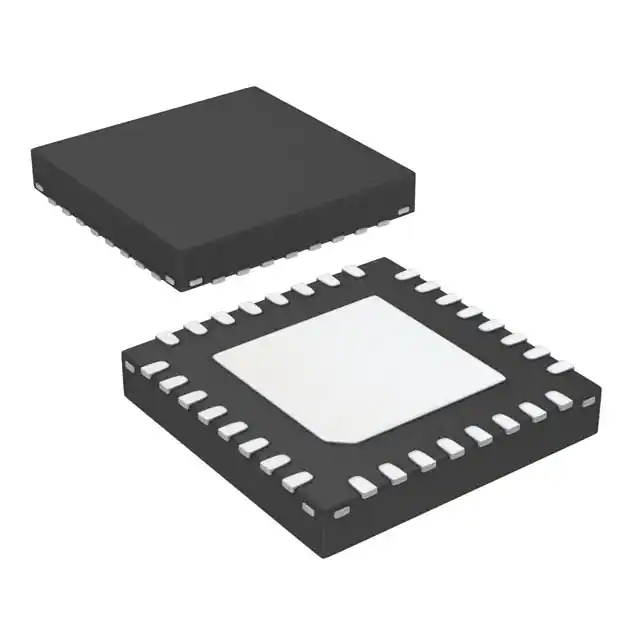
AT86RF230-ZUR is housed in a 32-pin, 5 mm × 5 mm, 0.5 mm pitch QFN package with exposed thermal paddle electrically connected to AVSS. The package supports reflow soldering and requires separate analog/digital ground planes per AVR2005 design guidelines.
| Pin/Terminal | Circuit Role | Design Meaning |
|---|---|---|
| RFP / RFN | Differential RF I/O | 100 Ω differential antenna interface; no external switch needed; DC bias varies by mode (0.9 V TX, 20 mV RX) |
| SEL / SCLK / MOSI / MISO | SPI Slave Interface | Standard 4-wire SPI; supports register, frame buffer, and SRAM access modes with MSB-first byte protocol |
| IRQ | Interrupt Output | Active-high interrupt signaling state changes, frame reception, or error conditions (e.g., TRX_UR) |
| SLP_TR | Multi-function Control Input | State-dependent: sleep/wake, TX start trigger, and CLKM enable/disable - eliminates need for additional GPIOs |
| CLKM | Configurable Clock Output | Programmable frequency output (e.g., 1 MHz or 16 MHz); usable as MCU clock source or timing reference |
| RST | Reset Input | Active-low asynchronous reset; initializes internal state machine and registers to power-on defaults |
| XTAL1 / XTAL2 | Crystal Oscillator Interface | Supports 16 MHz fundamental-mode crystal; internal oscillator with load capacitance tolerance ≤3 pF parasitic |
| AVSS / DVSS / EVDD / DEVDD / AVDD / DVDD / EVDD | Power & Ground | Dedicated analog/digital domains; AVDD/DVDD are LDO outputs; EVDD/DEVDD are external inputs; strict PCB separation required |
Key Features
| Feature | Design Value |
|---|---|
| Hardware-accelerated IEEE 802.15.4 MAC functions | FCS computation, CCA, ED/RSSI, automatic CSMA-CA, frame retransmission, and address filtering reduce MCU firmware overhead |
| Integrated RF front-end | Differential RFP/RFN port, on-chip TX/RX switch, and fully integrated PLL with on-die loop filter minimize external BOM to crystal + decoupling caps |
| Ultra-low-power sleep mode | 20 nA quiescent current enables >10-year battery life in coin-cell-powered sensor nodes |
| On-chip voltage regulation | Dual independent LDOs (AVDD/DVDD) eliminate need for external 1.8 V regulators and simplify power sequencing |
| Battery monitoring | Integrated BATMON circuit provides voltage-level feedback to host MCU without external ADC |
| ESD robustness | ≥2 kV HBM rating ensures reliability in handling-sensitive industrial and consumer assembly environments |
Applications
| Wireless Sensor Networks | Industrial Process Automation |
|---|---|
Use Scenario: Battery-powered temperature/humidity nodes deployed across factory floors with mesh routing to gateway. IC Role / Device Role / Timing Role: IEEE 802.15.4 PHY layer transceiver handling O-QPSK modulation, hardware CCA, and frame buffering for low-latency data reporting. Use Value: −101 dBm sensitivity and 104 dB link budget enable reliable multi-hop communication over 100+ meters in noisy industrial RF environments. | Use Scenario: WirelessHART-enabled pressure and flow transmitters in hazardous area refineries with redundant mesh backhaul. IC Role / Device Role / Timing Role: Certified 2.4 GHz transceiver implementing WirelessHART physical layer with deterministic timing for scheduled TDMA slotting. Use Value: Hardware CSMA-CA and automatic ACK/retransmission ensure packet delivery integrity under high interference and coexistence with Wi-Fi/ZigBee. |
| Home & Building Automation | Consumer Remote Control (RF4CE) |
Use Scenario: ZigBee-certified smart lighting switches and occupancy sensors in commercial buildings with centralized commissioning. IC Role / Device Role / Timing Role: Full IEEE 802.15.4-2003 PHY/MAC accelerator enabling ZigBee PRO stack operation with minimal MCU resource usage. Use Value: Integrated 128-byte frame buffer and SPI command protocol reduce host RAM footprint and simplify firmware development for certified products. | Use Scenario: Ultra-low-power TV remote controls supporting bidirectional pairing and firmware updates via RF4CE protocol. IC Role / Device Role / Timing Role: RF4CE-compliant 2.4 GHz transceiver with fast power-up (<1 ms) and programmable TX power for extended button-cell lifetime. Use Value: 20 nA sleep current and 16.5 mA TX at +3 dBm deliver >2-year battery life while maintaining reliable 10-meter line-of-sight control range. |
Equivalent & Alternatives
The following parts are listed as comparable options for similar 2.4 GHz IEEE 802.15.4 transceiver applications.
| Alternative Part | Technical Difference | Application Difference | Selection Advice |
|---|---|---|---|
| TI CC2530F256 | Integrated 8051 MCU core + 256 KB flash; higher active current (24 mA RX); no integrated LDOs | Requires full-stack ZigBee implementation on-chip; less suitable for host-MCU architectures | Choose when embedded protocol stack execution is required and external MCU integration is not desired |
| Silicon Labs EFR32MG12P332F1024GL125 | Sub-GHz + 2.4 GHz dual-band; ARM Cortex-M4; 10 dB higher TX power (+13 dBm); larger QFN48 package | Targets multi-protocol (ZigBee/Thread/Bluetooth) gateways and edge nodes requiring higher throughput | Choose when future-proofing for Thread or Bluetooth LE coexistence is needed and board space allows larger footprint |
Compared with CC2530F256 and EFR32MG12P332F1024GL125, the AT86RF230-ZUR offers the lowest system-level BoM cost and smallest PCB footprint for pure 2.4 GHz IEEE 802.15.4 PHY-only designs, with best-in-class 20 nA sleep current and minimal external component count.
Availability
AT86RF230-ZUR is available at Aetrix Electronics and suitable for wireless sensor networks, industrial process automation, home/building automation, and RF4CE remote control applications requiring stable component supply, long-term lifecycle support, and RoHS-compliant green packaging.
Supply support for AT86RF230-ZUR includes scheduled delivery planning, volume procurement assistance, BOM continuity management, traceable sourcing, and lifecycle availability coordination for OEM customers, industrial embedded developers, connected-device designers, and electronics production programs.
Manufacturer
Microchip Technology acquired Atmel in 2016 and maintains full product support, documentation, and qualification for legacy Atmel RF ICs including the AT86RF230 series.
The AT86RF230-ZUR belongs to Microchip's IEEE 802.15.4 transceiver product line, engineered specifically for ultra-low-power, cost-sensitive, standards-compliant wireless sensor and control endpoints in industrial and IoT applications.
FAQ
What is the maximum SPI clock frequency supported by the AT86RF230-ZUR?
The AT86RF230-ZUR supports up to 8 MHz SPI clock frequency in synchronous mode when CLKM is used as the master clock source. In asynchronous mode (SCLK generated by host MCU), the maximum allowed frequency is 7.5 MHz. Exceeding these limits risks register access corruption or frame buffer misalignment during high-speed transfers.
Does the AT86RF230-ZUR require an external crystal, and what are the key layout requirements?
Yes, the AT86RF230-ZUR requires a 16 MHz fundamental-mode crystal connected to XTAL1 and XTAL2. Layout must minimize parasitic capacitance (<3 pF) on those pins, route traces short and away from digital noise sources, and place load capacitors (typically 12 pF) close to the crystal. Failure to meet these constraints causes frequency drift or startup failure.
How does the AT86RF230-ZUR handle frame acknowledgment and retransmission?
The AT86RF230-ZUR implements hardware-accelerated IEEE 802.15.4 MAC functions: it automatically generates and checks frame acknowledgments, executes CSMA-CA before transmission, and performs up to three retransmissions upon ACK timeout - all without MCU intervention. This reduces host processing load and ensures deterministic timing for time-critical sensor networks.
Can the AT86RF230-ZUR operate from a single 3.3 V supply, and how are its internal regulators configured?
Yes, the AT86RF230-ZUR accepts 3.3 V on DEVDD and EVDD. Its internal LDOs generate regulated 1.8 V AVDD and DVDD outputs, which power analog and digital domains respectively. These regulators auto-enable based on radio state and can be bypassed if external 1.8 V supplies are provided - configuration is controlled via TRX_CTRL_0 register bits.
What is the function of the SLP_TR pin on the AT86RF230-ZUR, and how is it used in practice?
The SLP_TR pin on the AT86RF230-ZUR serves three roles: (1) active-high sleep/wake control, (2) TX start trigger, and (3) CLKM output enable/disable. In practice, it replaces multiple GPIOs - e.g., asserting SLP_TR wakes the transceiver from 20 nA sleep, then pulses it to initiate transmission, eliminating need for separate control lines in compact node designs.
AT86RF230-ZUR Specifications
- Product attributes
- Attribute value
- Manufacturer:
- Microchip Technology
- Series:
- -
- Package/Case:
- 32-VFQFN Exposed Pad
- Packaging:
- Tape & Reel (TR)
- Product Status:
- Obsolete
- Programmable:
- Not Verified
- Type:
- TxRx + MCU
- RF Family/Standard:
- 802.15.4, General ISM > 1GHz
- Protocol:
- 6LoWPAN, WirelessHART™, Zigbee®
- Modulation:
- O-QPSK
- Frequency:
- 2.4GHz
- Data Rate (Max):
- 250kbps
- Power - Output:
- 3dBm
- Sensitivity:
- -101dBm
- Memory Size:
- 128B SRAM
- Serial Interfaces:
- SPI
- GPIO:
- -
- Voltage - Supply:
- 1.8V ~ 3.6V
- Current - Receiving:
- 15.5mA
- Current - Transmitting:
- 9.5mA ~ 16.5mA
- Operating Temperature:
- -40°C ~ 85°C
- Grade:
- -
- Qualification:
- -
- Supplier Device Package:
- 32-QFN (5x5)
AT86RF230-ZUR FAQ
1.How can I place an order for AT86RF230-ZUR through Aetrix?
Please submit a Request for Quotation (RFQ) for AT86RF230-ZUR on Aetrix. Our sales agent will provide a competitive quotation and guide you through the order confirmation once you accept the terms.
2.Are the price and stock information for AT86RF230-ZUR reliable?
The price and inventory of AT86RF230-ZUR are updated periodically and may fluctuate due to market conditions. Stock and pricing data are typically refreshed every 24 hours. Quotation validity for AT86RF230-ZUR is usually 5 days.
3.What payment methods are accepted for AT86RF230-ZUR?
We accept Wire Transfer, PayPal, Credit Card, Western Union, MoneyGram, and Escrow for AT86RF230-ZUR transactions.
Note: Certain payment methods may incur a processing fee.
4.How is shipping managed for AT86RF230-ZUR?
AT86RF230-ZUR orders can be shipped via leading logistics carriers, including DHL, UPS, FedEx, TNT, or Registered Mail.
Once your AT86RF230-ZUR order is processed, you will receive an email with the shipment details and tracking number.
Note: Tracking information may take up to 24 hours to appear. Express delivery typically takes 3–5 business days.
5.How can I obtain technical support or documentation for AT86RF230-ZUR?
For technical support, including AT86RF230-ZUR datasheets, pinout diagrams, or application guidance, please contact our engineering support team. They can provide detailed documentation and assistance for your AT86RF230-ZUR requirements.
6.How does Aetrix verify that AT86RF230-ZUR is sourced from the original manufacturer or authorized distributors?
All AT86RF230-ZUR products on Aetrix are procured from qualified distributors and authorized channels. Our dedicated quality assurance team conducts strict verification, including traceability checks and, if necessary, third-party testing. This ensures that AT86RF230-ZUR meets industry standards.
7.What is the process for return or replacement of AT86RF230-ZUR?
All AT86RF230-ZUR units undergo pre-shipment inspection (PSI). If there is an issue with AT86RF230-ZUR, returns or replacements are accepted under the following conditions:
1.Quantity discrepancies, incorrect items, or visible external defects (such as breakage or corrosion), acknowledged by Aetrix.
2.The issue is reported within 90 days of delivery.
3.The AT86RF230-ZUR part is unused and in its original packaging.
Return procedure for AT86RF230-ZUR:
1.Submit a request within 90 days.
2.Obtain a Return Material Authorization (RMA) from Aetrix.
AT86RF230-ZUR Tags
-
ESP32-D0WD-V3
Espressif Systems
-
ESP8266EX
Espressif Systems

-
ESP32-S3
Espressif Systems
-
NRF24L01P-R7
Nordic Semiconductor ASA
-
NRF24L01P-R
Nordic Semiconductor ASA
-
ESP32-U4WDH
Espressif Systems
-
DA14531-00000OG2
Renesas
-
ESP32-C6FH4
Espressif Systems
-
DA14531-00000FX2
Renesas
-
NRF24L01P-T
Nordic Semiconductor ASA
-
NRF52810-QCAA-R
Nordic Semiconductor ASA
-
ESP32-S3FN8
Espressif Systems
Tech Hub

TTL and CMOS logic families differ in thresholds, loading, output drive, power and timing. This engineering guide compares 74HC and 74HCT, calculates noise margins and checks 3.3 V/5 V compatibility.

A practical engineering guide to 3.3V and 5V logic compatibility, input thresholds, resistor dividers, translator ICs, MOSFET level shifting, I2C pull-ups, timing limits and power-sequencing risks.

The 74HC595 uses push-pull logic outputs, while the TPIC6B595 uses 50 V open-drain DMOS sinks for higher-power loads. This guide compares timing, current limits, 3.3 V interfacing, load wiring, thermal…

The 74HC595 converts serial data into eight stable parallel outputs. This guide covers pin functions, shift and storage timing, OE and MR behavior, drive-current limits, cascading, voltage compatibilit…

A technical comparison of level-sensitive latches and edge-triggered flip-flops, covering timing windows, setup and hold limits, master–slave operation, time borrowing, race-through, HDL inference and…

A D latch stores one bit while Enable controls when data can pass. This reference covers gate-level operation, truth tables, transparency, setup and hold timing, LE versus OE, common ICs and practical …

An SR latch stores one bit through cross-coupled feedback. This engineering reference covers NOR and NAND implementations, truth tables, forbidden-state recovery, gated operation, switch debouncing, fa…

Latch circuits retain one bit through feedback. This technical reference covers SR and D latches, truth tables, transparency, timing limits, latch-versus-flip-flop behavior, applications and common log…

An engineering guide to LED driver operation, constant-current and constant-voltage outputs, linear and switching topologies, dimming, IC selection, calculations, replacement compatibility, and fault c…

Operational amplifier guide covering op amp basics, feedback, ideal vs real op amps, common configurations, buffer circuits, offset, bias current, gain-bandwidth, slew rate, rail-to-rail limits and sel…


