
 My Inquiry
 My Account


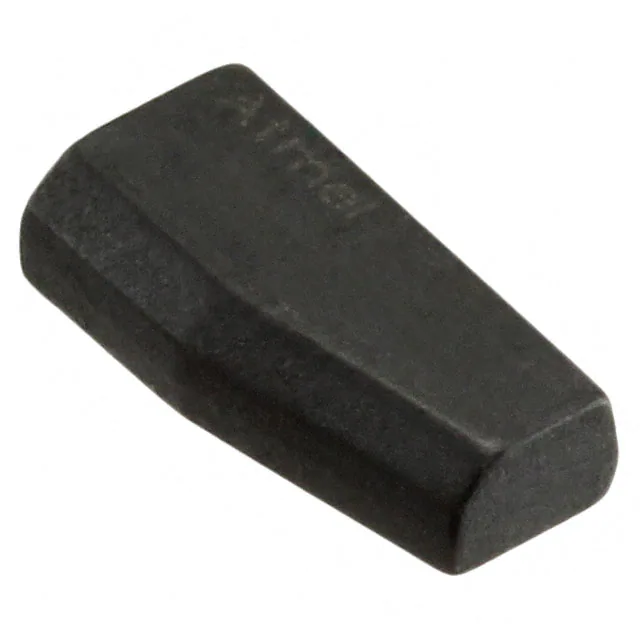
Microchip Technology ATA5577M1330C-PP
- Part No.:
- ATA5577M1330C-PP
- Manufacturer:
- Microchip Technology
- Category:
- RFID Transponders, Tags
- Package:
- Datasheet:
-
 ATA5577M1330C-PP.pdf
- Description:
- RFID TAG R/W 125KHZ ENCAP
- Quantity:
- Payment:

- Shipping:

Inventory:3,036
Please send an inquiry. Send us your inquiry, and we will respond immediately.
Product details
Overview
ATA5577M1330C-PP from Microchip Technology (formerly Atmel) is a contactless 125 kHz read/write RFID transponder IC embedded in a plastic brick package with integrated ferrite-core coil. It features 363-bit EEPROM (11 × 33-bit blocks), Manchester/FSK/ASK/PSK/NRZ/bi-phase modulation support, RF/2–RF/128 programmable data rate, and password-protected write access. It powers and communicates via load modulation in proximity RFID systems such as access control tokens and asset tags.
For engineers reviewing the ATA5577M1330C-PP datasheet, ATA5577M1330C-PP pinout, ATA5577M1330C-PP application, or ATA5577M1330C-PP equivalent, key selection criteria include 125 kHz carrier compatibility, block-wise EEPROM write protection, downlink protocol flexibility (e.g., Manchester at RF/32 default), and field strength thresholds for reliable read (≥14.5 A/m) and write (≥29 A/m) operation.
Technical Context
The ATA5577M1330C-PP integrates an analog front-end tuned to 125 kHz using on-chip capacitance and an external ferrite-core inductor (4.5 mH). Its bi-directional communication relies on amplitude-shift keying (ASK) downlink decoding and load-modulation uplink transmission.
Configuration is stored in two dedicated EEPROM blocks: Block 0 (32-bit config register) sets data rate and modulation mode; Block 3 (32-bit AFE option register) controls clamp voltage, soft modulation switching, and modulation level-pre-programmed to 0x00088040 (RF/32, Manchester) and 0x6DC00000 (soft modulation 2 pulses, clamp high) at delivery.
Key Specifications
| Parameter | Value and Actual Design Meaning |
|---|---|
| Operating Frequency | 125 kHz nominal carrier; resonance range 120–130 kHz ensures interoperability with standard LF readers. |
| EEPROM Capacity | 363 bits total: 7×32-bit user memory blocks + 2×32-bit UID blocks + 1×32-bit config register + 1×32-bit AFE option register. |
| Data Rate Options | RF/2 to RF/128 (binary selectable); default RF/32 enables ~3.9 kbps Manchester downlink in typical setups. |
| Modulation Schemes | Supports ASK, FSK, PSK, Manchester, bi-phase, and NRZ-enabling compatibility with diverse reader protocols. |
| Field Strength Thresholds | Min. 14.5 A/m for read mode; min. 29 A/m for programming; max. 600 A/m safe operating limit per ISO/IEC 18000-2. |
| Temperature Range | –40°C to +85°C operational; –40°C to +125°C storage-suitable for industrial and outdoor tagging environments. |
Pinout & Package
ATA5577M1330C-PP is a monolithic transponder IC housed in a molded plastic brick (11.9 × 4.9 × 4.2 mm) with integrated ferrite-core coil. The device has no external pins; coil terminals connect internally to the IC's RF interface (ANT1/ANT2). No discrete pinout applies-the antenna coil forms the sole electrical interface.
Key Features
| Feature | Design Value |
|---|---|
| Block-wise EEPROM write protection | Each of 11 EEPROM blocks includes a lock bit-enables selective, irreversible write-disable per block for secure UID or configuration retention. |
| Password-protected write access | One 32-bit password block prevents unauthorized reprogramming unless correct 32-bit value is presented during write command sequence. |
| Configurable analog front end | AFE option register (Block 3) adjusts clamp voltage, modulation level, and soft switching-optimizes performance across varying coil Q and reader field profiles. |
| Fast downlink capability | Supports ~6 kbps downlink (vs. ~3 kbps baseline) via optimized timing and gap detection-reduces transaction time in high-throughput access systems. |
Applications
| Access Control Token | Industrial Asset Tag |
|---|---|
Use Scenario: Contactless badge used for door entry in office buildings or secure facilities. IC Role / Device Role / Timing Role: Read/write IDIC providing unique UID and configurable access credentials via 125 kHz magnetic coupling. Use Value: Password-protected EEPROM blocks prevent cloning; RF/32 Manchester default ensures compatibility with legacy HID Prox readers. | Use Scenario: Durable tag affixed to machinery, tools, or containers in factory environments. IC Role / Device Role / Timing Role: Passive transponder storing maintenance history, calibration data, or ownership ID accessed by handheld LF readers. Use Value: –40°C to +85°C rating and ferrite-core coil enable reliable operation near motors, welders, and metal surfaces. |
| Animal Identification | Library Book Tracking |
Use Scenario: Subcutaneous implant for livestock or pet identification compliant with ISO 11784/11785. IC Role / Device Role / Timing Role: Bi-directional LF transponder supporting read-only UID retrieval and optional write-once lifetime data. Use Value: Two dedicated 32-bit UID blocks provide globally unique identifiers; lock bits ensure UID immutability post-implantation. | Use Scenario: Book spine tag enabling self-checkout and inventory reconciliation in library RFID systems. IC Role / Device Role / Timing Role: Low-cost, high-reliability transponder interfacing with fixed-mount 125 kHz gate readers. Use Value: Pre-programmed RF/32 Manchester config minimizes reader setup; 7×32-bit user memory stores ISBN, loan status, and location codes. |
Equivalent & Alternatives
The following parts are listed as comparable options for similar LF RFID transponder applications.
| Alternative Part | Technical Difference | Application Difference | Selection Advice |
|---|---|---|---|
| EM4102 | Read-only (no EEPROM write capability); fixed 64-bit UID; no modulation or data rate configurability. | Suitable only for static ID applications; cannot store dynamic data or support password-protected updates. | Select when cost sensitivity outweighs need for reprogrammability and security features. |
| T5557 | 330-bit EEPROM (10×33-bit); supports same modulation schemes but lacks AFE option register and soft modulation switching. | Compatible with legacy T5557 readers; lower field strength sensitivity (min. 35 A/m for write) limits range in low-power readers. | Choose for drop-in replacement where existing T5557 firmware and reader tuning are already deployed. |
Compared with EM4102 and T5557, the ATA5577M1330C-PP provides superior configurability (AFE register, password, fast downlink), higher EEPROM capacity (363 vs. 330 or 64 bits), and tighter field sensitivity-making it optimal for secure, updatable, and reader-interoperable LF RFID deployments.
Availability
ATA5577M1330C-PP is available at Aetrix Electronics and suitable for access control systems, industrial asset tracking, animal identification, and library management applications requiring stable component supply and long-term lifecycle support.
Supply support for ATA5577M1330C-PP includes scheduled delivery planning, volume procurement assistance, BOM continuity management, traceable sourcing, and lifecycle availability coordination for OEM customers, industrial embedded developers, connected-device designers, and electronics production programs.
Manufacturer
Microchip Technology acquired Atmel in 2016 and maintains its RFID product portfolio, including IDIC® transponders. The company specializes in secure microcontrollers, analog, and wireless solutions for industrial and embedded markets.
The ATA5577M1330C-PP belongs to Atmel's IDIC® (Identification Integrated Circuit) family, designed specifically for contactless, battery-free 125 kHz RFID applications requiring field-powered operation, secure memory, and multi-protocol downlink compatibility.
FAQ
What is the nominal operating frequency and resonance tolerance of the ATA5577M1330C-PP?
The ATA5577M1330C-PP operates at a nominal frequency of 125 kHz, with a specified resonance range of 120–130 kHz. This tolerance ensures robust interoperability with commercial 125 kHz RFID readers and accommodates manufacturing variance in the integrated ferrite-core coil and on-chip capacitor. The device achieves this via LC tank tuning, where the external 4.5 mH inductor combines with internal capacitance to set the resonant point.
How is EEPROM organized and protected on the ATA5577M1330C-PP?
The ATA5577M1330C-PP contains 363 bits of EEPROM arranged in 11 blocks of 33 bits each (32 data + 1 lock bit). Seven blocks serve user memory (including a dedicated 32-bit password block), two hold unique IDs, and one each holds the configuration and AFE option registers. Each block's lock bit, once set, permanently disables further writes to that block-enabling secure, granular memory protection without affecting other sections.
What modulation schemes and data rates does the ATA5577M1330C-PP support?
The ATA5577M1330C-PP supports ASK, FSK, PSK, Manchester, bi-phase, and NRZ downlink modulation. Data rates are programmable from RF/2 to RF/128 in binary steps; the default delivery configuration uses RF/32 with Manchester encoding, yielding ~3.9 kbps. These settings are stored in Block 0 (config register) and can be updated in-system via valid reader commands and password authentication.
Does the ATA5577M1330C-PP require an external power source or PCB layout?
No-the ATA5577M1330C-PP is a fully passive, contactless transponder. It derives all operating power from the reader's 125 kHz magnetic field via its integrated ferrite-core coil. As a pre-assembled plastic brick (11.9 × 4.9 × 4.2 mm), it requires no PCB mounting, soldering, or external components-only mechanical integration into a tag or card substrate.
What are the minimum and maximum magnetic field strengths required for reliable operation of the ATA5577M1330C-PP?
The ATA5577M1330C-PP requires a minimum field strength of 14.5 A/m for read mode and 29 A/m for programming (write) mode. Its absolute maximum rated field is 600 A/m. These values are measured at 125 kHz and define the operational envelope for compatible readers-ensuring reliable modulation under typical antenna geometries while preventing damage or unintended behavior at excessive field levels.
ATA5577M1330C-PP Specifications
- Product attributes
- Attribute value
- Manufacturer:
- Microchip Technology
- Series:
- -
- Packaging:
- Tray
- Product Status:
- Obsolete
- Style:
- Encapsulated
- Technology:
- Passive
- Frequency:
- 125kHz
- Memory Type:
- Read/Write
- Writable Memory:
- 363b (User)
- Standards:
- ISO 11784, ISO 11785
- Operating Temperature:
- -40°C ~ 85°C
- Size / Dimension:
- 0.469" L x 0.224" W (11.90mm x 5.70mm)
ATA5577M1330C-PP FAQ
1.How can I place an order for ATA5577M1330C-PP through Aetrix?
Please submit a Request for Quotation (RFQ) for ATA5577M1330C-PP on Aetrix. Our sales agent will provide a competitive quotation and guide you through the order confirmation once you accept the terms.
2.Are the price and stock information for ATA5577M1330C-PP reliable?
The price and inventory of ATA5577M1330C-PP are updated periodically and may fluctuate due to market conditions. Stock and pricing data are typically refreshed every 24 hours. Quotation validity for ATA5577M1330C-PP is usually 5 days.
3.What payment methods are accepted for ATA5577M1330C-PP?
We accept Wire Transfer, PayPal, Credit Card, Western Union, MoneyGram, and Escrow for ATA5577M1330C-PP transactions.
Note: Certain payment methods may incur a processing fee.
4.How is shipping managed for ATA5577M1330C-PP?
ATA5577M1330C-PP orders can be shipped via leading logistics carriers, including DHL, UPS, FedEx, TNT, or Registered Mail.
Once your ATA5577M1330C-PP order is processed, you will receive an email with the shipment details and tracking number.
Note: Tracking information may take up to 24 hours to appear. Express delivery typically takes 3–5 business days.
5.How can I obtain technical support or documentation for ATA5577M1330C-PP?
For technical support, including ATA5577M1330C-PP datasheets, pinout diagrams, or application guidance, please contact our engineering support team. They can provide detailed documentation and assistance for your ATA5577M1330C-PP requirements.
6.How does Aetrix verify that ATA5577M1330C-PP is sourced from the original manufacturer or authorized distributors?
All ATA5577M1330C-PP products on Aetrix are procured from qualified distributors and authorized channels. Our dedicated quality assurance team conducts strict verification, including traceability checks and, if necessary, third-party testing. This ensures that ATA5577M1330C-PP meets industry standards.
7.What is the process for return or replacement of ATA5577M1330C-PP?
All ATA5577M1330C-PP units undergo pre-shipment inspection (PSI). If there is an issue with ATA5577M1330C-PP, returns or replacements are accepted under the following conditions:
1.Quantity discrepancies, incorrect items, or visible external defects (such as breakage or corrosion), acknowledged by Aetrix.
2.The issue is reported within 90 days of delivery.
3.The ATA5577M1330C-PP part is unused and in its original packaging.
Return procedure for ATA5577M1330C-PP:
1.Submit a request within 90 days.
2.Obtain a Return Material Authorization (RMA) from Aetrix.
ATA5577M1330C-PP Tags
-
SL3S1013FTB0,115
NXP Semiconductors
-
NTP53321G0JHKZ
NXP Semiconductors
-
HTSH4801ETK,118
NXP Semiconductors
-
NTA53321G0FHKZ
NXP Semiconductors
-
RF-HDT-DVBE-N2
Texas Instruments
-
RF-HDT-DVBB-N2
Texas Instruments
-
HT2DC20S20/F/RSP
NXP Semiconductors
-
TRPGR30ATGA
Texas Instruments
-
TRPGR30ATGC
Texas Instruments
-
RI-TRP-DR2B-40
Texas Instruments
-
V680-D1KP52MT
Omron Automation and Safety
-
HTMS8001FTB/AF,115
NXP USA Inc.
Tech Hub

TTL and CMOS logic families differ in thresholds, loading, output drive, power and timing. This engineering guide compares 74HC and 74HCT, calculates noise margins and checks 3.3 V/5 V compatibility.

A practical engineering guide to 3.3V and 5V logic compatibility, input thresholds, resistor dividers, translator ICs, MOSFET level shifting, I2C pull-ups, timing limits and power-sequencing risks.

The 74HC595 uses push-pull logic outputs, while the TPIC6B595 uses 50 V open-drain DMOS sinks for higher-power loads. This guide compares timing, current limits, 3.3 V interfacing, load wiring, thermal…

The 74HC595 converts serial data into eight stable parallel outputs. This guide covers pin functions, shift and storage timing, OE and MR behavior, drive-current limits, cascading, voltage compatibilit…

A technical comparison of level-sensitive latches and edge-triggered flip-flops, covering timing windows, setup and hold limits, master–slave operation, time borrowing, race-through, HDL inference and…

A D latch stores one bit while Enable controls when data can pass. This reference covers gate-level operation, truth tables, transparency, setup and hold timing, LE versus OE, common ICs and practical …

An SR latch stores one bit through cross-coupled feedback. This engineering reference covers NOR and NAND implementations, truth tables, forbidden-state recovery, gated operation, switch debouncing, fa…

Latch circuits retain one bit through feedback. This technical reference covers SR and D latches, truth tables, transparency, timing limits, latch-versus-flip-flop behavior, applications and common log…

An engineering guide to LED driver operation, constant-current and constant-voltage outputs, linear and switching topologies, dimming, IC selection, calculations, replacement compatibility, and fault c…

Operational amplifier guide covering op amp basics, feedback, ideal vs real op amps, common configurations, buffer circuits, offset, bias current, gain-bandwidth, slew rate, rail-to-rail limits and sel…


