
 My Inquiry
 My Account


Microchip Technology ATA5577M1330C-UFQW
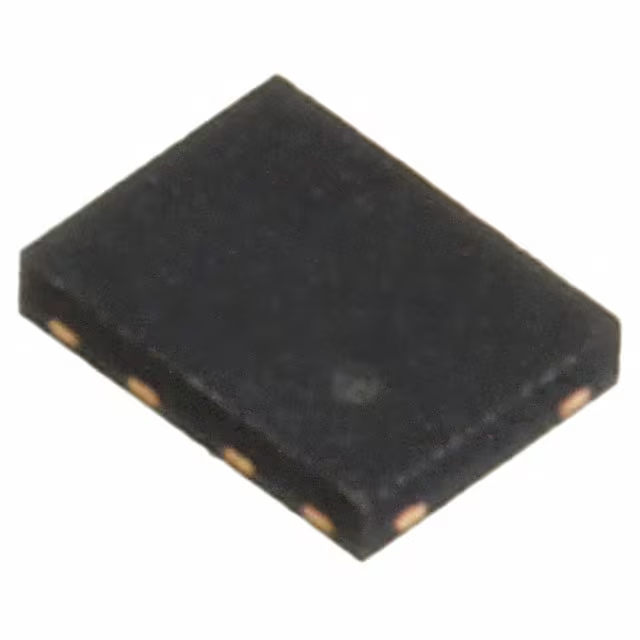
- Part No.:
- ATA5577M1330C-UFQW
- Manufacturer:
- Microchip Technology
- Category:
- RFID Transponders, Tags
- Package:
- Datasheet:
-
 ATA5577M1330C-UFQW.pdf
- Description:
- RFID TAG R/W 100-150KHZ ENCAP
- Quantity:
- Payment:

- Shipping:

Inventory:1,172
Please send an inquiry. Send us your inquiry, and we will respond immediately.
Product details
Overview
ATA5577M1330C-UFQW from Microchip Technology is a contactless read/write LF RFID identification IC operating at 125 kHz or 134 kHz, featuring 363-bit EEPROM (11 × 33-bit blocks), load modulation uplink, and OOK/PIE downlink decoding. It serves as the core transponder IC in passive RFID tags for access control, animal identification, and waste management systems.
For engineers reviewing the ATA5577M1330C-UFQW datasheet, ATA5577M1330C-UFQW pinout, ATA5577M1330C-UFQW application, or ATA5577M1330C-UFQW equivalent, this page delivers verified technical context, exact memory mapping, modulation protocol support (Manchester, FSK, PSK, NRZ), ISO/IEC 11784/785 configurability, and validated alternatives for tag design and replacement.
Technical Context
The ATA5577M1330C-UFQW integrates an analog front end with on-chip rectifier, clock extractor, field gap detector, and switchable resistive load between Coil 1 and Coil 2 for uplink modulation. Its HV generator enables EEPROM programming via RF field coupling without external voltage.
It supports two operational modes: Basic mode with fixed data rates (RF/8 to RF/128) and Extended mode with binary-selectable rates (RF/2 to RF/128), plus OTP lock, password protection, AOR wake-up, and inverse data output - all configured via dedicated EEPROM registers (block 0 for mode, block 3 page 1 for AFE options).
Key Specifications
| Parameter | Value and Actual Design Meaning |
|---|---|
| Operating Frequency | 125 kHz or 134 kHz - matches standard LF RFID reader field frequencies for reliable coil coupling and power harvesting. |
| EEPROM Capacity | 363 bits (11 × 33-bit blocks) - includes 7×32-bit user memory, 2×32-bit unique ID, 1×32-bit option register, and 1×32-bit configuration register. |
| Uplink Modulation | Resistive load modulation - enables bidirectional communication using single coil; no external components required for basic operation. |
| Downlink Protocol | 100% OOK with PIE encoding - decodes reader commands via pulse interval timing; supports Fast Downlink (~6 kbps) in Extended mode. |
| Data Rate Options | RF/2 to RF/128 (binary-selectable) or fixed RF/8–RF/128 - allows tuning for read range vs. noise immunity trade-offs in varying antenna Q environments. |
| Memory Protection | Per-block lock bit + OTP bit + master key (6 or 9) - provides hardware-level write protection; master key = 6 permanently locks configuration in One-Time-Programmable mode. |
| ISO Compatibility | Configurable for ISO/IEC 11784/785 - enables compliance with animal identification standards via EEPROM-based setup of modulation and data format. |
Pinout & Package
Package: UFQW - ultra-thin flip-chip wafer-level chip-scale package (WLCSP), 100 μm × 100 μm die size, optimized for direct bonding to miniature coil antennas in compact RFID tags.
| Pin/Terminal | Circuit Role | Design Meaning |
|---|---|---|
| Coil 1 | RF input / power harvest node | Primary terminal for AC coil voltage rectification; connects to one end of resonant LC tank for energy extraction and clock generation. |
| Coil 2 | RF return / modulation node | Second coil terminal; forms switchable resistive load path with Coil 1 to enable load modulation uplink transmission. |
Key Features
| Feature | Design Value |
|---|---|
| On-chip trimmed capacitor | 250 pF ±3% - reduces external component count and improves resonance stability across production lots. |
| Soft modulation switching | Configurable transition ramp - prevents clock loss during modulation onset, critical for high-Q antenna designs. |
| Answer-On-Request (AOR) | Wake-up via opcode + password - enables anti-collision in multi-tag fields and extends battery-free tag lifetime by suppressing idle modulation. |
| Traceability data structure | Factory-programmed 40-bit unique ID (lot/year/quarter/wafer/die) - supports supply chain traceability and counterfeit detection per ISO/IEC 15963-1. |
| High Q-antenna tolerance | Adjustable AFE thresholds and damping - maintains reliable operation across coil quality variations without redesign. |
Applications
| Access Control Systems | Animal Identification Tags |
|---|---|
Use Scenario: Contactless door entry using embedded RFID tags in employee badges or vehicle fobs. IC Role / Device Role / Timing Role: Passive transponder IC providing secure, low-power identity verification via load-modulated uplink response to reader interrogation. Use Value: Enables tamper-resistant credential storage with password-protected write access and factory-traceable UID for audit compliance. | Use Scenario: Implantable or ear-tag RFID for livestock tracking in agricultural and veterinary applications. IC Role / Device Role / Timing Role: ISO/IEC 11784/785-compliant IDIC delivering standardized 134.2 kHz uplink transmission with unique animal ID and traceability data. Use Value: Meets regulatory requirements for animal origin tracking via pre-programmed 40-bit UID and lockable memory blocks for permanent ID storage. |
| Waste Management Tags | Industrial Asset Tracking |
Use Scenario: Reusable bin or container tagging for automated collection route optimization and fill-level monitoring. IC Role / Device Role / Timing Role: Ruggedized LF RFID transponder with high Q-antenna tolerance, supporting reliable read/write in metal-rich or moisture-exposed environments. Use Value: Maintains stable operation despite coil detuning from environmental stress, enabled by configurable AFE options and soft modulation. | Use Scenario: Tooling or equipment tagging in manufacturing plants requiring durable, maintenance-free identification. IC Role / Device Role / Timing Role: Read/write IDIC with OTP lock and password mode, preventing unauthorized reprogramming of asset identifiers. Use Value: Ensures long-term data integrity through hardware-enforced write protection and factory-sealed traceability data. |
Equivalent & Alternatives
The following parts are listed as comparable options for similar LF RFID transponder IC applications.
| Alternative Part | Technical Difference | Application Difference | Selection Advice |
|---|---|---|---|
| T5557 | Same 363-bit EEPROM architecture and PIE downlink; lacks OTP lock, AOR mode, and ISO/IEC 11784/785 configurability. | Supports legacy access control systems but not animal ID compliance or advanced anti-collision. | Select when backward compatibility with existing T5557 infrastructure is required and extended features are unnecessary. |
| ATA5567 | Pin-compatible variant with identical memory map and modulation schemes; differs only in factory-trimmed capacitor value (330 pF vs. 250 pF). | Suitable for same applications but requires antenna retuning if substituting in high-Q coil designs. | Choose when higher capacitance is needed to match specific coil inductance for optimal resonance at 134.2 kHz. |
Compared with T5557 and ATA5567, the ATA5577M1330C-UFQW adds OTP locking, AOR wake-up, and ISO/IEC 11784/785 setup capability - enabling secure, standards-compliant, and collision-resistant tag deployment without layout changes.
Availability
ATA5577M1330C-UFQW is available at Aetrix Electronics and suitable for access control systems, animal identification tags, and industrial asset tracking requiring stable component supply, full traceability, and long-term lifecycle support.
Supply support for ATA5577M1330C-UFQW includes scheduled delivery planning, volume procurement assistance, BOM continuity management, traceable sourcing, and lifecycle availability coordination for OEM customers, industrial embedded developers, connected-device designers, and electronics production programs.
Manufacturer
Microchip Technology Inc. is a U.S.-based semiconductor manufacturer specializing in microcontrollers, analog devices, and secure authentication solutions.
The ATA5577 family is designed specifically for passive LF RFID transponder applications, emphasizing low-power operation, robust coil coupling, and configurable compliance with global identification standards.
FAQ
What is the primary function of the ATA5577M1330C-UFQW in an RFID system?
The ATA5577M1330C-UFQW functions as a passive, contactless read/write identification IC that harvests power from a 125 kHz or 134 kHz RF field and communicates bidirectionally using load modulation (uplink) and OOK/PIE decoding (downlink). As the core transponder IC in ATA5577M1330C-UFQW-based tags, it stores and transmits identity data while supporting password protection, OTP locking, and ISO/IEC 11784/785 configuration.
Does the ATA5577M1330C-UFQW require external components for basic operation?
No, the ATA5577M1330C-UFQW operates with only a single external coil connected between Coil 1 and Coil 2. Its integrated rectifier, clock extractor, HV generator, and 250 pF ±3% on-chip capacitor eliminate the need for external diodes, regulators, or tuning capacitors in standard LF RFID tag implementations.
How is memory organized and protected in the ATA5577M1330C-UFQW?
The ATA5577M1330C-UFQW contains 363 bits of EEPROM arranged in 11 blocks of 33 bits each (32 data + 1 lock bit). Block 0 holds configuration data, blocks 1–7 store user memory (including password), and blocks 1–2 of page 1 contain factory-programmed traceability data. Each block is individually lockable; setting the OTP bit with master key = 6 permanently disables all writes.
What modulation schemes does the ATA5577M1330C-UFQW support for uplink transmission?
The ATA5577M1330C-UFQW supports Manchester, Bi-phase, FSK, PSK, and NRZ modulation schemes for uplink transmission - all selectable via its EEPROM configuration register. In Extended mode, it additionally supports inverse data output and differential bi-phase encoding, enabling interoperability with diverse reader protocols including ISO/IEC 11784/785.
Is the ATA5577M1330C-UFQW compatible with existing T5557-based infrastructure?
Yes, the ATA5577M1330C-UFQW is designed to be compatible with T5557 and ATA5567 systems: it uses identical memory mapping, PIE downlink protocol, and Basic/Extended mode structure. However, use of Extended mode features (e.g., OTP, AOR) requires reader firmware updates; for drop-in replacement in legacy systems, configure ATA5577M1330C-UFQW to match T5557 default settings.
ATA5577M1330C-UFQW Specifications
- Product attributes
- Attribute value
- Manufacturer:
- Microchip Technology
- Series:
- -
- Packaging:
- Tape & Reel (TR)
- Product Status:
- Active
- Style:
- Encapsulated
- Technology:
- Passive
- Frequency:
- 100kHz ~ 150kHz
- Memory Type:
- Read/Write
- Writable Memory:
- 363b (User)
- Standards:
- ISO 11784, ISO 11785
- Operating Temperature:
- -40°C ~ 85°C
- Size / Dimension:
- 0.045" L x 0.039" W (1.15mm x 1.00mm)
ATA5577M1330C-UFQW FAQ
1.How can I place an order for ATA5577M1330C-UFQW through Aetrix?
Please submit a Request for Quotation (RFQ) for ATA5577M1330C-UFQW on Aetrix. Our sales agent will provide a competitive quotation and guide you through the order confirmation once you accept the terms.
2.Are the price and stock information for ATA5577M1330C-UFQW reliable?
The price and inventory of ATA5577M1330C-UFQW are updated periodically and may fluctuate due to market conditions. Stock and pricing data are typically refreshed every 24 hours. Quotation validity for ATA5577M1330C-UFQW is usually 5 days.
3.What payment methods are accepted for ATA5577M1330C-UFQW?
We accept Wire Transfer, PayPal, Credit Card, Western Union, MoneyGram, and Escrow for ATA5577M1330C-UFQW transactions.
Note: Certain payment methods may incur a processing fee.
4.How is shipping managed for ATA5577M1330C-UFQW?
ATA5577M1330C-UFQW orders can be shipped via leading logistics carriers, including DHL, UPS, FedEx, TNT, or Registered Mail.
Once your ATA5577M1330C-UFQW order is processed, you will receive an email with the shipment details and tracking number.
Note: Tracking information may take up to 24 hours to appear. Express delivery typically takes 3–5 business days.
5.How can I obtain technical support or documentation for ATA5577M1330C-UFQW?
For technical support, including ATA5577M1330C-UFQW datasheets, pinout diagrams, or application guidance, please contact our engineering support team. They can provide detailed documentation and assistance for your ATA5577M1330C-UFQW requirements.
6.How does Aetrix verify that ATA5577M1330C-UFQW is sourced from the original manufacturer or authorized distributors?
All ATA5577M1330C-UFQW products on Aetrix are procured from qualified distributors and authorized channels. Our dedicated quality assurance team conducts strict verification, including traceability checks and, if necessary, third-party testing. This ensures that ATA5577M1330C-UFQW meets industry standards.
7.What is the process for return or replacement of ATA5577M1330C-UFQW?
All ATA5577M1330C-UFQW units undergo pre-shipment inspection (PSI). If there is an issue with ATA5577M1330C-UFQW, returns or replacements are accepted under the following conditions:
1.Quantity discrepancies, incorrect items, or visible external defects (such as breakage or corrosion), acknowledged by Aetrix.
2.The issue is reported within 90 days of delivery.
3.The ATA5577M1330C-UFQW part is unused and in its original packaging.
Return procedure for ATA5577M1330C-UFQW:
1.Submit a request within 90 days.
2.Obtain a Return Material Authorization (RMA) from Aetrix.
ATA5577M1330C-UFQW Tags
-
SL3S1013FTB0,115
NXP Semiconductors
-
NTP53321G0JHKZ
NXP Semiconductors
-
HTSH4801ETK,118
NXP Semiconductors
-
NTA53321G0FHKZ
NXP Semiconductors
-
RF-HDT-DVBE-N2
Texas Instruments
-
RF-HDT-DVBB-N2
Texas Instruments
-
HT2DC20S20/F/RSP
NXP Semiconductors
-
TRPGR30ATGA
Texas Instruments
-
TRPGR30ATGC
Texas Instruments
-
RI-TRP-DR2B-40
Texas Instruments
-
V680-D1KP52MT
Omron Automation and Safety
-
HTMS8001FTB/AF,115
NXP USA Inc.
Tech Hub

TTL and CMOS logic families differ in thresholds, loading, output drive, power and timing. This engineering guide compares 74HC and 74HCT, calculates noise margins and checks 3.3 V/5 V compatibility.

A practical engineering guide to 3.3V and 5V logic compatibility, input thresholds, resistor dividers, translator ICs, MOSFET level shifting, I2C pull-ups, timing limits and power-sequencing risks.

The 74HC595 uses push-pull logic outputs, while the TPIC6B595 uses 50 V open-drain DMOS sinks for higher-power loads. This guide compares timing, current limits, 3.3 V interfacing, load wiring, thermal…

The 74HC595 converts serial data into eight stable parallel outputs. This guide covers pin functions, shift and storage timing, OE and MR behavior, drive-current limits, cascading, voltage compatibilit…

A technical comparison of level-sensitive latches and edge-triggered flip-flops, covering timing windows, setup and hold limits, master–slave operation, time borrowing, race-through, HDL inference and…

A D latch stores one bit while Enable controls when data can pass. This reference covers gate-level operation, truth tables, transparency, setup and hold timing, LE versus OE, common ICs and practical …

An SR latch stores one bit through cross-coupled feedback. This engineering reference covers NOR and NAND implementations, truth tables, forbidden-state recovery, gated operation, switch debouncing, fa…

Latch circuits retain one bit through feedback. This technical reference covers SR and D latches, truth tables, transparency, timing limits, latch-versus-flip-flop behavior, applications and common log…

An engineering guide to LED driver operation, constant-current and constant-voltage outputs, linear and switching topologies, dimming, IC selection, calculations, replacement compatibility, and fault c…

Operational amplifier guide covering op amp basics, feedback, ideal vs real op amps, common configurations, buffer circuits, offset, bias current, gain-bandwidth, slew rate, rail-to-rail limits and sel…


