
 My Inquiry
 My Account


Microchip Technology ATA8510-GHQW

- Part No.:
- ATA8510-GHQW
- Manufacturer:
- Microchip Technology
- Category:
- RF Transceiver ICs
- Package:
- 32-VFQFN Exposed Pad
- Datasheet:
-
 ATA8510-GHQW.pdf
- Description:
- IC RF TXRX+MCU ISM<1GHZ 32VQFN
- Quantity:
- Payment:

- Shipping:

Inventory:4,522
Please send an inquiry. Send us your inquiry, and we will respond immediately.
Product details
Overview
ATA8510-GHQW from Microchip (formerly Atmel) is a highly integrated UHF ASK/FSK transceiver with embedded 8-bit AVR® microcontroller, 20KB user Flash, 1KB SRAM, and 1024-byte EEPROM. It operates across 310–318 MHz, 418–477 MHz, and 836–956 MHz bands, supports programmable output power (–12 to +14.5 dBm), and achieves –122.5 dBm FSK sensitivity at 0.75 kbit/s - enabling ultra-low-power wireless sensor nodes and battery-operated remote controls.
For engineers reviewing the ATA8510-GHQW datasheet, ATA8510-GHQW pinout, ATA8510-GHQW application, or ATA8510-GHQW equivalent, this page delivers verified RF performance specs, SPI-controlled service-based polling architecture, fractional-N PLL frequency resolution (93 Hz low-band / 185 Hz high-band), digital RSSI accuracy (±1 dB), and antenna tuning capability - all critical for EN 300 220/FCC Part 15-compliant ISM band designs.
Technical Context
The ATA8510-GHQW implements a dual-path low-IF receiver with digitized IF processing, delivering 55 dB image rejection at 315/433.92 MHz and 64 dB blocking at 1 MHz offset. Its fractional-N PLL enables precise channel selection and supports mixed ASK/FSK telegrams with non-byte-aligned data handling.
Baseband operation is governed by a service-based configuration model: three EEPROM-stored and two SRAM-modifiable service configurations (each with three channels) enable on-the-fly parameter updates in IDLEMode via SPI. The embedded AVR executes custom firmware from 20 KB Flash, managing wake-up patterns, FIFO buffering, and autonomous polling without host intervention.
Key Specifications
| Parameter | Value and Actual Design Meaning |
|---|---|
| Frequency Bands | 310–318 MHz, 418–477 MHz, 836–956 MHz - covers global ISM bands including 315.00/433.92/868.30/915.00 MHz with single 24.305 MHz crystal |
| Modulation Support | ASK and FSK - with Gauss shaping, pre-emphasis, and programmable deviation (±0.375 kHz to ±93 kHz) |
| Receiver Sensitivity | –122.5 dBm at 0.75 kbit/s FSK (Manchester, Δf = ±0.75 kHz, BWIF = 25 kHz) - enables long-range, low-data-rate telemetry |
| Transmit Output Power | Programmable from –12 dBm to +14.5 dBm in 0.4 dB steps - allows regulatory compliance and link budget optimization |
| Supply Voltage | 1.9 V to 3.6 V - compatible with single-cell Li-ion/Li-metal and alkaline batteries |
| OFFMode Current | Typical 5 nA (max 600 nA at 3.6 V / 85°C) - ensures multi-year battery life in intermittent wake-up applications |
| SPI Interface | Up to 500 kbit/s - supports fast configuration and buffered data transfer between host MCU and transceiver FIFO |
Pinout & Package
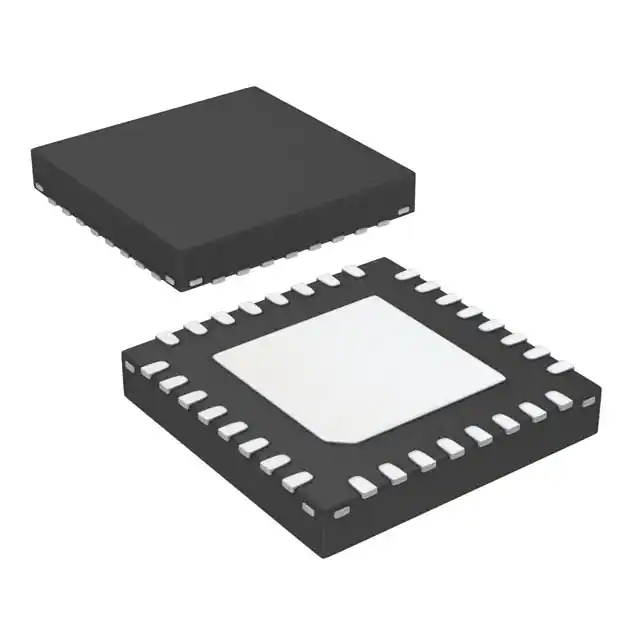
ATA8510-GHQW is housed in a 5 × 5 mm QFN32 package with 0.5 mm pitch and exposed die pad (AGND). Pin functions are validated per Atmel/Microchip datasheet 9315G–INDCO–08/15.
| Pin/Terminal | Circuit Role | Design Meaning |
|---|---|---|
| RFIN_LB (Pin 1) | Low-band LNA input | RF signal input for 310–477 MHz band; requires external matching network and DC path to ground |
| RFIN_HB (Pin 2) | High-band LNA input | RF signal input for 836–956 MHz band; used instead of RFIN_LB in 868/915 MHz applications |
| SPDT_ANT (Pin 4) | Antenna switch I/O | 50 Ω bidirectional port - connects to antenna in both RX and TX modes via internal SPDT switch |
| ANT_TUNE (Pin 5) | Antenna tuning control | Drives integrated variable capacitor for automatic loop antenna resonance calibration at Tx center frequency |
| RF_OUT (Pin 7) | PA output | Delivers programmable RF power up to +14.5 dBm; requires external harmonic filter for FCC/EN compliance |
| PB6/EVENT (Pin 28) | Firmware event flag | Asserts active-low interrupt to external host MCU on telegram start, FIFO status, or service completion |
| PC1..PC5 | NPWRON inputs | Five dedicated wake-up pins with internal 50 kΩ pull-ups - support button-triggered OFFMode exit without host MCU |
Key Features
| Feature | Design Value |
|---|---|
| Service-based configuration | Five total services (3 EEPROM + 2 SRAM); each with 3 channels - enables concurrent multi-frequency, multi-modulation scanning without reconfiguration overhead |
| Dual receive paths (A/B) | Independent demodulation chains - allow simultaneous detection of two distinct telegrams (e.g., different data rates or modulation types) |
| Digital RSSI | ±1 dB relative accuracy across temperature - eliminates need for external calibration in battery-powered sensor reporting |
| Automatic antenna tuning | On-chip variable capacitor controlled via ANT_TUNE pin - compensates for PCB trace antenna drift due to temperature/hand effects |
| Pattern-based wake-up | Hardware-accelerated preamble/SFID detection - reduces Rx duty cycle and extends battery life in polling-mode sensors |
Applications
| Remote Keyless Entry (RKE) | Wireless Sensor Node |
|---|---|
|
Use Scenario: Automotive key fob transmitting encrypted lock/unlock commands to vehicle receiver. IC Role / Device Role / Timing Role: Stand-alone transceiver executing firmware-driven encryption, ASK/FSK modulation, and low-latency TXMode activation (<1.5 ms from OFFMode). Use Value: 20 KB Flash enables OEM-specific security stack integration; 5 nA OFFMode current ensures >10-year shelf life on CR2032. |
Use Scenario: Battery-powered temperature/humidity sensor reporting to gateway every 5 minutes. IC Role / Device Role / Timing Role: Autonomous polling node using SRAM-modifiable service configs to adapt channel/frequency based on local interference. Use Value: Dual Rx paths and –122.5 dBm sensitivity at 0.75 kbit/s maximize range in noisy industrial environments while minimizing Tx power. |
| Home Automation Actuator | Smoke Detector Alert Transmitter |
|
Use Scenario: Wall-mounted smart switch receiving commands and controlling lighting loads via Zigbee-to-ISM bridge. IC Role / Device Role / Timing Role: SPI-slave transceiver interfacing with host MCU; handles Manchester-coded telegrams and EVENT-driven status reporting. Use Value: Programmable Rx-IF bandwidth (25–366 kHz) rejects adjacent-channel interference in dense 433 MHz deployments. |
Use Scenario: UL-certified smoke detector sending alarm burst upon smoke detection. IC Role / Device Role / Timing Role: Ultra-low-power transmitter activated by analog comparator; uses OFFMode wake-up via PC1 and immediate TXMode entry. Use Value: Guaranteed 600 nA max OFFMode current at 85°C ensures reliable operation in hot attic installations over 10+ years. |
Equivalent & Alternatives
The following parts are listed as comparable options for similar UHF ASK/FSK transceiver applications.
| Alternative Part | Technical Difference | Application Difference | Selection Advice |
|---|---|---|---|
| Silicon Labs Si4463-B1B-FMR | No integrated MCU; requires external processor; higher Rx sensitivity (–133 dBm @ 1.2 kbps) but no Flash/SRAM | Better suited for host-controlled systems needing maximum sensitivity, not self-contained firmware execution | Choose Si4463 if host MCU handles protocol stack and ultra-low-noise reception is prioritized over firmware autonomy |
| TI CC1120RHBR | Integrated 8051 MCU (4 KB RAM, 32 KB Flash); narrower frequency coverage (27–1050 MHz, no sub-GHz ISM focus); higher typical Rx current (14.3 mA) | Targeted at proprietary PHY layers with advanced packet handling, less optimized for EN 300 220-compliant ASK/FSK | Choose CC1120 if migrating from TI ecosystem and requiring integrated 8051 with extensive RF register control |
Compared with Si4463-B1B-FMR and CC1120RHBR, ATA8510-GHQW uniquely combines 20 KB user Flash, service-based polling, and <5 nA OFFMode current - making it optimal for cost-sensitive, battery-limited devices requiring firmware-defined behavior without host dependency.
Availability
ATA8510-GHQW is available at Aetrix Electronics and suitable for remote keyless entry, wireless sensor networks, home automation actuators, and smoke detector alert transmitters requiring stable component supply and long-term lifecycle support.
Supply support for ATA8510-GHQW includes scheduled delivery planning, volume procurement assistance, BOM continuity management, traceable sourcing, and lifecycle availability coordination for OEM customers, industrial embedded developers, connected-device designers, and electronics production programs.
Manufacturer
Microchip Technology acquired Atmel in 2016 and maintains full support for the legacy ATA85xx transceiver family. The company specializes in microcontrollers, analog, and connectivity solutions for industrial, automotive, and IoT markets.
The ATA8510-GHQW belongs to Microchip's UHF ISM transceiver product line, designed specifically for battery-powered remote control and sensor applications demanding ultra-low-power operation, regulatory compliance (EN 300 220/FCC Part 15), and firmware flexibility.
FAQ
What is the primary function of the ATA8510-GHQW?
The ATA8510-GHQW is a fully integrated UHF ASK/FSK transceiver with an embedded 8-bit AVR® microcontroller, 20 KB user Flash, and 1 KB SRAM. It performs RF transmission and reception across 310–477 MHz and 836–956 MHz bands while executing custom firmware for protocol handling, polling, and antenna tuning - eliminating the need for an external host MCU in many applications.
Does the ATA8510-GHQW support both ASK and FSK modulation?
Yes, the ATA8510-GHQW natively supports both ASK and FSK modulation. It includes hardware-based ASK shaping to reduce spectral bandwidth and programmable FSK deviation from ±0.375 kHz to ±93 kHz. Mixed ASK/FSK telegrams are supported, and Manchester coding is implemented for both modulation types with verified sensitivity down to –122.5 dBm at 0.75 kbit/s.
How does the service-based configuration model work in the ATA8510-GHQW?
The ATA8510-GHQW organizes RF settings into five services: three stored in EEPROM (fixed) and two in SRAM (modifiable on-the-fly). Each service contains three channels with independent frequency, modulation, and data rate settings. During IDLEMode, SPI commands or firmware can update SRAM services - enabling dynamic adaptation to interference or protocol changes without EEPROM wear or system reset.
What is the significance of the 5 nA OFFMode current in the ATA8510-GHQW?
The typical 5 nA OFFMode current (max 600 nA at 3.6 V / 85°C) allows the ATA8510-GHQW to remain powered for over a decade on a single CR2032 coin cell when used in infrequent wake-up applications like smoke detectors or utility metering. This ultra-low quiescent current is achieved through complete power gating of analog/digital blocks and biasing of NPWRON pins directly from VS.
Can the ATA8510-GHQW perform automatic antenna tuning?
Yes, the ATA8510-GHQW integrates an on-chip variable capacitor controlled via the ANT_TUNE pin (Pin 5) to automatically tune loop antennas to the transmit center frequency. This calibration compensates for manufacturing tolerances and environmental shifts (e.g., temperature, proximity), maintaining optimal RF efficiency without manual adjustment - a key feature confirmed in the 9315G–INDCO–08/15 datasheet.
ATA8510-GHQW Specifications
- Product attributes
- Attribute value
- Manufacturer:
- Microchip Technology
- Series:
- -
- Package/Case:
- 32-VFQFN Exposed Pad
- Packaging:
- Tape & Reel (TR)
- Product Status:
- Active
- Programmable:
- Not Verified
- Type:
- TxRx + MCU
- RF Family/Standard:
- General ISM < 1GHz
- Protocol:
- -
- Modulation:
- ASK, FSK
- Frequency:
- 315MHz, 433MHz, 868MHz, 915MHz
- Data Rate (Max):
- -
- Power - Output:
- 14.5dBm
- Sensitivity:
- -125dBm
- Memory Size:
- 20kB Flash
- Serial Interfaces:
- SPI
- GPIO:
- 2
- Voltage - Supply:
- 1.9V ~ 3.6V
- Current - Receiving:
- 10.5mA
- Current - Transmitting:
- 33.5mA
- Operating Temperature:
- -40°C ~ 85°C
- Grade:
- -
- Qualification:
- -
- Supplier Device Package:
- 32-VQFN (5x5)
ATA8510-GHQW FAQ
1.How can I place an order for ATA8510-GHQW through Aetrix?
Please submit a Request for Quotation (RFQ) for ATA8510-GHQW on Aetrix. Our sales agent will provide a competitive quotation and guide you through the order confirmation once you accept the terms.
2.Are the price and stock information for ATA8510-GHQW reliable?
The price and inventory of ATA8510-GHQW are updated periodically and may fluctuate due to market conditions. Stock and pricing data are typically refreshed every 24 hours. Quotation validity for ATA8510-GHQW is usually 5 days.
3.What payment methods are accepted for ATA8510-GHQW?
We accept Wire Transfer, PayPal, Credit Card, Western Union, MoneyGram, and Escrow for ATA8510-GHQW transactions.
Note: Certain payment methods may incur a processing fee.
4.How is shipping managed for ATA8510-GHQW?
ATA8510-GHQW orders can be shipped via leading logistics carriers, including DHL, UPS, FedEx, TNT, or Registered Mail.
Once your ATA8510-GHQW order is processed, you will receive an email with the shipment details and tracking number.
Note: Tracking information may take up to 24 hours to appear. Express delivery typically takes 3–5 business days.
5.How can I obtain technical support or documentation for ATA8510-GHQW?
For technical support, including ATA8510-GHQW datasheets, pinout diagrams, or application guidance, please contact our engineering support team. They can provide detailed documentation and assistance for your ATA8510-GHQW requirements.
6.How does Aetrix verify that ATA8510-GHQW is sourced from the original manufacturer or authorized distributors?
All ATA8510-GHQW products on Aetrix are procured from qualified distributors and authorized channels. Our dedicated quality assurance team conducts strict verification, including traceability checks and, if necessary, third-party testing. This ensures that ATA8510-GHQW meets industry standards.
7.What is the process for return or replacement of ATA8510-GHQW?
All ATA8510-GHQW units undergo pre-shipment inspection (PSI). If there is an issue with ATA8510-GHQW, returns or replacements are accepted under the following conditions:
1.Quantity discrepancies, incorrect items, or visible external defects (such as breakage or corrosion), acknowledged by Aetrix.
2.The issue is reported within 90 days of delivery.
3.The ATA8510-GHQW part is unused and in its original packaging.
Return procedure for ATA8510-GHQW:
1.Submit a request within 90 days.
2.Obtain a Return Material Authorization (RMA) from Aetrix.
ATA8510-GHQW Tags
-
ESP32-D0WD-V3
Espressif Systems
-
ESP8266EX
Espressif Systems

-
ESP32-S3
Espressif Systems
-
NRF24L01P-R7
Nordic Semiconductor ASA
-
NRF24L01P-R
Nordic Semiconductor ASA
-
ESP32-U4WDH
Espressif Systems
-
DA14531-00000OG2
Renesas
-
ESP32-C6FH4
Espressif Systems
-
DA14531-00000FX2
Renesas
-
NRF24L01P-T
Nordic Semiconductor ASA
-
NRF52810-QCAA-R
Nordic Semiconductor ASA
-
ESP32-S3FN8
Espressif Systems
Tech Hub

TTL and CMOS logic families differ in thresholds, loading, output drive, power and timing. This engineering guide compares 74HC and 74HCT, calculates noise margins and checks 3.3 V/5 V compatibility.

A practical engineering guide to 3.3V and 5V logic compatibility, input thresholds, resistor dividers, translator ICs, MOSFET level shifting, I2C pull-ups, timing limits and power-sequencing risks.

The 74HC595 uses push-pull logic outputs, while the TPIC6B595 uses 50 V open-drain DMOS sinks for higher-power loads. This guide compares timing, current limits, 3.3 V interfacing, load wiring, thermal…

The 74HC595 converts serial data into eight stable parallel outputs. This guide covers pin functions, shift and storage timing, OE and MR behavior, drive-current limits, cascading, voltage compatibilit…

A technical comparison of level-sensitive latches and edge-triggered flip-flops, covering timing windows, setup and hold limits, master–slave operation, time borrowing, race-through, HDL inference and…

A D latch stores one bit while Enable controls when data can pass. This reference covers gate-level operation, truth tables, transparency, setup and hold timing, LE versus OE, common ICs and practical …

An SR latch stores one bit through cross-coupled feedback. This engineering reference covers NOR and NAND implementations, truth tables, forbidden-state recovery, gated operation, switch debouncing, fa…

Latch circuits retain one bit through feedback. This technical reference covers SR and D latches, truth tables, transparency, timing limits, latch-versus-flip-flop behavior, applications and common log…

An engineering guide to LED driver operation, constant-current and constant-voltage outputs, linear and switching topologies, dimming, IC selection, calculations, replacement compatibility, and fault c…

Operational amplifier guide covering op amp basics, feedback, ideal vs real op amps, common configurations, buffer circuits, offset, bias current, gain-bandwidth, slew rate, rail-to-rail limits and sel…


