
 My Inquiry
 My Account


Microchip Technology ATSAMR21E19A-MFT
- Part No.:
- ATSAMR21E19A-MFT
- Manufacturer:
- Microchip Technology
- Category:
- RF Transceiver ICs
- Package:
- 32-VFQFN Exposed Pad
- Datasheet:
-
 ATSAMR21E19A-MFT.pdf
- Description:
- IC RF TXRX+MCU ISM>1GHZ 32QFN
- Quantity:
- Payment:

- Shipping:

Inventory:9,950
Please send an inquiry. Send us your inquiry, and we will respond immediately.
Product details
Overview
ATSAMR21E19A-MFT from Microchip Technology (formerly Atmel) is a 32-bit ARM Cortex-M0+ wireless microcontroller integrating an ultra-low-power 2.4GHz ISM band transceiver, 256KB on-chip Flash + 512KB serial Flash, 32KB SRAM, and operating at up to 48MHz. It delivers -99dBm RX sensitivity, +4dBm TX output power, and supports 250kb/s data rate for IEEE 802.15.4-compliant mesh and point-to-point IoT sensor nodes.
For engineers reviewing the ATSAMR21E19A-MFT datasheet, ATSAMR21E19A-MFT pinout, ATSAMR21E19A-MFT application, or ATSAMR21E19A-MFT equivalent, key selection criteria include QFN32 package compatibility, integrated AT86RF233 transceiver interface, SleepWalking peripheral autonomy, and SERCOM-configurable USART/I²C/SPI interfaces for low-power edge device design.
Technical Context
The ATSAMR21E19A-MFT implements a tightly coupled ARM Cortex-M0+ core with Micro Trace Buffer (MTB) and single-cycle hardware multiplier, paired with a dedicated 2.4GHz transceiver subsystem based on the AT86RF233 IC. Its clock system combines DFLL48M and FDPLL96M for precise frequency synthesis across CPU, peripherals, and RF domains.
Peripherals include three 16-bit Timer/Counters (TC), three 16-bit Timer/Counters for Control (TCC), a 12-channel Event System enabling inter-peripheral signaling in standby mode, and four SERCOM modules-each configurable as USART, SPI, I²C (up to 3.4MHz), or LIN slave-plus a full-speed USB 2.0 interface with embedded host/device capability.
Key Specifications
| Parameter | Value and Actual Design Meaning |
|---|---|
| CPU Core | ARM Cortex-M0+ running at up to 48MHz; enables deterministic real-time control with 2.46 CoreMark/MHz efficiency. |
| Memory | 256KB embedded Flash + 512KB external serial Flash (MX25V4006EWSK); supports over-the-air firmware updates without external memory controller. |
| RF Transceiver | Integrated AT86RF233-based 2.4GHz ISM transceiver with -99dBm sensitivity and +4dBm output; eliminates discrete RF front-end components. |
| ADC | 12-bit, 350ksps ADC with 4 external channels, programmable gain (1/2x–16x), and hardware oversampling to 16-bit resolution; suitable for battery voltage and sensor signal monitoring. |
| Power Modes | Idle and standby sleep modes with SleepWalking support; allows peripherals like TC or ADC to operate autonomously without waking CPU, reducing average current to µA range. |
| Operating Voltage | 1.8V–3.6V supply range; compatible with single-cell Li-ion, LiPo, or two-cell alkaline battery systems. |
| Temperature Range | -40°C to +85°C industrial grade; validated for deployment in uncontrolled indoor/outdoor environments. |
Pinout & Package
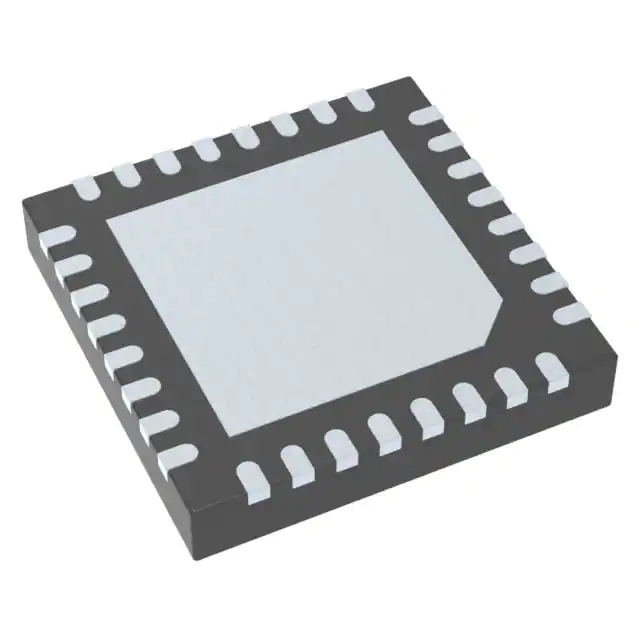
ATSAMR21E19A-MFT uses a 32-pin QFN package (5mm × 5mm, 0.5mm pitch) with exposed thermal pad connected to GND. Pin functions are multiplexed via PORT peripheral enable registers; RF pins RFP/RFN require differential 100Ω layout and AC coupling per AT86RF233 requirements.
| Pin/Terminal | Circuit Role | Design Meaning |
|---|---|---|
| PA00 / PA01 | XOSC32K input/output | Connects to 32.768kHz crystal for RTC/calendar; not present on SAM R21E variant per datasheet Table 4-2. |
| PA14 / PA15 | RFP / RFN | Differential RF port for 2.4GHz transceiver; requires matched 100Ω differential trace and DC-blocking capacitors. |
| PA30 / PA31 | SWCLK / SWDIO | Two-pin Serial Wire Debug interface; supports non-intrusive on-chip debug and flash programming. |
| XTAL1 / XTAL2 | XOSCRF oscillator | 16MHz crystal connection for RF transceiver PLL; internal oscillator drives AT86RF233 timing independently of main CPU clock. |
| PA24 / PA25 | USB_DM / USB_DP | Full-speed USB 2.0 differential pair; enables embedded host/device connectivity for firmware updates or HID bridging. |
Key Features
| Feature | Design Value |
|---|---|
| Hardware-assisted MAC | Auto-Acknowledge and Auto-Retry reduce host CPU overhead in packet transmission, improving link reliability in noisy 2.4GHz environments. |
| SleepWalking peripherals | Enables TC, ADC, or SERCOM to wake autonomously and execute predefined tasks (e.g., periodic sensor sampling) before waking CPU-cutting active time by >90% in duty-cycled applications. |
| 12-channel Event System | Allows peripherals to trigger each other directly (e.g., ADC completion → DMA transfer → TC timeout → interrupt), eliminating software polling and reducing latency to sub-microsecond levels. |
| Peripheral Touch Controller (PTC) | Supports up to 48 capacitive touch sensing points using only 6×2 X/Y lines; enables intuitive HMI on space-constrained PCBs without external touch IC. |
| Configurable SERCOM modules | Four SERCOM instances each support USART, SPI, I²C (up to 3.4MHz), or LIN slave-enabling flexible sensor, display, or legacy bus interfacing with shared pin resources. |
Applications
| Smart Home Sensor Node | Industrial Wireless Monitor |
|---|---|
Use Scenario: Battery-powered temperature/humidity/motion sensor node transmitting data every 5 minutes to a gateway via IEEE 802.15.4 mesh network. IC Role / Device Role / Timing Role: ATSAMR21E19A-MFT acts as system-on-chip controller and RF transceiver, managing sensor acquisition, low-power scheduling, and secure frame transmission. Use Value: Integrated AT86RF233 and SleepWalking reduce BOM count by 3 components and extend battery life beyond 5 years on two AA cells. | Use Scenario: DIN-rail mounted vibration and current monitor in factory automation, reporting anomalies via TSCH-enabled Thread network. IC Role / Device Role / Timing Role: ATSAMR21E19A-MFT serves as real-time edge processor and radio co-processor, executing FFT-based vibration analysis and synchronizing transmissions using RTC alarm triggers. Use Value: Hardware CRC-16, AES encryption, and deterministic TCC PWM generation enable secure, time-synchronized diagnostics without external crypto or timing ICs. |
| Medical Wearable Tracker | Asset Tracking Beacon |
Use Scenario: Disposable skin patch measuring skin impedance and ambient UV, transmitting encrypted health metrics hourly to smartphone BLE gateway. IC Role / Device Role / Timing Role: ATSAMR21E19A-MFT functions as analog front-end controller, cryptographic engine, and 2.4GHz transmitter-leveraging ADC oversampling and hardware AES for local data processing. Use Value: 12-bit ADC with 16x gain and hardware decimation achieves 16-bit effective resolution for precision bio-signal capture while minimizing MCU intervention. | Use Scenario: GPS-denied indoor logistics tag using RSSI triangulation and motion-triggered wake-up to report location every 30 seconds in warehouse zones. IC Role / Device Role / Timing Role: ATSAMR21E19A-MFT operates as autonomous beacon controller, using EIC-driven wake-on-motion and TC-based interval timing to minimize active RF duty cycle. Use Value: Standby current < 1.5µA and RF-ready wake time < 100µs enable multi-year operation on CR2032 coin cell with motion-triggered reporting. |
Equivalent & Alternatives
The following parts are listed as comparable options for similar wireless microcontroller applications.
| Alternative Part | Technical Difference | Application Difference | Selection Advice |
|---|---|---|---|
| ATSAMR21G18A-MF | 48-pin QFN, 28 GPIOs, 256KB Flash (no serial Flash), includes XOSC32K for RTC | Requires external serial Flash for OTA updates; better suited for designs needing more I/O or integrated RTC crystal support | Select when board layout accommodates larger QFN48 and RTC accuracy demands external 32.768kHz crystal. |
| STM32WB55RGV | ARM Cortex-M4/M0+ dual-core, Bluetooth LE 5.0 + IEEE 802.15.4, 1MB Flash, no external serial Flash needed | Higher RF protocol stack integration (BLE + Zigbee), but lacks SleepWalking and Event System-level peripheral autonomy | Select when Bluetooth coexistence or dual-protocol support is required, accepting higher active power and less autonomous peripheral offload. |
Compared with ATSAMR21G18A-MF, ATSAMR21E19A-MFT offers integrated 512KB serial Flash for robust OTA updates in compact QFN32 form factor; versus STM32WB55RGV, it provides superior low-power peripheral autonomy via SleepWalking and Event System-but requires external protocol stack implementation for IEEE 802.15.4.
Availability
ATSAMR21E19A-MFT is available at Aetrix Electronics and suitable for smart home sensor nodes, industrial wireless monitors, medical wearables, and asset tracking beacons requiring stable component supply and long-term production continuity.
Supply support for ATSAMR21E19A-MFT includes scheduled delivery planning, volume procurement assistance, BOM continuity management, traceable sourcing, and lifecycle availability coordination for OEM customers, industrial embedded developers, connected-device designers, and electronics production programs.
Manufacturer
Microchip Technology acquired Atmel in 2016 and maintains the SMART ARM-based microcontroller portfolio, emphasizing low-power, integrated wireless SoCs for IoT edge applications.
The SAM R21 product line was designed specifically for IEEE 802.15.4-based mesh networking and battery-operated sensor endpoints, combining ARM Cortex-M0+ performance with AT86RF233 RF fidelity and ultra-low-power peripheral subsystems.
FAQ
What is the RF transceiver architecture used in the ATSAMR21E19A-MFT?
The ATSAMR21E19A-MFT integrates the AT86RF233 single-chip 2.4GHz transceiver, which implements direct-sequence spread spectrum with O-QPSK modulation, hardware-assisted MAC (Auto-Ack, Auto-Retry), and a 128-byte frame buffer. It connects via dedicated SERCOM4 pins and requires external 16MHz crystal on XTAL1/XTAL2. The transceiver supports 250kb/s data rate with -99dBm sensitivity and +4dBm output power.
Does the ATSAMR21E19A-MFT include an integrated 32.768kHz crystal oscillator for RTC functionality?
No, the ATSAMR21E19A-MFT does not include an integrated 32.768kHz crystal oscillator (XOSC32K). Per datasheet Section 4.2 and Configuration Summary (page 4), XOSC32K is only available on SAM R21G variants. RTC functionality remains supported using the internal 32kHz ultra-low-power oscillator (OSCULP32K), though with lower accuracy than crystal-referenced timekeeping.
How many SERCOM modules are available on the ATSAMR21E19A-MFT, and what interfaces do they support?
The ATSAMR21E19A-MFT includes four SERCOM modules (SERCOM0–SERCOM3), each configurable as USART, UART, SPI, I²C (up to 3.4MHz), or LIN slave. SERCOM4 is reserved for internal connection to the AT86RF233 transceiver and is not available for general-purpose use. This configuration supports concurrent sensor communication (I²C), debug logging (USART), and actuator control (SPI) without external bus expanders.
What is the maximum ADC resolution achievable with hardware oversampling on the ATSAMR21E19A-MFT?
The ATSAMR21E19A-MFT's 12-bit, 350ksps ADC supports hardware oversampling and decimation to achieve up to 16-bit effective resolution. This is accomplished by sampling at higher rates (e.g., 4×, 8×, 16×, or 64× oversampling) followed by digital averaging in hardware-reducing quantization noise without CPU intervention. The feature is enabled via ADC CTRLB register settings and requires no firmware-based post-processing.
Can the ATSAMR21E19A-MFT operate in deep-sleep mode while maintaining RF readiness?
Yes, the ATSAMR21E19A-MFT supports standby sleep mode with selective peripheral retention, including the AT86RF233 transceiver's ability to remain powered and responsive to incoming frames. The Event System can wake the CPU upon IRQ assertion from the transceiver, achieving RF-ready wake times under 100µs. However, true DEEP_SLEEP (as defined in AT86RF233 datasheet) disables DVDD/AVDD regulators and requires full reinitialization-so standby is the lowest-power RF-active state.
ATSAMR21E19A-MFT Specifications
- Product attributes
- Attribute value
- Manufacturer:
- Microchip Technology
- Series:
- -
- Package/Case:
- 32-VFQFN Exposed Pad
- Packaging:
- Tape & Reel (TR)
- Product Status:
- Active
- Programmable:
- Not Verified
- Type:
- TxRx + MCU
- RF Family/Standard:
- General ISM > 1GHz
- Protocol:
- -
- Modulation:
- O-QPSK
- Frequency:
- 2.4GHz
- Data Rate (Max):
- 250kbps
- Power - Output:
- 4dBm
- Sensitivity:
- -99dBm
- Memory Size:
- 768kB Flash, 32kB SRAM
- Serial Interfaces:
- I2C, SPI, UART, USART, USB
- GPIO:
- 16
- Voltage - Supply:
- 2.35V ~ 3.6V
- Current - Receiving:
- 11.3mA ~ 11.8mA
- Current - Transmitting:
- 7.2mA ~ 13.8mA
- Operating Temperature:
- -40°C ~ 125°C
- Grade:
- -
- Qualification:
- -
- Supplier Device Package:
- 32-QFN (5x5)
ATSAMR21E19A-MFT FAQ
1.How can I place an order for ATSAMR21E19A-MFT through Aetrix?
Please submit a Request for Quotation (RFQ) for ATSAMR21E19A-MFT on Aetrix. Our sales agent will provide a competitive quotation and guide you through the order confirmation once you accept the terms.
2.Are the price and stock information for ATSAMR21E19A-MFT reliable?
The price and inventory of ATSAMR21E19A-MFT are updated periodically and may fluctuate due to market conditions. Stock and pricing data are typically refreshed every 24 hours. Quotation validity for ATSAMR21E19A-MFT is usually 5 days.
3.What payment methods are accepted for ATSAMR21E19A-MFT?
We accept Wire Transfer, PayPal, Credit Card, Western Union, MoneyGram, and Escrow for ATSAMR21E19A-MFT transactions.
Note: Certain payment methods may incur a processing fee.
4.How is shipping managed for ATSAMR21E19A-MFT?
ATSAMR21E19A-MFT orders can be shipped via leading logistics carriers, including DHL, UPS, FedEx, TNT, or Registered Mail.
Once your ATSAMR21E19A-MFT order is processed, you will receive an email with the shipment details and tracking number.
Note: Tracking information may take up to 24 hours to appear. Express delivery typically takes 3–5 business days.
5.How can I obtain technical support or documentation for ATSAMR21E19A-MFT?
For technical support, including ATSAMR21E19A-MFT datasheets, pinout diagrams, or application guidance, please contact our engineering support team. They can provide detailed documentation and assistance for your ATSAMR21E19A-MFT requirements.
6.How does Aetrix verify that ATSAMR21E19A-MFT is sourced from the original manufacturer or authorized distributors?
All ATSAMR21E19A-MFT products on Aetrix are procured from qualified distributors and authorized channels. Our dedicated quality assurance team conducts strict verification, including traceability checks and, if necessary, third-party testing. This ensures that ATSAMR21E19A-MFT meets industry standards.
7.What is the process for return or replacement of ATSAMR21E19A-MFT?
All ATSAMR21E19A-MFT units undergo pre-shipment inspection (PSI). If there is an issue with ATSAMR21E19A-MFT, returns or replacements are accepted under the following conditions:
1.Quantity discrepancies, incorrect items, or visible external defects (such as breakage or corrosion), acknowledged by Aetrix.
2.The issue is reported within 90 days of delivery.
3.The ATSAMR21E19A-MFT part is unused and in its original packaging.
Return procedure for ATSAMR21E19A-MFT:
1.Submit a request within 90 days.
2.Obtain a Return Material Authorization (RMA) from Aetrix.
ATSAMR21E19A-MFT Tags
-
ESP32-D0WD-V3
Espressif Systems
-
ESP8266EX
Espressif Systems

-
ESP32-S3
Espressif Systems
-
NRF24L01P-R7
Nordic Semiconductor ASA
-
NRF24L01P-R
Nordic Semiconductor ASA
-
ESP32-U4WDH
Espressif Systems
-
DA14531-00000OG2
Renesas
-
ESP32-C6FH4
Espressif Systems
-
DA14531-00000FX2
Renesas
-
NRF24L01P-T
Nordic Semiconductor ASA
-
NRF52810-QCAA-R
Nordic Semiconductor ASA
-
ESP32-S3FN8
Espressif Systems
Tech Hub

TTL and CMOS logic families differ in thresholds, loading, output drive, power and timing. This engineering guide compares 74HC and 74HCT, calculates noise margins and checks 3.3 V/5 V compatibility.

A practical engineering guide to 3.3V and 5V logic compatibility, input thresholds, resistor dividers, translator ICs, MOSFET level shifting, I2C pull-ups, timing limits and power-sequencing risks.

The 74HC595 uses push-pull logic outputs, while the TPIC6B595 uses 50 V open-drain DMOS sinks for higher-power loads. This guide compares timing, current limits, 3.3 V interfacing, load wiring, thermal…

The 74HC595 converts serial data into eight stable parallel outputs. This guide covers pin functions, shift and storage timing, OE and MR behavior, drive-current limits, cascading, voltage compatibilit…

A technical comparison of level-sensitive latches and edge-triggered flip-flops, covering timing windows, setup and hold limits, master–slave operation, time borrowing, race-through, HDL inference and…

A D latch stores one bit while Enable controls when data can pass. This reference covers gate-level operation, truth tables, transparency, setup and hold timing, LE versus OE, common ICs and practical …

An SR latch stores one bit through cross-coupled feedback. This engineering reference covers NOR and NAND implementations, truth tables, forbidden-state recovery, gated operation, switch debouncing, fa…

Latch circuits retain one bit through feedback. This technical reference covers SR and D latches, truth tables, transparency, timing limits, latch-versus-flip-flop behavior, applications and common log…

An engineering guide to LED driver operation, constant-current and constant-voltage outputs, linear and switching topologies, dimming, IC selection, calculations, replacement compatibility, and fault c…

Operational amplifier guide covering op amp basics, feedback, ideal vs real op amps, common configurations, buffer circuits, offset, bias current, gain-bandwidth, slew rate, rail-to-rail limits and sel…


