
 My Inquiry
 My Account


Microchip Technology ATSAMR34J16BT-I/7JX
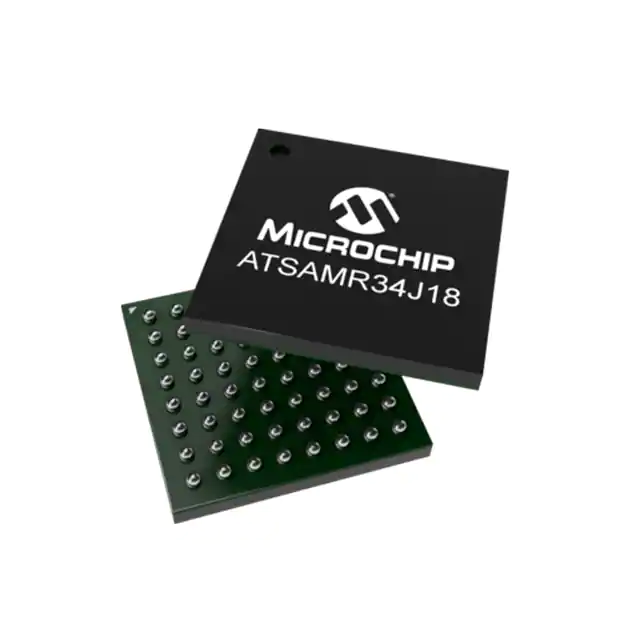
- Part No.:
- ATSAMR34J16BT-I/7JX
- Manufacturer:
- Microchip Technology
- Category:
- RF Transceiver ICs
- Package:
- 64-TFBGA
- Datasheet:
-
 ATSAMR34J16BT-I/7JX.pdf
- Description:
- IC RF TXRX+MCU 802.15.4 64TFBGA
- Quantity:
- Payment:

- Shipping:

Inventory:2,358
Please send an inquiry. Send us your inquiry, and we will respond immediately.
Product details
Overview
ATSAMR34J16BT-I/7JX from Microchip Technology is an ultra-low-power System-in-Package (SiP) combining a 32-bit ARM Cortex-M0+ MCU (48 MHz, 2.46 CoreMark/MHz) with integrated LoRa®/FSK UHF transceiver (137–1020 MHz), 64 KB Flash, 8 KB SRAM, and 4 KB low-power SRAM. It supports USB 2.0 Full-Speed interface and operates from 1.8V–3.6V for battery-powered remote sensor nodes and industrial telemetry gateways.
For engineers reviewing the ATSAMR34J16BT-I/7JX datasheet, ATSAMR34J16BT-I/7JX pinout, ATSAMR34J16BT-I/7JX application, or ATSAMR34J16BT-I/7JX equivalent, key selection criteria include LoRa modulation support, integrated USB for firmware updates, 64-ball TFBGA package (6×6 mm), -40°C to +85°C industrial temperature range, and SleepWalking peripheral wake-up capability in ultra-low-power modes.
Technical Context
The ATSAMR34J16BT-I/7JX integrates a Cortex-M0+ core with a dedicated LoRa/FSK transceiver subsystem sharing SERCOM4 for SPI-based host control. Its RF front-end includes tri-band coverage (137–175 MHz, 410–525 MHz, 862–1020 MHz), +20 dBm max output power (RFO_HF), and high sensitivity down to -136 dBm (LoRaWAN™ compliant). The MCU implements power domain gating, multiple sleep modes (Idle/Standby/Backup), and hardware-accelerated SleepWalking to enable autonomous peripheral operation without CPU wake-up.
RF and digital domains are isolated via separate supply rails (VDDANA, VDDIO2, VSW, VBAT_RF) and dedicated clock sources including XOSCRF (16 MHz RF oscillator), DFLL48M, and FDPLL96M. The transceiver connects internally to PB30/PB31/PC18/PC19 (SERCOM4 pins), while USB signals (DM/DP/SOF) route to PA24/PA25/PA23 - all validated in the 64-ball BGA land pattern per DS70005356C-page 45.
Key Specifications
| Parameter | Value and Actual Design Meaning |
|---|---|
| CPU Core | ARM Cortex-M0+, 48 MHz max - delivers 2.46 CoreMark/MHz efficiency for real-time LoRa packet processing. |
| Memory | 64 KB Flash / 8 KB SRAM / 4 KB LP-SRAM - sufficient for compact LoRaWAN stack + sensor firmware with battery-backed retention. |
| RF Bands | 137–175 MHz, 410–525 MHz, 862–1020 MHz - enables global sub-GHz deployment without hardware variants. |
| Max TX Power | +20 dBm (100 mW) at RFO_HF - achieves >160 dB link budget for long-range rural sensor networks. |
| Sensitivity | -136 dBm (LoRaWAN™ mode) - ensures reliable reception under weak-signal conditions typical of deep-indoor deployments. |
| USB Interface | Full-Speed (12 Mbps) USB 2.0 - enables direct firmware updates and PC-side debugging without external bridge ICs. |
| Operating Temp | -40°C to +85°C - qualified for uncontrolled industrial environments including outdoor gateways and utility metering. |
| Supply Voltage | 1.8V–3.6V - compatible with single-cell LiSOCl₂, dual-cell alkaline, or regulated 3.3V systems. |
Pinout & Package
ATSAMR34J16BT-I/7JX uses a 64-ball 6×6 mm Thin Fine-Pitch Ball Grid Array (TFBGA) package (7JX), with 27 programmable I/O pins, dedicated RF I/O (RFI_HF/RFO_HF/PA_BOOST), analog supplies (VDDANA/VBAT_ANA), and USB physical layer routing (PA23/PA24/PA25).
| Pin/Terminal | Circuit Role | Design Meaning |
|---|---|---|
| PA23 / PA24 / PA25 | USB DP / DM / SOF | Direct Full-Speed USB 2.0 physical layer interface - eliminates need for external USB transceiver in dongle designs. |
| RFI_HF / RFO_HF | RF Transceiver HF Input/Output | Connects to external matching network and antenna for 410–525 MHz or 862–1020 MHz bands. |
| PA_BOOST | High-Power Amplifier Enable | Controls +20 dBm output stage - must be driven high only when RFO_HF is active and VDDANA > 2.4 V. |
| PB30 / PB31 / PC18 / PC19 | SERCOM4 SPI Interface | Hardwired to transceiver for register access, packet FIFO control, and interrupt signaling (DIO0–DIO5). |
| VDDANA / VBAT_ANA | Analog Supply / Backup Rail | Separate 1.8–3.6V analog domain ensures RF stability; VBAT_ANA retains RTC and LP-SRAM during main power loss. |
Key Features
| Feature | Design Value |
|---|---|
| Tri-band LoRa Transceiver | Single SiP covers 137–175 MHz, 410–525 MHz, and 862–1020 MHz - avoids regional SKU proliferation and simplifies inventory. |
| SleepWalking Peripherals | ADC, TC, or SERCOM can autonomously sample, time, or receive data and wake CPU only on threshold/event - extends battery life by >10× vs polling. |
| Hardware CRC-32 Engine | Dedicated accelerator offloads LoRa packet integrity checks from CPU - reduces active time per transmission by ~120 µs. |
| Configurable Custom Logic (CCL) | Three independent CCL blocks implement glue logic (e.g., DIO signal conditioning, wake-up filtering) without CPU intervention or firmware overhead. |
| Integrated USB PHY | On-die USB transceiver supports device/host roles - enables field-upgradable gateways and secure bootloader delivery over USB mass storage. |
Applications
| Smart Utility Metering | Remote Environmental Monitoring |
|---|---|
Use Scenario: Battery-powered water/gas meters transmitting hourly consumption data over 5–15 km rural LoRaWAN networks. IC Role / Device Role / Timing Role: ATSAMR34J16BT-I/7JX acts as end-node controller and LoRa transceiver - managing sensor reads, packet assembly, adaptive data rate (ADR), and precise timing via 32-bit RTC. Use Value: Integrated +20 dBm PA and -136 dBm sensitivity achieve >160 dB link budget, enabling single-hop connectivity to base stations without repeaters. | Use Scenario: Solar-powered air quality sensors deployed across agricultural fields, reporting PM2.5, NO₂, and humidity every 10 minutes. IC Role / Device Role / Timing Role: ATSAMR34J16BT-I/7JX serves as system-on-chip - powering sensors via GPIO-controlled LDOs, executing low-power ADC oversampling, and scheduling LoRa transmissions using SleepWalking timers. Use Value: 4 KB battery-backed SRAM retains calibration data and last-known GPS position during solar charging gaps, ensuring continuity after multi-day outages. |
| Industrial Asset Tracking | USB-Based LoRa Gateway Dongle |
Use Scenario: Vibration and temperature monitors on rotating machinery in factories, transmitting alerts on threshold breaches. IC Role / Device Role / Timing Role: ATSAMR34J16BT-I/7JX functions as intelligent edge node - running predictive maintenance algorithms on sensor fusion data and triggering urgent LoRa uplinks only on anomaly detection. Use Value: Hardware-accelerated AES and TRNG enable secure OTA firmware updates and encrypted payload transmission per LoRaWAN v1.1 Class C requirements. | Use Scenario: Plug-and-play USB dongle connecting legacy PCs to private LoRa networks for lab testing and small-scale deployments. IC Role / Device Role / Timing Role: ATSAMR34J16BT-I/7JX operates as USB-to-LoRa bridge - converting CDC ACM serial commands into LoRa MAC layer frames and handling channel hopping per regional plan. Use Value: Integrated USB 2.0 PHY and SERCOM4-to-transceiver linkage eliminate external level shifters and SPI bridges, reducing BOM cost by $1.20 and PCB area by 22 mm². |
Equivalent & Alternatives
The following parts are listed as comparable options for similar LoRa SoC applications.
| Alternative Part | Technical Difference | Application Difference | Selection Advice |
|---|---|---|---|
| ATSAMR35J16BT-I/7JX | No USB interface; identical RF performance, memory, and package. | Suitable where USB is unnecessary and cost reduction is critical - e.g., sealed battery-powered sensors with OTA-only updates. | Select when USB functionality is unused; saves $0.35/unit and simplifies ESD protection on USB lines. |
| STM32WL55JC | ARM Cortex-M4 core (48 MHz), 256 KB Flash, dual-core LoRa/FSK, no integrated USB. | Better computational throughput for complex sensor fusion but requires external USB-UART bridge for PC connectivity. | Choose for higher CPU demand (e.g., real-time FFT on vibration data); accept added BOM complexity for M4 advantages. |
Compared with ATSAMR34J16BT-I/7JX, ATSAMR35J16BT-I/7JX removes USB at lower cost but sacrifices direct firmware update capability, while STM32WL55JC offers stronger compute and dual-core radio flexibility at the expense of requiring external USB bridging and larger layout footprint.
Availability
ATSAMR34J16BT-I/7JX is available at Aetrix Electronics and suitable for smart utility metering, remote environmental monitoring, and industrial asset tracking requiring stable component supply across multi-year production cycles.
Supply support for ATSAMR34J16BT-I/7JX includes scheduled delivery planning, volume procurement assistance, BOM continuity management, traceable sourcing, and lifecycle availability coordination for OEM customers, industrial embedded developers, connected-device designers, and electronics production programs.
Manufacturer
Microchip Technology Inc. is a leading provider of microcontrollers, analog components, and wireless solutions, headquartered in Chandler, Arizona, with global design and manufacturing operations.
The SAM R34 series is designed specifically for ultra-low-power, long-range IoT end-nodes and gateways - integrating LoRa transceivers with ARM Cortex-M0+ MCUs to reduce system complexity and accelerate time-to-market for certified sub-GHz wireless products.
FAQ
What is the maximum transmit power supported by the ATSAMR34J16BT-I/7JX?
The ATSAMR34J16BT-I/7JX supports up to +20 dBm (100 mW) output power on the RFO_HF pin when VDDANA exceeds 2.4 VDC. This is achieved using the internal PA_BOOST amplifier stage, which requires explicit enable control and proper RF matching network design per Microchip's AN3282 application note.
Does the ATSAMR34J16BT-I/7JX include USB functionality?
Yes, the ATSAMR34J16BT-I/7JX includes a full-speed (12 Mbps) USB 2.0 interface with embedded host and device capability, eight endpoints, and dedicated physical layer pins (PA23/PA24/PA25). This distinguishes it from the SAM R35 variant and enables direct USB-based firmware updates and debugging without external transceivers.
What RF frequency bands does the ATSAMR34J16BT-I/7JX support?
The ATSAMR34J16BT-I/7JX supports three discrete UHF bands: 137–175 MHz, 410–525 MHz, and 862–1020 MHz. Band selection is configured in software via the transceiver's frequency synthesizer registers, and regulatory compliance (e.g., FCC Part 15, ETSI EN 300 220) must be verified per regional deployment.
How much SRAM is available on the ATSAMR34J16BT-I/7JX?
The ATSAMR34J16BT-I/7JX provides 8 KB of general-purpose SRAM and 4 KB of low-power SRAM. The latter remains powered during Backup Sleep mode and retains data when main VDDIN is removed, enabling RTC/calendar persistence and fast wake-up state recovery.
Is the ATSAMR34J16BT-I/7JX pin-compatible with other SAM R34/R35 variants?
Yes, all SAM R34 and SAM R35 devices share the same 64-ball TFBGA package (7JX) and identical pinout - including ATSAMR34J16BT-I/7JX, ATSAMR34J18BT-I/7JX, and ATSAMR35J16BT-I/7JX. This allows hardware reuse across flash density and USB-enabled variants, provided firmware accounts for memory size differences.
ATSAMR34J16BT-I/7JX Specifications
- Product attributes
- Attribute value
- Manufacturer:
- Microchip Technology
- Series:
- -
- Package/Case:
- 64-TFBGA
- Packaging:
- Tape & Reel (TR)
- Product Status:
- Active
- Programmable:
- Not Verified
- Type:
- TxRx + MCU
- RF Family/Standard:
- 802.15.4
- Protocol:
- LoRa™
- Modulation:
- FSK, GFSK, GMSK, MSK, OOK
- Frequency:
- 137MHz ~ 175MHz, 410MHz ~ 525MHz, 862MHz ~ 1.02GHz
- Data Rate (Max):
- -
- Power - Output:
- 20dBm
- Sensitivity:
- -148dBm
- Memory Size:
- 64kB Flash, 8kB SRAM
- Serial Interfaces:
- I2S, SPI, USART, USB
- GPIO:
- 27
- Voltage - Supply:
- 1.8V ~ 3.63V
- Current - Receiving:
- 14.8mA ~ 15.8mA
- Current - Transmitting:
- 32.5mA ~ 94.5mA
- Operating Temperature:
- -40°C ~ 85°C
- Grade:
- -
- Qualification:
- -
- Supplier Device Package:
- 64-TFBGA (6x6)
ATSAMR34J16BT-I/7JX FAQ
1.How can I place an order for ATSAMR34J16BT-I/7JX through Aetrix?
Please submit a Request for Quotation (RFQ) for ATSAMR34J16BT-I/7JX on Aetrix. Our sales agent will provide a competitive quotation and guide you through the order confirmation once you accept the terms.
2.Are the price and stock information for ATSAMR34J16BT-I/7JX reliable?
The price and inventory of ATSAMR34J16BT-I/7JX are updated periodically and may fluctuate due to market conditions. Stock and pricing data are typically refreshed every 24 hours. Quotation validity for ATSAMR34J16BT-I/7JX is usually 5 days.
3.What payment methods are accepted for ATSAMR34J16BT-I/7JX?
We accept Wire Transfer, PayPal, Credit Card, Western Union, MoneyGram, and Escrow for ATSAMR34J16BT-I/7JX transactions.
Note: Certain payment methods may incur a processing fee.
4.How is shipping managed for ATSAMR34J16BT-I/7JX?
ATSAMR34J16BT-I/7JX orders can be shipped via leading logistics carriers, including DHL, UPS, FedEx, TNT, or Registered Mail.
Once your ATSAMR34J16BT-I/7JX order is processed, you will receive an email with the shipment details and tracking number.
Note: Tracking information may take up to 24 hours to appear. Express delivery typically takes 3–5 business days.
5.How can I obtain technical support or documentation for ATSAMR34J16BT-I/7JX?
For technical support, including ATSAMR34J16BT-I/7JX datasheets, pinout diagrams, or application guidance, please contact our engineering support team. They can provide detailed documentation and assistance for your ATSAMR34J16BT-I/7JX requirements.
6.How does Aetrix verify that ATSAMR34J16BT-I/7JX is sourced from the original manufacturer or authorized distributors?
All ATSAMR34J16BT-I/7JX products on Aetrix are procured from qualified distributors and authorized channels. Our dedicated quality assurance team conducts strict verification, including traceability checks and, if necessary, third-party testing. This ensures that ATSAMR34J16BT-I/7JX meets industry standards.
7.What is the process for return or replacement of ATSAMR34J16BT-I/7JX?
All ATSAMR34J16BT-I/7JX units undergo pre-shipment inspection (PSI). If there is an issue with ATSAMR34J16BT-I/7JX, returns or replacements are accepted under the following conditions:
1.Quantity discrepancies, incorrect items, or visible external defects (such as breakage or corrosion), acknowledged by Aetrix.
2.The issue is reported within 90 days of delivery.
3.The ATSAMR34J16BT-I/7JX part is unused and in its original packaging.
Return procedure for ATSAMR34J16BT-I/7JX:
1.Submit a request within 90 days.
2.Obtain a Return Material Authorization (RMA) from Aetrix.
ATSAMR34J16BT-I/7JX Tags
-
ESP32-D0WD-V3
Espressif Systems
-
ESP8266EX
Espressif Systems

-
ESP32-S3
Espressif Systems
-
NRF24L01P-R7
Nordic Semiconductor ASA
-
NRF24L01P-R
Nordic Semiconductor ASA
-
ESP32-U4WDH
Espressif Systems
-
DA14531-00000OG2
Renesas
-
ESP32-C6FH4
Espressif Systems
-
DA14531-00000FX2
Renesas
-
NRF24L01P-T
Nordic Semiconductor ASA
-
NRF52810-QCAA-R
Nordic Semiconductor ASA
-
ESP32-S3FN8
Espressif Systems
Tech Hub

TTL and CMOS logic families differ in thresholds, loading, output drive, power and timing. This engineering guide compares 74HC and 74HCT, calculates noise margins and checks 3.3 V/5 V compatibility.

A practical engineering guide to 3.3V and 5V logic compatibility, input thresholds, resistor dividers, translator ICs, MOSFET level shifting, I2C pull-ups, timing limits and power-sequencing risks.

The 74HC595 uses push-pull logic outputs, while the TPIC6B595 uses 50 V open-drain DMOS sinks for higher-power loads. This guide compares timing, current limits, 3.3 V interfacing, load wiring, thermal…

The 74HC595 converts serial data into eight stable parallel outputs. This guide covers pin functions, shift and storage timing, OE and MR behavior, drive-current limits, cascading, voltage compatibilit…

A technical comparison of level-sensitive latches and edge-triggered flip-flops, covering timing windows, setup and hold limits, master–slave operation, time borrowing, race-through, HDL inference and…

A D latch stores one bit while Enable controls when data can pass. This reference covers gate-level operation, truth tables, transparency, setup and hold timing, LE versus OE, common ICs and practical …

An SR latch stores one bit through cross-coupled feedback. This engineering reference covers NOR and NAND implementations, truth tables, forbidden-state recovery, gated operation, switch debouncing, fa…

Latch circuits retain one bit through feedback. This technical reference covers SR and D latches, truth tables, transparency, timing limits, latch-versus-flip-flop behavior, applications and common log…

An engineering guide to LED driver operation, constant-current and constant-voltage outputs, linear and switching topologies, dimming, IC selection, calculations, replacement compatibility, and fault c…

Operational amplifier guide covering op amp basics, feedback, ideal vs real op amps, common configurations, buffer circuits, offset, bias current, gain-bandwidth, slew rate, rail-to-rail limits and sel…


