
 My Inquiry
 My Account


STMicroelectronics BALFHB-WL-02D3
- Part No.:
- BALFHB-WL-02D3
- Manufacturer:
- STMicroelectronics
- Category:
- Balun
- Package:
- 8-WFBGA, CSPBGA
- Datasheet:
-
 BALFHB-WL-02D3.pdf
- Description:
- INTEGRATED FILTER MATCHED BALUN
- Quantity:
- Payment:

- Shipping:

Inventory:3,611
Please send an inquiry. Send us your inquiry, and we will respond immediately.
Product details
Overview
BALFHB-WL-02D3 from STMicroelectronics is an ultra-miniature integrated balun, matching network, and Tx harmonic filter optimized for QFN-packaged STM32WL sub-GHz wireless microcontrollers. It provides 50 Ω nominal input impedance conjugately matched to the STM32WL RFIO pins, delivers ≤0.85 dB Tx insertion loss at 915 MHz, achieves ≥26 dB harmonic attenuation at 2fo, and supports LoRa®, (G)FSK, (G)MSK, and BPSK modulations in LPWAN systems.
For engineers reviewing the BALFHB-WL-02D3 datasheet, BALFHB-WL-02D3 pinout, BALFHB-WL-02D3 application, or BALFHB-WL-02D3 equivalent, key selection criteria include its 862–928 MHz operating band, differential Rx balun with <±1.9° phase imbalance, integrated harmonics filtering up to 10fo, CSPG 8-bump package footprint, and compatibility with 4-layer QFN-4L PCB stack-ups requiring controlled-impedance RF routing.
Technical Context
This device implements ST's IPD (Integrated Passive Device) technology on a nonconductive glass substrate to deliver high RF performance in a 2.15 mm × 1.85 mm CSPG package. It integrates three functional blocks: a differential Rx balun (RFI_P_out/RFI_N_out), a single-ended Tx filter (RFO_in → RFO_out), and a shared ground architecture with three dedicated GND terminals (GND1–GND3).
The balun is specifically tuned for STM32WL's high-power mode RF interface: RFO_HP requires 57 Ω trace impedance, while RFI_out differential pair requires 61 Ω odd-mode (Zodd = 53 Ω) and 70 Ω even-mode (Zeven) routing. Antenna-side ports are strictly 50 Ω matched for both Tx and Rx paths, enabling direct connection to standard RF antennas without external matching.
Key Specifications
| Parameter | Value and Actual Design Meaning |
|---|---|
| Frequency Range | 862–928 MHz - Covers global sub-GHz ISM bands including EU 863–870 MHz, US 902–928 MHz, and CN 470–510 MHz (Rx path compatible) |
| Rx Insertion Loss | 1.10–1.35 dB at 915 MHz - Enables high-sensitivity reception with minimal signal degradation before LNA input |
| Tx Insertion Loss | 0.65–0.85 dB at 915 MHz - Preserves transmit power efficiency and extends battery life in low-power LPWAN nodes |
| Harmonic Rejection (2fo) | 26–31 dB - Meets ETSI EN 300 220 and FCC Part 15.247 spectral mask requirements without external filtering |
| Phase Imbalance (Rx) | ±1.9° - Maintains quadrature integrity for coherent demodulation of (G)FSK/(G)MSK signals |
| Package Dimensions | 2.15 mm × 1.85 mm × 0.63 mm - Fits space-constrained IoT sensor nodes and wearable modules with strict height limits |
| Operating Temperature | −40 °C to +105 °C - Supports industrial and outdoor deployment in uncontrolled environments |
Pinout & Package
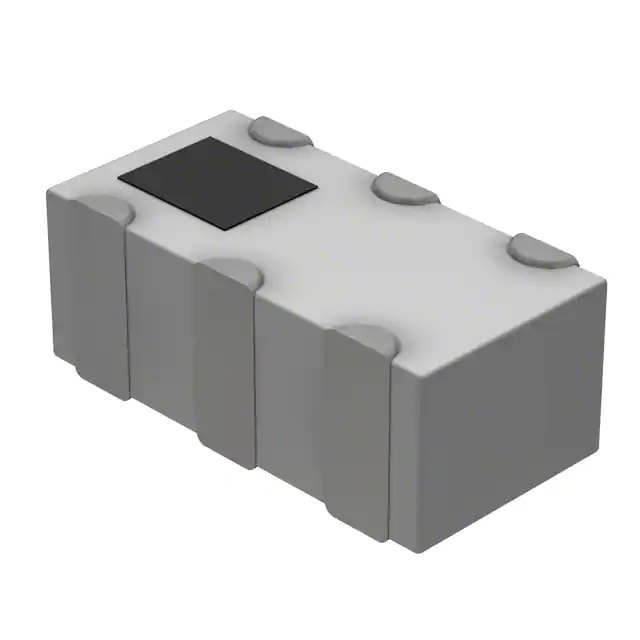
The BALFHB-WL-02D3 uses a CSPG (Chip Scale Package Glass) with 8 solder bumps in a 3×3 array (center pad omitted), measuring 2.15 mm × 1.85 mm and profile ≤630 µm after reflow. Ground terminals are distributed across three locations (GND1, GND2, GND3) to minimize RF return path inductance and suppress common-mode noise.
| Pin/Terminal | Circuit Role | Design Meaning |
|---|---|---|
| A1 | Tx filter input | Connects to STM32WL RFO_HP pin; requires 57 Ω controlled-impedance trace |
| A2 | Differential-N Rx output | One leg of balanced RF input to STM32WL RFI_N_out; routed as 61 Ω differential pair |
| A3 | Differential-P Rx output | Other leg of balanced RF input to STM32WL RFI_P_out; maintains Zodd = 53 Ω / Zeven = 70 Ω |
| B1 | Ground #2 | Local RF ground return near Tx path; must connect via multiple vias to inner ground plane |
| B2 | Ground #3 | Local RF ground return near Rx differential outputs; critical for amplitude/phase balance |
| C1 | Tx filter output | 50 Ω single-ended antenna port; connects directly to PCB antenna feed point or matching network |
| C2 | Ground #1 | Primary ground reference for balun core; placed under central die area for lowest inductance |
| C3 | Rx balun input | Single-ended RF input from antenna; requires 50 Ω trace to antenna port or external matching |
Key Features
| Feature | Design Value |
|---|---|
| Integrated balun + Tx filter | Eliminates need for discrete matching components and external harmonic filters, reducing RF BOM count by ≥4 parts |
| Conjugate impedance match to STM32WL | Optimized for QFN-4L STM32WL pinout and internal PA/LNA characteristics in high-power mode |
| Deep harmonic suppression up to 10fo | Meets regulatory spectral purity requirements without adding board area or tuning complexity |
| Low-profile CSPG construction | 0.63 mm max height enables integration into slim battery-powered edge sensors and compact gateways |
| ECOPACK2 compliance | Halogen-free, RoHS-compliant packaging aligned with industrial sustainability mandates |
Applications
| Smart Utility Meters | Industrial Sensor Networks |
|---|---|
Use Scenario: Battery-powered gas/water meters transmitting hourly consumption data over 868 MHz ISM band using LoRa modulation. IC Role / Device Role / Timing Role: Balun and harmonic filter for STM32WL's integrated sub-GHz transceiver, enabling certified emissions compliance and >15-year battery life. Use Value: Eliminates external SAW filter and π-match network, reducing PCB area by 22 mm² and assembly cost by $0.18/unit. | Use Scenario: Wireless vibration and temperature monitors deployed on rotating machinery in oil & gas refineries. IC Role / Device Role / Timing Role: RF interface component converting STM32WL's differential Rx output and single-ended Tx output to 50 Ω antenna ports with <±0.4 dB amplitude imbalance. Use Value: Maintains demodulation fidelity under wide temperature swing (−40 °C to +105 °C), ensuring reliable FSK packet decoding in harsh environments. |
| Asset Tracking Tags | LPWAN Gateway Modules |
Use Scenario: Compact BLE + sub-GHz dual-radio tags tracking logistics containers across Europe and North America. IC Role / Device Role / Timing Role: Single-component solution providing matched 50 Ω antenna interface for both Tx and Rx paths while rejecting second-harmonic energy at 1.8 GHz. Use Value: Enables simultaneous certification to ETSI EN 300 220-2 (EU) and FCC Part 15.247 (US) with one hardware variant. | Use Scenario: Indoor gateway aggregating data from 100+ LoRa end-devices in smart building HVAC control systems. IC Role / Device Role / Timing Role: High-isolation balun minimizing Tx-to-Rx coupling in half-duplex operation, supporting concurrent receive sensitivity of −148 dBm. Use Value: Improves adjacent-channel rejection by 3.2 dB versus discrete solutions, increasing network capacity per gateway. |
Availability
BALFHB-WL-02D3 is available at Aetrix Electronics and suitable for smart utility meters, industrial sensor networks, and LPWAN asset tracking tags requiring stable component supply and full regulatory compliance support.
Supply support for BALFHB-WL-02D3 includes scheduled delivery planning, volume procurement assistance, BOM continuity management, traceable sourcing, and lifecycle availability coordination for OEM customers, industrial embedded developers, connected-device designers, and electronics production programs.
Manufacturer
STMicroelectronics is a global semiconductor leader headquartered in Geneva, Switzerland, designing and manufacturing microcontrollers, analog ICs, power management devices, and RF components for industrial, automotive, and IoT applications.
The BALFHB-WL-02D3 belongs to ST's IPD-based RF front-end portfolio, engineered specifically to simplify RF design for STM32WL wireless MCUs by integrating impedance matching, balancing, and harmonic filtering into a single miniature package.
FAQ
What is the recommended PCB stack-up for optimal BALFHB-WL-02D3 performance?
The validated stack-up uses a 4-layer board with 110–210 µm dielectric thickness between layer 1 (signal) and layer 2 (solid ground). Layer 1 must include a dedicated ground pour under the balun, connected via ≥8 vias within 1 mm of each GND bump. Trace impedances are fixed: RFO_out = 50 Ω, RFI_in = 50 Ω, RFO_HP = 57 Ω, and RFI_out differential = 61 Ω (Zodd = 53 Ω, Zeven = 70 Ω).
Can BALFHB-WL-02D3 be used with STM32WL in low-power mode?
No - the BALFHB-WL-02D3 is explicitly optimized for STM32WL high-power mode operation. Its impedance matching network targets the RFO_HP and RFI_out pins active only in high-power mode. In low-power mode, the STM32WL routes RF through different internal paths (RFO_LP and RFI_LP), which require the BALFHB-WL-02D1 variant.
Does this balun support both Tx and Rx paths simultaneously?
Yes - it integrates a bidirectional RF interface: the C3 pin serves as the single-ended antenna input for Rx, while C1 serves as the antenna output for Tx. The device operates in time-division duplex (TDD) mode synchronized with STM32WL's internal RF switch control, with no additional external switching required.
What is the maximum input power rating for continuous operation?
The absolute maximum RF input power is +27 dBm (500 mW) at ambient temperature of 25 °C. Derating is required above 25 °C: maximum power decreases linearly to +23 dBm at +105 °C. Exceeding this limit risks permanent damage to the IPD structure due to localized thermal stress in the glass substrate.
BALFHB-WL-02D3 Specifications
- Product attributes
- Attribute value
- Manufacturer:
- STMicroelectronics
- Series:
- -
- Package/Case:
- 8-WFBGA, CSPBGA
- Packaging:
- Tape & Reel (TR)
- Product Status:
- Active
- Frequency Range:
- 862MHz ~ 928MHz
- Impedance - Unbalanced/Balanced:
- -
- Phase Difference:
- 0°
- Insertion Loss (Max):
- 1.4dB
- Return Loss (Min):
- 14dB
- Mounting Type:
- Surface Mount
BALFHB-WL-02D3 FAQ
1.How can I place an order for BALFHB-WL-02D3 through Aetrix?
Please submit a Request for Quotation (RFQ) for BALFHB-WL-02D3 on Aetrix. Our sales agent will provide a competitive quotation and guide you through the order confirmation once you accept the terms.
2.Are the price and stock information for BALFHB-WL-02D3 reliable?
The price and inventory of BALFHB-WL-02D3 are updated periodically and may fluctuate due to market conditions. Stock and pricing data are typically refreshed every 24 hours. Quotation validity for BALFHB-WL-02D3 is usually 5 days.
3.What payment methods are accepted for BALFHB-WL-02D3?
We accept Wire Transfer, PayPal, Credit Card, Western Union, MoneyGram, and Escrow for BALFHB-WL-02D3 transactions.
Note: Certain payment methods may incur a processing fee.
4.How is shipping managed for BALFHB-WL-02D3?
BALFHB-WL-02D3 orders can be shipped via leading logistics carriers, including DHL, UPS, FedEx, TNT, or Registered Mail.
Once your BALFHB-WL-02D3 order is processed, you will receive an email with the shipment details and tracking number.
Note: Tracking information may take up to 24 hours to appear. Express delivery typically takes 3–5 business days.
5.How can I obtain technical support or documentation for BALFHB-WL-02D3?
For technical support, including BALFHB-WL-02D3 datasheets, pinout diagrams, or application guidance, please contact our engineering support team. They can provide detailed documentation and assistance for your BALFHB-WL-02D3 requirements.
6.How does Aetrix verify that BALFHB-WL-02D3 is sourced from the original manufacturer or authorized distributors?
All BALFHB-WL-02D3 products on Aetrix are procured from qualified distributors and authorized channels. Our dedicated quality assurance team conducts strict verification, including traceability checks and, if necessary, third-party testing. This ensures that BALFHB-WL-02D3 meets industry standards.
7.What is the process for return or replacement of BALFHB-WL-02D3?
All BALFHB-WL-02D3 units undergo pre-shipment inspection (PSI). If there is an issue with BALFHB-WL-02D3, returns or replacements are accepted under the following conditions:
1.Quantity discrepancies, incorrect items, or visible external defects (such as breakage or corrosion), acknowledged by Aetrix.
2.The issue is reported within 90 days of delivery.
3.The BALFHB-WL-02D3 part is unused and in its original packaging.
Return procedure for BALFHB-WL-02D3:
1.Submit a request within 90 days.
2.Obtain a Return Material Authorization (RMA) from Aetrix.
BALFHB-WL-02D3 Tags

-
2450BL15B0100001E
Johanson Technology Inc.
-
0900BL15D0050001E
Johanson Technology Inc.
-
0900PC16J0042001E
Johanson Technology Inc.
-
2450BM15A0002001E
Johanson Technology Inc.
-
2450BM14G0011001T
Johanson Technology Inc.
-
BD0810N50100AHF
TTM Technologies, Inc.
-
1720BL15B0050001E
Johanson Technology Inc.
-
0900PC15A0036001E
Johanson Technology Inc.
-
0868BM15C0001001E
Johanson Technology Inc.
-
0915BM15A0001001E
Johanson Technology Inc.
-
HHM1776B3
TDK Corporation
-
2450BM14E0003001T
Johanson Technology Inc.
Tech Hub

A practical engineering and sourcing framework covering lifecycle verification, lifetime-buy calculations, replacement qualification, supplier checks and counterfeit-risk controls.

TTL and CMOS logic families differ in thresholds, loading, output drive, power and timing. This engineering guide compares 74HC and 74HCT, calculates noise margins and checks 3.3 V/5 V compatibility.

A practical engineering guide to 3.3V and 5V logic compatibility, input thresholds, resistor dividers, translator ICs, MOSFET level shifting, I2C pull-ups, timing limits and power-sequencing risks.

The 74HC595 uses push-pull logic outputs, while the TPIC6B595 uses 50 V open-drain DMOS sinks for higher-power loads. This guide compares timing, current limits, 3.3 V interfacing, load wiring, thermal…

The 74HC595 converts serial data into eight stable parallel outputs. This guide covers pin functions, shift and storage timing, OE and MR behavior, drive-current limits, cascading, voltage compatibilit…

A technical comparison of level-sensitive latches and edge-triggered flip-flops, covering timing windows, setup and hold limits, master–slave operation, time borrowing, race-through, HDL inference and…

A D latch stores one bit while Enable controls when data can pass. This reference covers gate-level operation, truth tables, transparency, setup and hold timing, LE versus OE, common ICs and practical …

An SR latch stores one bit through cross-coupled feedback. This engineering reference covers NOR and NAND implementations, truth tables, forbidden-state recovery, gated operation, switch debouncing, fa…

Latch circuits retain one bit through feedback. This technical reference covers SR and D latches, truth tables, transparency, timing limits, latch-versus-flip-flop behavior, applications and common log…

An engineering guide to LED driver operation, constant-current and constant-voltage outputs, linear and switching topologies, dimming, IC selection, calculations, replacement compatibility, and fault c…


