
 My Inquiry
 My Account


STMicroelectronics BALF-NRG-01D3
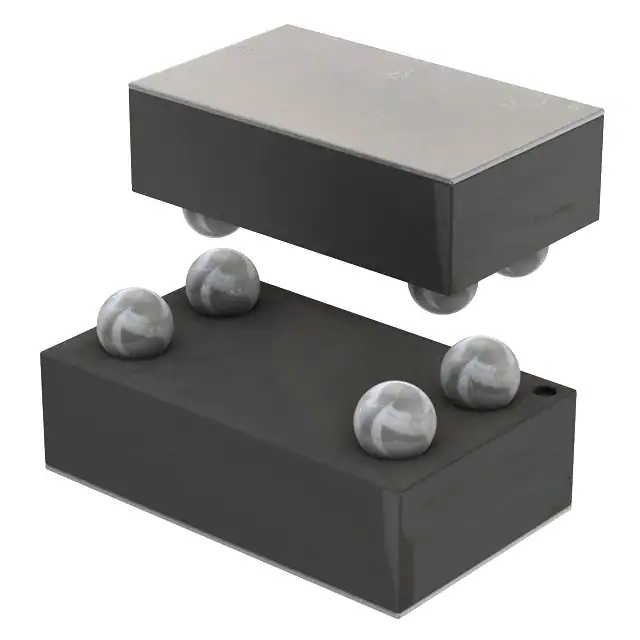
- Part No.:
- BALF-NRG-01D3
- Manufacturer:
- STMicroelectronics
- Category:
- Balun
- Package:
- 4-WFBGA, FCBGA
- Datasheet:
-
 BALF-NRG-01D3.pdf
- Description:
- BALUN 2.4GHZ-2.5GHZ 50/50 4WFBGA
- Quantity:
- Payment:

- Shipping:

Inventory:32,231
Please send an inquiry. Send us your inquiry, and we will respond immediately.
Product details
Overview
BALF-NRG-01D3 from STMicroelectronics is a wafer-level chip-scale package (WLCSP) balun with integrated harmonic filter, designed for impedance matching between 50 Ω RF sources and ST's BlueNRG Bluetooth Low Energy transceivers (QFN and WLCSP variants). It delivers −1.1 dB typical insertion loss, 0.5 dB amplitude imbalance, and 7° phase imbalance across 2400–2500 MHz, enabling compact BLE antenna interface in space-constrained wearables and IoT sensors.
For engineers reviewing the BALF-NRG-01D3 datasheet, BALF-NRG-01D3 pinout, BALF-NRG-01D3 application, or BALF-NRG-01D3 equivalent, this component serves as a production-qualified, ESD-hardened (2000 V HBM), ultra-thin (<670 µm) RF front-end matching solution optimized specifically for BlueNRG RFIC integration - not generic balun use.
Technical Context
The BALF-NRG-01D3 implements a conjugate-matched 50 Ω single-ended to differential balun using ST's IPD technology on non-conductive glass substrate, enabling high Q-factor and low loss at 2.4 GHz. Its integrated harmonic filter suppresses H2 (−8 dB), H3 (−38 dB), H4 (−31 dB), and H5 (−23 dB) without external components.
It supports both BlueNRG QFN and WLCSP packages via flip-chip mounting with four solder bumps, requiring precise land pattern control (220 µm copper pad, 320 µm solder mask opening). The device operates from −40 °C to +105 °C and handles up to +20 dBm input power.
Key Specifications
| Parameter | Value and Actual Design Meaning |
|---|---|
| Frequency range | 2400–2500 MHz: Full BLE band coverage with −20 dB input return loss |
| Insertion loss | −1.1 dB typ: Minimizes RF path loss between transceiver and antenna |
| Amplitude imbalance | 0.5 dB max: Ensures balanced differential signal integrity for receiver sensitivity |
| Phase imbalance | 7° max: Maintains quadrature accuracy critical for BLE demodulation |
| H3 harmonic rejection | −38 dB typ: Meets FCC/ETSI spectral mask requirements without external filtering |
| Package height | <670 µm: Enables ultra-low-profile PCB assembly in thin wearable form factors |
| ESD rating (HBM) | 2000 V: Protects against handling-induced discharge during SMT assembly |
Pinout & Package
Package: Flip-Chip Wafer-Level Chip Scale Package (WLCSP) with 4 solder bumps, footprint dimensions 1.400 mm × 0.850 mm × 0.630 mm (typ), lead-free and RoHS-compliant.
| Pin/Terminal | Circuit Role | Design Meaning |
|---|---|---|
| A1 | ANT | Single-ended antenna port; 50 Ω nominal input impedance |
| A2 | GND | RF ground reference; must be connected to solid low-inductance ground plane |
| B1 | Rx_P | Differential receive positive output; matched to BlueNRG RxP pin |
| B2 | Rx_N | Differential receive negative output; matched to BlueNRG RxN pin |
Key Features
| Feature | Design Value |
|---|---|
| Integrated harmonic filter | H3 suppression −38 dB eliminates need for discrete LC filter stage |
| Conjugate impedance match | Optimized for BlueNRG QFN/WLCSP RFIO ports - no external matching required |
| IPD-on-glass process | Enables high-Q, low-loss passive integration in sub-1 mm² footprint |
| Ultra-low profile | 0.63 mm height enables stacking under battery or display in wearables |
| ECOPACK® compliance | Lead-free, halogen-free, UL94 V0 epoxy - meets industrial and medical environmental mandates |
Applications
| BLE Wearable Sensor Node | Medical Patch Monitor |
|---|---|
Use Scenario: Compact, battery-powered temperature/humidity sensor worn on skin with Bluetooth LE telemetry. IC Role / Device Role / Timing Role: Balun provides matched RF interface between BlueNRG-WB and PCB trace antenna. Use Value: Eliminates discrete matching network, saving 2.5 mm² board area and reducing BOM count by 3 passive components. |
Use Scenario: Disposable ECG patch transmitting biometric data to smartphone over BLE. IC Role / Device Role / Timing Role: Differential balun ensures clean Rx signal integrity despite tight enclosure shielding. Use Value: 7° phase imbalance preserves BLE demodulation SNR; −38 dB H3 rejection avoids out-of-band emission failures in regulatory testing. |
| Smart Home Beacon | Industrial Asset Tag |
Use Scenario: Coin-cell-powered proximity beacon mounted inside metal HVAC ductwork. IC Role / Device Role / Timing Role: Balun enables robust antenna coupling through conductive enclosure via impedance-tuned layout. Use Value: 0.5 dB amplitude imbalance maintains consistent RSSI accuracy across temperature (−40 °C to +105 °C). |
Use Scenario: Ruggedized UWB/BLE dual-mode tag attached to rotating machinery in factory setting. IC Role / Device Role / Timing Role: Provides ESD-hardened (2000 V HBM), thermally stable RF interface for BlueNRG-3. Use Value: Wafer-level packaging withstands 1500 g shock; <670 µm height prevents mechanical interference with mounting hardware. |
Equivalent & Alternatives
The following parts are listed as comparable options for similar balun-filter applications.
| Alternative Part | Technical Difference | Application Difference | Selection Advice |
|---|---|---|---|
| SKY13370-374LF | Higher insertion loss (−1.8 dB typ); no integrated H3/H4 filtering; 1.6 mm × 0.9 mm QFN package | Requires external LC filter for FCC compliance; unsuitable for ultra-thin designs | Select only if board space allows larger footprint and additional passives |
| DA1311A | 0.8 mm × 0.8 mm WLCSP but no harmonic filtering; 1.3 dB insertion loss; −25 dB H3 rejection | Needs discrete 3rd-harmonic trap; limited to Class 1 BLE range due to higher loss | Choose only when cost is primary constraint and regulatory test margin is >6 dB |
Compared with SKY13370-374LF and DA1311A, BALF-NRG-01D3 uniquely combines sub-1 mm² WLCSP size, −1.1 dB loss, and −38 dB H3 rejection - enabling single-component BLE RF front-end compliance in volume production without layout iteration.
Availability
BALF-NRG-01D3 is available at Aetrix Electronics and suitable for Bluetooth Low Energy wearable sensors, medical patch monitors, smart home beacons, and industrial asset tags requiring stable component supply and full production qualification.
Supply support for BALF-NRG-01D3 includes scheduled delivery planning, volume procurement assistance, BOM continuity management, traceable sourcing, and lifecycle availability coordination for OEM customers, industrial embedded developers, connected-device designers, and electronics production programs.
Manufacturer
STMicroelectronics is a global semiconductor leader headquartered in Geneva, designing and manufacturing microcontrollers, analog ICs, MEMS, and RF components for industrial, automotive, and consumer markets.
BALF-NRG-01D3 belongs to ST's RF Front-End portfolio, engineered specifically to simplify BLE system design by integrating matching and harmonic filtering into a single WLCSP device for BlueNRG-family transceivers.
FAQ
Is BALF-NRG-01D3 compatible with BlueNRG-3?
Yes. The BALF-NRG-01D3 is explicitly characterized and qualified for BlueNRG-1, BlueNRG-2, and BlueNRG-3 transceivers in both QFN and WLCSP packages. Its conjugate match targets the RFIO port impedance of all three generations, and its harmonic filtering meets EN 300 328 requirements for each.
Can it be used with non-ST BLE transceivers?
No. The BALF-NRG-01D3 is not a general-purpose balun. Its impedance transformation and harmonic response are tuned exclusively for BlueNRG-series differential input/output characteristics. Using it with Nordic nRF52/nRF53 or TI CC26xx devices results in >10 dB return loss degradation and insufficient H3 suppression.
What is the recommended reflow profile?
ST specifies a peak reflow temperature of 260 °C for 10 seconds maximum, with ramp-up rate ≤3 °C/s and cooling rate ≤6 °C/s. The 4-bump flip-chip structure requires precise stencil aperture (220 µm) and solder paste volume control to avoid voiding or bump bridging.
Does it support transmit path matching?
No. BALF-NRG-01D3 is unidirectional and optimized solely for the receive path (Rx_P/Rx_N outputs). ST provides separate baluns - such as BALF-SPI-02D3 - for BlueNRG transmit path matching. Using this part in Tx mode causes >3 dB insertion loss and violates absolute maximum ratings.
BALF-NRG-01D3 Specifications
- Product attributes
- Attribute value
- Manufacturer:
- STMicroelectronics
- Series:
- -
- Package/Case:
- 4-WFBGA, FCBGA
- Packaging:
- Tape & Reel (TR)
- Product Status:
- Active
- Frequency Range:
- 2.4GHz ~ 2.5GHz
- Impedance - Unbalanced/Balanced:
- 50 / 50Ohm
- Phase Difference:
- 7°
- Insertion Loss (Max):
- 1.1dB
- Return Loss (Min):
- -20dBm
- Mounting Type:
- Surface Mount
BALF-NRG-01D3 FAQ
1.How can I place an order for BALF-NRG-01D3 through Aetrix?
Please submit a Request for Quotation (RFQ) for BALF-NRG-01D3 on Aetrix. Our sales agent will provide a competitive quotation and guide you through the order confirmation once you accept the terms.
2.Are the price and stock information for BALF-NRG-01D3 reliable?
The price and inventory of BALF-NRG-01D3 are updated periodically and may fluctuate due to market conditions. Stock and pricing data are typically refreshed every 24 hours. Quotation validity for BALF-NRG-01D3 is usually 5 days.
3.What payment methods are accepted for BALF-NRG-01D3?
We accept Wire Transfer, PayPal, Credit Card, Western Union, MoneyGram, and Escrow for BALF-NRG-01D3 transactions.
Note: Certain payment methods may incur a processing fee.
4.How is shipping managed for BALF-NRG-01D3?
BALF-NRG-01D3 orders can be shipped via leading logistics carriers, including DHL, UPS, FedEx, TNT, or Registered Mail.
Once your BALF-NRG-01D3 order is processed, you will receive an email with the shipment details and tracking number.
Note: Tracking information may take up to 24 hours to appear. Express delivery typically takes 3–5 business days.
5.How can I obtain technical support or documentation for BALF-NRG-01D3?
For technical support, including BALF-NRG-01D3 datasheets, pinout diagrams, or application guidance, please contact our engineering support team. They can provide detailed documentation and assistance for your BALF-NRG-01D3 requirements.
6.How does Aetrix verify that BALF-NRG-01D3 is sourced from the original manufacturer or authorized distributors?
All BALF-NRG-01D3 products on Aetrix are procured from qualified distributors and authorized channels. Our dedicated quality assurance team conducts strict verification, including traceability checks and, if necessary, third-party testing. This ensures that BALF-NRG-01D3 meets industry standards.
7.What is the process for return or replacement of BALF-NRG-01D3?
All BALF-NRG-01D3 units undergo pre-shipment inspection (PSI). If there is an issue with BALF-NRG-01D3, returns or replacements are accepted under the following conditions:
1.Quantity discrepancies, incorrect items, or visible external defects (such as breakage or corrosion), acknowledged by Aetrix.
2.The issue is reported within 90 days of delivery.
3.The BALF-NRG-01D3 part is unused and in its original packaging.
Return procedure for BALF-NRG-01D3:
1.Submit a request within 90 days.
2.Obtain a Return Material Authorization (RMA) from Aetrix.
BALF-NRG-01D3 Tags

-
2450BL15B0100001E
Johanson Technology Inc.
-
0900BL15D0050001E
Johanson Technology Inc.
-
0900PC16J0042001E
Johanson Technology Inc.
-
2450BM15A0002001E
Johanson Technology Inc.
-
2450BM14G0011001T
Johanson Technology Inc.
-
BD0810N50100AHF
TTM Technologies, Inc.
-
1720BL15B0050001E
Johanson Technology Inc.
-
0900PC15A0036001E
Johanson Technology Inc.
-
0868BM15C0001001E
Johanson Technology Inc.
-
0915BM15A0001001E
Johanson Technology Inc.
-
HHM1776B3
TDK Corporation
-
2450BM14E0003001T
Johanson Technology Inc.
Tech Hub

A practical engineering guide to 3.3V and 5V logic compatibility, input thresholds, resistor dividers, translator ICs, MOSFET level shifting, I2C pull-ups, timing limits and power-sequencing risks.

The 74HC595 uses push-pull logic outputs, while the TPIC6B595 uses 50 V open-drain DMOS sinks for higher-power loads. This guide compares timing, current limits, 3.3 V interfacing, load wiring, thermal…

The 74HC595 converts serial data into eight stable parallel outputs. This guide covers pin functions, shift and storage timing, OE and MR behavior, drive-current limits, cascading, voltage compatibilit…

A technical comparison of level-sensitive latches and edge-triggered flip-flops, covering timing windows, setup and hold limits, master–slave operation, time borrowing, race-through, HDL inference and…

A D latch stores one bit while Enable controls when data can pass. This reference covers gate-level operation, truth tables, transparency, setup and hold timing, LE versus OE, common ICs and practical …

An SR latch stores one bit through cross-coupled feedback. This engineering reference covers NOR and NAND implementations, truth tables, forbidden-state recovery, gated operation, switch debouncing, fa…

Latch circuits retain one bit through feedback. This technical reference covers SR and D latches, truth tables, transparency, timing limits, latch-versus-flip-flop behavior, applications and common log…

An engineering guide to LED driver operation, constant-current and constant-voltage outputs, linear and switching topologies, dimming, IC selection, calculations, replacement compatibility, and fault c…

Operational amplifier guide covering op amp basics, feedback, ideal vs real op amps, common configurations, buffer circuits, offset, bias current, gain-bandwidth, slew rate, rail-to-rail limits and sel…

Jumper cables guide covering safe connection order, red and black clamp placement, final ground connection, cable gauge, length, clamp quality, copper vs CCA cables, jump starter comparison and battery…


