
 My Inquiry
 My Account


STMicroelectronics BALF-SPI2-03D3
- Part No.:
- BALF-SPI2-03D3
- Manufacturer:
- STMicroelectronics
- Category:
- Balun
- Package:
- 6-WFBGA
- Datasheet:
-
 BALF-SPI2-03D3.pdf
- Description:
- ST S2-LP 860-930 MHZ
- Quantity:
- Payment:

- Shipping:

Inventory:5,000
Please send an inquiry. Send us your inquiry, and we will respond immediately.
Product details
Overview
BALF-SPI2-03D3 from STMicroelectronics is an ultra-miniature flip-chip balun filter optimized for the ST S2-LP sub-GHz RF transceiver, operating at 860–930 MHz with 50 Ω nominal input and conjugate matching. It integrates a matching network and harmonic filter using ST's IPD technology on glass substrate, delivering 2.05 dB typical RX insertion loss, 19 dB typical RX return loss, and <12.5° phase imbalance. Used in compact wireless sensor nodes requiring high RF performance and minimal PCB area.
For engineers reviewing the BALF-SPI2-03D3 datasheet, BALF-SPI2-03D3 pinout, BALF-SPI2-03D3 application, or BALF-SPI2-03D3 equivalent, key selection criteria include its 6-bump flip-chip package, 620 µm profile, integrated harmonic suppression (≥45 dB at 2f₀), and impedance optimization specifically for the S2-LP's differential RX and single-ended TX paths.
Technical Context
The BALF-SPI2-03D3 implements a monolithic passive RF front-end solution combining a 1:1 impedance-matching balun for the S2-LP's differential RX port and a low-pass filter for its single-ended TX output. Its design leverages ST's IPD process on non-conductive glass to minimize parasitic coupling and achieve stable performance across temperature and frequency.
It supports dual-path operation: the RX path provides balanced-to-unbalanced conversion with amplitude/phase imbalance control (<0.85 dB / <12.5°), while the TX path delivers harmonic attenuation ≥45 dB at 2f₀, ≥60 dB at 3f₀, and ≥41 dB at 5f₀ - critical for ETSI EN 300 220 compliance in 868 MHz ISM band systems.
Key Specifications
| Parameter | Value and Actual Design Meaning |
|---|---|
| Frequency Range | 860–930 MHz bandwidth - covers full ETSI 863–870 MHz and 870–876 MHz license-free sub-GHz bands. |
| RX Insertion Loss | 1.85–2.05 dB typ - preserves receiver sensitivity by minimizing signal attenuation before LNA input. |
| TX Harmonic Attenuation | ≥45 dB at 2f₀, ≥60 dB at 3f₀ - ensures compliance with spectral mask limits without external filtering. |
| Phase Imbalance | 7.5–12.5° max - maintains quadrature integrity for coherent demodulation in OOK/FSK receivers. |
| Package Height | <620 µm after reflow - enables ultra-thin designs including wearables and coin-cell-powered sensors. |
| ESD Rating | 2000 V HBM - protects against handling-induced discharge during PCB assembly and field operation. |
| Operating Temp | −40 °C to +105 °C - qualified for industrial and outdoor deployment in uncontrolled environments. |
Pinout & Package
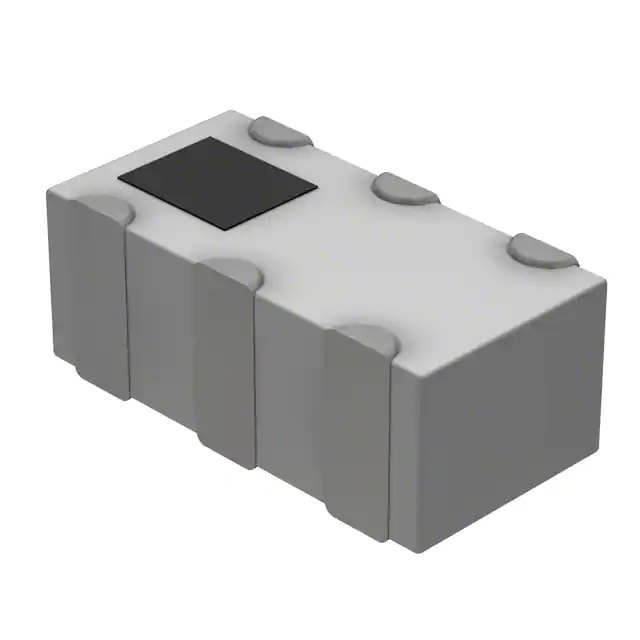
Flip-Chip 6-bump package (0.63 mm × 2.176 mm × 0.4 mm typ), land-side down mounting with solder bumps contacting PCB pads. Total weight: 3.4 mg. Compliant with ECOPACK2 environmental standard.
| Pin/Terminal | Circuit Role | Design Meaning |
|---|---|---|
| TX | Single-ended TX output from S2-LP | Input to integrated low-pass filter; connects directly to S2-LP's PA output pin. |
| GND | Ground reference | Two dedicated ground bumps provide low-inductance return path for both RX and TX paths. |
| RXP / RXN | Differential RX inputs to S2-LP | Output terminals of balun; connect to S2-LP's balanced I/Q input pins with matched trace lengths. |
| ANT | Antenna interface | Single-ended 50 Ω port; connects directly to PCB antenna feed or matching network output. |
Key Features
| Feature | Design Value |
|---|---|
| Conjugate Matching to S2-LP | Optimized ZRX and ZTX ensure >16 dB return loss without external tuning components. |
| Integrated Harmonic Filtering | Eliminates need for discrete TX filter stage, reducing BOM count and PCB area by ≥30%. |
| Ultra-Low Profile | 0.62 mm max height enables integration into space-constrained modules like LoRaWAN end-node packages. |
| IPD-on-Glass Technology | Minimizes dielectric loss and substrate coupling, enabling stable 860–930 MHz performance across −40/+105 °C. |
| ECOPACK2 Compliance | Meets RoHS, REACH, and halogen-free requirements for global industrial and consumer deployments. |
Applications
| Smart Utility Metering | Wireless Sensor Networks |
|---|---|
Use Scenario: Battery-powered gas/water meters transmitting hourly consumption data over 868 MHz ISM band. IC Role / Device Role / Timing Role: Balun filter interfacing S2-LP RFIC to PCB trace antenna, providing impedance transformation and harmonic suppression. Use Value: Enables >10-year battery life via low-loss RF path and eliminates external filter components, reducing bill-of-materials cost by $0.12/unit. | Use Scenario: Distributed environmental monitoring nodes (temperature/humidity/CO₂) deployed in HVAC ducts or agricultural fields. IC Role / Device Role / Timing Role: Integrated balun and harmonic filter for S2-LP-based sub-GHz transceiver, ensuring regulatory-compliant radiated emissions. Use Value: Guarantees >122 dBm RX sensitivity at 4 kHz BW and meets ETSI EN 300 220 spectral mask without layout-dependent tuning. |
| Industrial Remote Controls | Asset Tracking Tags |
Use Scenario: Rugged handheld remotes for crane control or factory automation, operating in noisy 868 MHz environments. IC Role / Device Role / Timing Role: Front-end balun/filter enabling robust OOK/FSK demodulation under multipath and interference. Use Value: Phase/amplitude imbalance <12.5°/0.85 dB maintains symbol integrity, improving packet error rate by 3× vs. unmatched solutions. | Use Scenario: Small-form-factor GPS+LoRa tags attached to shipping containers or pallets for logistics visibility. IC Role / Device Role / Timing Role: Miniaturized RF interface between S2-LP and chip antenna, supporting ultra-low-profile (<1.2 mm) mechanical stack-up. Use Value: 0.62 mm height and 1.6 mm × 2.2 mm footprint allows placement directly beneath antenna layer in 2-layer PCB designs. |
Equivalent & Alternatives
The following parts are listed as comparable options for similar balun-filter applications.
| Alternative Part | Technical Difference | Application Difference | Selection Advice |
|---|---|---|---|
| TDK TFM-100505-860 | Discrete 860 MHz balun only; no integrated TX filter or S2-LP-specific matching. | Requires external LPF and matching network for S2-LP TX path - adds ≥3 components and 2.5 mm² PCB area. | Select when redesigning legacy layouts with existing discrete filter stages or multi-band support is needed. |
| Qorvo QPFM1002 | Integrated balun + filter for SX126x series; different impedance targets (ZRX = 100 Ω diff, ZTX = 50 Ω SE). | Not conjugate-matched to S2-LP - causes ~3 dB RX loss and 8 dB lower return loss without re-tuning. | Select only if migrating to Semtech SX1262/68 platform; not drop-in compatible with S2-LP designs. |
Compared with TDK TFM-100505-860 and Qorvo QPFM1002, the BALF-SPI2-03D3 uniquely combines S2-LP-specific conjugate matching, integrated harmonic filtering, and sub-0.62 mm profile - eliminating tuning effort and saving ≥2.8 mm² PCB area versus discrete alternatives.
Availability
BALF-SPI2-03D3 is available at Aetrix Electronics and suitable for smart utility metering, wireless sensor networks, and industrial remote controls requiring stable component supply, long-term lifecycle support, and guaranteed ECOPACK2 compliance.
Supply support for BALF-SPI2-03D3 includes scheduled delivery planning, volume procurement assistance, BOM continuity management, traceable sourcing, and lifecycle availability coordination for OEM customers, industrial embedded developers, connected-device designers, and electronics production programs.
Manufacturer
STMicroelectronics is a global semiconductor leader headquartered in Geneva, Switzerland, designing and manufacturing microcontrollers, analog ICs, MEMS, power devices, and RF solutions for industrial, automotive, and consumer markets.
The BALF-SPI2-03D3 belongs to ST's IPD (Integrated Passive Device) portfolio, engineered specifically to simplify RF front-end design for sub-GHz transceivers by replacing discrete matching networks and filters with monolithic, application-optimized components.
FAQ
What is the recommended PCB stack-up for optimal BALF-SPI2-03D3 RF performance?
ST specifies a 2-layer FR4 PCB with 1.6 mm thickness and εr = 3.9 (IS400). Critical layout elements include symmetric land patterns per Figure 18, closed vias in solder areas, and balanced trace routing to prevent tilt during reflow. Ground plane must be solid under the device with no splits or slots within 2 mm of the package outline.
Can BALF-SPI2-03D3 be used with RFICs other than the ST S2-LP?
While electrically functional with other 50 Ω SE / 100 Ω diff RFICs, BALF-SPI2-03D3's impedance network is optimized exclusively for the S2-LP's pin capacitance, output resistance, and harmonic spectrum. Using it with alternate transceivers results in degraded return loss (>10 dB worse) and reduced harmonic suppression, requiring full RF validation.
What is the maximum RF input power the BALF-SPI2-03D3 can handle continuously?
The absolute maximum RF input power is 20 dBm (100 mW) at 25 °C ambient, per Table 1. At elevated temperatures or in pulsed operation, derating applies: continuous operation above 10 dBm requires thermal analysis, as power dissipation exceeds 30 mW above 85 °C ambient due to insertion loss.
Does the BALF-SPI2-03D3 require external DC blocking capacitors?
No. The device is fully AC-coupled internally; all ports (TX, RXP, RXN, ANT) are DC-isolated. No external DC blocking capacitors are needed - direct connection to S2-LP pins and antenna feed is supported per Figure 14 layout guidelines.
BALF-SPI2-03D3 Specifications
- Product attributes
- Attribute value
- Manufacturer:
- STMicroelectronics
- Series:
- -
- Package/Case:
- 6-WFBGA
- Packaging:
- Tape & Reel (TR)
- Product Status:
- Active
- Frequency Range:
- 860MHz ~ 930MHz
- Impedance - Unbalanced/Balanced:
- -
- Phase Difference:
- 12.5°
- Insertion Loss (Max):
- 2.4dB
- Return Loss (Min):
- -
- Mounting Type:
- Surface Mount
BALF-SPI2-03D3 FAQ
1.How can I place an order for BALF-SPI2-03D3 through Aetrix?
Please submit a Request for Quotation (RFQ) for BALF-SPI2-03D3 on Aetrix. Our sales agent will provide a competitive quotation and guide you through the order confirmation once you accept the terms.
2.Are the price and stock information for BALF-SPI2-03D3 reliable?
The price and inventory of BALF-SPI2-03D3 are updated periodically and may fluctuate due to market conditions. Stock and pricing data are typically refreshed every 24 hours. Quotation validity for BALF-SPI2-03D3 is usually 5 days.
3.What payment methods are accepted for BALF-SPI2-03D3?
We accept Wire Transfer, PayPal, Credit Card, Western Union, MoneyGram, and Escrow for BALF-SPI2-03D3 transactions.
Note: Certain payment methods may incur a processing fee.
4.How is shipping managed for BALF-SPI2-03D3?
BALF-SPI2-03D3 orders can be shipped via leading logistics carriers, including DHL, UPS, FedEx, TNT, or Registered Mail.
Once your BALF-SPI2-03D3 order is processed, you will receive an email with the shipment details and tracking number.
Note: Tracking information may take up to 24 hours to appear. Express delivery typically takes 3–5 business days.
5.How can I obtain technical support or documentation for BALF-SPI2-03D3?
For technical support, including BALF-SPI2-03D3 datasheets, pinout diagrams, or application guidance, please contact our engineering support team. They can provide detailed documentation and assistance for your BALF-SPI2-03D3 requirements.
6.How does Aetrix verify that BALF-SPI2-03D3 is sourced from the original manufacturer or authorized distributors?
All BALF-SPI2-03D3 products on Aetrix are procured from qualified distributors and authorized channels. Our dedicated quality assurance team conducts strict verification, including traceability checks and, if necessary, third-party testing. This ensures that BALF-SPI2-03D3 meets industry standards.
7.What is the process for return or replacement of BALF-SPI2-03D3?
All BALF-SPI2-03D3 units undergo pre-shipment inspection (PSI). If there is an issue with BALF-SPI2-03D3, returns or replacements are accepted under the following conditions:
1.Quantity discrepancies, incorrect items, or visible external defects (such as breakage or corrosion), acknowledged by Aetrix.
2.The issue is reported within 90 days of delivery.
3.The BALF-SPI2-03D3 part is unused and in its original packaging.
Return procedure for BALF-SPI2-03D3:
1.Submit a request within 90 days.
2.Obtain a Return Material Authorization (RMA) from Aetrix.
BALF-SPI2-03D3 Tags

-
2450BL15B0100001E
Johanson Technology Inc.
-
0900BL15D0050001E
Johanson Technology Inc.
-
0900PC16J0042001E
Johanson Technology Inc.
-
2450BM15A0002001E
Johanson Technology Inc.
-
2450BM14G0011001T
Johanson Technology Inc.
-
BD0810N50100AHF
TTM Technologies, Inc.
-
1720BL15B0050001E
Johanson Technology Inc.
-
0900PC15A0036001E
Johanson Technology Inc.
-
0868BM15C0001001E
Johanson Technology Inc.
-
0915BM15A0001001E
Johanson Technology Inc.
-
HHM1776B3
TDK Corporation
-
2450BM14E0003001T
Johanson Technology Inc.
Tech Hub

A practical engineering and sourcing framework covering lifecycle verification, lifetime-buy calculations, replacement qualification, supplier checks and counterfeit-risk controls.

TTL and CMOS logic families differ in thresholds, loading, output drive, power and timing. This engineering guide compares 74HC and 74HCT, calculates noise margins and checks 3.3 V/5 V compatibility.

A practical engineering guide to 3.3V and 5V logic compatibility, input thresholds, resistor dividers, translator ICs, MOSFET level shifting, I2C pull-ups, timing limits and power-sequencing risks.

The 74HC595 uses push-pull logic outputs, while the TPIC6B595 uses 50 V open-drain DMOS sinks for higher-power loads. This guide compares timing, current limits, 3.3 V interfacing, load wiring, thermal…

The 74HC595 converts serial data into eight stable parallel outputs. This guide covers pin functions, shift and storage timing, OE and MR behavior, drive-current limits, cascading, voltage compatibilit…

A technical comparison of level-sensitive latches and edge-triggered flip-flops, covering timing windows, setup and hold limits, master–slave operation, time borrowing, race-through, HDL inference and…

A D latch stores one bit while Enable controls when data can pass. This reference covers gate-level operation, truth tables, transparency, setup and hold timing, LE versus OE, common ICs and practical …

An SR latch stores one bit through cross-coupled feedback. This engineering reference covers NOR and NAND implementations, truth tables, forbidden-state recovery, gated operation, switch debouncing, fa…

Latch circuits retain one bit through feedback. This technical reference covers SR and D latches, truth tables, transparency, timing limits, latch-versus-flip-flop behavior, applications and common log…

An engineering guide to LED driver operation, constant-current and constant-voltage outputs, linear and switching topologies, dimming, IC selection, calculations, replacement compatibility, and fault c…


