
 My Inquiry
 My Account


STMicroelectronics BAL-NRF01D3
- Part No.:
- BAL-NRF01D3
- Manufacturer:
- STMicroelectronics
- Category:
- Balun
- Package:
- 5-WFBGA, FCBGA
- Datasheet:
-
 BAL-NRF01D3.pdf
- Description:
- BALUN 2.4GHZ-2.54GHZ 5WFBGA
- Quantity:
- Payment:

- Shipping:

Inventory:265,578
Please send an inquiry. Send us your inquiry, and we will respond immediately.
Product details
Overview
BAL-NRF01D3 from STMicroelectronics is an ultraminiature 2.45 GHz balun with integrated harmonic filter, designed for impedance matching between 50 Ω single-ended RF sources and differential inputs of Nordic Semiconductor transceivers including nRF51422-QFAA (build code CA/C0), nRF51822-QFAA/QFAB, and nRF24LE1/AP2. It delivers 2.25 dB typical insertion loss, <0.1 dB amplitude imbalance, and <3° phase imbalance across 2400–2540 MHz.
For engineers reviewing the BAL-NRF01D3 datasheet, BAL-NRF01D3 pinout, BAL-NRF01D3 application, or BAL-NRF01D3 equivalent, key selection criteria include its 5-bump flip-chip package footprint (<1.5 mm²), conjugate match to Nordic's QFN32/QFAA/QFAB RF pins, 2nd/3rd harmonic suppression (10 dB @ 4880 MHz, 20 dB @ 7320 MHz), and compatibility with nRFgo modules nRF2723/nRF2752.
Technical Context
The BAL-NRF01D3 implements a passive, glass-substrate IPD-based balun with fixed 50 Ω single-ended input and conjugate-matched differential output tailored to Nordic's transceiver RF port impedances. Its architecture integrates both impedance transformation and harmonic filtering in a monolithic structure without external components.
It operates over –40 °C to +105 °C, supports 20 dBm maximum input power, and meets MIL-STD-883C HBM (2000 V), JESD22-C101-C CDM (500 V), and MM (200 V) ESD ratings - enabling robust integration into compact 2.4 GHz ISM-band wireless modules.
Key Specifications
| Parameter | Value and Actual Design Meaning |
|---|---|
| Frequency Range | 2400–2540 MHz - full 2.4 GHz ISM band coverage for Bluetooth Low Energy and proprietary 2.4 GHz protocols |
| Insertion Loss | 2.25 dB typ - minimal RF path attenuation preserving link budget in ultra-low-power transceiver designs |
| Amplitude Imbalance | 0.1 dB max - ensures balanced I/Q signal integrity critical for low-EVM 2.4 GHz modulation |
| Phase Imbalance | 3° max - maintains orthogonal signal fidelity required for differential receiver sensitivity |
| 2nd Harmonic Suppression | 10 dB @ 4880 MHz - reduces out-of-band emissions to meet FCC/ETSI radiated spurious limits |
| 3rd Harmonic Suppression | 20 dB @ 7320 MHz - enables compliance with stringent spectral mask requirements for Class 1/2 radios |
| Input Impedance | 50 Ω nominal - direct interface to standard RF PCB traces and SMA connectors without matching networks |
| Package Size | 1.485 × 1.020 mm (typ) - fits within tight layout constraints of wearable and coin-cell-powered devices |
Pinout & Package
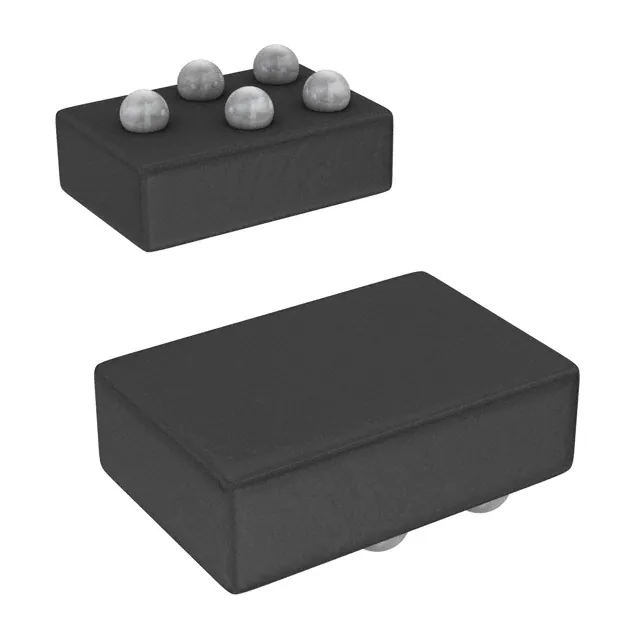
Package: Flip-Chip 5-bump, lead-free, non-conductive glass substrate (ST IPD technology); dimensions 1.485 mm × 1.020 mm × 0.630 mm; 595 µm profile after reflow.
| Pin/Terminal | Circuit Role | Design Meaning |
|---|---|---|
| SE | Single-ended RF input | 50 Ω matched port for connection to PA output or antenna switch |
| DIFF A / DIFF B | Differential RF outputs | Conjugate-matched pair driving nRF51/nRF24 RFIO_P/RFIO_N pins |
| VCC | Supply reference bump | DC bias connection point; must be decoupled locally per Nordic layout guidelines |
| GND | Ground reference bump | Low-inductance return path for RF and DC; requires solid ground plane under die |
Key Features
| Feature | Design Value |
|---|---|
| Integrated harmonic filter | Monolithic 2nd/3rd harmonic suppression eliminates need for discrete LC filters, reducing BOM count by ≥2 components |
| Conjugate impedance match | Pre-tuned to Nordic nRF51/nRF24 RF port ZDIFF - removes iterative matching network design and simulation effort |
| Ultra-low profile | 630 µm total thickness - enables use in space-constrained wearables and hearing aids where height < 0.7 mm is mandatory |
| IPD on glass substrate | High-Q passive integration on low-loss dielectric - delivers stable RF performance across temperature and process variation |
| Nordic-qualified | Tested and approved on nRF2723/nRF2752 nRFgo modules - de-risks qualification timeline for certified BLE product development |
Applications
| Bluetooth Low Energy Wearables | Proprietary 2.4 GHz Remote Controls |
|---|---|
Use Scenario: Compact hearable device with nRF51822-QFAA operating on coin cell, requiring minimal board area and height. IC Role / Device Role / Timing Role: Balun providing SE-to-DIFF conversion and harmonic filtering between antenna switch and transceiver RFIO pins. Use Value: Eliminates discrete matching network and harmonic filter, saving 1.2 mm² PCB area and enabling 595 µm system height. | Use Scenario: Sub-gram infrared/2.4 GHz hybrid remote using nRF24LE1 QFN32 for low-latency button telemetry. IC Role / Device Role / Timing Role: Impedance transformer and harmonic suppressor interfacing ceramic chip antenna to transceiver differential RF ports. Use Value: Achieves >10 dB 2nd-harmonic suppression without tuning, ensuring FCC Part 15.247 compliance in first-pass certification. |
| BLE Beacon Modules | nRFgo Development Platforms |
Use Scenario: Battery-powered iBeacon using nRF51422-QFAA (build code CA) with PCB trace antenna. IC Role / Device Role / Timing Role: Fixed-ratio balun enabling repeatable 50 Ω SE-to-100 Ω DIFF conversion across production batches. Use Value: Reduces RF validation time by eliminating variable matching component selection and placement sensitivity. | Use Scenario: Nordic Semiconductor nRF2752 evaluation board implementing reference RF layout. IC Role / Device Role / Timing Role: Qualified balun used in nRFgo module RF front-end to validate transceiver RF performance per spec. Use Value: Provides traceable, pre-validated RF interface - accelerates customer reference design reuse and firmware bring-up. |
Equivalent & Alternatives
The following parts are listed as comparable options for similar balun/filter applications.
| Alternative Part | Technical Difference | Application Difference | Selection Advice |
|---|---|---|---|
| TDK HHM2719B1 | Wider bandwidth (2400–2500 MHz), no integrated harmonic filtering, 3.2 dB IL typ | Requires external 2nd/3rd harmonic LC filter; not qualified on nRFgo modules | Select when broader frequency tolerance is needed but harmonic filtering can be added externally |
| Johanson 2450BM15A0002 | Same 2.4–2.5 GHz range, 2.5 dB IL, no harmonic suppression, 1.6× larger footprint (2.0 × 1.2 mm) | Lacks Nordic-specific conjugate match; requires custom matching for nRF51 RFIO pins | Choose only if board area allows larger package and harmonic filtering is handled elsewhere in RF chain |
Compared with HHM2719B1 and 2450BM15A0002, BAL-NRF01D3 uniquely combines Nordic-optimized conjugate matching, monolithic harmonic filtering, and sub-1.5 mm² footprint - making it the only drop-in solution for nRF51/nRF24-based designs targeting rapid certification and minimal RF layout iteration.
Availability
BAL-NRF01D3 is available at Aetrix Electronics and suitable for Bluetooth Low Energy wearables, proprietary 2.4 GHz remote controls, and BLE beacon modules requiring stable component supply, consistent RF performance across production lots, and support for high-volume tape-and-reel assembly.
Supply support for BAL-NRF01D3 includes scheduled delivery planning, volume procurement assistance, BOM continuity management, traceable sourcing, and lifecycle availability coordination for OEM customers, industrial embedded developers, connected-device designers, and electronics production programs.
Manufacturer
STMicroelectronics is a global semiconductor leader headquartered in Geneva, Switzerland, delivering intelligent power, analog, MEMS, and microcontroller solutions for automotive, industrial, and consumer markets.
BAL-NRF01D3 belongs to ST's IPD (Integrated Passive Device) balun product line, engineered specifically to simplify RF front-end design for ultra-low-power 2.4 GHz transceivers by embedding matching and filtering in a miniature, qualified package.
FAQ
What is the recommended PCB footprint for BAL-NRF01D3?
The official footprint uses a 3-mil stencil with non-solder-mask-defined pads: 220 µm copper pad diameter (180–260 µm range), 320 µm solder mask opening (300–340 µm), and 220 µm stencil aperture. ST recommends this configuration to ensure reliable flip-chip reflow and minimize voiding under bumps.
Does BAL-NRF01D3 require external matching components?
No. BAL-NRF01D3 is a fully integrated, pre-matched balun with no external components required. Its 50 Ω SE input and conjugate-matched DIFF output are optimized for direct connection to Nordic nRF51/nRF24 RF pins - verified on nRF2723/nRF2752 modules.
Can BAL-NRF01D3 be used with nRF52832 or nRF52840?
No. BAL-NRF01D3 is specifically tuned for nRF51422-QFAA (CA/C0), nRF51822-QFAA/QFAB (CA/C0, AA/A0), and nRF24LE1/AP2. nRF52-series transceivers have different RF port impedances and require distinct matching - ST does not qualify or characterize BAL-NRF01D3 for nRF52 use.
What is the thermal resistance and power handling capability?
BAL-NRF01D3 has no specified thermal resistance (RθJA) due to its passive, flip-chip construction on low-thermal-mass glass. It supports continuous 20 dBm input power (100 mW) per absolute maximum ratings, with no derating required up to +105 °C ambient - validated under JEDEC J-STD-020 reflow and thermal cycling conditions.
BAL-NRF01D3 Specifications
- Product attributes
- Attribute value
- Manufacturer:
- STMicroelectronics
- Series:
- -
- Package/Case:
- 5-WFBGA, FCBGA
- Packaging:
- Tape & Reel (TR)
- Product Status:
- Active
- Frequency Range:
- 2.4GHz ~ 2.54GHz
- Impedance - Unbalanced/Balanced:
- 50 / -Ohm
- Phase Difference:
- 3°
- Insertion Loss (Max):
- 2.25dB
- Return Loss (Min):
- 10dB
- Mounting Type:
- Surface Mount
BAL-NRF01D3 FAQ
1.How can I place an order for BAL-NRF01D3 through Aetrix?
Please submit a Request for Quotation (RFQ) for BAL-NRF01D3 on Aetrix. Our sales agent will provide a competitive quotation and guide you through the order confirmation once you accept the terms.
2.Are the price and stock information for BAL-NRF01D3 reliable?
The price and inventory of BAL-NRF01D3 are updated periodically and may fluctuate due to market conditions. Stock and pricing data are typically refreshed every 24 hours. Quotation validity for BAL-NRF01D3 is usually 5 days.
3.What payment methods are accepted for BAL-NRF01D3?
We accept Wire Transfer, PayPal, Credit Card, Western Union, MoneyGram, and Escrow for BAL-NRF01D3 transactions.
Note: Certain payment methods may incur a processing fee.
4.How is shipping managed for BAL-NRF01D3?
BAL-NRF01D3 orders can be shipped via leading logistics carriers, including DHL, UPS, FedEx, TNT, or Registered Mail.
Once your BAL-NRF01D3 order is processed, you will receive an email with the shipment details and tracking number.
Note: Tracking information may take up to 24 hours to appear. Express delivery typically takes 3–5 business days.
5.How can I obtain technical support or documentation for BAL-NRF01D3?
For technical support, including BAL-NRF01D3 datasheets, pinout diagrams, or application guidance, please contact our engineering support team. They can provide detailed documentation and assistance for your BAL-NRF01D3 requirements.
6.How does Aetrix verify that BAL-NRF01D3 is sourced from the original manufacturer or authorized distributors?
All BAL-NRF01D3 products on Aetrix are procured from qualified distributors and authorized channels. Our dedicated quality assurance team conducts strict verification, including traceability checks and, if necessary, third-party testing. This ensures that BAL-NRF01D3 meets industry standards.
7.What is the process for return or replacement of BAL-NRF01D3?
All BAL-NRF01D3 units undergo pre-shipment inspection (PSI). If there is an issue with BAL-NRF01D3, returns or replacements are accepted under the following conditions:
1.Quantity discrepancies, incorrect items, or visible external defects (such as breakage or corrosion), acknowledged by Aetrix.
2.The issue is reported within 90 days of delivery.
3.The BAL-NRF01D3 part is unused and in its original packaging.
Return procedure for BAL-NRF01D3:
1.Submit a request within 90 days.
2.Obtain a Return Material Authorization (RMA) from Aetrix.
BAL-NRF01D3 Tags

-
2450BL15B0100001E
Johanson Technology Inc.
-
0900BL15D0050001E
Johanson Technology Inc.
-
0900PC16J0042001E
Johanson Technology Inc.
-
2450BM15A0002001E
Johanson Technology Inc.
-
2450BM14G0011001T
Johanson Technology Inc.
-
BD0810N50100AHF
TTM Technologies, Inc.
-
1720BL15B0050001E
Johanson Technology Inc.
-
0900PC15A0036001E
Johanson Technology Inc.
-
0868BM15C0001001E
Johanson Technology Inc.
-
0915BM15A0001001E
Johanson Technology Inc.
-
HHM1776B3
TDK Corporation
-
2450BM14E0003001T
Johanson Technology Inc.
Tech Hub

A practical engineering and sourcing framework covering lifecycle verification, lifetime-buy calculations, replacement qualification, supplier checks and counterfeit-risk controls.

TTL and CMOS logic families differ in thresholds, loading, output drive, power and timing. This engineering guide compares 74HC and 74HCT, calculates noise margins and checks 3.3 V/5 V compatibility.

A practical engineering guide to 3.3V and 5V logic compatibility, input thresholds, resistor dividers, translator ICs, MOSFET level shifting, I2C pull-ups, timing limits and power-sequencing risks.

The 74HC595 uses push-pull logic outputs, while the TPIC6B595 uses 50 V open-drain DMOS sinks for higher-power loads. This guide compares timing, current limits, 3.3 V interfacing, load wiring, thermal…

The 74HC595 converts serial data into eight stable parallel outputs. This guide covers pin functions, shift and storage timing, OE and MR behavior, drive-current limits, cascading, voltage compatibilit…

A technical comparison of level-sensitive latches and edge-triggered flip-flops, covering timing windows, setup and hold limits, master–slave operation, time borrowing, race-through, HDL inference and…

A D latch stores one bit while Enable controls when data can pass. This reference covers gate-level operation, truth tables, transparency, setup and hold timing, LE versus OE, common ICs and practical …

An SR latch stores one bit through cross-coupled feedback. This engineering reference covers NOR and NAND implementations, truth tables, forbidden-state recovery, gated operation, switch debouncing, fa…

Latch circuits retain one bit through feedback. This technical reference covers SR and D latches, truth tables, transparency, timing limits, latch-versus-flip-flop behavior, applications and common log…

An engineering guide to LED driver operation, constant-current and constant-voltage outputs, linear and switching topologies, dimming, IC selection, calculations, replacement compatibility, and fault c…


