
 My Inquiry
 My Account


NXP Semiconductors BB152,115
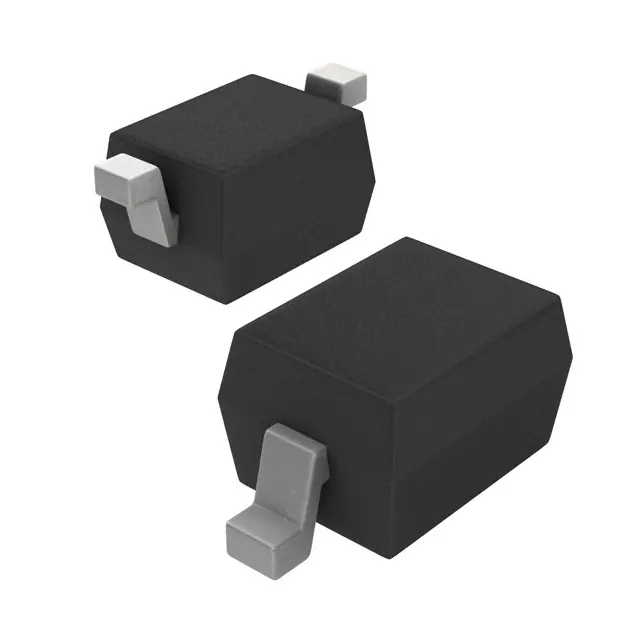
- Part No.:
- BB152,115
- Manufacturer:
- NXP Semiconductors
- Package:
- SC-76, SOD-323
- Datasheet:
-
 BB152,115.pdf
- Description:
- DIODE VHF VAR CAP 32V SOD323
- Quantity:
- Payment:

- Shipping:

Inventory:7,569
Please send an inquiry. Send us your inquiry, and we will respond immediately.
Product details
Overview
BB152 from NXP Semiconductors is a VHF variable capacitance diode (varactor) fabricated in planar technology, designed for electronic tuning in television tuners up to 160 MHz and voltage-controlled oscillators. It delivers Cd(1 V) = 52–62 pF, Cd(28 V) = 2.48–2.89 pF, capacitance ratio of 20.6–22, series resistance rs = 1.0–1.2 Ω at 100 MHz, and matching accuracy ≤2 % via Direct Matching Assembly.
For engineers reviewing the BB152 datasheet, BB152 pinout, BB152 application, or BB152 equivalent, key selection criteria include reverse voltage range (up to 32 V), low leakage (≤10 nA at VR = 30 V), tight capacitance matching across diode pairs, and SOD323 package compatibility with high-frequency VHF tuning circuits.
Technical Context
The BB152 operates as a reverse-biased junction capacitor whose depletion width-and thus capacitance-varies nonlinearly with applied DC bias. Its capacitance tuning curve is characterized at 1 MHz with typical values spanning 52 pF at 1 V to 2.7 pF at 28 V, yielding a usable tuning ratio near 22:1.
It employs gliding matching and Direct Matching Assembly (DMA) to achieve ≤2 % capacitance deviation across sequences of 10 diodes, enabling precise pair-matching for balanced VCO and tuner front-end designs requiring symmetrical tuning response.
Key Specifications
| Parameter | Value and Actual Design Meaning |
|---|---|
| Cd(1 V) | 52–62 pF - defines maximum tuning capacitance at low bias, critical for VCO start-up and low-frequency band coverage |
| Cd(28 V) | 2.48–2.89 pF - sets minimum capacitance, determining upper frequency limit in VHF tuners (up to 160 MHz) |
| Capacitance ratio | 20.6–22 - quantifies usable tuning range; higher ratio enables broader frequency coverage without switching bands |
| Series resistance rs | 1.0–1.2 Ω @ 100 MHz - directly impacts Q-factor and phase noise in oscillator tanks; low rs preserves tuning linearity |
| Reverse leakage IR | ≤10 nA @ VR = 30 V, 25 °C - ensures stable bias point and minimal drift in precision tuning applications |
| Matching tolerance | ≤2 % over 10-diode sequence - enables matched-pair use in differential VCOs and image-reject tuners without calibration |
Pinout & Package
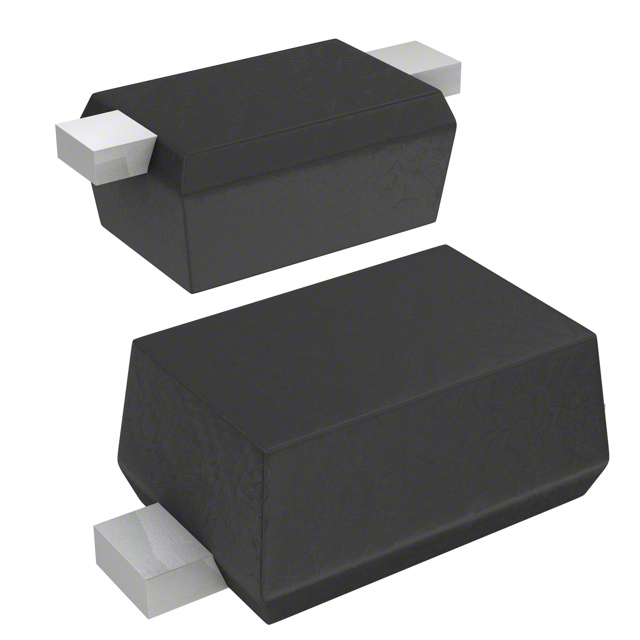
The BB152 is housed in the SOD323 (SC-76) plastic surface-mounted package: 1.35–1.8 mm length, 0.8–1.15 mm width, 0.25–0.45 mm height, with cathode indicated by a marking bar.
| Pin/Terminal | Circuit Role | Design Meaning |
|---|---|---|
| 1 | Cathode | Connected to higher DC bias potential in reverse-bias configuration; marking bar identifies this terminal |
| 2 | Anode | Connected to AC ground or RF return path; forms the low-impedance side of the varactor junction |
Key Features
| Feature | Design Value |
|---|---|
| High linearity | Capacitance vs. voltage curve optimized for minimal second-order distortion in VCO tuning, reducing harmonic spurs |
| Excellent matching | ≤2 % capacitance deviation across 10-device sequences supports differential architectures without trimming |
| Low series resistance | 1.0–1.2 Ω at 100 MHz sustains Q > 100 in 50 Ω-tuned circuits, critical for low-phase-noise oscillators |
| VHF-optimized package | SOD323 footprint minimizes parasitic inductance (<0.3 nH) and capacitance, preserving tuning integrity up to 160 MHz |
Applications
| VHF Television Tuner (Band A) | Voltage-Controlled Oscillator (VCO) |
|---|---|
Use Scenario: Tuning front-end RF filters and local oscillator stages in analog/digital TV receivers operating up to 160 MHz. IC Role / Device Role / Timing Role: Varactor diode providing bias-dependent capacitance for channel-selective resonance in LC tank circuits. Use Value: Enables single-component electronic tuning across Band A without mechanical adjustment or switched capacitor banks. | Use Scenario: Frequency tuning element in monolithic or hybrid VCOs for wireless transceivers and signal generators. IC Role / Device Role / Timing Role: Voltage-variable reactance controlling oscillation frequency in Colpitts or Clapp topologies. Use Value: Delivers 22:1 capacitance ratio and ≤2 % matching to support stable, low-drift VCO operation with minimal tuning voltage range. |
| FM Radio Tuner Front-End | Dual-Varactor Image-Reject Mixer |
Use Scenario: Resonant tuning in 88–108 MHz FM broadcast receiver input stages. IC Role / Device Role / Timing Role: Bias-controlled capacitance adjusting LC resonator center frequency for station selection. Use Value: Low series resistance (1.0–1.2 Ω) maintains high tank Q, improving selectivity and adjacent-channel rejection. | Use Scenario: Paired BB152 diodes used differentially in image-reject mixer LO paths to cancel even-order distortion. IC Role / Device Role / Timing Role: Matched varactors providing symmetric, voltage-controlled phase shift in quadrature LO generation. Use Value: ≤2 % DMA matching ensures amplitude and phase balance between I/Q paths, suppressing image artifacts. |
Equivalent & Alternatives
The following parts are listed as comparable options for similar varactor diode applications.
| Alternative Part | Technical Difference | Application Difference | Selection Advice |
|---|---|---|---|
| BB204,115 | Higher Cd(1 V) = 70–85 pF; lower capacitance ratio ≈ 15; same SOD323 package and 32 V VR rating | Better suited for lower-frequency tuning (e.g., AM/MW bands); reduced VHF bandwidth due to lower ratio | Select BB204,115 when wider low-end capacitance is required and 160 MHz coverage is not needed. |
| SMV1232-011 | Higher VR = 30 V (max), Cd(1 V) = 56 pF, Cd(28 V) = 2.9 pF, ratio ≈ 19.3; SOD-523 package (smaller footprint) | Smaller package increases layout density but raises parasitic sensitivity above 100 MHz; slightly lower ratio limits VHF reach | Choose SMV1232-011 only if board space is constrained and full 160 MHz performance is secondary to size reduction. |
Compared with BB204,115 and SMV1232-011, the BB152 uniquely balances 22:1 tuning ratio, ≤2 % matching, and SOD323 robustness for VHF television tuners-making it the preferred choice where both bandwidth and pair-matching stability are mandatory.
Availability
BB152 is available at Aetrix Electronics and suitable for VHF television tuners, voltage-controlled oscillators, FM radio front-ends, and image-reject mixer designs requiring stable component supply and traceable sourcing.
Supply support for BB152 includes scheduled delivery planning, volume procurement assistance, BOM continuity management, traceable sourcing, and lifecycle availability coordination for OEM customers, industrial embedded developers, connected-device designers, and electronics production programs.
Manufacturer
NXP Semiconductors is a global semiconductor company headquartered in Eindhoven, Netherlands, specializing in secure connectivity solutions for automotive, industrial, and consumer applications.
The BB152 belongs to NXP's RF varactor diode product line, engineered specifically for high-linearity, matched-capacitance tuning in VHF broadcast and communications equipment.
FAQ
What is the maximum reverse voltage rating for the BB152?
The BB152 has an absolute maximum reverse voltage (VR) rating of 32 V and a peak reverse voltage (VRM) of 35 V when used in series with a 10 kΩ resistor. Operation beyond these limits risks permanent junction damage per IEC 60134 limiting values. The BB152 is rated for continuous reverse bias up to 28 V in normal operation, where its capacitance is specified as 2.48–2.89 pF.
How does the BB152 achieve ≤2 % capacitance matching?
The BB152 achieves ≤2 % capacitance matching through a combination of gliding matching during wafer sort and Direct Matching Assembly (DMA) at packaging. This process selects and groups diodes from adjacent die positions with tightly correlated doping and geometry, ensuring consistent Cd(1 V) to Cd(28 V) behavior across sequences of 10 devices-critical for differential VCO and tuner designs requiring symmetry.
What is the series resistance of the BB152 and why does it matter?
The BB152 exhibits a typical series resistance (rs) of 1.0–1.2 Ω measured at 100 MHz with Cd = 30 pF. This low rs directly determines the Q-factor of resonant tank circuits: Q ≈ 1/(2πf·rs·C). At 100 MHz and 5 pF, rs = 1.1 Ω yields Q > 280-enabling low-phase-noise VCOs and high-selectivity tuners. Higher rs would degrade tuning efficiency and increase close-in phase noise.
Can the BB152 be used in automotive applications?
No-the BB152 is not automotive-qualified. NXP explicitly states in its legal disclaimers that unless a product data sheet expressly declares automotive qualification, the device is unsuitable for automotive use. The BB152 has not undergone AEC-Q200 stress testing or temperature cycling validation for under-hood environments, and its guaranteed operating range (−55 °C to +125 °C junction) does not reflect automotive-grade reliability requirements.
What does the marking code 'PB' indicate on the BB152 package?
The marking code 'PB' laser-etched on the BB152's SOD323 body identifies the specific device variant and manufacturing lot traceability per NXP's internal coding system. It is not a generic identifier-it corresponds exclusively to the BB152 VHF varactor specification, distinguishing it from other NXP diodes like BB204 ('PC') or BB171 ('PA'). The cathode is always denoted by the marking bar adjacent to pin 1.
BB152,115 Specifications
- Product attributes
- Attribute value
- Manufacturer:
- NXP Semiconductors
- Series:
- -
- Package/Case:
- SC-76, SOD-323
- Packaging:
- Tape & Reel (TR)
- Product Status:
- Obsolete
- Capacitance @ Vr, F:
- 2.89pF @ 28V, 1MHz
- Capacitance Ratio:
- 22.0
- Capacitance Ratio Condition:
- C1/C28
- Voltage - Peak Reverse (Max):
- 32 V
- Diode Type:
- Single
- Q @ Vr, F:
- -
- Operating Temperature:
- -55°C ~ 125°C (TJ)
- Grade:
- -
- Qualification:
- -
- Mounting Type:
- Surface Mount
- Supplier Device Package:
- SOD-323
BB152,115 FAQ
1.How can I place an order for BB152,115 through Aetrix?
Please submit a Request for Quotation (RFQ) for BB152,115 on Aetrix. Our sales agent will provide a competitive quotation and guide you through the order confirmation once you accept the terms.
2.Are the price and stock information for BB152,115 reliable?
The price and inventory of BB152,115 are updated periodically and may fluctuate due to market conditions. Stock and pricing data are typically refreshed every 24 hours. Quotation validity for BB152,115 is usually 5 days.
3.What payment methods are accepted for BB152,115?
We accept Wire Transfer, PayPal, Credit Card, Western Union, MoneyGram, and Escrow for BB152,115 transactions.
Note: Certain payment methods may incur a processing fee.
4.How is shipping managed for BB152,115?
BB152,115 orders can be shipped via leading logistics carriers, including DHL, UPS, FedEx, TNT, or Registered Mail.
Once your BB152,115 order is processed, you will receive an email with the shipment details and tracking number.
Note: Tracking information may take up to 24 hours to appear. Express delivery typically takes 3–5 business days.
5.How can I obtain technical support or documentation for BB152,115?
For technical support, including BB152,115 datasheets, pinout diagrams, or application guidance, please contact our engineering support team. They can provide detailed documentation and assistance for your BB152,115 requirements.
6.How does Aetrix verify that BB152,115 is sourced from the original manufacturer or authorized distributors?
All BB152,115 products on Aetrix are procured from qualified distributors and authorized channels. Our dedicated quality assurance team conducts strict verification, including traceability checks and, if necessary, third-party testing. This ensures that BB152,115 meets industry standards.
7.What is the process for return or replacement of BB152,115?
All BB152,115 units undergo pre-shipment inspection (PSI). If there is an issue with BB152,115, returns or replacements are accepted under the following conditions:
1.Quantity discrepancies, incorrect items, or visible external defects (such as breakage or corrosion), acknowledged by Aetrix.
2.The issue is reported within 90 days of delivery.
3.The BB152,115 part is unused and in its original packaging.
Return procedure for BB152,115:
1.Submit a request within 90 days.
2.Obtain a Return Material Authorization (RMA) from Aetrix.
BB152,115 Tags
-
BBY5702VH6327XTSA1
Infineon Technologies
-
BBY5602VH6327XTSA1
Infineon Technologies
-
SMV1405-040LF
Skyworks Solutions Inc.
-
BBY6502VH6327XTSA1
Infineon Technologies
-
BBY6602VH6327XTSA1
Infineon Technologies
-
BBY5802VH6327XTSA1
Infineon Technologies
.jpg)
-
BB175X
NXP Semiconductors
-
SMV1430-040LF
Skyworks Solutions Inc.
-
SMV1273-079LF
Skyworks Solutions Inc.
-
SMV1255-079LF
Skyworks Solutions Inc.
-
SMV1213-079LF
Skyworks Solutions Inc.
-
SMV1247-079LF
Skyworks Solutions Inc.
Tech Hub

A practical engineering guide to 3.3V and 5V logic compatibility, input thresholds, resistor dividers, translator ICs, MOSFET level shifting, I2C pull-ups, timing limits and power-sequencing risks.

The 74HC595 uses push-pull logic outputs, while the TPIC6B595 uses 50 V open-drain DMOS sinks for higher-power loads. This guide compares timing, current limits, 3.3 V interfacing, load wiring, thermal…

The 74HC595 converts serial data into eight stable parallel outputs. This guide covers pin functions, shift and storage timing, OE and MR behavior, drive-current limits, cascading, voltage compatibilit…

A technical comparison of level-sensitive latches and edge-triggered flip-flops, covering timing windows, setup and hold limits, master–slave operation, time borrowing, race-through, HDL inference and…

A D latch stores one bit while Enable controls when data can pass. This reference covers gate-level operation, truth tables, transparency, setup and hold timing, LE versus OE, common ICs and practical …

An SR latch stores one bit through cross-coupled feedback. This engineering reference covers NOR and NAND implementations, truth tables, forbidden-state recovery, gated operation, switch debouncing, fa…

Latch circuits retain one bit through feedback. This technical reference covers SR and D latches, truth tables, transparency, timing limits, latch-versus-flip-flop behavior, applications and common log…

An engineering guide to LED driver operation, constant-current and constant-voltage outputs, linear and switching topologies, dimming, IC selection, calculations, replacement compatibility, and fault c…

Operational amplifier guide covering op amp basics, feedback, ideal vs real op amps, common configurations, buffer circuits, offset, bias current, gain-bandwidth, slew rate, rail-to-rail limits and sel…

Jumper cables guide covering safe connection order, red and black clamp placement, final ground connection, cable gauge, length, clamp quality, copper vs CCA cables, jump starter comparison and battery…


