
 My Inquiry
 My Account


onsemi BC556BU
,TO-226_straightlead.jpg)
- Part No.:
- BC556BU
- Manufacturer:
- onsemi
- Category:
- Single Bipolar Transistors
- Package:
- TO-226-3, TO-92-3 (TO-226AA)
- Datasheet:
-
 BC556BU.pdf
- Description:
- TRANS PNP 65V 0.1A TO-92-3
- Quantity:
- Payment:

- Shipping:

Inventory:5,499
Please send an inquiry. Send us your inquiry, and we will respond immediately.
Product details
Overview
BC556BU from onsemi is a PNP epitaxial silicon transistor designed for general-purpose switching and linear amplification in low-power analog and digital circuits. It features VCEO = −65 V, IC = −100 mA, hFE = 110–800 (Class B), fT = 150 MHz, and TO-92-3 (Case 135AN) packaging. It serves as a high-voltage complement to BC546–BC550 NPN transistors in bias networks, signal inversion stages, and discrete logic interfaces.
For engineers reviewing the BC556BU datasheet, pinout, applications, or equivalent options, key selection criteria include verified VCEO rating, hFE classification consistency, saturation voltage at defined IC/IB, thermal derating behavior, and Pb-free RoHS-compliant packaging compatibility with through-hole assembly processes.
Technical Context
The BC556BU operates as a medium-speed, medium-voltage PNP bipolar junction transistor optimized for DC-coupled amplification and saturated switching. Its hFE range (200–450 for Class B) supports stable biasing across temperature, while VCE(sat) ≤ −300 mV at IC = −10 mA / IB = −0.5 mA ensures low conduction loss in active-low switch configurations.
Thermal performance is defined by RJA = 250 °C/W (FR-4 PCB, 76 mm × 114 mm), with linear derating of 4.0 mW/°C above 25 °C. Its Cob = 6 pF at VCB = −10 V enables use in audio-frequency amplifiers and low-speed digital interfaces without significant capacitive loading.
Key Specifications
| Parameter | Value and Actual Design Meaning |
|---|---|
| VCEO | −65 V - Supports operation in negative-rail circuits up to 65 V, e.g., industrial sensor biasing or relay drivers with elevated supply rails. |
| IC (DC) | −100 mA - Enables direct drive of small solenoids, LEDs, or logic inputs without external current gain staging. |
| hFE (Class B) | 200–450 - Ensures predictable base current requirements for stable DC bias design across production lots and temperature. |
| VCE(sat) | −300 mV max @ IC = −10 mA / IB = −0.5 mA - Minimizes power dissipation and voltage drop in saturated switch applications. |
| fT | 150 MHz - Permits use in audio preamplifiers and low-frequency RF stages (e.g., IF amplification up to ~10 MHz). |
| Cob | 6 pF @ VCB = −10 V - Limits high-frequency feedback and maintains stability in common-emitter amplifier topologies. |
| PD | 500 mW @ TA = 25°C - Allows continuous operation at full current under moderate ambient conditions with standard PCB copper area. |
Pinout & Package
BC556BU is housed in a TO-92-3 plastic package (Case 135AN), with leads arranged in straight-lead configuration. The package measures 4.825 mm × 4.76 mm and is RoHS-compliant, Pb-free, and halogen-free.
| Pin/Terminal | Circuit Role | Design Meaning |
|---|---|---|
| 1 | Collector | Primary current sink node; connected to most negative potential in PNP operation; requires heatsinking consideration at >100 mW dissipation. |
| 2 | Base | Control input; requires current-limiting resistor to set operating point; sensitive to ESD due to thin oxide layer. |
| 3 | Emitter | Current source terminal; typically tied to circuit ground or positive rail depending on topology; defines reference for VBE and VCE. |
Key Features
| Feature | Design Value |
|---|---|
| High-voltage PNP architecture | VCEO = −65 V enables robust operation in negative-supply systems where lower-voltage PNP devices would break down. |
| Low-noise amplification capability | NF = 2–10 dB @ 1 kHz supports clean signal amplification in microphone preamps and sensor front-ends. |
| Complementary pairing with BC546–BC550 series | Matched hFE ranges and thermal coefficients allow balanced push-pull stage design in Class A/B audio outputs. |
| Pb-free, RoHS-compliant construction | Meets global environmental compliance mandates without requiring process requalification for legacy through-hole manufacturing lines. |
Applications
| Audio Signal Amplification | Discrete Logic Level Shifting |
|---|---|
Use Scenario: Low-noise preamplifier stage for electret condenser microphones in portable voice recorders. IC Role / Device Role / Timing Role: PNP common-emitter amplifier providing 20–40 dB voltage gain with minimal added noise. Use Value: NF = 2–10 dB and hFE ≥ 200 ensure high signal-to-noise ratio and stable gain over battery discharge cycles. | Use Scenario: Inverting level translator between 5 V TTL logic and −5 V analog control bus in test equipment. IC Role / Device Role / Timing Role: Saturated PNP switch converting positive logic highs to negative rail activation signals. Use Value: VCE(sat) ≤ −300 mV guarantees reliable turn-on margin and fast edge response under load. |
| Industrial Sensor Biasing | Relay Driver Interface |
Use Scenario: Constant-current bias source for RTD or thermistor bridges in programmable logic controller (PLC) analog input modules. IC Role / Device Role / Timing Role: Emitter-follower configured transistor delivering stable −1–2 mA bias current independent of supply variation. Use Value: VCEO = −65 V accommodates wide-range industrial supplies (e.g., −24 V to −48 V) without derating. | Use Scenario: Direct drive of 12 V/400 Ω electromagnetic relay coil in HVAC control panels. IC Role / Device Role / Timing Role: Saturated switch sinking relay current through collector to ground, with base driven by microcontroller GPIO. Use Value: IC = −100 mA rating exceeds typical relay hold current (≈80 mA), ensuring long-term reliability. |
Equivalent & Alternatives
The following parts are listed as comparable options for similar PNP general-purpose transistor applications.
| Alternative Part | Technical Difference | Application Difference | Selection Advice |
|---|---|---|---|
| BC557BTA | VCEO = −45 V; same hFE Class B (200–450); identical TO-92-3 (135AR) package but bent-lead form. | Limited to ≤45 V negative-rail systems; not suitable for 65 V designs such as telecom line interface cards. | Select BC557BTA only when supply voltage is confirmed ≤45 V and bent-lead assembly is required. |
| MMBT5551 | NPN polarity; VCEO = 160 V; SOT-23 package; hFE = 80–250; not complementary to BC546–BC550 series. | Requires circuit topology redesign (e.g., inverting stage insertion); unsuitable for direct replacement in existing PNP-based layouts. | Use MMBT5551 only in new NPN-centric designs demanding higher voltage tolerance and surface-mount compatibility. |
Compared with BC556BU, BC557BTA offers identical gain and noise performance but reduced voltage rating, while MMBT5551 provides superior voltage handling in a different polarity and footprint-neither is pin-compatible, and both require schematic and layout revision.
Availability
BC556BU is available at Aetrix Electronics and suitable for industrial sensor biasing, audio preamplification, discrete logic level translation, and relay driver interface applications requiring stable component supply and legacy through-hole compatibility.
Supply support for BC556BU includes scheduled delivery planning, volume procurement assistance, BOM continuity management, traceable sourcing, and lifecycle availability coordination for OEM customers, industrial embedded developers, connected-device designers, and electronics production programs.
Manufacturer
onsemi (formerly ON Semiconductor) is a global semiconductor supplier specializing in energy-efficient power management, analog, sensing, and connectivity solutions for automotive, industrial, and cloud infrastructure markets.
The BC556BU belongs to the BC556–BC560 family of general-purpose PNP transistors engineered for cost-sensitive, high-reliability through-hole applications in analog signal conditioning, discrete switching, and complementary amplifier stages.
FAQ
What is the maximum collector-emitter voltage rating for BC556BU?
The BC556BU has a guaranteed VCEO rating of −65 V at TA = 25°C. This rating applies under DC conditions and must be derated linearly above 25°C per the device's thermal characteristics. Exceeding this voltage risks permanent breakdown, especially in circuits with inductive loads or transient spikes. Always verify operating margin against worst-case supply and flyback conditions when using BC556BU in high-voltage designs.
Is BC556BU RoHS-compliant and lead-free?
Yes, BC556BU is explicitly marked as Pb-free, halogen-free/BFR-free, and RoHS-compliant per onsemi's datasheet revision 3 (June 2024). It meets EU Directive 2011/65/EU and associated amendments. The TO-92-3 Case 135AN package uses lead-free solderable terminations and complies with JEDEC J-STD-020 moisture sensitivity level (MSL) requirements for through-hole reflow and wave soldering.
How does BC556BU differ from BC556BTA?
BC556BU and BC556BTA share identical electrical specifications and TO-92-3 packaging, but differ in lead configuration and packaging format: BC556BU uses straight leads in bulk box (10,000 units), while BC556BTA uses bent leads in fan-fold tape (2,000 units). Both are Class B (hFE = 200–450) and RoHS-compliant. The choice depends solely on assembly method-not performance or reliability.
What is the typical noise figure of BC556BU and where is it specified?
The BC556BU exhibits a noise figure (NF) of 2–10 dB at 1 kHz, VCE = −5 V, IC = −200 µA, and RG = 2 kΩ, as documented in the "Electrical Characteristics" table on page 2 of the onsemi datasheet. This value positions BC556BU for low-noise small-signal amplification, particularly in microphone preamp and sensor interface circuits where input-referred noise must remain below 10 nV/√Hz.
Can BC556BU replace BC557B in an existing design?
No-BC556BU is not a direct replacement for BC557B due to differing VCEO ratings: BC556BU supports −65 V while BC557B is rated for −45 V. Substituting BC556BU into a BC557B-design may be safe if voltage stress remains within −45 V, but substituting BC557B into a BC556BU-design risks breakdown. Always validate maximum applied VCE and transient margins before interchange, and confirm hFE binning matches system bias requirements for BC556BU.
BC556BU Specifications
- Product attributes
- Attribute value
- Manufacturer:
- onsemi
- Series:
- -
- Package/Case:
- TO-226-3, TO-92-3 (TO-226AA)
- Packaging:
- Bulk
- Product Status:
- Obsolete
- Transistor Type:
- PNP
- Current - Collector (Ic) (Max):
- 100 mA
- Voltage - Collector Emitter Breakdown (Max):
- 65 V
- Vce Saturation (Max) @ Ib, Ic:
- 650mV @ 5mA, 100mA
- Current - Collector Cutoff (Max):
- 15nA (ICBO)
- DC Current Gain (hFE) (Min) @ Ic, Vce:
- 110 @ 2mA, 5V
- Power - Max:
- 500 mW
- Frequency - Transition:
- 150MHz
- Operating Temperature:
- 150°C (TJ)
- Grade:
- -
- Qualification:
- -
- Mounting Type:
- Through Hole
- Supplier Device Package:
- TO-92-3
BC556BU FAQ
1.How can I place an order for BC556BU through Aetrix?
Please submit a Request for Quotation (RFQ) for BC556BU on Aetrix. Our sales agent will provide a competitive quotation and guide you through the order confirmation once you accept the terms.
2.Are the price and stock information for BC556BU reliable?
The price and inventory of BC556BU are updated periodically and may fluctuate due to market conditions. Stock and pricing data are typically refreshed every 24 hours. Quotation validity for BC556BU is usually 5 days.
3.What payment methods are accepted for BC556BU?
We accept Wire Transfer, PayPal, Credit Card, Western Union, MoneyGram, and Escrow for BC556BU transactions.
Note: Certain payment methods may incur a processing fee.
4.How is shipping managed for BC556BU?
BC556BU orders can be shipped via leading logistics carriers, including DHL, UPS, FedEx, TNT, or Registered Mail.
Once your BC556BU order is processed, you will receive an email with the shipment details and tracking number.
Note: Tracking information may take up to 24 hours to appear. Express delivery typically takes 3–5 business days.
5.How can I obtain technical support or documentation for BC556BU?
For technical support, including BC556BU datasheets, pinout diagrams, or application guidance, please contact our engineering support team. They can provide detailed documentation and assistance for your BC556BU requirements.
6.How does Aetrix verify that BC556BU is sourced from the original manufacturer or authorized distributors?
All BC556BU products on Aetrix are procured from qualified distributors and authorized channels. Our dedicated quality assurance team conducts strict verification, including traceability checks and, if necessary, third-party testing. This ensures that BC556BU meets industry standards.
7.What is the process for return or replacement of BC556BU?
All BC556BU units undergo pre-shipment inspection (PSI). If there is an issue with BC556BU, returns or replacements are accepted under the following conditions:
1.Quantity discrepancies, incorrect items, or visible external defects (such as breakage or corrosion), acknowledged by Aetrix.
2.The issue is reported within 90 days of delivery.
3.The BC556BU part is unused and in its original packaging.
Return procedure for BC556BU:
1.Submit a request within 90 days.
2.Obtain a Return Material Authorization (RMA) from Aetrix.
BC556BU Tags
-
MMBT3906LT1G
onsemi
-
MMBT3904-7-F
Diodes Incorporated
-
MMBT3904LT1G
onsemi
-
MMBT3906-7-F
Diodes Incorporated
-
MMBT3904-TP
Micro Commercial Co
-
MMBT2222A-7-F
Diodes Incorporated
-
BC846BLT1G
onsemi
-
BC847B,215
Nexperia USA Inc.
-
SMMBT3904LT1G
onsemi
-
MMBT2222A-TP
Micro Commercial Co
-
MMBTA06LT1G
onsemi
-
MMBT2222ALT1G
onsemi
Tech Hub
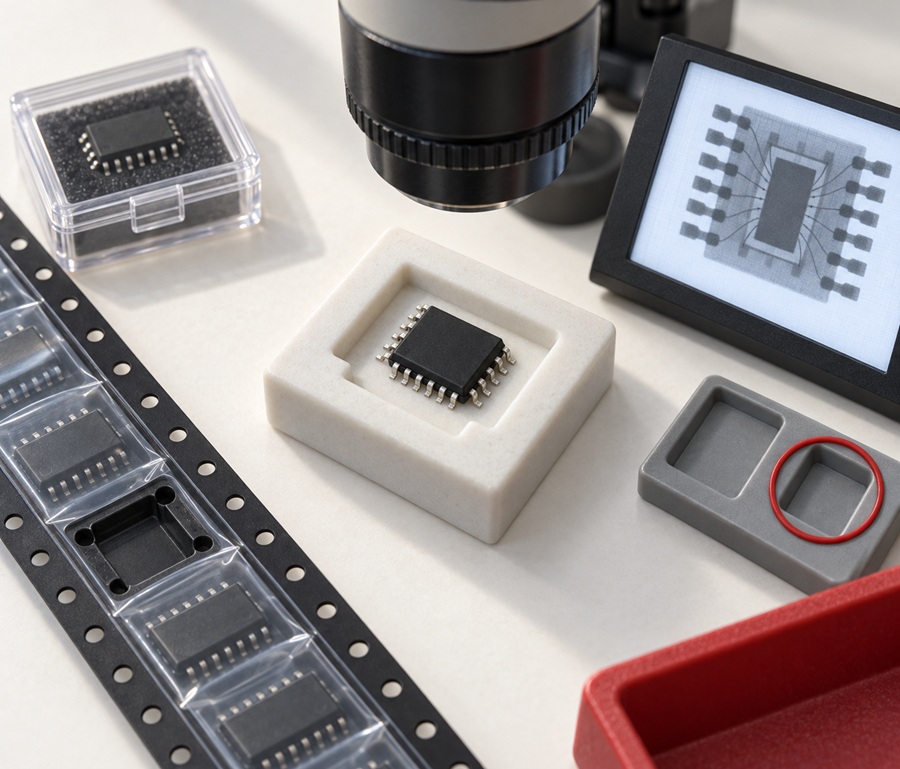
Counterfeit components can hide behind convincing markings and passing basic function tests. This engineering reference covers source traceability, external inspection, X-ray, XRF, electrical testing, …

A practical engineering and sourcing framework covering lifecycle verification, lifetime-buy calculations, replacement qualification, supplier checks and counterfeit-risk controls.

TTL and CMOS logic families differ in thresholds, loading, output drive, power and timing. This engineering guide compares 74HC and 74HCT, calculates noise margins and checks 3.3 V/5 V compatibility.

A practical engineering guide to 3.3V and 5V logic compatibility, input thresholds, resistor dividers, translator ICs, MOSFET level shifting, I2C pull-ups, timing limits and power-sequencing risks.

The 74HC595 uses push-pull logic outputs, while the TPIC6B595 uses 50 V open-drain DMOS sinks for higher-power loads. This guide compares timing, current limits, 3.3 V interfacing, load wiring, thermal…

The 74HC595 converts serial data into eight stable parallel outputs. This guide covers pin functions, shift and storage timing, OE and MR behavior, drive-current limits, cascading, voltage compatibilit…

A technical comparison of level-sensitive latches and edge-triggered flip-flops, covering timing windows, setup and hold limits, master–slave operation, time borrowing, race-through, HDL inference and…

A D latch stores one bit while Enable controls when data can pass. This reference covers gate-level operation, truth tables, transparency, setup and hold timing, LE versus OE, common ICs and practical …

An SR latch stores one bit through cross-coupled feedback. This engineering reference covers NOR and NAND implementations, truth tables, forbidden-state recovery, gated operation, switch debouncing, fa…

Latch circuits retain one bit through feedback. This technical reference covers SR and D latches, truth tables, transparency, timing limits, latch-versus-flip-flop behavior, applications and common log…


