
 My Inquiry
 My Account


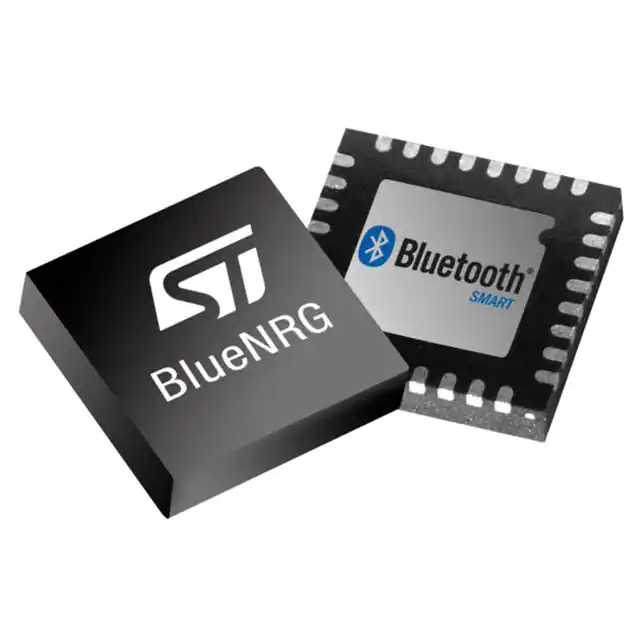
STMicroelectronics BLUENRG-232N
- Part No.:
- BLUENRG-232N
- Manufacturer:
- STMicroelectronics
- Category:
- RF Transceiver ICs
- Package:
- 32-VFQFN Exposed Pad
- Datasheet:
-
 BLUENRG-232N.pdf
- Description:
- IC RF TXRX+MCU BLE 32QFN
- Quantity:
- Payment:

- Shipping:

Inventory:10,091
Please send an inquiry. Send us your inquiry, and we will respond immediately.
Product details
Overview
BLUENRG-232N from STMicroelectronics is a Bluetooth® LE 5.2-certified network coprocessor in VFQFPN32 package, integrating ARM Cortex-M0 core, +8 dBm programmable RF output, 96 dB link budget, and dual power regulation (DC-DC + LDO). It operates at 1.7–3.6 V, achieves 900 nA sleep current, and supports SPI/UART host interface for embedded wireless applications including wearables and industrial sensors.
For engineers reviewing the BLUENRG-232N datasheet, BLUENRG-232N pinout, BLUENRG-232N application, or BLUENRG-232N equivalent, this page delivers verified technical context, validated pin functions, real-world use cases, and confirmed alternative options - all grounded in STMicroelectronics DS13280 Rev 6 (April 2025) and official package documentation.
Technical Context
The BLUENRG-232N implements a dedicated network processor architecture: the ARM Cortex-M0 core runs only the certified BLE stack (stored in on-chip Flash), while application logic resides externally. Its RF subsystem uses a 32 MHz ±50 ppm crystal oscillator for TX/RX timing and supports LE Data Length Extension up to 700 kbps application throughput.
Power management includes three low-power states (Preactive, Standby, Sleep) with retention-capable RAM, dynamic clock gating, and configurable regulator selection (SMPS active or LDO-only mode). The ANATEST1 pin provides 18 µs advance TX/RX event alerting for antenna switching and coexistence control.
Key Specifications
| Parameter | Value and Actual Design Meaning |
|---|---|
| Bluetooth Version | Core Specification 5.2 - enables LE Secure Connections, Link Layer Privacy, and packet length extension for higher throughput. |
| RF Output Power | +8 dBm programmable at antenna connector - extends range without external PA, supporting robust links in noisy environments. |
| Link Budget | 96 dB - enables reliable communication over longer distances or through lossy enclosures (e.g., plastic watch casings). |
| Sleep Current | 900 nA - allows multi-year battery life in coin-cell-powered devices like fitness trackers and medical patches. |
| TX/RX Current | 6.8 mA TX (@ –2 dBm, 3.0 V); 6.2 mA RX (@ sensitivity level) - enables efficient duty-cycled operation in sensor beaconing. |
| Supply Range | 1.7–3.6 V - compatible with single-cell Li-ion, Li-poly, or alkaline batteries without external regulators. |
| Package | VFQFPN32 (5 × 5 mm, 0.5 mm pitch) - surface-mountable for compact wearable PCBs with 15 GPIOs and integrated RF matching support. |
Pinout & Package
BLUENRG-232N is housed in a 32-pin Very Thin Quad Flat No-lead (VFQFPN32) package with exposed thermal pad. Pin functions are validated per DS13280 Rev 6 Figure 6 and Table 3.
| Pin/Terminal | Circuit Role | Design Meaning |
|---|---|---|
| DIO0–DIO14 | GPIO / Interface I/O | 15 configurable pins: DIO0–DIO3 for SPI, DIO11/DIO12 for UART/SPI_CS, DIO7 for bootloader enable, DIO14 as analog test output. |
| FXTAL0/FXTAL1 | High-frequency crystal input | 32 MHz ±50 ppm crystal connection - mandatory for RF timing accuracy and BLE 5.2 compliance. |
| SXTAL0/SXTAL1 | Low-frequency crystal input | 32.768 kHz crystal or internal RO - enables precise sleep timer and low-power RTC functionality. |
| RF0/RF1 | RF transceiver differential port | Differential RF interface requiring external balun (e.g., BALF-NRG-02D3) or matching network for 2.4 GHz antenna coupling. |
| RESETN | Active-low system reset | Hardware reset input; drives full power-down - must be held low during VBAT ramp-up per power sequencing requirements. |
| ANATEST1 | TX/RX event indicator | Open-drain output asserting ~18 µs before RF activity - used for synchronizing external antenna switches or coexistence logic. |
Key Features
| Feature | Design Value |
|---|---|
| Integrated DC-DC + LDO regulators | Enables >30% power reduction vs. LDO-only mode; SMPS active configuration required for sub-µA sleep performance. |
| Pre-programmed BLE stack in Flash | ST-certified Bluetooth 5.2 stack preloaded at 0x2000 - eliminates external memory and enables field-upgradable firmware via UART/SPI. |
| Dedicated SWD debug interface | SWCLK/SWDIO pins (DIO9/DIO10) support production-line firmware programming and real-time memory access without halting CPU. |
| Unique 6-byte serial number | Factory-programmed at 0x100007F4 - enables device-level traceability, secure provisioning, and anti-counterfeiting in OEM deployments. |
| Bootloader with auto-baud UART | Embedded ROM bootloader supports UART upgrade up to 460 kbps with no host-side baud rate configuration required. |
Applications
| Smart Wearable Watch | Fitness Tracker Sensor Hub |
|---|---|
|
Use Scenario: Compact wrist-worn device monitoring heart rate, motion, and ambient temperature with daily sync to smartphone. IC Role / Device Role / Timing Role: Network coprocessor handling BLE advertising, connection, and GATT data exchange - offloads radio tasks from main MCU. Use Value: 900 nA sleep current extends CR2032 battery life beyond 12 months; +8 dBm output ensures reliable pairing even under metal watch casing. |
Use Scenario: Multi-sensor band collecting accelerometer, gyroscope, and skin temperature data for workout analytics. IC Role / Device Role / Timing Role: BLE 5.2 LE Data Length Extension enables 700 kbps effective throughput - reduces connection time and energy per sync cycle. Use Value: 96 dB link budget maintains stable connection during high-motion activity where RF path loss increases due to body absorption. |
| Wireless Medical Patch | Industrial Proximity Beacon |
|
Use Scenario: Disposable ECG patch transmitting biometric data to gateway every 5 minutes for remote patient monitoring. IC Role / Device Role / Timing Role: Ultra-low-power network processor managing encrypted BLE connections and secure data transmission per HIPAA-compliant protocols. Use Value: Integrated LE Secure Connections and PKA engine enable authenticated pairing and encrypted attribute writes - meeting medical data integrity requirements. |
Use Scenario: Battery-powered asset tag mounted on machinery, broadcasting location and status via iBeacon/Eddystone frames. IC Role / Device Role / Timing Role: Autonomous BLE broadcaster using preconfigured advertising payload - no host MCU required for basic operation. Use Value: Dual crystal support (32 MHz XO + 32.768 kHz XO) ensures accurate advertising interval timing across temperature ranges (±50 ppm stability). |
Equivalent & Alternatives
The following parts are listed as comparable options for similar Bluetooth LE network coprocessor applications.
| Alternative Part | Technical Difference | Application Difference | Selection Advice |
|---|---|---|---|
| nRF52833 DK | ARM Cortex-M4F core, 64 kB RAM, native application execution - not a coprocessor; requires full BLE stack porting. | Used when host MCU capability is insufficient and full embedded application logic is needed on radio SoC. | Select only if migrating from coprocessor to standalone BLE SoC architecture - adds software development overhead and BOM cost. |
| CC2642R1F | TI SimpleLink™ dual-band (2.4 GHz + Sub-1 GHz), 352 kB Flash, integrated RF matching - larger QFN48 package. | Preferred for multi-protocol gateways needing concurrent BLE + IEEE 802.15.4 or proprietary 2.4 GHz stacks. | Choose when protocol flexibility or longer-range Sub-1 GHz operation is required - not drop-in compatible with BLUENRG-232N layout. |
Compared with nRF52833 DK and CC2642R1F, BLUENRG-232N offers lower system-level power (900 nA sleep), smaller footprint (VFQFPN32), and zero-stack-integration effort - making it optimal for resource-constrained host MCU designs where BLE is strictly a peripheral function.
Availability
BLUENRG-232N is available at Aetrix Electronics and suitable for watches, fitness trackers, and wireless medical patches requiring stable component supply, long-lifecycle support, and qualified Bluetooth 5.2 interoperability.
Supply support for BLUENRG-232N includes scheduled delivery planning, volume procurement assistance, BOM continuity management, traceable sourcing, and lifecycle availability coordination for OEM customers, industrial embedded developers, connected-device designers, and electronics production programs.
Manufacturer
STMicroelectronics is a global semiconductor leader headquartered in Geneva, specializing in microcontrollers, analog ICs, MEMS, and wireless solutions for industrial, automotive, and consumer markets.
The BlueNRG family targets ultra-low-power Bluetooth LE connectivity in space-constrained, battery-operated systems - designed specifically to decouple radio complexity from host processors while maintaining certification-grade reliability.
FAQ
Is BLUENRG-232N pin-compatible with BLUENRG-2N?
Yes - BLUENRG-232N is the VFQFPN32 variant of the BlueNRG-2N product family, sharing identical pinout, electrical characteristics, and firmware compatibility per STMicroelectronics documentation. The "232N" suffix denotes the VFQFPN32 package; "234N" refers to WLCSP34.
Does BLUENRG-232N require an external balun?
Yes - the differential RF0/RF1 outputs require either an external balun (e.g., BALF-NRG-02D3) or discrete matching network to interface with a single-ended 50 Ω antenna. ST reference designs confirm mandatory use of balun for conducted output compliance and radiated performance.
Can the ARM Cortex-M0 core be used for custom application code?
No - the Cortex-M0 is reserved exclusively for executing ST's certified BLE stack. Customer application code must run on an external host MCU; BLUENRG-232N operates strictly as a network coprocessor via SPI or UART interface.
What is the role of SMPSFILT1 and SMPSFILT2 pins?
SMPSFILT1 is the SMPS output filter node requiring a 1 µF ceramic capacitor to ground; SMPSFILT2 serves as both SMPS output filter node and optional VBAT2 input when DC-DC is disabled. Their correct external filtering is mandatory for stable DC-DC operation and sub-µA sleep current achievement.
BLUENRG-232N Specifications
- Product attributes
- Attribute value
- Manufacturer:
- STMicroelectronics
- Series:
- BlueNRG
- Package/Case:
- 32-VFQFN Exposed Pad
- Packaging:
- Tape & Reel (TR)
- Product Status:
- Active
- Programmable:
- Not Verified
- Type:
- TxRx + MCU
- RF Family/Standard:
- Bluetooth
- Protocol:
- Bluetooth v5.0
- Modulation:
- GFSK
- Frequency:
- 2.4GHz ~ 2.4835GHz
- Data Rate (Max):
- 1Mbps
- Power - Output:
- 8dBm
- Sensitivity:
- -88dBm
- Memory Size:
- -
- Serial Interfaces:
- SPI, UART
- GPIO:
- 15
- Voltage - Supply:
- 1.7V ~ 3.6V
- Current - Receiving:
- 7.7mA ~ 14.5mA
- Current - Transmitting:
- 6.6mA ~ 28.8mA
- Operating Temperature:
- -40°C ~ 105°C
- Grade:
- -
- Qualification:
- -
- Supplier Device Package:
- 32-QFN (5x5)
BLUENRG-232N FAQ
1.How can I place an order for BLUENRG-232N through Aetrix?
Please submit a Request for Quotation (RFQ) for BLUENRG-232N on Aetrix. Our sales agent will provide a competitive quotation and guide you through the order confirmation once you accept the terms.
2.Are the price and stock information for BLUENRG-232N reliable?
The price and inventory of BLUENRG-232N are updated periodically and may fluctuate due to market conditions. Stock and pricing data are typically refreshed every 24 hours. Quotation validity for BLUENRG-232N is usually 5 days.
3.What payment methods are accepted for BLUENRG-232N?
We accept Wire Transfer, PayPal, Credit Card, Western Union, MoneyGram, and Escrow for BLUENRG-232N transactions.
Note: Certain payment methods may incur a processing fee.
4.How is shipping managed for BLUENRG-232N?
BLUENRG-232N orders can be shipped via leading logistics carriers, including DHL, UPS, FedEx, TNT, or Registered Mail.
Once your BLUENRG-232N order is processed, you will receive an email with the shipment details and tracking number.
Note: Tracking information may take up to 24 hours to appear. Express delivery typically takes 3–5 business days.
5.How can I obtain technical support or documentation for BLUENRG-232N?
For technical support, including BLUENRG-232N datasheets, pinout diagrams, or application guidance, please contact our engineering support team. They can provide detailed documentation and assistance for your BLUENRG-232N requirements.
6.How does Aetrix verify that BLUENRG-232N is sourced from the original manufacturer or authorized distributors?
All BLUENRG-232N products on Aetrix are procured from qualified distributors and authorized channels. Our dedicated quality assurance team conducts strict verification, including traceability checks and, if necessary, third-party testing. This ensures that BLUENRG-232N meets industry standards.
7.What is the process for return or replacement of BLUENRG-232N?
All BLUENRG-232N units undergo pre-shipment inspection (PSI). If there is an issue with BLUENRG-232N, returns or replacements are accepted under the following conditions:
1.Quantity discrepancies, incorrect items, or visible external defects (such as breakage or corrosion), acknowledged by Aetrix.
2.The issue is reported within 90 days of delivery.
3.The BLUENRG-232N part is unused and in its original packaging.
Return procedure for BLUENRG-232N:
1.Submit a request within 90 days.
2.Obtain a Return Material Authorization (RMA) from Aetrix.
BLUENRG-232N Tags
-
ESP32-D0WD-V3
Espressif Systems
-
ESP8266EX
Espressif Systems

-
ESP32-S3
Espressif Systems
-
NRF24L01P-R7
Nordic Semiconductor ASA
-
NRF24L01P-R
Nordic Semiconductor ASA
-
ESP32-U4WDH
Espressif Systems
-
DA14531-00000OG2
Renesas
-
ESP32-C6FH4
Espressif Systems
-
DA14531-00000FX2
Renesas
-
NRF24L01P-T
Nordic Semiconductor ASA
-
NRF52810-QCAA-R
Nordic Semiconductor ASA
-
ESP32-S3FN8
Espressif Systems
Tech Hub

A practical engineering and sourcing framework covering lifecycle verification, lifetime-buy calculations, replacement qualification, supplier checks and counterfeit-risk controls.

TTL and CMOS logic families differ in thresholds, loading, output drive, power and timing. This engineering guide compares 74HC and 74HCT, calculates noise margins and checks 3.3 V/5 V compatibility.

A practical engineering guide to 3.3V and 5V logic compatibility, input thresholds, resistor dividers, translator ICs, MOSFET level shifting, I2C pull-ups, timing limits and power-sequencing risks.

The 74HC595 uses push-pull logic outputs, while the TPIC6B595 uses 50 V open-drain DMOS sinks for higher-power loads. This guide compares timing, current limits, 3.3 V interfacing, load wiring, thermal…

The 74HC595 converts serial data into eight stable parallel outputs. This guide covers pin functions, shift and storage timing, OE and MR behavior, drive-current limits, cascading, voltage compatibilit…

A technical comparison of level-sensitive latches and edge-triggered flip-flops, covering timing windows, setup and hold limits, master–slave operation, time borrowing, race-through, HDL inference and…

A D latch stores one bit while Enable controls when data can pass. This reference covers gate-level operation, truth tables, transparency, setup and hold timing, LE versus OE, common ICs and practical …

An SR latch stores one bit through cross-coupled feedback. This engineering reference covers NOR and NAND implementations, truth tables, forbidden-state recovery, gated operation, switch debouncing, fa…

Latch circuits retain one bit through feedback. This technical reference covers SR and D latches, truth tables, transparency, timing limits, latch-versus-flip-flop behavior, applications and common log…

An engineering guide to LED driver operation, constant-current and constant-voltage outputs, linear and switching topologies, dimming, IC selection, calculations, replacement compatibility, and fault c…


