
 My Inquiry
 My Account


STMicroelectronics BLUENRG-M0A
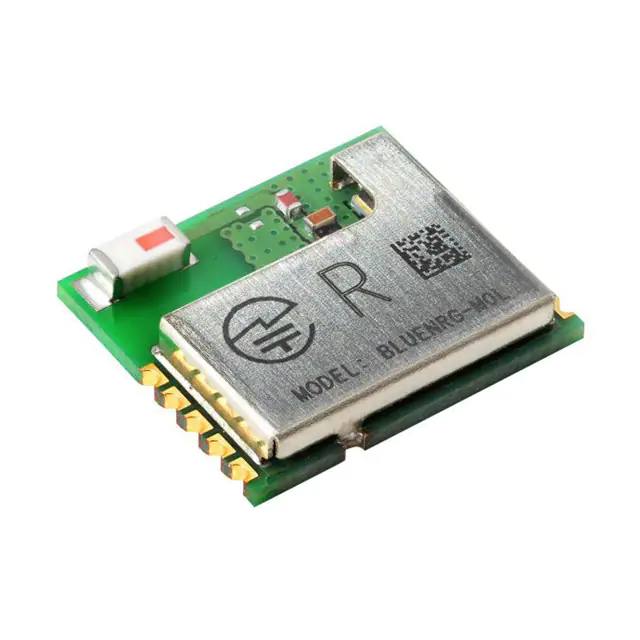
- Part No.:
- BLUENRG-M0A
- Manufacturer:
- STMicroelectronics
- Category:
- RF Transceiver Modules and Modems
- Package:
- 11-SMD Module
- Datasheet:
-
 BLUENRG-M0A.pdf
- Description:
- RF TXRX MOD BLUETOOTH CHIP SMD
- Quantity:
- Payment:

- Shipping:

Inventory:5,503
Please send an inquiry. Send us your inquiry, and we will respond immediately.
Product details
Overview
BLUENRG-M0A from STMicroelectronics is a certified Bluetooth® LE v4.2 network processor module integrating the BlueNRG-MS SoC, supporting simultaneous master/slave roles, +8 dBm radiated output power, -85 dBm conducted RX sensitivity, and SPI-based host interface - deployed in ultra-low-power wearable sensors and coin-cell–powered remote controls.
For engineers reviewing the BLUENRG-M0A datasheet, BLUENRG-M0A pinout, BLUENRG-M0A application, or BLUENRG-M0A equivalent, key selection criteria include radiated RF performance with integrated chip antenna, sleep-mode current (1.7 µA), DC-DC converter support for battery longevity, and modular FCC/ISED/CE certification status enabling rapid regulatory approval of end products.
Technical Context
The BLUENRG-M0A implements a complete Bluetooth LE protocol stack (GAP, GATT, SM, L2CAP, LL, RFPHY) within embedded Flash, offloading all radio and link-layer processing from the host MCU. Its hardware architecture integrates a 32 MHz XO oscillator, 32 kHz low-power clock, and on-chip DC-DC converter optimized for 1.7–3.6 V operation.
It uses a standard 5-wire SPI interface (CLK, CS, MOSI, MISO, IRQ) with active-low reset and internal pull-downs on all SPI pins except CS (pull-up). The IRQ line signals pending host data, and the module supports over-the-air stack upgrades via SPI without requiring host firmware changes.
Key Specifications
| Parameter | Value and Actual Design Meaning |
|---|---|
| Bluetooth Version | Compliant with Bluetooth v4.2 specification, supporting privacy v1.1, directed advertising, and connection parameter requests. |
| Output Power | +8 dBm radiated (typ.), enabling reliable 10–15 m range in compact PCB layouts with integrated chip antenna. |
| RX Sensitivity | -85 dBm conducted (typ.), delivering robust link budget (≥93 dB) in noisy 2.4 GHz environments. |
| Sleep Current | 1.7 µA with 32 kHz XO enabled and 12 KB RAM retention - suitable for multi-year operation on CR2032 coin cells. |
| Supply Range | 1.7 V to 3.6 V; supports direct connection to single 3 V coin cell, dual AAA, or regulated 1.8 V/3.3 V rails. |
| Regulatory Status | FCC ID S9NBNRGM0AL, ISED 8976C-BNRGM0AL, CE RED certificate 0051-RED-0097 - pre-certified for global deployment. |
| Host Interface | SPI slave (8 MHz max), with dedicated IRQ and active-low RESET - no UART or USB required; minimal host GPIO footprint. |
Pinout & Package
BLUENRG-M0A is housed in an 11-pin, 4-layer surface-mount module (13.5 × 11.5 × 2.1 mm) with exposed ground pad and integrated chip antenna occupying one short edge. All pins are 3.9 V tolerant; unused pins must remain floating per design guidelines.
| Pin/Terminal | Circuit Role | Design Meaning |
|---|---|---|
| Vin (Pin 5) | Power input | Accepts 1.7–3.6 V; powers internal DC-DC converter and RF core - enables efficient coin-cell operation. |
| GND (Pin 6) | Ground reference | Must be solidly connected to system ground plane; critical for RF stability and EMI control near antenna zone. |
| SPI_IRQ (Pin 4) | Interrupt output | Active-high signal indicating pending data from module; requires external pull-down resistor per datasheet. |
| SPI_CLK (Pin 7) | Clock input | Master-generated SPI clock (≤8 MHz); internal pull-down ensures safe idle state during host reset. |
| SPI_MISO (Pin 8) | Data output | Module-to-host serial data line; high-impedance in low-power states to minimize leakage. |
| SPI_MOSI (Pin 9) | Data input | Host-to-module serial data line; internal pull-down prevents spurious commands during power-up. |
| SPI_CS (Pin 10) | Chip select | Active-low enable; internal pull-up ensures module remains deselected until host asserts CS. |
| BT_RESET (Pin 11) | Reset input | Active-low asynchronous reset (1.7–3.6 V compatible); debounced internally for robust recovery. |
Key Features
| Feature | Design Value |
|---|---|
| Integrated DC-DC converter | Enables >30% reduction in active TX current vs. LDO-only operation - extends CR2032 life by 2.5× at 10% duty cycle. |
| On-field stack upgrade | Firmware updates delivered over SPI without host MCU reprogramming - supports field-deployed security patches and BLE feature extensions. |
| AES-128 co-processor | Dedicated hardware acceleration for Link Layer encryption/decryption - eliminates host CPU overhead and timing jitter in secure connections. |
| Multi-role concurrency | Simultaneous central + peripheral + observer roles - allows single module to act as sensor node and hub in mesh-adjacent topologies. |
| Modular certification | FCC/ISED/CE pre-approval covers RF, EMC, and safety - eliminates need for full-system RF testing when integrated per layout guidelines. |
Applications
| Fitness Tracker | Smart Remote Control |
|---|---|
|
Use Scenario: Wrist-worn activity monitor collecting heart rate, motion, and ambient temperature every 5 seconds. IC Role / Device Role / Timing Role: BLE network processor handling sensor data aggregation, encrypted GATT attribute updates, and low-latency connection supervision. Use Value: 1.7 µA sleep current and +8 dBm output sustain 12-month battery life on CR2032 while maintaining reliable smartphone pairing at 5 m through fabric. |
Use Scenario: Battery-powered universal remote controlling TVs, soundbars, and streaming sticks via BLE HID reports. IC Role / Device Role / Timing Role: Dual-role BLE device acting as peripheral to host apps and central scanning for nearby accessories. Use Value: Simultaneous advertising and scanning enables instant wake-on-proximity and sub-100 ms HID report latency without host intervention. |
| Medical Sensor Patch | Industrial Asset Tag |
|
Use Scenario: Disposable skin patch measuring skin impedance and temperature for chronic condition monitoring. IC Role / Device Role / Timing Role: Certified BLE transmitter broadcasting encrypted biometric data using privacy-enabled directed advertising. Use Value: Pre-certified RF platform eliminates Class II medical device RF validation burden; -85 dBm sensitivity ensures reception in shielded clinical environments. |
Use Scenario: Ruggedized tag attached to HVAC equipment reporting temperature, vibration, and uptime via periodic BLE beaconing. IC Role / Device Role / Timing Role: Low-duty-cycle peripheral broadcasting sensor data with configurable advertising intervals (20 ms–10.24 s). Use Value: 93 dB link budget and robust 2.4 GHz coexistence allow reliable operation in electrically noisy factory floors with metal enclosures. |
Equivalent & Alternatives
The following parts are listed as comparable options for similar Bluetooth LE network processor applications.
| Alternative Part | Technical Difference | Application Difference | Selection Advice |
|---|---|---|---|
| nRF52833 DK | Higher peak TX current (13.5 mA @ 0 dBm), no integrated DC-DC, requires external antenna matching. | Requires full RF design expertise and separate FCC certification; better suited for custom PCBs with antenna tuning. | Select when needing higher compute headroom (64 MHz Arm Cortex-M4F) and custom protocol stacks beyond BLE. |
| DA14585-01FXQ2 | Lower TX power (+4 dBm max), no modular certification, 2.2 µA sleep current with 8 KB RAM retention. | Lacks pre-approved FCC/ISED/CE - adds 8–12 weeks to time-to-market for regulatory testing and labeling compliance. | Select only for cost-sensitive, non-regulated prototypes where certification timeline is not constrained. |
Compared with nRF52833 DK and DA14585-01FXQ2, BLUENRG-M0A delivers faster time-to-market via drop-in regulatory compliance, superior battery efficiency from integrated DC-DC, and guaranteed RF performance with chip antenna - making it optimal for volume production of certified consumer and medical wearables.
Availability
BLUENRG-M0A is available at Aetrix Electronics and suitable for fitness trackers, smart remotes, medical sensor patches, and industrial asset tags requiring stable component supply, long-term lifecycle assurance, and pre-certified RF integration.
Supply support for BLUENRG-M0A includes scheduled delivery planning, volume procurement assistance, BOM continuity management, traceable sourcing, and lifecycle availability coordination for OEM customers, industrial embedded developers, connected-device designers, and electronics production programs.
Manufacturer
STMicroelectronics is a global semiconductor leader headquartered in Geneva, specializing in microcontrollers, analog ICs, MEMS, and wireless solutions for industrial, automotive, and consumer markets.
The BlueNRG product line targets ultra-low-power Bluetooth LE connectivity for space-constrained, battery-operated devices - emphasizing regulatory readiness, minimal host resource usage, and seamless integration into certified end products.
FAQ
Does BLUENRG-M0A require an external crystal?
No. The BLUENRG-M0A integrates both a 32 MHz crystal oscillator (XO) for RF timing and a 32 kHz XO for low-power sleep mode - eliminating external crystal components and associated layout constraints. This reduces BOM count and improves time-to-market for certified designs.
Can BLUENRG-M0A operate without the DC-DC converter?
Yes. The BLUENRG-M0A supports both DC-DC and LDO power modes. When DC-DC is disabled, typical TX current rises from 16.5 mA to ~27 mA at +8 dBm (per BLUENRG-M0L data), reducing battery life significantly. ST recommends enabling DC-DC for all coin-cell applications.
What is the maximum SPI clock frequency supported?
The BLUENRG-M0A supports SPI clock frequencies up to 8 MHz in standard mode. Higher speeds are not guaranteed due to AC timing margins in the ACI protocol layer; exceeding 8 MHz may cause command corruption or missed IRQ assertions during high-throughput transfers.
Is the chip antenna usable in metal-enclosed devices?
No. The integrated chip antenna requires ≥6 mm clearance from ground planes, metal shields, batteries, or conductive surfaces in all directions per layout guidelines. For metal-enclosed applications, ST recommends the BLUENRG-M0L variant with external antenna pad and matching network.
BLUENRG-M0A Specifications
- Product attributes
- Attribute value
- Manufacturer:
- STMicroelectronics
- Series:
- BlueNRG
- Package/Case:
- 11-SMD Module
- Packaging:
- Tape & Reel (TR)
- Product Status:
- Active
- Programmable:
- Not Verified
- RF Family/Standard:
- Bluetooth
- Protocol:
- Bluetooth v4.2
- Modulation:
- -
- Frequency:
- 2.4GHz ~ 2.4835GHz
- Data Rate:
- -
- Power - Output:
- 6dBm
- Sensitivity:
- -85dBm
- Serial Interfaces:
- SPI
- Antenna Type:
- Integrated, Chip
- Utilized IC / Part:
- BlueNRG-MS
- Memory Size:
- -
- Voltage - Supply:
- 1.7V ~ 3.6V
- Current - Receiving:
- 9.36mA
- Current - Transmitting:
- 7.82mA ~ 16.5mA
- Mounting Type:
- Surface Mount
- Operating Temperature:
- -40°C ~ 85°C (TA)
BLUENRG-M0A FAQ
1.How can I place an order for BLUENRG-M0A through Aetrix?
Please submit a Request for Quotation (RFQ) for BLUENRG-M0A on Aetrix. Our sales agent will provide a competitive quotation and guide you through the order confirmation once you accept the terms.
2.Are the price and stock information for BLUENRG-M0A reliable?
The price and inventory of BLUENRG-M0A are updated periodically and may fluctuate due to market conditions. Stock and pricing data are typically refreshed every 24 hours. Quotation validity for BLUENRG-M0A is usually 5 days.
3.What payment methods are accepted for BLUENRG-M0A?
We accept Wire Transfer, PayPal, Credit Card, Western Union, MoneyGram, and Escrow for BLUENRG-M0A transactions.
Note: Certain payment methods may incur a processing fee.
4.How is shipping managed for BLUENRG-M0A?
BLUENRG-M0A orders can be shipped via leading logistics carriers, including DHL, UPS, FedEx, TNT, or Registered Mail.
Once your BLUENRG-M0A order is processed, you will receive an email with the shipment details and tracking number.
Note: Tracking information may take up to 24 hours to appear. Express delivery typically takes 3–5 business days.
5.How can I obtain technical support or documentation for BLUENRG-M0A?
For technical support, including BLUENRG-M0A datasheets, pinout diagrams, or application guidance, please contact our engineering support team. They can provide detailed documentation and assistance for your BLUENRG-M0A requirements.
6.How does Aetrix verify that BLUENRG-M0A is sourced from the original manufacturer or authorized distributors?
All BLUENRG-M0A products on Aetrix are procured from qualified distributors and authorized channels. Our dedicated quality assurance team conducts strict verification, including traceability checks and, if necessary, third-party testing. This ensures that BLUENRG-M0A meets industry standards.
7.What is the process for return or replacement of BLUENRG-M0A?
All BLUENRG-M0A units undergo pre-shipment inspection (PSI). If there is an issue with BLUENRG-M0A, returns or replacements are accepted under the following conditions:
1.Quantity discrepancies, incorrect items, or visible external defects (such as breakage or corrosion), acknowledged by Aetrix.
2.The issue is reported within 90 days of delivery.
3.The BLUENRG-M0A part is unused and in its original packaging.
Return procedure for BLUENRG-M0A:
1.Submit a request within 90 days.
2.Obtain a Return Material Authorization (RMA) from Aetrix.
BLUENRG-M0A Tags

-
ESP32-C3FH4
Espressif Systems
-
ESP32-S2FH4
Espressif Systems
-
ESP32-S2FN4R2
Espressif Systems
-
ESP32-C3-MINI-1-N4
Espressif Systems
-
ESP32-C3-WROOM-02-N4
Espressif Systems
-
ESP32-C3-MINI-1U-N4
Espressif Systems
-
ESP32-C3-MINI-1U-H4
Espressif Systems
-
ESP32-C3-WROOM-02U-N4
Espressif Systems
-
ESP32-H2-MINI-1-N4
Espressif Systems
-
ESP32-H2-MINI-1-H4
Espressif Systems
_viewa.jpg)
-
ESP32-MINI-1-N4
Espressif Systems
-
ESP32-S2-MINI-2-N4R2
Espressif Systems
Tech Hub

Operational amplifier guide covering op amp basics, feedback, ideal vs real op amps, common configurations, buffer circuits, offset, bias current, gain-bandwidth, slew rate, rail-to-rail limits and sel…

Jumper cables guide covering safe connection order, red and black clamp placement, final ground connection, cable gauge, length, clamp quality, copper vs CCA cables, jump starter comparison and battery…

LDO regulator guide covering low dropout voltage, power dissipation, thermal design, PSRR, output noise, capacitor stability, adjustable LDO circuits, LDO vs buck converter and datasheet selection chec…

Conditional Access Module guide covering CAM meaning, CI/CI+ interface, smart card authorization, DVB security workflow, TV and set-top box compatibility, internal electronics, ESD protection, connecto…

Guide to electronic component obsolescence covering EOL risk, PCN/PDN notices, last-time buy planning, replacement options, form-fit-function validation, counterfeit risk and BOM lifecycle management.

18650 battery guide covering lithium-ion cell basics, 3.6V/3.7V voltage, 4.2V charging, mAh and Wh capacity, protected cells, chargers, BMS, series-parallel packs, holders, welding and sourcing checks.…

Hall effect sensor guide covering working principle, linear and digital sensors, Arduino circuits, current sensing, speed detection, automotive applications, A3144 examples, signal filtering and datash…

Product Change Notification guide for electronic components, covering PCN meaning, PCN vs PDN/EOL, common change types, risk levels, form-fit-function review, engineering validation, BOM control, LTB/L…

A practical guide to blend door actuators, covering HVAC function, symptoms, location, AC and heater issues, reset and calibration, replacement cost, electrical diagnosis, compatibility checks, and rep…

Engineering guide to Raspberry Pi alternatives, covering chip-level differences, Orange Pi, ROCK, Jetson, Banana Pi, NanoPi, Compute Module, Pico, GPIO, camera, HAT compatibility, and replacement risks…


