
 My Inquiry
 My Account


Texas Instruments BQ2204ASN-N
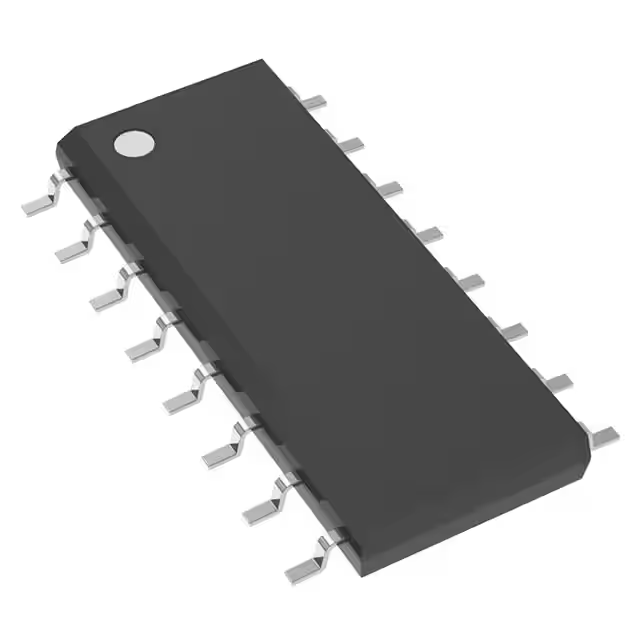
- Part No.:
- BQ2204ASN-N
- Manufacturer:
- Texas Instruments
- Category:
- Controllers
- Package:
- 16-SOIC (0.154", 3.90mm Width)
- Datasheet:
-
 BQ2204ASN-N.pdf
- Description:
- IC X4 SRAM NONVOL CTRLR 16-SOIC
- Quantity:
- Payment:

- Shipping:

Inventory:2,392
Please send an inquiry. Send us your inquiry, and we will respond immediately.
Product details
Overview
BQ2204ASN-N from Texas Instruments is a CMOS SRAM nonvolatile controller IC that converts up to four banks of standard CMOS SRAM into battery-backed nonvolatile memory. It features 5V VCC supply operation, dual 3V primary-cell backup inputs (BC1/BC2), <10ns CE propagation delay, power-fail detection at 4.62V (THS=VSS) or 4.37V (THS=VCC), and conditioned CE outputs for write-protection during brownout - used in industrial data loggers requiring persistent memory retention during AC loss.
For engineers reviewing the BQ2204ASN-N datasheet, BQ2204ASN-N pinout, BQ2204ASN-N application, or BQ2204ASN-N equivalent, key selection criteria include its 16-pin SOIC package with industrial temperature range (–40°C to +85°C), dual-battery switchover logic, hardware-based address decoding (A/B inputs), and guaranteed tCER ≤120ms power-up write-protect hold time.
Technical Context
The BQ2204ASN-N implements a precision comparator-based power-fail detection circuit with user-selectable VPFD thresholds (4.62V typical for 5% tolerance, 4.37V for 10%) via THS pin configuration. Its internal switching architecture routes VOUT to BC1 or BC2 based on real-time voltage comparison with VBSO ≥0.25V hysteresis, enabling sequential battery replacement without memory loss.
During valid power, the A/B decoder transparently passes CE to one of four CECON outputs with <10ns propagation delay; during power failure, CECON outputs are forced high within tWPT (40–150µs) to unconditionally write-protect SRAM, independent of CE state. The device operates in data-retention mode drawing ≤100nA when VOUT is isolated.
Key Specifications
| Parameter | Value and Actual Design Meaning |
|---|---|
| VCC Supply | 4.75–5.5V; supports standard 5V logic systems with ±5% or ±10% tolerance selectable via THS pin |
| VPFD Threshold | 4.55–4.75V (THS=VSS) or 4.30–4.50V (THS=VCC); triggers automatic SRAM write-protection before VCC collapse |
| tCER Hold Time | 40–120ms after VCC crosses VPFD; ensures processor stabilization before enabling SRAM access on power-up |
| tWPT Delay | 40–150µs after VCC falls below VPFD; guarantees memory cycle completion before write-protection activation |
| VOUT Output Current | ≤160mA at VOUT > VCC – 0.3V; sufficient to drive multiple SRAM banks during backup mode |
| Backup Inputs | BC1/BC2 accept 2.0–4.0V primary cells (e.g., lithium); automatic switchover when ΔV ≥0.25V (VBSO) |
| Operating Temp | –40°C to +85°C; qualified for industrial environments with no derating required |
Pinout & Package
Package: 16-pin SOIC (D), 3.9mm width, RoHS-compliant NIPDAU finish, MSL Level-2-260°C-1 year.
| Pin/Terminal | Circuit Role | Design Meaning |
|---|---|---|
| VCC | +5V main supply input | Power source for logic and comparator; VPFD detection referenced to this rail |
| VSS | Ground reference | Common return for all analog/digital circuits; THS tie-down point for 5% mode |
| CE | Chip-enable active-low input | Primary control signal passed through decoder; initiates isolation if held low during VPFD→VSO transition |
| A, B | Address decode inputs | Two-bit select lines routing CE to CECON1–CECON4; typically connected to high-order address bits |
| CECON1–CECON4 | Conditioned chip-enable outputs | Active-low outputs driving SRAM CE pins; forced high during power fail or tCER window |
| BC1, BC2 | 3V primary cell inputs | Backup energy sources; device selects higher-voltage cell with ≥0.25V differential (VBSO) |
| VOUT | Backup supply output | Switched output sourcing VCC or BC1/BC2; powers SRAM VCC pins and CECON pull-ups during backup |
| THS | Threshold select input | Configures VPFD: tied to VSS for 4.62V (5%), tied to VCC for 4.37V (10%) detection threshold |
Key Features
| Feature | Design Value |
|---|---|
| Dual 3V battery switchover | Automatically selects BC1 or BC2 based on real-time voltage comparison with 0.25–0.6V hysteresis (VBSO), enabling hot-swap battery replacement |
| Hardware address decoding | Integrated 2-to-4 decoder (A/B inputs) eliminates external logic, reducing BOM count and PCB area for multi-bank SRAM expansion |
| Controlled write-protection timing | Guaranteed tWPT (40–150µs) and tCER (40–120ms) windows ensure memory integrity across power transitions without firmware intervention |
| Low-power data retention | Draws ≤100nA in isolation mode, preserving backup battery life for years in standby applications like utility meters |
| Robust power-fail detection | Comparator-based VPFD with user-selectable threshold avoids false triggers from transient noise or slow VCC ramp rates |
Applications
| Industrial Data Logger | Utility Meter Memory Backup |
|---|---|
|
Use Scenario: Continuous recording of sensor readings during mains power interruption. IC Role / Device Role / Timing Role: Nonvolatile controller managing SRAM banks storing timestamped measurements; asserts CECON outputs to freeze writes during brownout. Use Value: Prevents data corruption by enforcing deterministic write-protection within 150µs of VCC drop below VPFD, ensuring last-valid reading is preserved. |
Use Scenario: Retaining billing cycle data and tamper logs in electricity/water meters during grid outages. IC Role / Device Role / Timing Role: Battery-backed memory supervisor using BC1/BC2 inputs to extend operational life beyond single-cell capacity. Use Value: Dual-battery switchover extends backup runtime by 100% versus single-cell solutions, supporting 10+ year meter deployments. |
| Medical Device Event Recorder | POS Terminal Transaction Cache |
|
Use Scenario: Capturing critical patient vitals and alarm events during unexpected AC loss in bedside monitors. IC Role / Device Role / Timing Role: Hardware-enforced memory lock preventing partial writes to SRAM during power collapse. Use Value: Guarantees atomic storage of last event packet via tWPT timing compliance, meeting IEC 62304 data integrity requirements. |
Use Scenario: Preserving pending credit card transaction buffers during brief store power interruptions. IC Role / Device Role / Timing Role: Transparent CE pass-through during normal operation; immediate CECON deassertion on VPFD crossing. Use Value: Eliminates need for battery-backed RAM modules - reduces cost and footprint while maintaining PCI PTS transaction persistence. |
Equivalent & Alternatives
The following parts are listed as comparable options for similar SRAM nonvolatile controller applications.
| Alternative Part | Technical Difference | Application Difference | Selection Advice |
|---|---|---|---|
| MAX6900 | Single 3V backup input only; no BC1/BC2 switchover; uses external resistor divider for VPFD setting | Lacks dual-battery management; suitable for cost-sensitive designs with fixed backup source | Select MAX6900 when battery redundancy is unnecessary and board space permits external VPFD tuning components. |
| DS1230Y | Integrated lithium battery and NV SRAM in single DIP-28 package; no external SRAM support | Monolithic solution with fixed 256kbit memory; no address decoding or multi-bank flexibility | Choose DS1230Y for plug-and-play NV memory where density and integration outweigh configurability needs. |
Compared with BQ2204ASN-N, MAX6900 offers simpler VPFD adjustment but sacrifices battery redundancy and multi-bank control, while DS1230Y provides integrated memory at the expense of external SRAM scalability and hardware decoding - making BQ2204ASN-N optimal for flexible, high-reliability industrial memory expansion.
Availability
BQ2204ASN-N is available at Aetrix Electronics and suitable for industrial data loggers, utility meters, medical event recorders, and POS terminal transaction caches requiring stable component supply across extended product lifecycles.
Supply support for BQ2204ASN-N includes scheduled delivery planning, volume procurement assistance, BOM continuity management, traceable sourcing, and lifecycle availability coordination for OEM customers, industrial embedded developers, connected-device designers, and electronics production programs.
Manufacturer
Texas Instruments is a global semiconductor company founded in 1930, specializing in analog, embedded processing, and power management technologies with broad industrial and automotive qualification.
The BQ2204ASN-N belongs to TI's legacy battery-management and nonvolatile memory controller product line, designed specifically for hardware-transparent SRAM backup in mission-critical industrial systems where firmware-based solutions introduce reliability risk.
FAQ
What is the operating temperature range for the BQ2204ASN-N?
The BQ2204ASN-N is rated for industrial operation from –40°C to +85°C. This extended range is validated per TI's qualification standards and enables deployment in harsh environments such as outdoor utility meters, factory-floor data loggers, and transportation infrastructure equipment where ambient temperatures exceed commercial-grade limits. The BQ2204ASN-N maintains full parameter compliance across this entire range without derating.
How does the BQ2204ASN-N handle dual battery switchover between BC1 and BC2?
The BQ2204ASN-N continuously compares BC1 and BC2 voltages during backup mode and switches VOUT to the higher-voltage source only when the difference exceeds VBSO (0.25–0.6V). This prevents oscillation and ensures stable power delivery. If BC1 drops below BC2 minus VBSO, VOUT transitions to BC2 - enabling sequential battery replacement without interrupting memory retention. The BQ2204ASN-N does not require external control signals to manage this behavior.
What is the purpose of the THS pin on the BQ2204ASN-N?
The THS (Threshold Select) pin configures the power-fail detection voltage (VPFD): tying THS to VSS sets VPFD to 4.62V typical for ±5% VCC tolerance, while tying THS to VCC sets it to 4.37V for ±10% tolerance. This allows system designers to match VPFD to their power supply's regulation spec without redesigning the detection circuit. The BQ2204ASN-N requires THS to be hard-wired to either VSS or VCC - floating or resistive biasing is not supported.
Can the BQ2204ASN-N support more than four SRAM banks?
No, the BQ2204ASN-N supports exactly four SRAM banks via its CECON1–CECON4 outputs and 2-bit A/B decoder. Each CECON output drives one bank's chip-enable line, and the truth table defines exclusive mapping (e.g., A=L/B=L → CECON1 active). To expand beyond four banks, multiple BQ2204ASN-N devices must be cascaded with decoded address bits routed to separate controllers - the BQ2204ASN-N itself does not support daisy-chaining or additional bank addressing.
What is the maximum current the BQ2204ASN-N can deliver from its VOUT pin?
The BQ2204ASN-N delivers up to 160mA from VOUT when VOUT > VCC – 0.3V, sufficient to power multiple 3V SRAM devices simultaneously. In data-retention mode (VOUT isolated), quiescent current drops to ≤100nA. The BQ2204ASN-N does not regulate VOUT - it acts as a switch between VCC and the selected backup cell - so load capability depends on the external battery's internal resistance and voltage headroom relative to the SRAM's minimum VCC requirement.
BQ2204ASN-N Specifications
- Product attributes
- Attribute value
- Manufacturer:
- Texas Instruments
- Series:
- -
- Package/Case:
- 16-SOIC (0.154", 3.90mm Width)
- Packaging:
- Tube
- Product Status:
- Active
- Controller Type:
- Nonvolatile SRAM
- Voltage - Supply:
- 4.5V ~ 5.5V
- Operating Temperature:
- -40°C ~ 85°C
- Mounting Type:
- Surface Mount
- Supplier Device Package:
- 16-SOIC
BQ2204ASN-N FAQ
1.How can I place an order for BQ2204ASN-N through Aetrix?
Please submit a Request for Quotation (RFQ) for BQ2204ASN-N on Aetrix. Our sales agent will provide a competitive quotation and guide you through the order confirmation once you accept the terms.
2.Are the price and stock information for BQ2204ASN-N reliable?
The price and inventory of BQ2204ASN-N are updated periodically and may fluctuate due to market conditions. Stock and pricing data are typically refreshed every 24 hours. Quotation validity for BQ2204ASN-N is usually 5 days.
3.What payment methods are accepted for BQ2204ASN-N?
We accept Wire Transfer, PayPal, Credit Card, Western Union, MoneyGram, and Escrow for BQ2204ASN-N transactions.
Note: Certain payment methods may incur a processing fee.
4.How is shipping managed for BQ2204ASN-N?
BQ2204ASN-N orders can be shipped via leading logistics carriers, including DHL, UPS, FedEx, TNT, or Registered Mail.
Once your BQ2204ASN-N order is processed, you will receive an email with the shipment details and tracking number.
Note: Tracking information may take up to 24 hours to appear. Express delivery typically takes 3–5 business days.
5.How can I obtain technical support or documentation for BQ2204ASN-N?
For technical support, including BQ2204ASN-N datasheets, pinout diagrams, or application guidance, please contact our engineering support team. They can provide detailed documentation and assistance for your BQ2204ASN-N requirements.
6.How does Aetrix verify that BQ2204ASN-N is sourced from the original manufacturer or authorized distributors?
All BQ2204ASN-N products on Aetrix are procured from qualified distributors and authorized channels. Our dedicated quality assurance team conducts strict verification, including traceability checks and, if necessary, third-party testing. This ensures that BQ2204ASN-N meets industry standards.
7.What is the process for return or replacement of BQ2204ASN-N?
All BQ2204ASN-N units undergo pre-shipment inspection (PSI). If there is an issue with BQ2204ASN-N, returns or replacements are accepted under the following conditions:
1.Quantity discrepancies, incorrect items, or visible external defects (such as breakage or corrosion), acknowledged by Aetrix.
2.The issue is reported within 90 days of delivery.
3.The BQ2204ASN-N part is unused and in its original packaging.
Return procedure for BQ2204ASN-N:
1.Submit a request within 90 days.
2.Obtain a Return Material Authorization (RMA) from Aetrix.
BQ2204ASN-N Tags

-
BQ2201SN-N
Texas Instruments
-
DS1314S+
Analog Devices Inc./Maxim Integrated
-
BQ2205LYPW
Texas Instruments
-
MXD1210CSA+
Analog Devices Inc./Maxim Integrated
-
MXD1210CPA+
Analog Devices Inc./Maxim Integrated

-
4RCD0232KC1ATG
Renesas
-
DS1312S-2+
Analog Devices Inc./Maxim Integrated
-
DS1314S-2+T&R
Analog Devices Inc./Maxim Integrated
-
DS1321S+
Analog Devices Inc./Maxim Integrated
-
DS1312S+
Analog Devices Inc./Maxim Integrated
-
MXD1210ESA+
Analog Devices Inc./Maxim Integrated
-
DS1321E+
Analog Devices Inc./Maxim Integrated
Tech Hub

A practical engineering guide to 3.3V and 5V logic compatibility, input thresholds, resistor dividers, translator ICs, MOSFET level shifting, I2C pull-ups, timing limits and power-sequencing risks.

The 74HC595 uses push-pull logic outputs, while the TPIC6B595 uses 50 V open-drain DMOS sinks for higher-power loads. This guide compares timing, current limits, 3.3 V interfacing, load wiring, thermal…

The 74HC595 converts serial data into eight stable parallel outputs. This guide covers pin functions, shift and storage timing, OE and MR behavior, drive-current limits, cascading, voltage compatibilit…

A technical comparison of level-sensitive latches and edge-triggered flip-flops, covering timing windows, setup and hold limits, master–slave operation, time borrowing, race-through, HDL inference and…

A D latch stores one bit while Enable controls when data can pass. This reference covers gate-level operation, truth tables, transparency, setup and hold timing, LE versus OE, common ICs and practical …

An SR latch stores one bit through cross-coupled feedback. This engineering reference covers NOR and NAND implementations, truth tables, forbidden-state recovery, gated operation, switch debouncing, fa…

Latch circuits retain one bit through feedback. This technical reference covers SR and D latches, truth tables, transparency, timing limits, latch-versus-flip-flop behavior, applications and common log…

An engineering guide to LED driver operation, constant-current and constant-voltage outputs, linear and switching topologies, dimming, IC selection, calculations, replacement compatibility, and fault c…

Operational amplifier guide covering op amp basics, feedback, ideal vs real op amps, common configurations, buffer circuits, offset, bias current, gain-bandwidth, slew rate, rail-to-rail limits and sel…

Jumper cables guide covering safe connection order, red and black clamp placement, final ground connection, cable gauge, length, clamp quality, copper vs CCA cables, jump starter comparison and battery…


