
 My Inquiry
 My Account


Texas Instruments BQ4016YMC-70
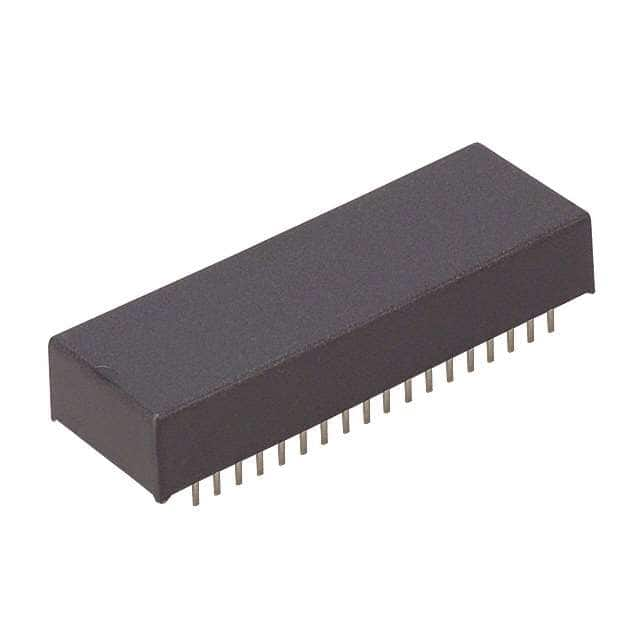
- Part No.:
- BQ4016YMC-70
- Manufacturer:
- Texas Instruments
- Category:
- Memory
- Package:
- 36-DIP Module (0.610", 15.49mm)
- Datasheet:
-
 BQ4016YMC-70.pdf
- Description:
- IC NVSRAM 8MBIT PAR 36DIP MODULE
- Quantity:
- Payment:

- Shipping:

Inventory:4,724
Please send an inquiry. Send us your inquiry, and we will respond immediately.
Product details
Overview
BQ4016YMC-70 from Texas Instruments is a nonvolatile 1,048,576 × 8-bit SRAM with integrated lithium backup, 70 ns access time, -10% VCC supply tolerance (VPFD = 4.37 V), and 10-year data retention without power. It operates as standard SRAM during normal operation and automatically switches to battery-backed mode during power failure-used in industrial control memory logging and embedded system configuration storage.
For engineers reviewing the BQ4016YMC-70 datasheet, BQ4016YMC-70 pinout, BQ4016YMC-70 application, or BQ4016YMC-70 equivalent, key selection criteria include VPFD threshold compatibility with ±10% supply systems, write-protection timing (tWPT = 100 µs typical), tCER = 120 ms recovery window, and MC-module 36-pin DIP mechanical fit for legacy board layouts.
Technical Context
The BQ4016YMC-70 integrates CMOS SRAM with on-die power-fail detection circuitry that triggers at VPFD = 4.37 V (typical), enabling automatic write-protection and lithium cell activation before VCC drops below 3 V. Its control logic ensures uninterrupted data preservation across power transitions without external components.
It supports conventional asynchronous SRAM timing with CE/OE/WE controls, delivers 70 ns read cycle time (tRC), and maintains high-impedance I/O states during power-down. The internal lithium cell remains electrically isolated until first VCC application, limiting self-discharge to ~0.5% per year prior to activation.
Key Specifications
| Parameter | Value and Actual Design Meaning |
|---|---|
| Memory Organization | 1,048,576 words × 8 bits (8 Mbit total) |
| Access Time | 70 ns - defines minimum cycle time for reliable read/write in high-speed microcontroller interfaces |
| VPFD Threshold | 4.37 V (typical) - triggers write-protection and backup switchover in ±10% 5 V supply systems |
| Data Retention | 10 years without power - enabled by isolated lithium coin cell activated after first VCC application |
| Supply Voltage Range | 4.75 V to 5.5 V - supports stable operation across full tolerance range for industrial 5 V rails |
| Standby Current | 2.5–5 mA (ISB2) - low quiescent draw during CE-high standby, critical for battery-buffered hold modes |
| Write-Protect Delay | 100 µs (tWPT typical) - ensures ongoing memory cycles complete before protection engages during brownout |
Pinout & Package
Package: 36-pin plastic dual-in-line module (MC-type), 0.600-inch width, through-hole mounting compatible with legacy PCB footprints.
| Pin/Terminal | Circuit Role | Design Meaning |
|---|---|---|
| A0–A19 | Address inputs | 20-bit address bus supporting full 1M-word decoding; no address multiplexing required |
| DQ0–DQ7 | Data input/output | 8-bit bidirectional data bus compatible with standard microprocessor data buses |
| CE | Chip enable input | Active-low global enable; forces high-Z outputs and disables internal logic when high |
| OE | Output enable input | Active-low control for output drivers only; allows read data gating without disabling chip |
| WE | Write enable input | Active-low signal initiating write cycle; works in conjunction with CE for cycle definition |
| VCC | +5 V supply input | Main power rail; monitored continuously for VPFD threshold violation |
| VSS | Ground | Reference return path for all digital and analog circuitry including backup control |
| NC | No connect | Unbonded pin; must remain unconnected per design to avoid interference with internal lithium isolation |
Key Features
| Feature | Design Value |
|---|---|
| Automatic power-fail response | Switches to lithium backup within µs of VCC crossing 4.37 V, preserving data without host intervention |
| Zero external component requirement | Integrates voltage monitor, switch-over logic, and lithium cell-no discrete diodes, capacitors, or regulators needed |
| Unlimited write endurance | Retains standard SRAM write-cycle robustness-no wear-out mechanism like EEPROM or Flash |
| First-power isolation | Lithium cell remains disconnected until initial VCC application, minimizing shelf-life degradation (<0.5%/year) |
| 120 ms post-power-up write lockout | tCER window prevents premature writes during processor reset stabilization after VCC recovery |
Applications
| Industrial PLC Configuration Storage | Medical Device Calibration Data Retention |
|---|---|
|
Use Scenario: Storing firmware configuration, I/O mapping, and alarm thresholds in programmable logic controllers operating in environments with unstable AC line supplies. IC Role / Device Role / Timing Role: Nonvolatile SRAM providing immediate-read/write access during runtime and guaranteed data hold during 100-ms brownouts. Use Value: Eliminates need for slow EEPROM writes during configuration changes while ensuring >10-year data integrity without refresh. |
Use Scenario: Holding factory-calibrated sensor offsets and patient-specific therapy parameters in portable infusion pumps and diagnostic monitors. IC Role / Device Role / Timing Role: Battery-backed memory maintaining critical calibration data across battery swaps and power cycling. Use Value: Meets IEC 62304 Class C software requirements for persistent parameter storage without checksum overhead or write latency. |
| Telecom Base Station Real-Time Logs | Avionics Black Box Event Buffering |
|
Use Scenario: Capturing real-time network status, error codes, and handover events in outdoor cellular base station controllers exposed to grid fluctuations. IC Role / Device Role / Timing Role: High-speed SRAM acting as circular buffer with seamless failover to lithium backup during AC loss. Use Value: Enables continuous 70 ns log writes during operation and preserves last 10 seconds of pre-failure data without flash wear or write abort risk. |
Use Scenario: Recording flight control surface positions, sensor anomalies, and command timestamps in certified avionics recorders requiring DO-160 Section 22 crash survivability. IC Role / Device Role / Timing Role: Nonvolatile memory buffer retaining timestamped telemetry during emergency power loss and post-crash battery depletion. Use Value: Guarantees 10-year data retention in unpowered state per FAA TSO-C124a requirements without periodic refresh. |
Equivalent & Alternatives
The following parts are listed as comparable options for similar nonvolatile SRAM applications.
| Alternative Part | Technical Difference | Application Difference | Selection Advice |
|---|---|---|---|
| STK15C88-70 | 70 ns access, 5V, but uses external capacitor-based backup; no integrated lithium cell or VPFD monitoring | Requires external 12 V backup supply and discrete power-fail circuitry; higher BOM count and layout complexity | Select when existing designs already use capacitor backup and require drop-in timing compatibility without lithium handling |
| BQ4015YMC-70 | Same package and pinout, but 512K × 8 organization (4 Mbit); identical VPFD = 4.37 V and tCER = 120 ms | Suitable where memory depth requirements are halved; shares same thermal profile and footprint for redesign reuse | Choose for cost-sensitive applications needing lower density with identical power-fail behavior and qualification history |
Compared with STK15C88-70, BQ4016YMC-70 eliminates external backup components and provides longer data retention; versus BQ4015YMC-70, it doubles memory capacity while preserving identical timing, VPFD, and reliability characteristics for seamless scalability.
Availability
BQ4016YMC-70 is available at Aetrix Electronics and suitable for industrial control configuration storage, medical device calibration data retention, and telecom real-time logging requiring stable component supply across extended product lifecycles.
Supply support for BQ4016YMC-70 includes scheduled delivery planning, volume procurement assistance, BOM continuity management, traceable sourcing, and lifecycle availability coordination for OEM customers, industrial embedded developers, connected-device designers, and electronics production programs.
Manufacturer
Texas Instruments is a global semiconductor company headquartered in Dallas, Texas, delivering analog and embedded processing solutions for industrial, automotive, and communications markets.
The BQ4016YMC-70 belongs to TI's Benchmarq nonvolatile SRAM product line, engineered specifically for mission-critical data retention in systems subject to frequent or unpredictable power interruptions.
FAQ
What is the VPFD threshold voltage for BQ4016YMC-70, and how does it differ from the standard BQ4016MC-70?
The BQ4016YMC-70 has a VPFD threshold of 4.37 V (typical), optimized for systems with ±10% 5 V supply tolerance. In contrast, the BQ4016MC-70 uses 4.62 V (typical) for ±5% tolerance. This difference ensures reliable write-protection triggering across wider input voltage variations without requiring external adjustment-critical for industrial power supplies with looser regulation.
Does BQ4016YMC-70 require external components to achieve nonvolatility?
No, the BQ4016YMC-70 requires zero external components for nonvolatile operation. Its integrated lithium coin cell, precision voltage monitor, and automatic switchover circuitry eliminate the need for backup capacitors, diodes, or discrete power-fail detectors-reducing BOM count, PCB area, and qualification effort compared to capacitor-based NVSRAM alternatives.
How long does the internal lithium cell retain data in BQ4016YMC-70 after power removal?
The BQ4016YMC-70 guarantees ≥10 years of data retention without external power, measured from the time VCC is first applied. The lithium cell remains electrically isolated until that initial power-on event, limiting pre-activation self-discharge to approximately 0.5% per year-ensuring shelf life exceeds 15 years before deployment.
What happens to BQ4016YMC-70 outputs during power-down?
When VCC falls below the VPFD threshold, the BQ4016YMC-70 immediately places all DQ0–DQ7 outputs into high-impedance state and treats all inputs as "don't care." This prevents bus contention and unintended writes during brownout, while the internal lithium supply sustains memory contents until VCC returns above VPFD + tCER (120 ms).
Is BQ4016YMC-70 pin-compatible with other members of the bq4016 family?
Yes, the BQ4016YMC-70 shares identical 36-pin MC-module pinout and signal definitions with BQ4016MC-70 and BQ4015YMC-70. Address, data, and control pins (A0–A19, DQ0–DQ7, CE/OE/WE, VCC/VSS) map one-to-one-enabling direct substitution in existing layouts where supply tolerance or memory depth requirements change.
BQ4016YMC-70 Specifications
- Product attributes
- Attribute value
- Manufacturer:
- Texas Instruments
- Series:
- -
- Package/Case:
- 36-DIP Module (0.610", 15.49mm)
- Packaging:
- Tube
- Product Status:
- Obsolete
- Programmable:
- Not Verified
- Memory Type:
- Non-Volatile
- Memory Format:
- NVSRAM
- Technology:
- NVSRAM (Non-Volatile SRAM)
- Memory Size:
- 8Mbit
- Memory Organization:
- 1M x 8
- Memory Interface:
- Parallel
- Clock Frequency:
- -
- Write Cycle Time - Word, Page:
- 70ns
- Access Time:
- 70 ns
- Voltage - Supply:
- 4.5V ~ 5.5V
- Operating Temperature:
- 0°C ~ 70°C (TA)
- Grade:
- -
- Qualification:
- -
- Mounting Type:
- Through Hole
- Supplier Device Package:
- 36-DIP Module
BQ4016YMC-70 FAQ
1.How can I place an order for BQ4016YMC-70 through Aetrix?
Please submit a Request for Quotation (RFQ) for BQ4016YMC-70 on Aetrix. Our sales agent will provide a competitive quotation and guide you through the order confirmation once you accept the terms.
2.Are the price and stock information for BQ4016YMC-70 reliable?
The price and inventory of BQ4016YMC-70 are updated periodically and may fluctuate due to market conditions. Stock and pricing data are typically refreshed every 24 hours. Quotation validity for BQ4016YMC-70 is usually 5 days.
3.What payment methods are accepted for BQ4016YMC-70?
We accept Wire Transfer, PayPal, Credit Card, Western Union, MoneyGram, and Escrow for BQ4016YMC-70 transactions.
Note: Certain payment methods may incur a processing fee.
4.How is shipping managed for BQ4016YMC-70?
BQ4016YMC-70 orders can be shipped via leading logistics carriers, including DHL, UPS, FedEx, TNT, or Registered Mail.
Once your BQ4016YMC-70 order is processed, you will receive an email with the shipment details and tracking number.
Note: Tracking information may take up to 24 hours to appear. Express delivery typically takes 3–5 business days.
5.How can I obtain technical support or documentation for BQ4016YMC-70?
For technical support, including BQ4016YMC-70 datasheets, pinout diagrams, or application guidance, please contact our engineering support team. They can provide detailed documentation and assistance for your BQ4016YMC-70 requirements.
6.How does Aetrix verify that BQ4016YMC-70 is sourced from the original manufacturer or authorized distributors?
All BQ4016YMC-70 products on Aetrix are procured from qualified distributors and authorized channels. Our dedicated quality assurance team conducts strict verification, including traceability checks and, if necessary, third-party testing. This ensures that BQ4016YMC-70 meets industry standards.
7.What is the process for return or replacement of BQ4016YMC-70?
All BQ4016YMC-70 units undergo pre-shipment inspection (PSI). If there is an issue with BQ4016YMC-70, returns or replacements are accepted under the following conditions:
1.Quantity discrepancies, incorrect items, or visible external defects (such as breakage or corrosion), acknowledged by Aetrix.
2.The issue is reported within 90 days of delivery.
3.The BQ4016YMC-70 part is unused and in its original packaging.
Return procedure for BQ4016YMC-70:
1.Submit a request within 90 days.
2.Obtain a Return Material Authorization (RMA) from Aetrix.
BQ4016YMC-70 Tags

-
M24C02-WMN6TP
STMicroelectronics
-
AT24C02C-XHM-T
Microchip Technology
-
AT21CS01-STUM10-T
Microchip Technology

-
AT24C02C-SSHM-T
Microchip Technology
-
24LC01BT-I/OT
Microchip Technology
-
M24C02-FMC6TG
STMicroelectronics
-
AT24CS02-SSHM-T
Microchip Technology

-
93LC46BT-I/OT
Microchip Technology
-
AT24C04C-SSHM-T
Microchip Technology

-
24LC01BT-I/SN
Microchip Technology
-
24AA02UIDT-I/OT
Microchip Technology
-
AT24C08C-STUM-T
Microchip Technology
Tech Hub

A practical engineering guide to 3.3V and 5V logic compatibility, input thresholds, resistor dividers, translator ICs, MOSFET level shifting, I2C pull-ups, timing limits and power-sequencing risks.

The 74HC595 uses push-pull logic outputs, while the TPIC6B595 uses 50 V open-drain DMOS sinks for higher-power loads. This guide compares timing, current limits, 3.3 V interfacing, load wiring, thermal…

The 74HC595 converts serial data into eight stable parallel outputs. This guide covers pin functions, shift and storage timing, OE and MR behavior, drive-current limits, cascading, voltage compatibilit…

A technical comparison of level-sensitive latches and edge-triggered flip-flops, covering timing windows, setup and hold limits, master–slave operation, time borrowing, race-through, HDL inference and…

A D latch stores one bit while Enable controls when data can pass. This reference covers gate-level operation, truth tables, transparency, setup and hold timing, LE versus OE, common ICs and practical …

An SR latch stores one bit through cross-coupled feedback. This engineering reference covers NOR and NAND implementations, truth tables, forbidden-state recovery, gated operation, switch debouncing, fa…

Latch circuits retain one bit through feedback. This technical reference covers SR and D latches, truth tables, transparency, timing limits, latch-versus-flip-flop behavior, applications and common log…

An engineering guide to LED driver operation, constant-current and constant-voltage outputs, linear and switching topologies, dimming, IC selection, calculations, replacement compatibility, and fault c…

Operational amplifier guide covering op amp basics, feedback, ideal vs real op amps, common configurations, buffer circuits, offset, bias current, gain-bandwidth, slew rate, rail-to-rail limits and sel…

Jumper cables guide covering safe connection order, red and black clamp placement, final ground connection, cable gauge, length, clamp quality, copper vs CCA cables, jump starter comparison and battery…


