
 My Inquiry
 My Account


Texas Instruments CC1201RHBT
- Part No.:
- CC1201RHBT
- Manufacturer:
- Texas Instruments
- Category:
- RF Transceiver ICs
- Package:
- 32-VFQFN Exposed Pad
- Datasheet:
-
 CC1201RHBT.pdf
- Description:
- IC RF TXRX+MCU ISM<1GHZ 32VQFN
- Quantity:
- Payment:

- Shipping:

Inventory:267
Please send an inquiry. Send us your inquiry, and we will respond immediately.
Product details
Overview
CC1201RHBT from Texas Instruments is a fully integrated, low-voltage (2.0–3.6 V) RF transceiver IC for ISM/SRD bands (164–190, 410–475, 820–950 MHz), delivering –120 dBm sensitivity at 1.2 kbps, +16 dBm programmable output power with 0.4-dB steps, and hardware AES-128 acceleration. It serves as the radio front-end in battery-powered wireless sensor networks and smart metering systems requiring regulatory compliance with ETSI EN 300 220, FCC Part 15, and ARIB STD-T108.
For engineers reviewing the CC1201RHBT datasheet, CC1201RHBT pinout, CC1201RHBT application, or CC1201RHBT equivalent, this page delivers verified technical context, validated pin functions, confirmed RF performance across frequency bands, and real-world design implications for 802.15.4g-compliant packet handling, eWOR-based ultra-low-power receive, and seamless integration with CC1190 range extenders.
Technical Context
The CC1201RHBT implements a fractional-N synthesizer with configurable loop bandwidth (200–500 kHz), enabling phase noise as low as –114 dBc/Hz at 10-kHz offset (169 MHz band). Its analog front end integrates a high-linearity LNA (IIP3 = –14 dBm), 90-dB dynamic range ADCs, and autonomous image removal - all supporting simultaneous high-performance and low-power RX modes.
Digital subsystems include dedicated packet handling with CRC-16/32, FEC, dual sync detection, whitening, and separate 128-byte TX/RX FIFOs. The device supports WaveMatch DSP for improved sync detection and built-in coding gain, while its SPI interface controls all operating parameters including channel filter bandwidth (50–1600 kHz), modulation formats (2/4-FSK/GFSK, MSK, OOK), and data rates up to 1.25 Mbps.
Key Specifications
| Parameter | Value and Actual Design Meaning |
|---|---|
| Sensitivity | –120 dBm @ 1.2 kbps (433 MHz); enables long-range, low-data-rate sensor links with minimal transmit power |
| Output Power | +16 dBm max (169/433 MHz, VDD = 3.6 V); supports extended range without external PA in sub-GHz bands |
| Data Rate | Up to 1.25 Mbps in packet mode; accommodates high-throughput telemetry and firmware updates |
| Modulation Support | 2/4-FSK, 2/4-GFSK, MSK, OOK; ensures interoperability with legacy and standards-based protocols |
| Regulatory Compliance | ETSI EN 300 220 Cat. 2/3, FCC Part 15.247/249, ARIB STD-T108; certified for deployment in EU, US, and Japan |
| Power Consumption | 0.12 µA in power-down with retention; enables multi-year battery life in eWOR-polling applications |
| Security | Hardware AES-128 accelerator; offloads encryption from host MCU, reducing latency and CPU load |
Pinout & Package
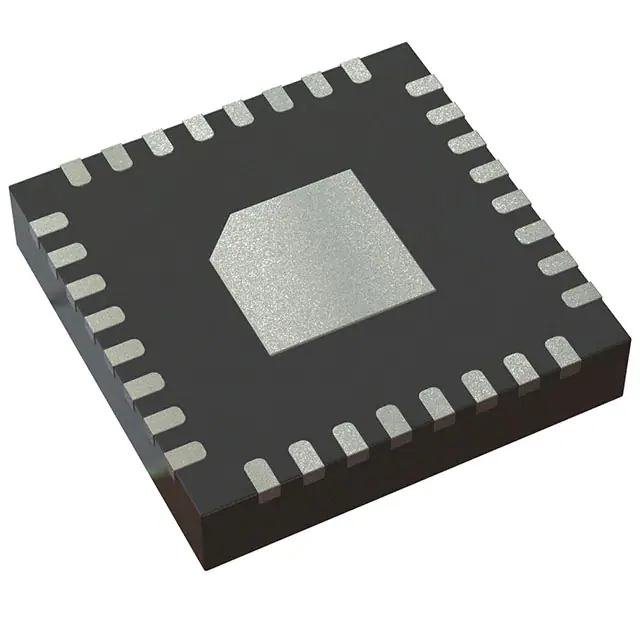
VQFN-32 (RHB) package: 5.00 mm × 5.00 mm, no-lead, thermally enhanced with exposed ground pad requiring solid ground plane connection.
| Pin/Terminal | Circuit Role | Design Meaning |
|---|---|---|
| VDD_GUARD, DVDD, AVDD_IF, AVDD_RF, AVDD_SYNTH1, AVDD_SYNTH2, AVDD_PFD_CHP, AVDD_XOSC | Power supply inputs | Eight independent 2.0–3.6 V rails isolate analog/digital/synthesizer domains to minimize noise coupling and enable selective power gating |
| LNA_P / LNA_N | Differential RX input | Requires DC path to ground; optimized for 60 + j60 Ω (868 MHz) or 140 + j40 Ω (169 MHz) source impedance |
| PA | Single-ended TX output | Requires DC path to VDD; supports +16 dBm output with internal PA and integrated matching |
| TRX_SW | TX/RX antenna switch control | Internally connects PA to antenna in TX mode and floats in RX mode; eliminates need for external SPDT switch |
| CSn, SI, SO(GPIO1), SCLK | SPI interface | Standard 4-wire SPI with GPIO1 multiplexed on SO; enables configuration and packet data transfer at up to 20 MHz clock rate |
| RBIAS | Analog bias reference | Connects external precision resistor to set LNA/PGA gain and ADC reference; critical for sensitivity calibration |
| XOSC_Q1 / XOSC_Q2 / EXT_XOSC | Crystal/TCXO interface | Supports 40-MHz crystal (Q1/Q2 grounded if TCXO used) or external 40-MHz clock (EXT_XOSC active) |
Key Features
| Feature | Design Value |
|---|---|
| WaveMatch DSP engine | Improves sync word detection reliability under fading and interference, reducing false wake-ups in eWOR polling |
| Autonomous image rejection | Eliminates need for external image-reject filters in 169/433/868 MHz bands, simplifying BOM and layout |
| Enhanced Wake-On-Radio (eWOR) | Enables periodic RX sniffing at 0.5 mA average current, extending battery life to >10 years in 1-second polling intervals |
| Integrated packet handler | Offloads CRC, FEC, whitening, and address filtering from host MCU - reduces firmware complexity and latency |
| Pin compatibility with CC1120 | Allows drop-in replacement in existing CC1120 designs while upgrading to higher sensitivity and +16 dBm output |
Applications
| Smart Metering (AMR/AMI) | Wireless Sensor Networks |
|---|---|
Use Scenario: Bidirectional communication between utility meters and concentrators over 868/915 MHz ISM bands in dense urban deployments. IC Role / Device Role / Timing Role: Primary RF transceiver handling encrypted 802.15.4g PHY/MAC frames with automatic ACK, CCA, and retransmission. Use Value: –120 dBm sensitivity at 1.2 kbps extends link budget by 6 dB vs. CC1120, enabling single-hop coverage across 3+ city blocks without repeaters. |
Use Scenario: Battery-powered temperature/humidity nodes transmitting 10-byte packets every 5 minutes in industrial facilities. IC Role / Device Role / Timing Role: Low-power RX/TX controller using eWOR to wake only for scheduled transmissions and sync-word detection. Use Value: 0.12 µA power-down current and 0.5 mA RX sniff mode enable 15-year coin-cell operation (CR2032) per node. |
| Home Automation Gateways | Wireless Alarm Systems |
Use Scenario: Central hub aggregating Z-Wave or proprietary sub-GHz sensor data and bridging to Wi-Fi/Ethernet. IC Role / Device Role / Timing Role: High-performance transceiver supporting multiple concurrent channels and modulation schemes for multi-protocol support. Use Value: Programmable channel filter (50–1600 kHz) and 4-GFSK support allow coexistence with legacy 12.5-kHz-channel alarm systems in same environment. |
Use Scenario: Door/window sensors and motion detectors reporting tamper alerts within 100 ms of event detection. IC Role / Device Role / Timing Role: Ultra-fast RX turnaround (43 µs) and hardware CCA ensure rapid channel access and reliable alarm delivery. Use Value: 369 µs IDLE-to-RX time with PLL calibration enables sub-500 ms end-to-end alarm latency - meeting EN 50131 Grade 2 response requirements. |
Equivalent & Alternatives
The following parts are listed as comparable options for similar RF transceiver applications.
| Alternative Part | Technical Difference | Application Difference | Selection Advice |
|---|---|---|---|
| CC1120RHBT | Lower max output (+14 dBm), –117 dBm sensitivity at 1.2 kbps, no hardware AES-128, narrower channel filter (≤500 kHz) | Targeted at cost-sensitive, medium-range applications where regulatory margin and security are secondary | Select CC1120RHBT when BOM cost reduction outweighs need for +2 dB link budget and secure over-the-air updates |
| CC1200RHBT | Identical architecture and pinout; differs only in factory-programmed register defaults - CC1200 lacks narrowband (<50 kHz) channel filter support | Optimized for high-data-rate (>50 kbps), wide-channel applications where narrowband filtering is unnecessary | Choose CC1200RHBT for 802.15.4g mandatory mode (50 kbps, 104 kHz filter) where CC1201RHBT's full filter range adds no benefit |
Compared with CC1120RHBT, CC1201RHBT provides +3 dB sensitivity and +2 dB output for extended range, plus AES-128 for secure firmware updates; versus CC1200RHBT, it adds narrowband filtering capability essential for legacy 12.5-kHz-channel systems and ETSI Category 2 compliance.
Availability
CC1201RHBT is available at Aetrix Electronics and suitable for smart metering, industrial wireless sensor networks, and home automation gateways requiring stable component supply, long-term lifecycle assurance, and traceable sourcing for global deployments.
Supply support for CC1201RHBT includes scheduled delivery planning, volume procurement assistance, BOM continuity management, traceable sourcing, and lifecycle availability coordination for OEM customers, industrial embedded developers, connected-device designers, and electronics production programs.
Manufacturer
Texas Instruments is a global semiconductor leader specializing in analog, embedded processing, and connectivity solutions, with decades of RF IC expertise serving industrial, automotive, and IoT markets.
The CC1201RHBT belongs to TI's CC120x sub-GHz transceiver family, engineered for high-performance, ultra-low-power wireless systems targeting ETSI/FCC/ARIB regulatory certification and interoperability with 802.15.4g and proprietary protocols.
FAQ
What is the maximum output power of the CC1201RHBT and under what conditions?
The CC1201RHBT delivers +16 dBm maximum output power at 169 MHz and 433 MHz when supplied with 3.6 V, and +15 dBm at 868/915/920 MHz under the same condition. At 3.0 V, output is +15 dBm (169/433 MHz) or +14 dBm (868/915/920 MHz). Power is programmable in 0.4-dB steps across a –38 dBm to +16 dBm range, enabling precise link budget tuning. This capability is intrinsic to the CC1201RHBT's integrated high-efficiency PA and supports regulatory compliance without external amplification.
Does the CC1201RHBT support hardware encryption, and how is it implemented?
Yes, the CC1201RHBT includes a dedicated hardware AES-128 accelerator that performs encryption/decryption independently of the host microcontroller. It operates via dedicated registers accessible through the SPI interface and supports key loading, block cipher execution, and result retrieval without CPU intervention. This feature reduces latency, lowers MCU processing overhead, and enhances security integrity - a core capability of the CC1201RHBT not present in earlier CC112x devices.
How does the CC1201RHBT achieve ultra-low-power operation in battery-powered applications?
The CC1201RHBT achieves ultra-low-power operation through multiple integrated features: 0.12 µA power-down current with register retention, 0.5 mA RX sniff mode with configurable wake intervals, and enhanced Wake-On-Radio (eWOR) using an internal 40-kHz RC oscillator. In typical sensor node use, the CC1201RHBT wakes every second, listens for 200 µs, and returns to sleep - achieving ~8 µA average current. This behavior is natively supported by the CC1201RHBT's packet handler and timing engine, eliminating external timers or complex firmware state machines.
Is the CC1201RHBT pin-compatible with other Texas Instruments transceivers?
Yes, the CC1201RHBT is pin-compatible with the CC1120RHBT in the same 5-mm × 5-mm QFN-32 (RHB) package, enabling direct PCB replacement in existing designs. Pin mapping for power, SPI, GPIO, RF I/O, and crystal connections matches exactly. However, register initialization sequences differ due to architectural enhancements in the CC1201RHBT, including wider channel filter range and added AES engine - requiring updated firmware configuration but no hardware changes.
Which frequency bands and regulatory standards does the CC1201RHBT support out of the box?
The CC1201RHBT supports ISM/SRD bands at 164–190 MHz, 410–475 MHz, and 820–950 MHz, with documented performance in 169, 433, 868, 915, and 920 MHz sub-bands. It is designed for compliance with ETSI EN 300 220 (Categories 2 and 3), FCC Part 15.247/249, and ARIB STD-T108. Regulatory qualification is achieved using TI's reference designs and layout guidelines - a validated capability of the CC1201RHBT, not dependent on external components beyond standard matching networks.
CC1201RHBT Specifications
- Product attributes
- Attribute value
- Manufacturer:
- Texas Instruments
- Series:
- -
- Package/Case:
- 32-VFQFN Exposed Pad
- Packaging:
- Tape & Reel (TR)
- Product Status:
- Active
- Programmable:
- Not Verified
- Type:
- TxRx + MCU
- RF Family/Standard:
- General ISM < 1GHz
- Protocol:
- -
- Modulation:
- 2FSK, 2GFSK, 4FSK, 4GFSK, MSK, OOK
- Frequency:
- 164MHz ~ 190MHz, 410MHz ~ 475MHz, 820MHz ~ 950MHz
- Data Rate (Max):
- 1.25Mbps
- Power - Output:
- 16dBm
- Sensitivity:
- -120dBm
- Memory Size:
- 4kB ROM, 256B RAM
- Serial Interfaces:
- SPI
- GPIO:
- 4
- Voltage - Supply:
- 2V ~ 3.6V
- Current - Receiving:
- 19mA ~ 23.6mA
- Current - Transmitting:
- 33.6mA ~ 54mA
- Operating Temperature:
- -40°C ~ 85°C
- Grade:
- -
- Qualification:
- -
- Supplier Device Package:
- 32-VQFN (5x5)
CC1201RHBT FAQ
1.How can I place an order for CC1201RHBT through Aetrix?
Please submit a Request for Quotation (RFQ) for CC1201RHBT on Aetrix. Our sales agent will provide a competitive quotation and guide you through the order confirmation once you accept the terms.
2.Are the price and stock information for CC1201RHBT reliable?
The price and inventory of CC1201RHBT are updated periodically and may fluctuate due to market conditions. Stock and pricing data are typically refreshed every 24 hours. Quotation validity for CC1201RHBT is usually 5 days.
3.What payment methods are accepted for CC1201RHBT?
We accept Wire Transfer, PayPal, Credit Card, Western Union, MoneyGram, and Escrow for CC1201RHBT transactions.
Note: Certain payment methods may incur a processing fee.
4.How is shipping managed for CC1201RHBT?
CC1201RHBT orders can be shipped via leading logistics carriers, including DHL, UPS, FedEx, TNT, or Registered Mail.
Once your CC1201RHBT order is processed, you will receive an email with the shipment details and tracking number.
Note: Tracking information may take up to 24 hours to appear. Express delivery typically takes 3–5 business days.
5.How can I obtain technical support or documentation for CC1201RHBT?
For technical support, including CC1201RHBT datasheets, pinout diagrams, or application guidance, please contact our engineering support team. They can provide detailed documentation and assistance for your CC1201RHBT requirements.
6.How does Aetrix verify that CC1201RHBT is sourced from the original manufacturer or authorized distributors?
All CC1201RHBT products on Aetrix are procured from qualified distributors and authorized channels. Our dedicated quality assurance team conducts strict verification, including traceability checks and, if necessary, third-party testing. This ensures that CC1201RHBT meets industry standards.
7.What is the process for return or replacement of CC1201RHBT?
All CC1201RHBT units undergo pre-shipment inspection (PSI). If there is an issue with CC1201RHBT, returns or replacements are accepted under the following conditions:
1.Quantity discrepancies, incorrect items, or visible external defects (such as breakage or corrosion), acknowledged by Aetrix.
2.The issue is reported within 90 days of delivery.
3.The CC1201RHBT part is unused and in its original packaging.
Return procedure for CC1201RHBT:
1.Submit a request within 90 days.
2.Obtain a Return Material Authorization (RMA) from Aetrix.
CC1201RHBT Tags
-
ESP32-D0WD-V3
Espressif Systems
-
ESP8266EX
Espressif Systems

-
ESP32-S3
Espressif Systems
-
NRF24L01P-R7
Nordic Semiconductor ASA
-
NRF24L01P-R
Nordic Semiconductor ASA
-
ESP32-U4WDH
Espressif Systems
-
DA14531-00000OG2
Renesas
-
ESP32-C6FH4
Espressif Systems
-
DA14531-00000FX2
Renesas
-
NRF24L01P-T
Nordic Semiconductor ASA
-
NRF52810-QCAA-R
Nordic Semiconductor ASA
-
ESP32-S3FN8
Espressif Systems
Tech Hub

A practical engineering guide to 3.3V and 5V logic compatibility, input thresholds, resistor dividers, translator ICs, MOSFET level shifting, I2C pull-ups, timing limits and power-sequencing risks.

The 74HC595 uses push-pull logic outputs, while the TPIC6B595 uses 50 V open-drain DMOS sinks for higher-power loads. This guide compares timing, current limits, 3.3 V interfacing, load wiring, thermal…

The 74HC595 converts serial data into eight stable parallel outputs. This guide covers pin functions, shift and storage timing, OE and MR behavior, drive-current limits, cascading, voltage compatibilit…

A technical comparison of level-sensitive latches and edge-triggered flip-flops, covering timing windows, setup and hold limits, master–slave operation, time borrowing, race-through, HDL inference and…

A D latch stores one bit while Enable controls when data can pass. This reference covers gate-level operation, truth tables, transparency, setup and hold timing, LE versus OE, common ICs and practical …

An SR latch stores one bit through cross-coupled feedback. This engineering reference covers NOR and NAND implementations, truth tables, forbidden-state recovery, gated operation, switch debouncing, fa…

Latch circuits retain one bit through feedback. This technical reference covers SR and D latches, truth tables, transparency, timing limits, latch-versus-flip-flop behavior, applications and common log…

An engineering guide to LED driver operation, constant-current and constant-voltage outputs, linear and switching topologies, dimming, IC selection, calculations, replacement compatibility, and fault c…

Operational amplifier guide covering op amp basics, feedback, ideal vs real op amps, common configurations, buffer circuits, offset, bias current, gain-bandwidth, slew rate, rail-to-rail limits and sel…

Jumper cables guide covering safe connection order, red and black clamp placement, final ground connection, cable gauge, length, clamp quality, copper vs CCA cables, jump starter comparison and battery…


