
 My Inquiry
 My Account


Texas Instruments CC3220MODASM2MONR
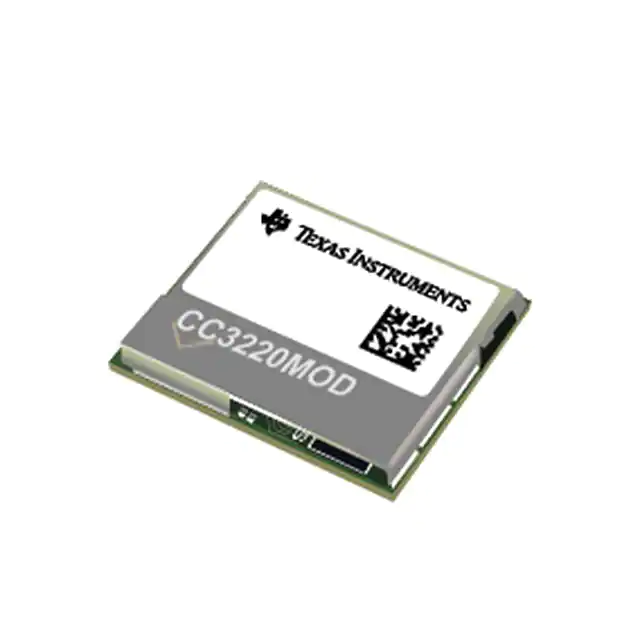
- Part No.:
- CC3220MODASM2MONR
- Manufacturer:
- Texas Instruments
- Category:
- RF Transceiver ICs
- Package:
- 63-SMD Module
- Datasheet:
-
 CC3220MODASM2MONR.pdf
- Description:
- IC RF TXRX+MCU WIFI 63SMD
- Quantity:
- Payment:

- Shipping:

Inventory:1,006
Please send an inquiry. Send us your inquiry, and we will respond immediately.
Product details
Overview
CC3220MODASM2MONR from Texas Instruments is a FCC/CE/SRRC-certified Wi-Fi® CERTIFIED™ wireless MCU module integrating dual Arm® Cortex®-M4 and network processor subsystems, 256KB RAM, integrated 32-Mbit SPI Flash, 40-MHz and 32.768-kHz crystals, and PCB antenna - designed for secure, low-power IoT edge nodes requiring embedded TLS/SSL, IPv4/IPv6, and WPA3 support.
For engineers reviewing the CC3220MODASM2MONR datasheet, CC3220MODASM2MONR pinout, CC3220MODASM2MONR application, or CC3220MODASM2MONR equivalent, key selection considerations include its 63-pin QFM package with integral antenna, 25.5 mm × 20.5 mm footprint, industrial temperature range (–40°C to +85°C), and dual-execution security architecture with hardware crypto engine (AES/SHA2/MD5/CRC).
Technical Context
The CC3220MODASM2MONR implements physically separated execution environments: an 80-MHz Arm® Cortex®-M4 application MCU with 256KB RAM and ROM-based peripheral drivers, and a dedicated network processor running Wi-Fi® MAC/PHY, TCP/IP stack (IPv4/IPv6), and TLS/SSL - enabling concurrent application and network processing without host CPU intervention.
Its security architecture includes hardware-accelerated crypto (AES, SHA2, MD5, CRC), secure boot with runtime binary validation, encrypted file system, device identity, and locked JTAG/cJTAG/SWD debug interfaces - all supporting WPA3 Personal/Enterprise, HTTPS server, and trusted root-certificate catalog.
Key Specifications
| Parameter | Value and Actual Design Meaning |
|---|---|
| Wireless Standard | IEEE 802.11b/g/n at 2.4 GHz - supports Station, AP (up to 4 stations), and Wi-Fi Direct® modes |
| Wi-Fi TX Power | 17.0 dBm at 1 DSSS - enables robust link budget in noisy industrial environments |
| Wi-Fi RX Sensitivity | –95.0 dBm at 1 DSSS - ensures reliable reception at long range or low signal conditions |
| Application Throughput | TCP: 13 Mbps / UDP: 16 Mbps - sufficient for real-time sensor telemetry and firmware OTA updates |
| Power Modes | Shutdown: 1 µA / Hibernate: 5 µA / LPDS: 135 µA - extends battery life in always-connected edge devices |
| Security Features | Hardware crypto engine, secure boot, encrypted file system, cloning protection - meets IEC 62443-3-3 SL2 requirements for embedded IoT |
| Operating Temp | –40°C to +85°C - qualified for industrial automation, building control, and outdoor metering |
Pinout & Package
CC3220MODASM2MONR uses a 63-pin, 1.27-mm pitch QFM package measuring 25.5 mm × 20.5 mm, with integrated PCB antenna and dedicated RF ground plane layout. Pin functions are validated per TI SWRS206E Rev E (May 2021) Section 7.1–7.2.
| Pin/Terminal | Circuit Role | Design Meaning |
|---|---|---|
| RF_BG | RF Ground Reference | Primary RF return path for PCB antenna; must be connected to solid ground plane |
| ANT_SEL1 / ANT_SEL2 | Antenna Selection Control | Configures internal antenna switch; required for antenna diversity or external antenna routing |
| VBAT1 / VBAT2 | Main Power Inputs | Independent 2.3–3.6 V supply pins - decoupling required per TI layout guidelines |
| nRESET | Active-Low Reset Input | Asynchronous reset with internal 100 kΩ pull-up; VBAT_RESET pin enables controlled reset sourcing |
| GPIO0–GPIO30 | General-Purpose I/O | 31 configurable digital I/Os supporting UART, SPI, I2C, ADC, PWM, and camera interface |
| JTAG_TCK/TMS/TDI/TDO | JTAG Debug Interface | Standard 4-pin boundary-scan interface; debug ports locked by default for production security |
Key Features
| Feature | Design Value |
|---|---|
| Dual Execution Environment | Physically isolated Arm® Cortex®-M4 (application) and network processor MCUs eliminate software interference and simplify RTOS integration |
| Integrated Antenna | PCB-integrated 2.4-GHz antenna eliminates external RF matching components and reduces BOM cost |
| Secure Boot & Key Storage | Runtime binary authentication and encrypted secure key storage prevent unauthorized firmware execution and credential theft |
| RESTful API Support | Built-in HTTP/HTTPS server with dynamic user callbacks enables direct cloud API interaction without host MCU middleware |
| SmartConfig™ Provisioning | Zero-touch Wi-Fi setup via mobile app - no AP mode or physical button press required during field deployment |
Applications
| Smart Thermostats | Industrial Wireless Sensors |
|---|---|
Use Scenario: Residential HVAC control unit connecting to cloud platform for remote scheduling and energy analytics. IC Role / Device Role / Timing Role: Primary wireless MCU handling sensor acquisition (ADC), local UI logic, and secure TLS-encrypted MQTT communication to AWS IoT Core. Use Value: Integrated 256KB RAM and 32-Mbit Flash enable local rule engine and offline operation; WPA3 and secure boot meet UL 2900-1 cybersecurity certification requirements. | Use Scenario: Battery-powered vibration/temperature node in factory predictive maintenance system. IC Role / Device Role / Timing Role: Edge data aggregator with LPDS mode (135 µA), wake-on-event GPIO, and encrypted OTA firmware updates over TLS. Use Value: 5 µA hibernate current and shutdown mode (1 µA) extend 10-year battery life; hardware crypto accelerates AES-128 encryption of sensor payloads. |
| Smart Locks | IP-Based Security Cameras |
Use Scenario: BLE + Wi-Fi dual-mode electronic lock with cloud-based access logging and emergency override. IC Role / Device Role / Timing Role: Secure Wi-Fi endpoint managing encrypted credential storage, TLS handshake with Azure IoT Hub, and tamper-detection GPIO monitoring. Use Value: Cloning protection and secure key storage prevent physical extraction of credentials; WPA3 Enterprise ensures compliance with NIST SP 800-171 for government facilities. | Use Scenario: Low-power video streaming camera using MJPEG over HTTP to on-premise NVR. IC Role / Device Role / Timing Role: Video-capable MCU with 8-bit parallel interface, McASP for audio sync, and embedded HTTP server serving live stream. Use Value: 2-ch I2S and SD/MMC support enable synchronized audio/video capture; 13 Mbps TCP throughput sustains 720p@15fps streaming. |
Equivalent & Alternatives
The following parts are listed as comparable options for similar wireless MCU applications.
| Alternative Part | Technical Difference | Application Difference | Selection Advice |
|---|---|---|---|
| CC3220MODSF12MOBR | Same 63-pin QFM package but 1MB XIP Flash instead of RAM-only; no integral antenna | Requires external antenna and RF matching; better for code-intensive applications needing local Flash execution | Select when firmware size exceeds 256KB RAM capacity and external antenna is preferred |
| ESP32-WROVER-E | 2.4 GHz Wi-Fi + Bluetooth combo; 4MB PSRAM; no WPA3 or hardware crypto engine; different pinout and SDK | Lacks TI's certified security stack and industrial temp qualification; requires third-party TLS implementation | Select for cost-sensitive consumer products where WPA3 and IEC 62443 compliance are not mandated |
Compared with CC3220MODSF12MOBR, CC3220MODASM2MONR trades Flash capacity for integrated antenna and simplified RF design; versus ESP32-WROVER-E, it delivers certified WPA3, hardware crypto acceleration, and industrial-grade reliability - critical for medical, building automation, and utility metering deployments.
Availability
CC3220MODASM2MONR is available at Aetrix Electronics and suitable for smart thermostats, industrial wireless sensors, electronic locks, and IP-based security cameras requiring stable component supply across multi-year production cycles.
Supply support for CC3220MODASM2MONR includes scheduled delivery planning, volume procurement assistance, BOM continuity management, traceable sourcing, and lifecycle availability coordination for OEM customers, industrial embedded developers, connected-device designers, and electronics production programs.
Manufacturer
Texas Instruments is a global semiconductor company delivering analog and embedded processing solutions for industrial, automotive, and personal electronics markets.
The CC3220MODASM2MONR belongs to TI's SimpleLink™ Wi-Fi® MCU portfolio - engineered for secure, low-power, FCC/CE-certified IoT edge connectivity with minimal external components and full protocol stack offload.
FAQ
What certifications does the CC3220MODASM2MONR hold?
The CC3220MODASM2MONR holds FCC, IC, CE, MIC, and SRRC regulatory certifications, and is Wi-Fi Alliance® Wi-Fi CERTIFIED™. It supports WPA3 Personal and Enterprise security protocols, and its hardware crypto engine enables TLS 1.2 compliance for secure cloud connectivity - making CC3220MODASM2MONR suitable for globally deployed IoT products requiring regional radio approval and enterprise-grade security.
Does CC3220MODASM2MONR include an integrated antenna?
Yes, CC3220MODASM2MONR integrates a PCB-mounted 2.4-GHz antenna - eliminating the need for external RF components, antenna tuning, or RF connector placement. This simplifies PCB layout, reduces bill-of-materials cost, and accelerates time-to-certification. The antenna is accessed via RF_BG and ANT_SEL1/ANT_SEL2 pins, and performance is characterized per TI SWRS206E Section 8.9.
What memory resources are available on CC3220MODASM2MONR?
CC3220MODASM2MONR provides 256KB of application-dedicated RAM and 32-Mbit (4MB) SPI Flash integrated on-module. Unlike Flash-based variants (e.g., CC3220MODASF12MONR), this model uses RAM for code/data execution - ideal for applications requiring fast code iteration or dynamic allocation. The CC3220MODASM2MONR does not include on-chip Flash memory for XIP execution.
How does the dual-MCU architecture of CC3220MODASM2MONR improve system reliability?
The CC3220MODASM2MONR separates application logic (Arm® Cortex®-M4) from Wi-Fi/network processing (dedicated network processor) - preventing Wi-Fi stack crashes from affecting application execution and vice versa. This isolation enables deterministic real-time response, simplifies debugging, and allows independent firmware updates. For example, a failed TLS handshake will not stall the main application loop - a key advantage of CC3220MODASM2MONR in mission-critical edge devices.
What power modes does CC3220MODASM2MONR support for battery-operated designs?
CC3220MODASM2MONR supports Shutdown (1 µA), Hibernate (5 µA), and Low-Power Deep Sleep (LPDS) at 135 µA with 256KB RAM retention - verified per SWRS206E Section 8.4. In LPDS with DTIM=1, idle connected current is 710 µA. These modes are managed by the integrated DC/DC converter and power-management subsystem, enabling multi-year battery life in wireless sensors and smart locks - a core design benefit of CC3220MODASM2MONR.
CC3220MODASM2MONR Specifications
- Product attributes
- Attribute value
- Manufacturer:
- Texas Instruments
- Series:
- SimpleLink™
- Package/Case:
- 63-SMD Module
- Packaging:
- Tape & Reel (TR)
- Product Status:
- Active
- Programmable:
- Not Verified
- Type:
- TxRx + MCU
- RF Family/Standard:
- WiFi
- Protocol:
- 802.11b/g/n
- Modulation:
- DSSS, OFDM
- Frequency:
- 2.4GHz
- Data Rate (Max):
- -
- Power - Output:
- 17dBm
- Sensitivity:
- -95dBm
- Memory Size:
- 256kB RAM
- Serial Interfaces:
- -
- GPIO:
- 21
- Voltage - Supply:
- 2.3V ~ 3.6V
- Current - Receiving:
- -
- Current - Transmitting:
- -
- Operating Temperature:
- -40°C ~ 85°C
- Grade:
- -
- Qualification:
- -
- Supplier Device Package:
- -
CC3220MODASM2MONR FAQ
1.How can I place an order for CC3220MODASM2MONR through Aetrix?
Please submit a Request for Quotation (RFQ) for CC3220MODASM2MONR on Aetrix. Our sales agent will provide a competitive quotation and guide you through the order confirmation once you accept the terms.
2.Are the price and stock information for CC3220MODASM2MONR reliable?
The price and inventory of CC3220MODASM2MONR are updated periodically and may fluctuate due to market conditions. Stock and pricing data are typically refreshed every 24 hours. Quotation validity for CC3220MODASM2MONR is usually 5 days.
3.What payment methods are accepted for CC3220MODASM2MONR?
We accept Wire Transfer, PayPal, Credit Card, Western Union, MoneyGram, and Escrow for CC3220MODASM2MONR transactions.
Note: Certain payment methods may incur a processing fee.
4.How is shipping managed for CC3220MODASM2MONR?
CC3220MODASM2MONR orders can be shipped via leading logistics carriers, including DHL, UPS, FedEx, TNT, or Registered Mail.
Once your CC3220MODASM2MONR order is processed, you will receive an email with the shipment details and tracking number.
Note: Tracking information may take up to 24 hours to appear. Express delivery typically takes 3–5 business days.
5.How can I obtain technical support or documentation for CC3220MODASM2MONR?
For technical support, including CC3220MODASM2MONR datasheets, pinout diagrams, or application guidance, please contact our engineering support team. They can provide detailed documentation and assistance for your CC3220MODASM2MONR requirements.
6.How does Aetrix verify that CC3220MODASM2MONR is sourced from the original manufacturer or authorized distributors?
All CC3220MODASM2MONR products on Aetrix are procured from qualified distributors and authorized channels. Our dedicated quality assurance team conducts strict verification, including traceability checks and, if necessary, third-party testing. This ensures that CC3220MODASM2MONR meets industry standards.
7.What is the process for return or replacement of CC3220MODASM2MONR?
All CC3220MODASM2MONR units undergo pre-shipment inspection (PSI). If there is an issue with CC3220MODASM2MONR, returns or replacements are accepted under the following conditions:
1.Quantity discrepancies, incorrect items, or visible external defects (such as breakage or corrosion), acknowledged by Aetrix.
2.The issue is reported within 90 days of delivery.
3.The CC3220MODASM2MONR part is unused and in its original packaging.
Return procedure for CC3220MODASM2MONR:
1.Submit a request within 90 days.
2.Obtain a Return Material Authorization (RMA) from Aetrix.
CC3220MODASM2MONR Tags
-
ESP32-D0WD-V3
Espressif Systems
-
ESP8266EX
Espressif Systems

-
ESP32-S3
Espressif Systems
-
NRF24L01P-R7
Nordic Semiconductor ASA
-
NRF24L01P-R
Nordic Semiconductor ASA
-
ESP32-U4WDH
Espressif Systems
-
DA14531-00000OG2
Renesas
-
ESP32-C6FH4
Espressif Systems
-
DA14531-00000FX2
Renesas
-
NRF24L01P-T
Nordic Semiconductor ASA
-
NRF52810-QCAA-R
Nordic Semiconductor ASA
-
ESP32-S3FN8
Espressif Systems
Tech Hub

A practical engineering guide to 3.3V and 5V logic compatibility, input thresholds, resistor dividers, translator ICs, MOSFET level shifting, I2C pull-ups, timing limits and power-sequencing risks.

The 74HC595 uses push-pull logic outputs, while the TPIC6B595 uses 50 V open-drain DMOS sinks for higher-power loads. This guide compares timing, current limits, 3.3 V interfacing, load wiring, thermal…

The 74HC595 converts serial data into eight stable parallel outputs. This guide covers pin functions, shift and storage timing, OE and MR behavior, drive-current limits, cascading, voltage compatibilit…

A technical comparison of level-sensitive latches and edge-triggered flip-flops, covering timing windows, setup and hold limits, master–slave operation, time borrowing, race-through, HDL inference and…

A D latch stores one bit while Enable controls when data can pass. This reference covers gate-level operation, truth tables, transparency, setup and hold timing, LE versus OE, common ICs and practical …

An SR latch stores one bit through cross-coupled feedback. This engineering reference covers NOR and NAND implementations, truth tables, forbidden-state recovery, gated operation, switch debouncing, fa…

Latch circuits retain one bit through feedback. This technical reference covers SR and D latches, truth tables, transparency, timing limits, latch-versus-flip-flop behavior, applications and common log…

An engineering guide to LED driver operation, constant-current and constant-voltage outputs, linear and switching topologies, dimming, IC selection, calculations, replacement compatibility, and fault c…

Operational amplifier guide covering op amp basics, feedback, ideal vs real op amps, common configurations, buffer circuits, offset, bias current, gain-bandwidth, slew rate, rail-to-rail limits and sel…

Jumper cables guide covering safe connection order, red and black clamp placement, final ground connection, cable gauge, length, clamp quality, copper vs CCA cables, jump starter comparison and battery…


