
 My Inquiry
 My Account


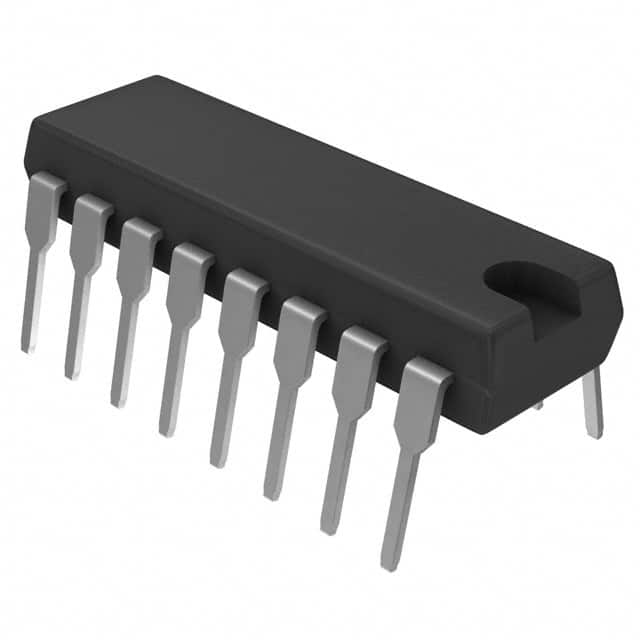
Texas Instruments CD74HCT153E
- Part No.:
- CD74HCT153E
- Manufacturer:
- Texas Instruments
- Category:
- Signal Switches, Multiplexers, Decoders
- Package:
- 16-DIP (0.300", 7.62mm)
- Datasheet:
-
 CD74HCT153E.pdf
- Description:
- IC MULTIPLEXER 2 X 4:1 16DIP
- Quantity:
- Payment:

- Shipping:

Inventory:690
Please send an inquiry. Send us your inquiry, and we will respond immediately.
Product details
Overview
CD74HCT153E from Texas Instruments is a dual 4-to-1-line selector/multiplexer with common select inputs (S0, S1), independent enable inputs (1E, 2E), and TTL-compatible CMOS logic. It operates from 4.5 V to 5.5 V, delivers propagation delays as low as 24 ns (I to Y, CL = 50 pF), and supports industrial temperature range (–55 °C to +125 °C). It is used in digital signal routing, data path selection, and address decoding in embedded control systems.
For engineers reviewing the CD74HCT153E datasheet, CD74HCT153E pinout, CD74HCT153E application, or CD74HCT153E equivalent, key selection criteria include its HCT-level input compatibility (VIH ≥ 2 V, VIL ≤ 0.8 V), dual-section independent enable control, 16-pin PDIP package, and guaranteed operation across extended temperature extremes.
Technical Context
The CD74HCT153E implements two independent 4-input multiplexers sharing select lines S0 and S1, where each section outputs one of four data inputs (1I0–1I3 or 2I0–2I3) based on the binary value of S1:S0 when its respective enable (1E or 2E) is LOW. Outputs are actively driven and go LOW when enable is HIGH - a true active-low enable architecture.
Its HCT logic family ensures direct interface with legacy LSTTL devices without level shifting: input thresholds meet VIH ≥ 2.0 V (min) and VIL ≤ 0.8 V (max) at VCC = 4.5–5.5 V, while output drive meets VOH ≥ 3.7 V (min, TTL load) and VOL ≤ 0.4 V (max, 4 mA sink) over full temperature range.
Key Specifications
| Parameter | Value and Actual Design Meaning |
|---|---|
| Logic Family | HCT - TTL-compatible CMOS, enabling direct connection to 5 V LSTTL without level shifters |
| Supply Voltage Range | 4.5 V to 5.5 V - matches standard 5 V system rails and rejects supply noise up to ±0.5 V |
| Propagation Delay (I to Y) | 24 ns (typ), 36 ns (max) at VCC = 4.5 V, CL = 50 pF - supports >10 MHz data switching in synchronous systems |
| Operating Temperature | –55 °C to +125 °C - qualified for aerospace, military, and under-hood automotive applications |
| Input Leakage Current | ±1 µA (max) at –55 °C to +125 °C - ensures reliable high-impedance input behavior across full range |
| Output Drive Capability | Sinks 4 mA / sources 0.4 mA (TTL load) - sufficient to drive 10 LSTTL loads directly |
| Power Dissipation Capacitance | 45 pF - enables accurate dynamic power estimation: PD = VCC² × fi × (CPD + CL) |
Pinout & Package
CD74HCT153E is housed in a 16-lead plastic dual in-line package (PDIP, N package), with 0.3-inch body width and through-hole mounting. Pin 1 is located at top-left corner (quadrant Q1) when notch faces upward.
| Pin/Terminal | Circuit Role | Design Meaning |
|---|---|---|
| 1E, 2E | Active-Low Enable Inputs | Enable respective multiplexer section only when LOW; outputs forced LOW when HIGH |
| S0, S1 | Common Binary Select Inputs | Shared by both sections; determine which of four inputs (I0–I3) is routed to output (Y) |
| 1I0–1I3, 2I0–2I3 | Data Inputs | Two independent sets of four digital inputs; each set selectable per S1:S0 |
| 1Y, 2Y | Complementary Outputs | Active-HIGH outputs reflecting selected input; no inversion applied |
| VCC (Pin 16), GND (Pin 8) | Power Supply Terminals | Single 5 V supply rail; decoupling capacitor required between VCC and GND near device |
Key Features
| Feature | Design Value |
|---|---|
| Common Select Architecture | Reduces PCB routing complexity by sharing S0/S1 between dual sections - cuts select-line count by 50% vs discrete muxes |
| Independent Enable Control | Allows time-multiplexed or conditional activation of each 4:1 section - enables gated data path isolation |
| LSTTL Input Compatibility | Eliminates need for external level-shifting circuitry when interfacing with legacy 5 V TTL logic families |
| Wide Temperature Operation | Validated performance from –55 °C to +125 °C supports deployment in uncontrolled environments without derating |
| Buffered I/O | Prevents loading effects on upstream drivers and downstream receivers - maintains signal integrity in fanout-heavy designs |
Applications
| Industrial PLC I/O Expansion | Aerospace Avionics Data Routing |
|---|---|
Use Scenario: Multiplexing discrete sensor inputs (temperature, pressure, position) into a single ADC channel within a ruggedized programmable logic controller. IC Role / Device Role / Timing Role: Dual 4:1 selector routes up to eight analog-conditioned signals using shared address lines and independent channel enables. Use Value: Reduces component count versus two separate 74LS153s while maintaining full channel independence and meeting MIL-STD-810 thermal requirements. | Use Scenario: Selecting among redundant flight control data streams (pitch, roll, yaw) in a fault-tolerant avionics bus interface module. IC Role / Device Role / Timing Role: Enables real-time switching between primary and backup sensor channels using deterministic, sub-40 ns propagation delay. Use Value: Guarantees timing-critical signal routing within DO-254 safety-critical timing budgets due to specified max delay and monotonic transition behavior. |
| Automotive Engine Control Unit | Test Equipment Signal Conditioning |
Use Scenario: Routing diagnostic test signals (OBD-II PID responses, actuator feedback) onto a shared CAN transceiver data line during ECU self-test mode. IC Role / Device Role / Timing Role: Acts as a digitally controlled analog switch matrix - selects one of four conditioned voltage signals for transmission. Use Value: Supports AEC-Q100 Grade 1 qualification via extended temperature operation and robust ESD tolerance (per TI handling cautions). | Use Scenario: Configuring input signal paths in automated test equipment (ATE) that must route DUT outputs to multiple measurement instruments (oscilloscope, DMM, logic analyzer). IC Role / Device Role / Timing Role: Provides repeatable, low-jitter signal selection under software-controlled address sequencing. Use Value: Delivers consistent 24 ns typical propagation delay across units - critical for time-aligned multi-instrument capture synchronization. |
Equivalent & Alternatives
The following parts are listed as comparable options for similar dual 4:1 multiplexer applications.
| Alternative Part | Technical Difference | Application Difference | Selection Advice |
|---|---|---|---|
| SN74HCT153N | Same HCT logic, identical pinout and DC/AC specs; manufactured by TI with updated process and RoHS compliance. | No functional difference; SN74HCT153N replaces CD74HCT153E in new designs requiring current TI production status. | Select SN74HCT153N for new designs requiring long-term availability and TI's latest manufacturing release. |
| 74ACT153PC | Advanced CMOS (ACT) family: wider VCC range (4.5–5.5 V), faster tPLH/tPHL (11 ns typ), but higher ICC (20 µA typ vs 8 µA). | Better speed/power trade-off for high-frequency test fixtures; not drop-in due to different AC characteristics and layout sensitivity. | Choose 74ACT153PC only when propagation delay <12 ns is required and board-level noise immunity can be maintained. |
Compared with CD74HCT153E, SN74HCT153N offers identical functionality with enhanced lifecycle support, while 74ACT153PC trades higher static current for significantly reduced delay - making it suitable only where speed outweighs power and noise constraints.
Availability
CD74HCT153E is available at Aetrix Electronics and suitable for industrial PLC I/O expansion, aerospace avionics data routing, and automotive engine control unit applications requiring stable component supply across extended temperature ranges and long production lifecycles.
Supply support for CD74HCT153E includes scheduled delivery planning, volume procurement assistance, BOM continuity management, traceable sourcing, and lifecycle availability coordination for OEM customers, industrial embedded developers, connected-device designers, and electronics production programs.
Manufacturer
Texas Instruments is a global semiconductor company headquartered in Dallas, Texas, delivering analog and embedded processing solutions for industrial, automotive, and communications markets.
The CD74HCT153E belongs to TI's legacy High-Speed CMOS Logic (HCT) product line, designed specifically for seamless migration from bipolar TTL systems while retaining low power consumption and wide operating margins.
FAQ
What is the maximum clock/data frequency supported by CD74HCT153E?
The CD74HCT153E does not operate on a clock; it is a combinational logic device. Its usable data switching rate depends on propagation delay and system setup/hold timing. With a maximum I-to-Y propagation delay of 36 ns (–55 °C to +125 °C), CD74HCT153E reliably supports input signal changes up to approximately 10 MHz in well-designed synchronous systems where select lines are stable before data transitions.
Can CD74HCT153E interface directly with 3.3 V microcontrollers?
No - CD74HCT153E requires a 4.5 V to 5.5 V supply and is not 3.3 V tolerant. Its inputs are designed for LSTTL compatibility (VIH ≥ 2.0 V, VIL ≤ 0.8 V), but driving it from a 3.3 V GPIO may result in marginal or non-functional VIH levels. For 3.3 V systems, use CD74HC153E (2–6 V operation) or add level-shifting circuitry before the CD74HCT153E inputs.
Does CD74HCT153E have internal pull-up or pull-down resistors on its enable or select pins?
No - CD74HCT153E has no internal termination resistors. All inputs (1E, 2E, S0, S1, and data lines) are CMOS gates with high-impedance inputs. External pull-up or pull-down resistors must be used to ensure defined logic states during power-up, reset, or floating conditions - especially critical for enable pins to prevent unintended output activation.
Is CD74HCT153E suitable for use in safety-critical automotive applications?
CD74HCT153E itself is not AEC-Q100 qualified, but its –55 °C to +125 °C rating and proven reliability in military-grade variants (CD54HCT153) make it a candidate for under-hood or chassis applications when validated per ISO 26262 requirements. Customers must perform their own FMEDA and qualification testing; TI provides no ASIL-rated documentation for CD74HCT153E.
What is the thermal resistance (θJA) of the CD74HCT153E PDIP package?
The junction-to-ambient thermal resistance (θJA) for the CD74HCT153E in its 16-lead PDIP (N) package is 67 °C/W under typical JEDEC-standard PCB conditions (single-layer copper, 1 in² pad). This value assumes no added heatsinking and guides safe power dissipation limits - for example, at 160 µA ICC (max) and 5.5 V, total power is ~0.88 mW, resulting in negligible temperature rise.
CD74HCT153E Specifications
- Product attributes
- Attribute value
- Manufacturer:
- Texas Instruments
- Series:
- 74HCT
- Package/Case:
- 16-DIP (0.300", 7.62mm)
- Packaging:
- Tube
- Product Status:
- Active
- Type:
- Multiplexer
- Circuit:
- 2 x 4:1
- Independent Circuits:
- 1
- Current - Output High, Low:
- 4mA, 4mA
- Voltage Supply Source:
- Single Supply
- Voltage - Supply:
- 4.5V ~ 5.5V
- Operating Temperature:
- -55°C ~ 125°C
- Grade:
- -
- Qualification:
- -
- Mounting Type:
- Through Hole
- Supplier Device Package:
- 16-PDIP
CD74HCT153E FAQ
1.How can I place an order for CD74HCT153E through Aetrix?
Please submit a Request for Quotation (RFQ) for CD74HCT153E on Aetrix. Our sales agent will provide a competitive quotation and guide you through the order confirmation once you accept the terms.
2.Are the price and stock information for CD74HCT153E reliable?
The price and inventory of CD74HCT153E are updated periodically and may fluctuate due to market conditions. Stock and pricing data are typically refreshed every 24 hours. Quotation validity for CD74HCT153E is usually 5 days.
3.What payment methods are accepted for CD74HCT153E?
We accept Wire Transfer, PayPal, Credit Card, Western Union, MoneyGram, and Escrow for CD74HCT153E transactions.
Note: Certain payment methods may incur a processing fee.
4.How is shipping managed for CD74HCT153E?
CD74HCT153E orders can be shipped via leading logistics carriers, including DHL, UPS, FedEx, TNT, or Registered Mail.
Once your CD74HCT153E order is processed, you will receive an email with the shipment details and tracking number.
Note: Tracking information may take up to 24 hours to appear. Express delivery typically takes 3–5 business days.
5.How can I obtain technical support or documentation for CD74HCT153E?
For technical support, including CD74HCT153E datasheets, pinout diagrams, or application guidance, please contact our engineering support team. They can provide detailed documentation and assistance for your CD74HCT153E requirements.
6.How does Aetrix verify that CD74HCT153E is sourced from the original manufacturer or authorized distributors?
All CD74HCT153E products on Aetrix are procured from qualified distributors and authorized channels. Our dedicated quality assurance team conducts strict verification, including traceability checks and, if necessary, third-party testing. This ensures that CD74HCT153E meets industry standards.
7.What is the process for return or replacement of CD74HCT153E?
All CD74HCT153E units undergo pre-shipment inspection (PSI). If there is an issue with CD74HCT153E, returns or replacements are accepted under the following conditions:
1.Quantity discrepancies, incorrect items, or visible external defects (such as breakage or corrosion), acknowledged by Aetrix.
2.The issue is reported within 90 days of delivery.
3.The CD74HCT153E part is unused and in its original packaging.
Return procedure for CD74HCT153E:
1.Submit a request within 90 days.
2.Obtain a Return Material Authorization (RMA) from Aetrix.
CD74HCT153E Tags
-
SN74HC138DR
Texas Instruments
-
TC7SB3157CFU,LF(CT
Toshiba Semiconductor and Storage
-
74CBTLV3257PW,118
Nexperia USA Inc.
-
SN74CBTLV3257PWR
Texas Instruments
-
74CBTLV3257GUX
Nexperia USA Inc.
-
74HC154BQ,118
Nexperia USA Inc.

-
P3S0200GMX
NXP USA Inc.
-
SN74CB3Q3245PWR
Texas Instruments
-
SN74CB3Q3257RGYR
Texas Instruments
-
TCA9543APWR
Texas Instruments
-
TCA9546APWR
Texas Instruments
-
SN74HC138N
Texas Instruments
Tech Hub

A practical engineering guide to 3.3V and 5V logic compatibility, input thresholds, resistor dividers, translator ICs, MOSFET level shifting, I2C pull-ups, timing limits and power-sequencing risks.

The 74HC595 uses push-pull logic outputs, while the TPIC6B595 uses 50 V open-drain DMOS sinks for higher-power loads. This guide compares timing, current limits, 3.3 V interfacing, load wiring, thermal…

The 74HC595 converts serial data into eight stable parallel outputs. This guide covers pin functions, shift and storage timing, OE and MR behavior, drive-current limits, cascading, voltage compatibilit…

A technical comparison of level-sensitive latches and edge-triggered flip-flops, covering timing windows, setup and hold limits, master–slave operation, time borrowing, race-through, HDL inference and…

A D latch stores one bit while Enable controls when data can pass. This reference covers gate-level operation, truth tables, transparency, setup and hold timing, LE versus OE, common ICs and practical …

An SR latch stores one bit through cross-coupled feedback. This engineering reference covers NOR and NAND implementations, truth tables, forbidden-state recovery, gated operation, switch debouncing, fa…

Latch circuits retain one bit through feedback. This technical reference covers SR and D latches, truth tables, transparency, timing limits, latch-versus-flip-flop behavior, applications and common log…

An engineering guide to LED driver operation, constant-current and constant-voltage outputs, linear and switching topologies, dimming, IC selection, calculations, replacement compatibility, and fault c…

Operational amplifier guide covering op amp basics, feedback, ideal vs real op amps, common configurations, buffer circuits, offset, bias current, gain-bandwidth, slew rate, rail-to-rail limits and sel…

Jumper cables guide covering safe connection order, red and black clamp placement, final ground connection, cable gauge, length, clamp quality, copper vs CCA cables, jump starter comparison and battery…


