
 My Inquiry
 My Account


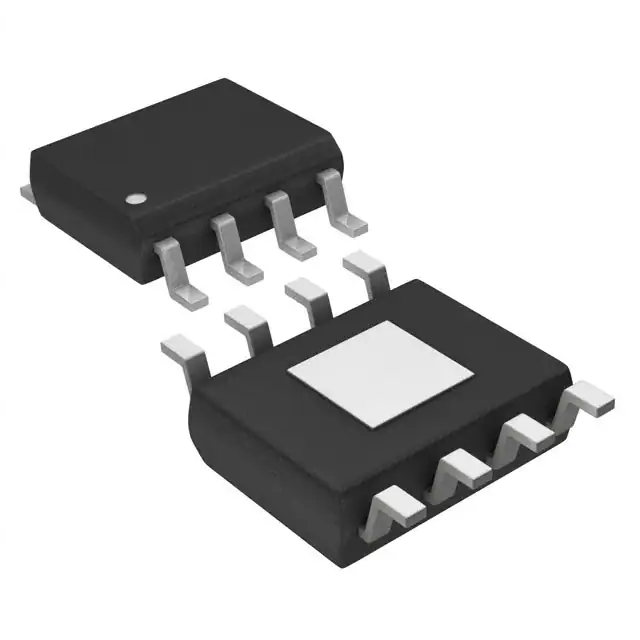
Microchip Technology CL330SG-G
- Part No.:
- CL330SG-G
- Manufacturer:
- Microchip Technology
- Category:
- LED Drivers
- Package:
- 8-SOIC (0.154", 3.90mm Width) Exposed Pad
- Datasheet:
-
 CL330SG-G.pdf
- Description:
- IC LED DRVR LIN PWM 30MA 8SOIC
- Quantity:
- Payment:

- Shipping:

Inventory:1,220
Please send an inquiry. Send us your inquiry, and we will respond immediately.
Product details
Overview
CL330SG-G from Microchip Technology is a 3-channel, 30 mA fixed-output linear LED driver in an 8-lead SOIC package with heat slug, designed for constant-current sinking of three independent LED strings. It operates from 6.5 V to 90 V input, delivers ±6% current accuracy over 4–15 V output range, and features separate active-low enable pins (EN1–EN3) for per-channel PWM dimming or fault isolation. Used in LCD backlighting and indicator lamp systems requiring stable, low-noise current regulation.
For engineers reviewing the CL330SG-G datasheet, CL330SG-G pinout, CL330SG-G application, or CL330SG-G equivalent, key selection considerations include its 90 V standoff voltage, integrated overtemperature shutdown at 135°C, 84°C/W thermal resistance (θJA), and compatibility with shared 100 nF ceramic bypass capacitor across multiple drivers in multi-string designs.
Technical Context
The CL330SG-G implements a linear constant-current sink architecture with three independent output channels, each delivering a nominal 30 mA with ±6% tolerance over VOUT = 4–15 V. Its internal regulator accepts 6.5–90 V input and maintains stable current despite variations in forward voltage across LED strings.
Each channel is controlled by a dedicated active-low enable pin (EN1/EN2/EN3), supporting precise PWM dimming up to 100 kHz, three-step linear dimming via output paralleling, or individual channel disablement. Overtemperature protection triggers full-channel shutdown at 135°C junction temperature with 30°C hysteresis for automatic recovery.
Key Specifications
| Parameter | Value and Actual Design Meaning |
|---|---|
| Output Current | 30 mA per channel, ±6% accuracy over 4–15 V output range - ensures consistent brightness across varying LED VF and temperature. |
| Input Voltage Range | 6.5 V to 90 V - supports wide-input industrial and automotive LED supply rails without external regulators. |
| Standoff Voltage | 90 V - enables safe operation under transient overvoltage conditions common in 24 V and 48 V systems. |
| Enable Input Frequency | DC to 100 kHz - allows high-frequency PWM dimming for flicker-free lighting control. |
| Junction Temp Limit | 135°C shutdown with 30°C hysteresis - prevents thermal runaway while enabling reliable auto-recovery after cooling. |
| Thermal Resistance | θJA = 84°C/W (JEDEC 2s2p board) - requires PCB copper heatsinking via exposed underside ground plate for sustained 30 mA/channel operation. |
| Bypass Capacitor | 100 nF ceramic, shared among multiple drivers - reduces BOM count and layout area in multi-driver arrays. |
Pinout & Package
CL330SG-G uses an 8-lead SOIC (narrow body) package with exposed thermal pad (heat slug) on the underside, internally connected to GND. The pad must be soldered to ≥1 cm² PCB copper area for effective thermal management.
| Pin/Terminal | Circuit Role | Design Meaning |
|---|---|---|
| EN1, EN2, EN3 (Pins 1, 2, 3) | Active-low channel enable inputs | Independent control of each LED string; logic-low enables current sink, logic-high disables output (IOUT(OFF) ≤ 10 µA). |
| GND (Pin 4) | Power and signal reference | Common return for VIN, outputs, and enable inputs; electrically tied to underside thermal pad. |
| OUT3, OUT2, OUT1 (Pins 5, 6, 7) | Constant-current sinking outputs | Connect LED cathodes directly; each delivers 30 mA when enabled and VOUT ≤ 15 V. |
| VIN (Pin 8) | Main power input | Accepts 6.5–90 V supply; requires local 100 nF ceramic bypass capacitor to GND for stability. |
Key Features
| Feature | Design Value |
|---|---|
| Per-channel PWM dimming | Three independent active-low enable pins support synchronized or staggered dimming without external MOSFETs or gate drivers. |
| Fixed 30 mA output | No external current-setting resistors required - simplifies layout, improves production consistency, and eliminates resistor tolerance drift. |
| Integrated thermal protection | Automatic shutdown at 135°C junction temperature with 30°C hysteresis - eliminates need for external thermal sensors or monitoring circuitry. |
| High-voltage input capability | 90 V standoff and 6.5–90 V operating range - enables direct connection to unregulated 24 V, 48 V, or PoE-derived supplies without pre-regulation. |
| Shared bypass capacitor support | Single 100 nF ceramic capacitor can serve multiple CL330SG-G devices - reduces component count and board space in multi-backlight systems. |
Applications
| LCD Backlighting | Industrial Indicator Lamps |
|---|---|
Use Scenario: Driving three parallel LED strings behind TFT-LCD panels in medical displays and industrial HMIs where EMI-sensitive analog circuits are nearby. IC Role / Device Role / Timing Role: Constant-current sink providing stable 30 mA per string with minimal switching noise - avoids interference with touch sensing or ADC references. Use Value: Eliminates need for inductive buck converters, reducing BOM cost and board area while meeting CISPR-22 Class B conducted emissions limits. |
Use Scenario: Powering status-indicating LEDs on PLC I/O modules exposed to 48 V DC field wiring with surge transients. IC Role / Device Role / Timing Role: High-voltage-tolerant linear driver with 90 V standoff and overtemperature shutdown - protects against wiring faults and ambient temperature excursions. Use Value: Enables direct connection to 48 V bus without Zener clamping or TVS diodes, lowering system-level protection component count. |
| Automotive Interior Lighting | Architectural Accent Lighting |
Use Scenario: Controlling RGB LED strips for dashboard illumination in 12 V/24 V vehicles with CAN-controlled dimming profiles. IC Role / Device Role / Timing Role: Three independent enable inputs accept PWM signals from microcontroller GPIOs - supports per-color intensity control without multiplexing delays. Use Value: Delivers smooth 100 kHz dimming response (tRISE = 1.2 µs, tFALL = 250 ns) matching human eye persistence for flicker-free color blending. |
Use Scenario: Low-profile LED arrays embedded in architectural cove lighting where thermal dissipation is constrained by metal housings. IC Role / Device Role / Timing Role: Linear driver with exposed thermal pad soldered to aluminum extrusion - transfers heat directly into fixture structure instead of relying on airflow. Use Value: Achieves 30 mA/channel operation at 75°C ambient using only PCB copper + housing conduction, avoiding bulky heatsinks or fans. |
Equivalent & Alternatives
The following parts are listed as comparable options for similar 3-channel linear LED driver applications.
| Alternative Part | Technical Difference | Application Difference | Selection Advice |
|---|---|---|---|
| AL8863T-13 (Diodes Inc.) | Switching buck controller (not linear); requires external MOSFET, inductor, and diode; 30 V max input; ±3% current accuracy. | Higher efficiency (>90%) but generates switching noise; unsuitable for EMI-sensitive analog environments. | Choose AL8863T-13 when input voltage is ≤30 V and thermal budget is tight; avoid when low-noise operation is mandatory. |
| MAX16833ATP+ (Analog Devices) | Linear driver with adjustable current (via resistor); 40 V max input; 3-channel with single enable; no per-channel PWM support. | Lacks independent EN pins - limits dimming flexibility and fault isolation capability. | Choose MAX16833ATP+ only when per-channel control is unnecessary and input voltage stays below 40 V. |
Compared with AL8863T-13 and MAX16833ATP+, the CL330SG-G uniquely combines 90 V input tolerance, true per-channel PWM dimming, and zero-EMI linear operation - making it the only option for high-voltage, noise-sensitive, multi-string LED systems requiring independent channel control.
Availability
CL330SG-G is available at Aetrix Electronics and suitable for LCD backlighting, industrial indicator lamps, and automotive interior lighting requiring stable component supply, long-term lifecycle support, and RoHS-compliant packaging.
Supply support for CL330SG-G includes scheduled delivery planning, volume procurement assistance, BOM continuity management, traceable sourcing, and lifecycle availability coordination for OEM customers, industrial embedded developers, connected-device designers, and electronics production programs.
Manufacturer
Microchip Technology is a global semiconductor company specializing in microcontrollers, analog devices, and timing solutions, with ISO/TS-16949 certified manufacturing and design facilities.
The CL330SG-G belongs to Microchip's linear LED driver product line, engineered specifically for high-voltage, low-noise, multi-string LED biasing in industrial, automotive, and medical display applications.
FAQ
What is the maximum output voltage range supported by the CL330SG-G?
The CL330SG-G maintains ±6% current accuracy when output voltage (VOUT) is between 4 V and 15 V. Beyond 15 V - up to its 90 V standoff limit - output current degrades gradually; datasheet specifies 27–33 mA at VOUT = 15–90 V. For stable 30 mA operation, keep VOUT ≤ 15 V per channel. This constraint defines usable LED string count and forward voltage headroom in CL330SG-G designs.
Can the CL330SG-G drive more than 30 mA per channel by paralleling outputs?
Yes - the CL330SG-G supports output paralleling to increase current capacity. Connecting OUT1, OUT2, and OUT3 together yields up to 90 mA total (3 × 30 mA) with matched current sharing due to internal matching. However, thermal design must accommodate higher power dissipation: θJA remains 84°C/W, so PCB copper area and airflow must scale accordingly. Paralleling also disables independent channel control - all three outputs switch simultaneously.
Does the CL330SG-G require external components beyond the 100 nF bypass capacitor?
No - the CL330SG-G is a fully self-contained linear LED driver requiring only a single 100 nF ceramic capacitor from VIN to GND. Unlike adjustable-current drivers, it needs no external current-setting resistors, feedback networks, or compensation components. The 8-lead SOIC package integrates all regulation, protection, and channel control circuitry, minimizing bill-of-materials and layout complexity for CL330SG-G implementations.
How does the overtemperature protection in the CL330SG-G behave during thermal overload?
The CL330SG-G shuts down all three output channels when die temperature reaches +135°C, with automatic recovery once temperature falls by 30°C (to ~105°C). During shutdown, enable inputs remain functional and output leakage stays below 10 µA. This hysteresis prevents oscillation near the trip point and ensures robust operation in sealed enclosures or high-ambient environments where CL330SG-G may experience sustained thermal stress.
Is the underside thermal pad of the CL330SG-G electrically connected, and how should it be handled on the PCB?
Yes - the exposed underside plate of the CL330SG-G is internally connected to the GND pin (Pin 4). It must be soldered to a ≥1 cm² copper pour tied to system ground for effective thermal conduction. Leaving it floating or unconnected severely degrades thermal performance (θJA increases significantly), risking premature overtemperature shutdown. Plating the copper area improves solder wetting and thermal transfer in CL330SG-G production assemblies.
CL330SG-G Specifications
- Product attributes
- Attribute value
- Manufacturer:
- Microchip Technology
- Series:
- -
- Package/Case:
- 8-SOIC (0.154", 3.90mm Width) Exposed Pad
- Packaging:
- Tape & Reel (TR)
- Product Status:
- Active
- Type:
- Linear
- Topology:
- -
- Internal Switch(s):
- Yes
- Number of Outputs:
- 3
- Voltage - Supply (Min):
- 6.5V
- Voltage - Supply (Max):
- 90V
- Voltage - Output:
- 4V ~ 90V
- Current - Output / Channel:
- 30mA
- Frequency:
- 0Hz ~ 100kHz
- Dimming:
- Analog, PWM
- Applications:
- Backlight
- Operating Temperature:
- -40°C ~ 119°C (TJ)
- Grade:
- -
- Qualification:
- -
- Mounting Type:
- Surface Mount
- Supplier Device Package:
- 8-SOIC-EP
CL330SG-G FAQ
1.How can I place an order for CL330SG-G through Aetrix?
Please submit a Request for Quotation (RFQ) for CL330SG-G on Aetrix. Our sales agent will provide a competitive quotation and guide you through the order confirmation once you accept the terms.
2.Are the price and stock information for CL330SG-G reliable?
The price and inventory of CL330SG-G are updated periodically and may fluctuate due to market conditions. Stock and pricing data are typically refreshed every 24 hours. Quotation validity for CL330SG-G is usually 5 days.
3.What payment methods are accepted for CL330SG-G?
We accept Wire Transfer, PayPal, Credit Card, Western Union, MoneyGram, and Escrow for CL330SG-G transactions.
Note: Certain payment methods may incur a processing fee.
4.How is shipping managed for CL330SG-G?
CL330SG-G orders can be shipped via leading logistics carriers, including DHL, UPS, FedEx, TNT, or Registered Mail.
Once your CL330SG-G order is processed, you will receive an email with the shipment details and tracking number.
Note: Tracking information may take up to 24 hours to appear. Express delivery typically takes 3–5 business days.
5.How can I obtain technical support or documentation for CL330SG-G?
For technical support, including CL330SG-G datasheets, pinout diagrams, or application guidance, please contact our engineering support team. They can provide detailed documentation and assistance for your CL330SG-G requirements.
6.How does Aetrix verify that CL330SG-G is sourced from the original manufacturer or authorized distributors?
All CL330SG-G products on Aetrix are procured from qualified distributors and authorized channels. Our dedicated quality assurance team conducts strict verification, including traceability checks and, if necessary, third-party testing. This ensures that CL330SG-G meets industry standards.
7.What is the process for return or replacement of CL330SG-G?
All CL330SG-G units undergo pre-shipment inspection (PSI). If there is an issue with CL330SG-G, returns or replacements are accepted under the following conditions:
1.Quantity discrepancies, incorrect items, or visible external defects (such as breakage or corrosion), acknowledged by Aetrix.
2.The issue is reported within 90 days of delivery.
3.The CL330SG-G part is unused and in its original packaging.
Return procedure for CL330SG-G:
1.Submit a request within 90 days.
2.Obtain a Return Material Authorization (RMA) from Aetrix.
CL330SG-G Tags
-
BCR402RE6327HTSA1
Infineon Technologies

-
BCR430UXTSA2
Infineon Technologies
-
BCR420UE6433HTMA1
Infineon Technologies
-
BCR420UE6327HTSA1
Infineon Technologies
-
BCR421UE6327HTSA1
Infineon Technologies
-
LYT1604D-TL
Power Integrations

-
HV9910CLG-G
Microchip Technology

-
CL2N8-G
Microchip Technology
-
BCR420UW6-7
Diodes Incorporated
-
BCR421UW6-7
Diodes Incorporated
-
BCR420UFD-7
Diodes Incorporated
-
BCR421UFD-7
Diodes Incorporated
Tech Hub

TTL and CMOS logic families differ in thresholds, loading, output drive, power and timing. This engineering guide compares 74HC and 74HCT, calculates noise margins and checks 3.3 V/5 V compatibility.

A practical engineering guide to 3.3V and 5V logic compatibility, input thresholds, resistor dividers, translator ICs, MOSFET level shifting, I2C pull-ups, timing limits and power-sequencing risks.

The 74HC595 uses push-pull logic outputs, while the TPIC6B595 uses 50 V open-drain DMOS sinks for higher-power loads. This guide compares timing, current limits, 3.3 V interfacing, load wiring, thermal…

The 74HC595 converts serial data into eight stable parallel outputs. This guide covers pin functions, shift and storage timing, OE and MR behavior, drive-current limits, cascading, voltage compatibilit…

A technical comparison of level-sensitive latches and edge-triggered flip-flops, covering timing windows, setup and hold limits, master–slave operation, time borrowing, race-through, HDL inference and…

A D latch stores one bit while Enable controls when data can pass. This reference covers gate-level operation, truth tables, transparency, setup and hold timing, LE versus OE, common ICs and practical …

An SR latch stores one bit through cross-coupled feedback. This engineering reference covers NOR and NAND implementations, truth tables, forbidden-state recovery, gated operation, switch debouncing, fa…

Latch circuits retain one bit through feedback. This technical reference covers SR and D latches, truth tables, transparency, timing limits, latch-versus-flip-flop behavior, applications and common log…

An engineering guide to LED driver operation, constant-current and constant-voltage outputs, linear and switching topologies, dimming, IC selection, calculations, replacement compatibility, and fault c…

Operational amplifier guide covering op amp basics, feedback, ideal vs real op amps, common configurations, buffer circuits, offset, bias current, gain-bandwidth, slew rate, rail-to-rail limits and sel…


