
 My Inquiry
 My Account


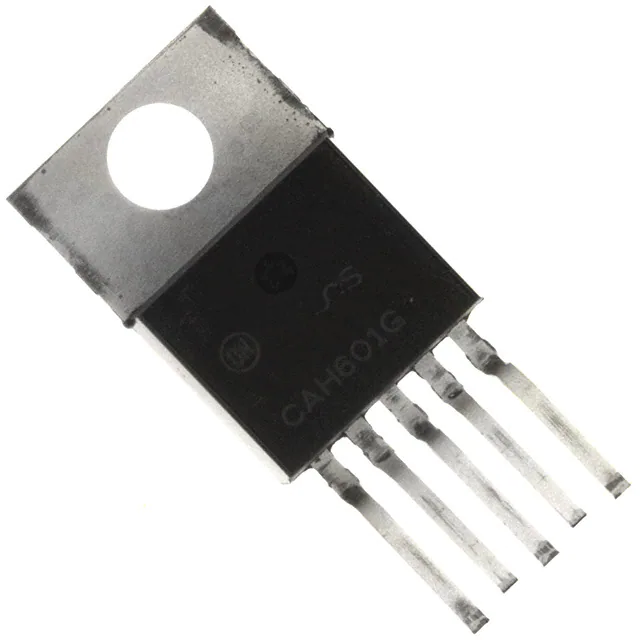
onsemi CS8122YTVA5G
- Part No.:
- CS8122YTVA5G
- Manufacturer:
- onsemi
- Package:
- TO-220-5 Formed Leads
- Datasheet:
-
 CS8122YTVA5G.pdf
- Description:
- IC REG LIN 5V 750MA TO220-5
- Quantity:
- Payment:

- Shipping:

Inventory:4,672
Please send an inquiry. Send us your inquiry, and we will respond immediately.
Product details
Overview
CS8122YTVA5G from onsemi is a precision 5.0 V ±2.0% low-dropout linear regulator delivering up to 750 mA output current with 0.6 V dropout at 500 mA, integrated delayed RESET function programmed via external capacitor, and robust fault protection including −50 V reverse transient, 60 V load dump, short-circuit (1.2 A typ), and thermal shutdown - used in automotive body control modules for stable microcontroller power sequencing.
For engineers reviewing the CS8122YTVA5G datasheet, pinout, applications, or equivalent options, this page delivers verified technical context, exact pin functions, real-world use cases, and validated alternative options for automotive-grade power management design.
Technical Context
The CS8122YTVA5G integrates a bandgap reference, error amplifier, anti-saturation current-limit circuit, and dual hysteresis comparators for RESET and delay functions - enabling reliable power-on reset generation down to 1.0 V output voltage. Its latching discharge circuit fully discharges the external delay capacitor upon any out-of-regulation event, ensuring deterministic RESET pulse width.
It features internally limited power dissipation, operates across −40°C to +125°C ambient, supports input voltage range of −0.5 V to 26 V, and maintains regulation under 120 Hz ripple with 75 dB typical rejection - all while sustaining CMOS/TTL-compatible open-collector RESET output with 150–250 mV hysteresis.
Key Specifications
| Parameter | Value and Actual Design Meaning |
|---|---|
| Output Voltage | 5.0 V ±2.0% - ensures microcontroller supply meets tight VDD tolerance requirements without external trimming. |
| Dropout Voltage | 0.6 V @ 500 mA - enables stable 5 V output from as low as 5.6 V input, critical for cold-crank automotive operation. |
| Output Current | 750 mA continuous - sufficient to power MCU, CAN transceiver, and sensor interface ICs in single-rail systems. |
| RESET Threshold | VRT(ON) = 4.65–4.90 V, VRT(OFF) = 4.50–4.70 V - provides clean, noise-immune reset assertion during brownout recovery. |
| Delay Time | 16–48 ms with 0.1 µF capacitor - configurable reset hold-off prevents spurious resets during transient dips. |
| Fault Protection | −50 V reverse transient, 60 V load dump, short-circuit (1.2 A typ), thermal shutdown - meets ISO 7637-2 Pulse 1/2/3a/3b and ISO 16750-2 requirements. |
| Ripple Rejection | 75 dB @ 120 Hz - suppresses alternator ripple to prevent false resets or logic errors in downstream digital circuits. |
Pinout & Package
CS8122YTVA5G is housed in a Pb-free TO-220-5L vertical-mount package (Case 314K) with copper tab for heatsink attachment; RJA = 50°C/W, RJC = 2.1°C/W.
| Pin/Terminal | Circuit Role | Design Meaning |
|---|---|---|
| 1 - VIN | Unregulated input supply | Accepts −0.5 V to 26 V; withstands −50 V reverse transients and 60 V load dump pulses. |
| 2 - VOUT | Regulated 5.0 V output | Delivers up to 750 mA; requires ≥10 µF output capacitor with ESR ≥0.1 Ω for stability. |
| 3 - GND | Ground reference | Common return path for internal bias, RESET discharge, and delay current sink. |
| 4 - Delay | Timing capacitor connection | Sources 5–15 µA charge current; sinks current to discharge CDELAY when VOUT falls below VRT(OFF). |
| 5 - RESET | Open-collector reset output | Active-low CMOS/TTL-compatible signal; pulls low when VOUT < 4.5 V and stays low for programmed delay. |
Key Features
| Feature | Design Value |
|---|---|
| Externally programmable RESET delay | Enables precise reset timing control (16–48 ms) using one capacitor - eliminates need for external timer ICs. |
| Dual hysteresis comparators | 200–800 mV hysteresis on both RESET and delay thresholds - prevents chatter during slow-rising/falling VOUT transitions. |
| Latching delay capacitor discharge | Ensures full discharge of CDELAY after any brief fault - guarantees minimum RESET pulse width regardless of fault duration. |
| Automotive-grade transient protection | Withstands −50 V reverse battery, 60 V load dump, and +40 V overvoltage - reduces need for external TVS diodes in cost-sensitive designs. |
| Pb-free TO-220 vertical package | Case 314K footprint enables direct PCB mounting with heatsink access through copper tab - simplifies thermal management in space-constrained ECUs. |
Applications
| Body Control Module (BCM) | Engine Control Unit (ECU) Power Sequencing |
|---|---|
Use Scenario: Powers 32-bit MCU, LIN transceiver, and door lock actuator drivers in vehicle body electronics. IC Role / Device Role / Timing Role: Primary 5 V supply with programmable power-on reset and brownout detection. Use Value: Ensures deterministic MCU boot after ignition key turn by holding RESET until VOUT stabilizes above 4.65 V for ≥32 ms. | Use Scenario: Supplies auxiliary 5 V rail for sensor signal conditioning and EEPROM interface in engine management systems. IC Role / Device Role / Timing Role: Secondary regulated source with fault-isolated RESET signaling to main controller. Use Value: Prevents erroneous sensor readings during cranking by asserting RESET until battery voltage recovers above 11.5 V and VOUT reaches regulation. |
| Advanced Driver Assistance Systems (ADAS) Camera ECU | Electric Power Steering (EPS) Control Board |
Use Scenario: Provides clean 5 V supply to image signal processor and serializer in rear-view camera module. IC Role / Device Role / Timing Role: Low-noise LDO with high PSRR and transient immunity for analog front-end stability. Use Value: Maintains 75 dB ripple rejection at 120 Hz to eliminate horizontal banding artifacts caused by alternator noise. | Use Scenario: Powers motor gate driver logic and position sensor interface in EPS electronic control unit. IC Role / Device Role / Timing Role: Fault-tolerant 5 V regulator with immediate short-circuit shutdown and thermal foldback. Use Value: Limits peak fault current to 1.2 A and initiates thermal shutdown at 150°C - protects MOSFET drivers during phase loss or stall conditions. |
Equivalent & Alternatives
The following parts are listed as comparable options for similar 5 V automotive LDO applications.
| Alternative Part | Technical Difference | Application Difference | Selection Advice |
|---|---|---|---|
| TLV73350PDBVR | 300 mA output, 170 mV dropout, no RESET, SOT-23-5 package | Lacks RESET, delay, and automotive transient protection; rated only to 125°C junction | Use only in non-automotive, low-current, non-reset-critical applications where board space is constrained. |
| TPS7B6950QDCYRQ1 | 150 mA output, 300 mV dropout, integrated RESET with fixed 200 ms delay, wettable flank QFN | Lower current, fixed delay, no external RC programming; qualified to AEC-Q100 Grade 1 (−40°C to +125°C) | Select when RESET timing must be factory-fixed and footprint size is prioritized over output current capability. |
Compared with TLV73350PDBVR and TPS7B6950QDCYRQ1, the CS8122YTVA5G uniquely combines 750 mA drive, programmable RESET delay, and full ISO 7637-2 transient immunity - making it the only option among the three suitable for high-current automotive control modules requiring field-configurable reset timing.
Availability
CS8122YTVA5G is available at Aetrix Electronics and suitable for automotive body control modules, engine control units, ADAS camera ECUs, and electric power steering systems requiring stable component supply across extended temperature and harsh electrical environments.
Supply support for CS8122YTVA5G includes scheduled delivery planning, volume procurement assistance, BOM continuity management, traceable sourcing, and lifecycle availability coordination for OEM customers, industrial embedded developers, connected-device designers, and electronics production programs.
Manufacturer
onsemi (formerly ON Semiconductor) is a global semiconductor supplier focused on energy-efficient technologies for automotive, industrial, cloud, and IoT applications.
The CS8122YTVA5G belongs to onsemi's SMART REGULATOR® family - engineered specifically for automotive power management with integrated protection, precise reset control, and ruggedized packaging for under-hood deployment.
FAQ
What is the maximum input voltage rating for CS8122YTVA5G?
The CS8122YTVA5G supports an absolute maximum input voltage of 26 V under normal operation. It also withstands transient overvoltages up to +60 V (load dump) and reverse transients down to −50 V - meeting ISO 7637-2 Pulse 1, 2a, 3a, and 3b test requirements. These ratings are guaranteed across the full −40°C to +125°C operating ambient range, and do not require external clamping components.
How does the RESET delay function work in CS8122YTVA5G?
The CS8122YTVA5G uses an external capacitor connected to the Delay pin (Pin 4) to set RESET assertion time. A precision 5–15 µA charge current ramps the capacitor voltage; RESET remains low until this voltage exceeds 3.50 V (typ). If VOUT drops below 4.50 V, the internal latching discharge circuit fully drains the capacitor - guaranteeing a fresh delay cycle starts upon recovery. Typical delay with 0.1 µF is 32 ms.
Can CS8122YTVA5G be used without an output capacitor?
No - CS8122YTVA5G requires a minimum 10 µF output capacitor with ≥0.1 Ω ESR for loop stability, as specified in the datasheet Figure 13 and Application Notes section. Ceramic capacitors with near-zero ESR cause oscillation; tantalum or aluminum electrolytic types are recommended. Omitting COUT or using undersized/low-ESR types risks sustained output ringing and potential system malfunction.
What thermal management is required for CS8122YTVA5G at 750 mA output?
At 750 mA and 14 V input, CS8122YTVA5G dissipates ~6.75 W. With RJA = 50°C/W, junction temperature rise would exceed safe limits without heatsinking. The TO-220-5L copper tab must be mounted to a heatsink; using RJC = 2.1°C/W and a 10°C/W heatsink yields ~45°C rise - keeping TJ within 150°C max. Derating curves in Figure 8 confirm 750 mA is sustainable only with adequate heatsink area and airflow.
Is CS8122YTVA5G pin-compatible with CS8126?
Yes - CS8122YTVA5G is a direct replacement for CS8126 in the same TO-220-5L package with identical pinout (VIN, VOUT, GND, Delay, RESET) and mechanical footprint. Key improvements include tighter output voltage tolerance (±2.0% vs. ±4.0%) and enhanced transient immunity, but no PCB layout changes are needed when upgrading from CS8126 to CS8122YTVA5G.
CS8122YTVA5G Specifications
- Product attributes
- Attribute value
- Manufacturer:
- onsemi
- Series:
- -
- Package/Case:
- TO-220-5 Formed Leads
- Packaging:
- Tube
- Product Status:
- Obsolete
- Output Configuration:
- Positive
- Output Type:
- Fixed
- Number of Regulators:
- 1
- Voltage - Input (Max):
- 26V
- Voltage - Output (Min/Fixed):
- 5V
- Voltage - Output (Max):
- -
- Voltage Dropout (Max):
- 0.6V @ 500mA
- Current - Output:
- 750mA
- Current - Quiescent (Iq):
- 70 mA
- Current - Supply (Max):
- 100 mA
- PSRR:
- 75dB (120Hz)
- Control Features:
- Reset
- Protection Features:
- Over Temperature, Over Voltage, Reverse Polarity, Short Circuit
- Operating Temperature:
- -40°C ~ 125°C
- Grade:
- -
- Qualification:
- -
- Mounting Type:
- Through Hole
- Supplier Device Package:
- TO-220-5 Vertical
CS8122YTVA5G FAQ
1.How can I place an order for CS8122YTVA5G through Aetrix?
Please submit a Request for Quotation (RFQ) for CS8122YTVA5G on Aetrix. Our sales agent will provide a competitive quotation and guide you through the order confirmation once you accept the terms.
2.Are the price and stock information for CS8122YTVA5G reliable?
The price and inventory of CS8122YTVA5G are updated periodically and may fluctuate due to market conditions. Stock and pricing data are typically refreshed every 24 hours. Quotation validity for CS8122YTVA5G is usually 5 days.
3.What payment methods are accepted for CS8122YTVA5G?
We accept Wire Transfer, PayPal, Credit Card, Western Union, MoneyGram, and Escrow for CS8122YTVA5G transactions.
Note: Certain payment methods may incur a processing fee.
4.How is shipping managed for CS8122YTVA5G?
CS8122YTVA5G orders can be shipped via leading logistics carriers, including DHL, UPS, FedEx, TNT, or Registered Mail.
Once your CS8122YTVA5G order is processed, you will receive an email with the shipment details and tracking number.
Note: Tracking information may take up to 24 hours to appear. Express delivery typically takes 3–5 business days.
5.How can I obtain technical support or documentation for CS8122YTVA5G?
For technical support, including CS8122YTVA5G datasheets, pinout diagrams, or application guidance, please contact our engineering support team. They can provide detailed documentation and assistance for your CS8122YTVA5G requirements.
6.How does Aetrix verify that CS8122YTVA5G is sourced from the original manufacturer or authorized distributors?
All CS8122YTVA5G products on Aetrix are procured from qualified distributors and authorized channels. Our dedicated quality assurance team conducts strict verification, including traceability checks and, if necessary, third-party testing. This ensures that CS8122YTVA5G meets industry standards.
7.What is the process for return or replacement of CS8122YTVA5G?
All CS8122YTVA5G units undergo pre-shipment inspection (PSI). If there is an issue with CS8122YTVA5G, returns or replacements are accepted under the following conditions:
1.Quantity discrepancies, incorrect items, or visible external defects (such as breakage or corrosion), acknowledged by Aetrix.
2.The issue is reported within 90 days of delivery.
3.The CS8122YTVA5G part is unused and in its original packaging.
Return procedure for CS8122YTVA5G:
1.Submit a request within 90 days.
2.Obtain a Return Material Authorization (RMA) from Aetrix.
CS8122YTVA5G Tags
-
MIC5504-1.8YM5-TR
Microchip Technology
-
MIC5504-3.3YM5-TR
Microchip Technology
-
MIC5365-3.0YC5-TR
Microchip Technology
-
MIC5365-1.8YC5-TR
Microchip Technology
-
MIC5365-2.5YC5-TR
Microchip Technology
-
MIC5365-3.3YC5-TR
Microchip Technology
-
MIC5365-3.3YD5-TR
Microchip Technology
-
MIC5317-3.3YM5-TR
Microchip Technology
-
TLV1117LV33DCYR
Texas Instruments
-
MIC5317-3.3YMT-TZ
Microchip Technology
-
MIC5528-3.3YMT-TR
Microchip Technology
-
TLV75801PDRVR
Texas Instruments
Tech Hub

Counterfeit components can hide behind convincing markings and passing basic function tests. This engineering reference covers source traceability, external inspection, X-ray, XRF, electrical testing, …

A practical engineering and sourcing framework covering lifecycle verification, lifetime-buy calculations, replacement qualification, supplier checks and counterfeit-risk controls.

TTL and CMOS logic families differ in thresholds, loading, output drive, power and timing. This engineering guide compares 74HC and 74HCT, calculates noise margins and checks 3.3 V/5 V compatibility.

A practical engineering guide to 3.3V and 5V logic compatibility, input thresholds, resistor dividers, translator ICs, MOSFET level shifting, I2C pull-ups, timing limits and power-sequencing risks.

The 74HC595 uses push-pull logic outputs, while the TPIC6B595 uses 50 V open-drain DMOS sinks for higher-power loads. This guide compares timing, current limits, 3.3 V interfacing, load wiring, thermal…

The 74HC595 converts serial data into eight stable parallel outputs. This guide covers pin functions, shift and storage timing, OE and MR behavior, drive-current limits, cascading, voltage compatibilit…

A technical comparison of level-sensitive latches and edge-triggered flip-flops, covering timing windows, setup and hold limits, master–slave operation, time borrowing, race-through, HDL inference and…

A D latch stores one bit while Enable controls when data can pass. This reference covers gate-level operation, truth tables, transparency, setup and hold timing, LE versus OE, common ICs and practical …

An SR latch stores one bit through cross-coupled feedback. This engineering reference covers NOR and NAND implementations, truth tables, forbidden-state recovery, gated operation, switch debouncing, fa…

Latch circuits retain one bit through feedback. This technical reference covers SR and D latches, truth tables, transparency, timing limits, latch-versus-flip-flop behavior, applications and common log…


