
 My Inquiry
 My Account


Infineon Technologies CY8CPLC20-48LFXI
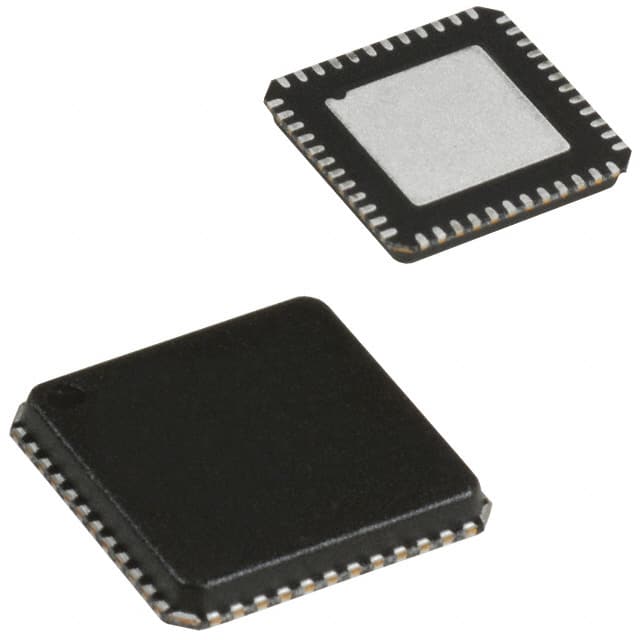
- Part No.:
- CY8CPLC20-48LFXI
- Manufacturer:
- Infineon Technologies
- Category:
- Modems - ICs and Modules
- Package:
- 48-VFQFN Exposed Pad
- Datasheet:
-
 CY8CPLC20-48LFXI.pdf
- Description:
- IC PLC PSOC CMOS 48QFN
- Quantity:
- Payment:

- Shipping:

Inventory:4,327
Please send an inquiry. Send us your inquiry, and we will respond immediately.
Product details
Overview
CY8CPLC20-48LFXI from Infineon Technologies (formerly Cypress Semiconductor) is a single-chip powerline communication (PLC) solution integrating an FSK modem PHY, network protocol stack (data link + transport + network layers), and a programmable PSoC 1 mixed-signal microcontroller. It supports bidirectional half-duplex communication up to 2400 bps on AC/DC powerlines, includes 8-bit CRC error detection, and operates with I²C interface at 50/100/400 kHz. Used in smart grid metering, home automation control nodes, and industrial building management systems.
For engineers reviewing the CY8CPLC20-48LFXI datasheet, CY8CPLC20-48LFXI pinout, CY8CPLC20-48LFXI application, or CY8CPLC20-48LFXI equivalent, key selection criteria include FSK carrier frequencies (131.8/133.3 kHz), integrated MAC/PHY co-processing, CENELEC EN 50065-1 and FCC Part 15 compliance support, and PSoC 1's configurable analog/digital blocks for coupling circuit control and signal conditioning.
Technical Context
The CY8CPLC20-48LFXI implements a dedicated FSK-based physical layer with fixed carrier frequencies (131.8 kHz for logic '1', 133.3 kHz for logic '0'; optional 130.4 kHz for wider deviation) and on-chip HF band-pass filtering, mixer, correlator, and low-pass filtering for robust demodulation in noisy powerline environments. Its digital receiver includes hysteresis comparator and deserializer to suppress noise-induced false triggers.
The embedded network protocol handles bidirectional half-duplex communication using CSMA collision avoidance, 8-bit logical addressing (256 nodes), and automatic packet retransmission on CRC failure. It runs alongside user application code on the M8C Harvard-architecture core, enabling concurrent PLC stack execution and custom firmware logic without external host processor.
Key Specifications
| Parameter | Value and Actual Design Meaning |
|---|---|
| Modulation | Frequency Shift Keying (FSK) with fixed 131.8/133.3 kHz carriers; enables reliable baseband signaling over lossy powerlines. |
| Max Data Rate | 2400 bps raw data rate; sufficient for command/control telemetry in smart metering and lighting networks. |
| I²C Interface | Slave/master/multi-master support at 50/100/400 kHz; allows direct connection to host MCU or sensor hub without level-shifting. |
| Processor Core | M8C Harvard architecture, 24 MHz max clock; executes PLC protocol stack and application logic concurrently. |
| Memory | 32 KB flash (50k erase/write cycles), 2 KB SRAM, EEPROM emulation; supports field-upgradable firmware and persistent node configuration. |
| Error Detection | 8-bit CRC per packet; ensures data integrity and triggers automatic retransmission on corruption. |
| Powerline Compliance | Reference designs compliant with CENELEC EN 50065-1:2001 and FCC Part 15; simplifies regulatory certification for 110/240 V AC and 12/24 V AC/DC systems. |
Pinout & Package
Package: 48-pin QFP (LQFP-48), 7 mm × 7 mm, 0.5 mm pitch, RoHS-compliant, lead-free.
| Pin/Terminal | Circuit Role | Design Meaning |
|---|---|---|
| VDD, VSS | Core power supply and ground | Supports 3.3 V ±10% operation; decoupling required per datasheet layout guidelines for PLC noise immunity. |
| SCL, SDA | I²C bus interface | Configurable as master or slave; internal pull-ups disabled by default-external resistors required for bus termination. |
| PLC_IN, PLC_OUT | Powerline analog transceiver interface | Differential FSK signal path to external coupling circuit; requires external low-pass filter and line driver/receiver stage. |
| XIN, XOUT | Crystal oscillator terminals | Drive 1–24 MHz crystal; used for precise timing of FSK modulation/demodulation and protocol timing. |
| P0[0]–P0[7], P1[0]–P1[7], P2[0]–P2[7], P3[0]–P3[7] | Programmable GPIO | All pins support analog input (12-bit SAR ADC), digital I/O, interrupt, and configurable drive modes (25 mA sink / 10 mA source). |
Key Features
| Feature | Design Value |
|---|---|
| Integrated PLC PHY + Protocol Stack | Eliminates need for external modem IC and protocol controller-reduces BOM count and PCB area in endpoint nodes. |
| Configurable Analog PSoC Blocks | 12 rail-to-rail analog blocks enable real-time coupling circuit biasing, signal monitoring, and EMI filtering calibration without external op-amps. |
| CSMA-Based Network Layer | Prevents packet collisions in multi-node deployments (e.g., streetlight clusters), enabling scalable deployment without centralized scheduler. |
| On-Chip Voltage Reference | Stable internal reference supports accurate ADC measurements for line voltage sensing and fault detection in metering applications. |
| Programmable Gain Amplifier (PGA) | Tunable gain in receiver path compensates for variable line attenuation across different powerline topologies and distances. |
Applications
| Smart Electricity Metering | Home Automation Control Node |
|---|---|
Use Scenario: Two-way communication between utility meter and concentrator over 230 V AC mains for remote reading and firmware updates. IC Role / Device Role / Timing Role: Standalone PLC transceiver and protocol engine; handles physical layer modulation, MAC arbitration, and packet framing without host MCU. Use Value: Meets CENELEC EN 50065-1 spectral mask and achieves >99.5% packet success rate under burst noise conditions typical in residential grids. | Use Scenario: Wireless-lighting retrofit where existing AC wiring serves as data backbone for dimmer switches and occupancy sensors. IC Role / Device Role / Timing Role: Embedded PLC node with integrated analog sensing; monitors local load current and controls triac drivers via GPIO. Use Value: Eliminates wireless interference issues and battery replacement; leverages existing infrastructure for secure, deterministic control latency (<100 ms). |
| Industrial Building Management | Streetlight Monitoring System |
Use Scenario: HVAC zone controllers communicating over 24 V DC power rails in commercial buildings to report temperature and adjust setpoints. IC Role / Device Role / Timing Role: Low-voltage PLC endpoint with I²C interface to local MCU; manages coupling circuit bias and performs CRC-checked command relay. Use Value: Enables daisy-chained topology over 100 m distance with no additional wiring-reducing installation cost by ~35% vs. RS-485. | Use Scenario: Solar-powered LED streetlights exchanging status (voltage, temperature, lamp state) and receiving scheduling commands over municipal 110 V AC grid. IC Role / Device Role / Timing Role: Autonomous PLC node with sleep timer and wake-on-event; handles time-synchronized broadcast commands from central gateway. Use Value: Achieves 10-year battery life in solar-charged units via ultra-low-power idle mode (1.2 µA typical) and adaptive retransmission backoff. |
Equivalent & Alternatives
The following parts are listed as comparable options for similar powerline communication applications.
| Alternative Part | Technical Difference | Application Difference | Selection Advice |
|---|---|---|---|
| ST7580 | OFDM-based PHY, higher data rate (up to 132 kbps), requires external microcontroller for protocol stack. | Better suited for high-throughput smart grid AMI; lacks integrated MCU and analog resources for sensor fusion. | Select when bandwidth >5 kbps is required and host MCU is already present. |
| MAX2990 | FSK PHY only (no protocol stack), 1200 bps max, integrated line driver, no programmable analog blocks. | Targeted at simple repeater or bridge nodes; requires external MCU and ADC for sensor interfacing. | Select for cost-sensitive, fixed-function repeaters where firmware flexibility is not needed. |
Compared with ST7580 and MAX2990, CY8CPLC20-48LFXI uniquely integrates full OSI Layers 1–3 plus PSoC 1 programmable analog/digital resources-enabling self-contained, sensor-aware PLC endpoints without external components or host coordination.
Availability
CY8CPLC20-48LFXI is available at Aetrix Electronics and suitable for smart electricity metering, home automation control nodes, and industrial building management systems requiring stable component supply, long-term lifecycle support, and regulatory-compliant powerline communication capability.
Supply support for CY8CPLC20-48LFXI includes scheduled delivery planning, volume procurement assistance, BOM continuity management, traceable sourcing, and lifecycle availability coordination for OEM customers, industrial embedded developers, connected-device designers, and electronics production programs.
Manufacturer
Infineon Technologies AG is a German semiconductor manufacturer specializing in power management, automotive, and industrial control ICs, with global R&D and manufacturing infrastructure.
CY8CPLC20 belongs to the PSoC 1 family-designed specifically for mixed-signal embedded control applications where analog sensing, digital logic, and communications (including PLC) must be tightly integrated on a single chip.
FAQ
What coupling circuit is required for CY8CPLC20-48LFXI on 230 V AC mains?
The device requires an external passive coupling circuit comprising a series LC filter, isolation transformer, and common-mode choke, as specified in Cypress Application Note AN2197. Reference design CY8CPLC20-REF-230V provides validated bill-of-materials and layout for CENELEC compliance, including 1.2 kV surge protection and <100 µA leakage current.
Does CY8CPLC20-48LFXI support automatic network discovery and node addressing?
Yes-it implements a configurable logical addressing scheme supporting 8-bit (256 nodes), 16-bit (65,536 nodes), or 64-bit (2⁶⁴ nodes) addressing. Address assignment is performed via I²C during initialization or through broadcast configuration packets; no manual dip-switch setup is required.
Can the M8C core run user code while the PLC stack is active?
Yes-the PSoC 1 architecture allocates dedicated RAM and flash sections for the PLC firmware and user application. The M8C core uses hardware interrupts and priority-based task scheduling to interleave PLC protocol processing (e.g., packet reception, CRC check) with user-defined functions such as sensor polling or actuator control.
Is there production-ready development software for CY8CPLC20-48LFXI firmware?
Yes-PSoC Designer v5.4 (legacy but fully supported) provides drag-and-drop PLC User Modules (e.g., "PLC Modem", "PLC Network Stack"), auto-generated APIs, and full-speed ICE debugging. Cypress-provided example projects include complete I²C-controlled metering node firmware with CRC-verified command parsing and coupling circuit calibration routines.
CY8CPLC20-48LFXI Specifications
- Product attributes
- Attribute value
- Manufacturer:
- Infineon Technologies
- Series:
- -
- Package/Case:
- 48-VFQFN Exposed Pad
- Packaging:
- Tray
- Product Status:
- Obsolete
- Data Format:
- FSK
- Baud Rates:
- 2.4k
- Voltage - Supply:
- 4.75V ~ 5.25V
- Mounting Type:
- Surface Mount
- Supplier Device Package:
- 48-QFN (7x7)
CY8CPLC20-48LFXI FAQ
1.How can I place an order for CY8CPLC20-48LFXI through Aetrix?
Please submit a Request for Quotation (RFQ) for CY8CPLC20-48LFXI on Aetrix. Our sales agent will provide a competitive quotation and guide you through the order confirmation once you accept the terms.
2.Are the price and stock information for CY8CPLC20-48LFXI reliable?
The price and inventory of CY8CPLC20-48LFXI are updated periodically and may fluctuate due to market conditions. Stock and pricing data are typically refreshed every 24 hours. Quotation validity for CY8CPLC20-48LFXI is usually 5 days.
3.What payment methods are accepted for CY8CPLC20-48LFXI?
We accept Wire Transfer, PayPal, Credit Card, Western Union, MoneyGram, and Escrow for CY8CPLC20-48LFXI transactions.
Note: Certain payment methods may incur a processing fee.
4.How is shipping managed for CY8CPLC20-48LFXI?
CY8CPLC20-48LFXI orders can be shipped via leading logistics carriers, including DHL, UPS, FedEx, TNT, or Registered Mail.
Once your CY8CPLC20-48LFXI order is processed, you will receive an email with the shipment details and tracking number.
Note: Tracking information may take up to 24 hours to appear. Express delivery typically takes 3–5 business days.
5.How can I obtain technical support or documentation for CY8CPLC20-48LFXI?
For technical support, including CY8CPLC20-48LFXI datasheets, pinout diagrams, or application guidance, please contact our engineering support team. They can provide detailed documentation and assistance for your CY8CPLC20-48LFXI requirements.
6.How does Aetrix verify that CY8CPLC20-48LFXI is sourced from the original manufacturer or authorized distributors?
All CY8CPLC20-48LFXI products on Aetrix are procured from qualified distributors and authorized channels. Our dedicated quality assurance team conducts strict verification, including traceability checks and, if necessary, third-party testing. This ensures that CY8CPLC20-48LFXI meets industry standards.
7.What is the process for return or replacement of CY8CPLC20-48LFXI?
All CY8CPLC20-48LFXI units undergo pre-shipment inspection (PSI). If there is an issue with CY8CPLC20-48LFXI, returns or replacements are accepted under the following conditions:
1.Quantity discrepancies, incorrect items, or visible external defects (such as breakage or corrosion), acknowledged by Aetrix.
2.The issue is reported within 90 days of delivery.
3.The CY8CPLC20-48LFXI part is unused and in its original packaging.
Return procedure for CY8CPLC20-48LFXI:
1.Submit a request within 90 days.
2.Obtain a Return Material Authorization (RMA) from Aetrix.
CY8CPLC20-48LFXI Tags
-
CMX865AD4-TR1K
CML Micro
-
TDA5051AT/C1,518
NXP Semiconductors
-
CMX868AD2
CML Micro
-
CMX869BD2
CML Micro
-
AD5700-1ACPZ-RL7
Analog Devices Inc.
-
MX604TN-TR1K
CML Micro
-
AD5700BCPZ-R5
Analog Devices Inc.
-
MX604TN
CML Micro
-
FX604D4
CML Micro
-
MX614DW
CML Micro
-
FX614D4
CML Micro
-
AD5700-1BCPZ-RL7
Analog Devices Inc.
Tech Hub

Jumper cables guide covering safe connection order, red and black clamp placement, final ground connection, cable gauge, length, clamp quality, copper vs CCA cables, jump starter comparison and battery…

LDO regulator guide covering low dropout voltage, power dissipation, thermal design, PSRR, output noise, capacitor stability, adjustable LDO circuits, LDO vs buck converter and datasheet selection chec…

Conditional Access Module guide covering CAM meaning, CI/CI+ interface, smart card authorization, DVB security workflow, TV and set-top box compatibility, internal electronics, ESD protection, connecto…

Guide to electronic component obsolescence covering EOL risk, PCN/PDN notices, last-time buy planning, replacement options, form-fit-function validation, counterfeit risk and BOM lifecycle management.

18650 battery guide covering lithium-ion cell basics, 3.6V/3.7V voltage, 4.2V charging, mAh and Wh capacity, protected cells, chargers, BMS, series-parallel packs, holders, welding and sourcing checks.…

Hall effect sensor guide covering working principle, linear and digital sensors, Arduino circuits, current sensing, speed detection, automotive applications, A3144 examples, signal filtering and datash…

Product Change Notification guide for electronic components, covering PCN meaning, PCN vs PDN/EOL, common change types, risk levels, form-fit-function review, engineering validation, BOM control, LTB/L…

A practical guide to blend door actuators, covering HVAC function, symptoms, location, AC and heater issues, reset and calibration, replacement cost, electrical diagnosis, compatibility checks, and rep…

Engineering guide to Raspberry Pi alternatives, covering chip-level differences, Orange Pi, ROCK, Jetson, Banana Pi, NanoPi, Compute Module, Pico, GPIO, camera, HAT compatibility, and replacement risks…

Engineering guide to dynamic load response testing for high-current buck converters, covering load step setup, slew rate, Vcore undershoot, overshoot, recovery time, probe location, output capacitors a…


