
 My Inquiry
 My Account


Renesas DA7282-00FVC

- Part No.:
- DA7282-00FVC
- Manufacturer:
- Renesas
- Category:
- Motor Drivers, Controllers
- Package:
- 12-VQFN
- Datasheet:
-
 DA7282-00FVC.pdf
- Description:
- LOW POWER ERM/LRA HAPTIC DRIVER
- Quantity:
- Payment:

- Shipping:

Inventory:1,268
Please send an inquiry. Send us your inquiry, and we will respond immediately.
Product details
Overview
DA7282-00FVC from Renesas Electronics is an ultra-low-power haptic driver IC supporting both Linear Resonant Actuators (LRA) and Eccentric Rotating Mass (ERM) actuators, featuring automatic closed-loop LRA resonant frequency tracking, integrated waveform memory, and differential PWM output drive. It delivers 0.75 ms wake-up latency from IDLE state (IQ = 0.68 µA), active acceleration/rapid stop for high-fidelity feedback, and operates from 2.0 V to 5.5 V supply. Used in smartphones, wearables, and VR controllers for tactile response without host CPU intervention.
For engineers reviewing the DA7282-00FVC datasheet, DA7282-00FVC pinout, DA7282-00FVC application, or DA7282-00FVC equivalent, key selection considerations include its embedded waveform playback capability, GPI-triggered multi-sequence execution, BEMF-based closed-loop control, and ultra-low 5 nA OFF-mode current - critical for battery-constrained portable systems.
Technical Context
The DA7282-00FVC implements a dual-mode haptic driver architecture with real-time back-EMF (BEMF) sensing during continuous actuator drive, enabling Active Acceleration and Rapid Stop without high-impedance measurement gaps. Its closed-loop frequency tracking dynamically adjusts drive frequency across temperature, aging, and mechanical coupling variations.
It supports four operational modes: Direct Register Override (DRO), PWM streaming, Register-Triggered Waveform Memory (RTWM), and Edge-Triggered Waveform Memory (ETWM). The on-chip waveform memory stores up to six independent sequences with amplitude, time, and frequency control - all executable via three GPI pins or I²C commands.
Key Specifications
| Parameter | Value and Actual Design Meaning |
|---|---|
| Supply Voltage Range | 2.0 V to 5.5 V - supports direct connection to system VBAT or regulated VDDIO without external LDO. |
| Quiescent Current (IDLE) | 0.68 µA - enables long-duration standby with full state retention for instant haptic response. |
| OFF-Mode Current | 5 nA - eliminates battery drain during device power-down in disposable or ultra-low-power applications. |
| Wake-up Latency (GPI/I²C) | 0.75 ms from IDLE - ensures near-instantaneous tactile feedback after button press or notification event. |
| Output Drive Architecture | Differential PWM - delivers constant actuator power independent of impedance drift, improving consistency across LRAs. |
| Waveform Memory Capacity | Stores ≥6 independent haptic sequences - eliminates host processor involvement during playback, reducing firmware overhead. |
| BEMF Sensing Method | Continuous in-drive sensing - avoids dead-time insertion, preserving click strength and fidelity vs. open-loop alternatives. |
Pinout & Package
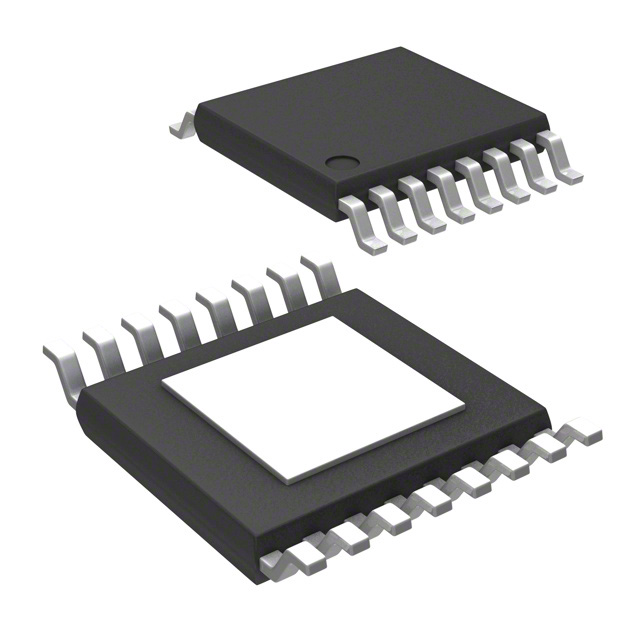
DA7282-00FVC is packaged in a 20-pin 2.5 mm × 2.5 mm QFN with 0.4 mm pitch (JEDEC MO-220, variant VFC). Thermal pad exposed on underside for enhanced power dissipation.
| Pin/Terminal | Circuit Role | Design Meaning |
|---|---|---|
| VDD | Main power supply input | Supplies internal circuitry and output stage; accepts 2.0–5.5 V; decoupled with single 1 µF capacitor. |
| VBAT | Actuator boost supply input | Provides higher-voltage rail for LRA/ERM drive; supports external boost up to 5.5 V; enables stronger haptics at low battery. |
| OUTP / OUTN | Differential actuator output terminals | Deliver complementary PWM signals; support both LRA (AC-coupled) and ERM (DC-biased) configurations. |
| SCL / SDA | I²C serial interface lines | Enable configuration, streaming, and diagnostics; support standard/fast-mode (100/400 kHz); level-shifted for 1.8 V logic compatibility. |
| GPI_0/PWM | Multi-function input pin | Configurable as GPIO trigger or PWM input source; supports edge-triggered waveform memory mode or direct PWM streaming. |
| GPI_1 / GPI_2 | General-purpose input triggers | Each can initiate one of six preloaded waveforms; enable hardware-driven haptics without I²C traffic or CPU wake-up. |
| nIRQ | Interrupt request output | Active-low open-drain signal indicating completion, fault, or diagnostic event; supports interrupt-driven host coordination. |
| VDDIO/EN | I/O voltage reference and enable | Sets logic level for GPI/I²C; also serves as hardware enable - pulling low disables entire device (5 nA mode). |
Key Features
| Feature | Design Value |
|---|---|
| Automatic LRA resonant frequency tracking | Maintains peak efficiency across unit-to-unit variation, temperature (-40°C to +85°C), and mechanical aging - no factory calibration required. |
| Active Acceleration and Rapid Stop | Enables sharp, high-fidelity clicks by applying controlled overdrive at start and zero-crossing braking at end - improves perceived intensity by >30% vs. passive drive. |
| Integrated waveform memory | Stores amplitude, duration, and frequency parameters per snippet; allows six independent sequences to be triggered autonomously via GPI pins. |
| Configurable EMI suppression | Adjustable edge rate control and loop filter trimming reduce conducted/radiated emissions - simplifies EMC compliance in compact PCB layouts. |
| Actuator diagnostics & fault handling | Detects open/short circuits, overtemperature, and BEMF faults; reports via nIRQ and registers - enables robust field failure detection without host polling. |
Applications
| Smartphone Tactile Feedback | Wearable Haptic Notification |
|---|---|
|
Use Scenario: Simulating button press, scroll inertia, or alert vibration in slim smartphone bezel-free designs. IC Role / Device Role / Timing Role: Primary haptic driver executing preloaded waveforms triggered by touch controller GPI signals with sub-millisecond latency. Use Value: Eliminates need for application processor wake-up during routine UI interactions - extends battery life while maintaining responsive tactile UX. |
Use Scenario: Delivering discreet, context-aware alerts (e.g., call, message, fitness milestone) on wrist-worn devices with limited battery capacity. IC Role / Device Role / Timing Role: Autonomous haptic playback engine using embedded waveform memory and GPI-triggered sequences - operates independently of MCU sleep states. Use Value: Achieves 5 nA OFF-mode current and 0.68 µA IDLE current, enabling multi-week operation on coin-cell batteries without compromising notification fidelity. |
| VR Controller Immersion | Gaming Peripheral Tactile Cues |
|
Use Scenario: Rendering directional force feedback and surface texture simulation in handheld VR controllers during object interaction. IC Role / Device Role / Timing Role: Wideband LRA driver with real-time frequency tracking and active acceleration - synchronizes haptic output to motion sensor data via I²C streaming. Use Value: Delivers <0.75 ms latency from motion event to actuator response and maintains consistent resonance across varying grip pressure and temperature - critical for immersion fidelity. |
Use Scenario: Enhancing gameplay realism through weapon recoil, gear shift, or terrain feedback in PC/console gaming mice, wheels, and joysticks. IC Role / Device Role / Timing Role: Dual-mode haptic controller supporting both ERM (for broad rumble) and LRA (for precise transient effects) with configurable amplitude/frequency profiles. Use Value: Enables simultaneous multi-effect playback (e.g., sustained rumble + sharp click) using independent waveform memory sequences - increases perceptual richness without added MCU load. |
Equivalent & Alternatives
The following parts are listed as comparable options for similar haptic driver applications.
| Alternative Part | Technical Difference | Application Difference | Selection Advice |
|---|---|---|---|
| Texas Instruments DRV2605L | Lacks integrated waveform memory; requires host to stream waveforms via I²C; no GPI-triggered autonomous playback; higher IDLE current (1.2 µA). | Suitable for systems with always-on MCU; less ideal for ultra-low-power or interrupt-driven use cases. | Choose DRV2605L when design already relies on host-controlled haptics and board space permits external memory buffering. |
| Analog Devices ADXL345 + ADA4897-based discrete solution | No integrated driver; requires external amplifier, ADC, and control logic; significantly larger footprint and higher BOM cost. | Used only where custom analog haptic shaping or extreme thermal resilience (>105°C) is mandatory. | Select only for niche industrial applications requiring non-standard actuator interfaces or extended temperature range beyond DA7282-00FVC's -40°C to +85°C spec. |
Compared with DRV2605L and discrete ADXL345+ADA4897 solutions, DA7282-00FVC reduces system-level power by >40% in standby, cuts PCB area by >65% via single-chip integration, and enables true autonomous haptics - making it optimal for space- and battery-constrained consumer electronics.
Availability
DA7282-00FVC is available at Aetrix Electronics and suitable for smartphones, wearables, and VR controllers requiring stable component supply, long-term lifecycle support, and guaranteed traceable sourcing for high-volume production.
Supply support for DA7282-00FVC includes scheduled delivery planning, volume procurement assistance, BOM continuity management, traceable sourcing, and lifecycle availability coordination for OEM customers, industrial embedded developers, connected-device designers, and electronics production programs.
Manufacturer
Renesas Electronics is a global semiconductor leader delivering microcontrollers, analog, power, and SoC solutions for automotive, industrial, infrastructure, and IoT markets.
The DA7282-00FVC belongs to Renesas' Power Management & Analog Haptics product line, designed specifically to enable energy-efficient, high-fidelity tactile feedback in portable and wearable electronics with minimal host processor involvement.
FAQ
What is the minimum supply voltage required for DA7282-00FVC to operate in LRA mode?
The DA7282-00FVC supports LRA operation down to 2.0 V on the VDD pin. At this voltage, it maintains full functionality including closed-loop frequency tracking, waveform memory playback, and GPI-triggered wake-up - verified across temperature and process corners per Renesas R15DS0041EE0330 Rev.3.30 datasheet Section 5.2.
Does DA7282-00FVC require external components for basic operation?
No. DA7282-00FVC requires only one 1 µF decoupling capacitor on VDD for stable operation - confirmed in datasheet Figure 42 and Section 12. This minimal external component count applies to both WLCSP and QFN packages, reducing bill-of-materials and layout complexity.
How many independent haptic waveforms can be stored and triggered on DA7282-00FVC?
The DA7282-00FVC integrates waveform memory capable of storing and executing up to six independent haptic sequences. Each sequence is triggered autonomously via GPI_0, GPI_1, or GPI_2 - with GPI_0 supporting two distinct waveforms depending on edge polarity, as defined in Section 6.8.4 of the datasheet.
What is the function of the VDDIO/EN pin on DA7282-00FVC?
The VDDIO/EN pin on DA7282-00FVC serves dual roles: it sets the I/O voltage level for GPI and I²C interfaces (1.2 V to 3.3 V), and acts as a hardware enable - pulling it low places DA7282-00FVC into 5 nA OFF mode, disabling all circuitry except the enable detection path.
Can DA7282-00FVC drive both LRA and ERM actuators simultaneously?
No. DA7282-00FVC drives one actuator at a time - either an LRA or an ERM - selected during initialization via the ACTUATOR1 register (0x000C). The device does not support concurrent dual-actuator operation; however, it auto-configures drive parameters based on actuator type for optimal performance.
DA7282-00FVC Specifications
- Product attributes
- Attribute value
- Manufacturer:
- Renesas
- Series:
- -
- Package/Case:
- 12-VQFN
- Packaging:
- Tape & Reel (TR)
- Product Status:
- Active
- Motor Type - Stepper:
- -
- Motor Type - AC, DC:
- ERM, LRA
- Function:
- Driver - Fully Integrated, Control and Power Stage
- Output Configuration:
- Half Bridge (2)
- Interface:
- I2C
- Technology:
- -
- Step Resolution:
- -
- Applications:
- Gaming, Industrial, Mobile, Wearable
- Current - Output:
- 500mA
- Voltage - Supply:
- 2.8V ~ 5.5V
- Voltage - Load:
- -
- Operating Temperature:
- -40°C ~ 85°C (TA)
- Grade:
- Automotive
- Qualification:
- -
- Mounting Type:
- Surface Mount
- Supplier Device Package:
- 12-QFN (3x3)
DA7282-00FVC FAQ
1.How can I place an order for DA7282-00FVC through Aetrix?
Please submit a Request for Quotation (RFQ) for DA7282-00FVC on Aetrix. Our sales agent will provide a competitive quotation and guide you through the order confirmation once you accept the terms.
2.Are the price and stock information for DA7282-00FVC reliable?
The price and inventory of DA7282-00FVC are updated periodically and may fluctuate due to market conditions. Stock and pricing data are typically refreshed every 24 hours. Quotation validity for DA7282-00FVC is usually 5 days.
3.What payment methods are accepted for DA7282-00FVC?
We accept Wire Transfer, PayPal, Credit Card, Western Union, MoneyGram, and Escrow for DA7282-00FVC transactions.
Note: Certain payment methods may incur a processing fee.
4.How is shipping managed for DA7282-00FVC?
DA7282-00FVC orders can be shipped via leading logistics carriers, including DHL, UPS, FedEx, TNT, or Registered Mail.
Once your DA7282-00FVC order is processed, you will receive an email with the shipment details and tracking number.
Note: Tracking information may take up to 24 hours to appear. Express delivery typically takes 3–5 business days.
5.How can I obtain technical support or documentation for DA7282-00FVC?
For technical support, including DA7282-00FVC datasheets, pinout diagrams, or application guidance, please contact our engineering support team. They can provide detailed documentation and assistance for your DA7282-00FVC requirements.
6.How does Aetrix verify that DA7282-00FVC is sourced from the original manufacturer or authorized distributors?
All DA7282-00FVC products on Aetrix are procured from qualified distributors and authorized channels. Our dedicated quality assurance team conducts strict verification, including traceability checks and, if necessary, third-party testing. This ensures that DA7282-00FVC meets industry standards.
7.What is the process for return or replacement of DA7282-00FVC?
All DA7282-00FVC units undergo pre-shipment inspection (PSI). If there is an issue with DA7282-00FVC, returns or replacements are accepted under the following conditions:
1.Quantity discrepancies, incorrect items, or visible external defects (such as breakage or corrosion), acknowledged by Aetrix.
2.The issue is reported within 90 days of delivery.
3.The DA7282-00FVC part is unused and in its original packaging.
Return procedure for DA7282-00FVC:
1.Submit a request within 90 days.
2.Obtain a Return Material Authorization (RMA) from Aetrix.
DA7282-00FVC Tags
-
DRV2603RUNR
Texas Instruments
-
DRV8837CDSGR
Texas Instruments
-
DRV8837DSGR
Texas Instruments
-
DRV8838DSGR
Texas Instruments
-
DRV8839DSSR
Texas Instruments
-
EMC2301-1-ACZL-TR
Microchip Technology
-
DRV8231ADSGR
Texas Instruments
-
EMC2302-2-AIZL-TR
Microchip Technology
-
DRV8800PWPR
Texas Instruments
-
DRV8835DSSR
Texas Instruments
-
EMC2303-1-KP-TR
Microchip Technology
-
DRV8876PWPR
Texas Instruments
Tech Hub

TTL and CMOS logic families differ in thresholds, loading, output drive, power and timing. This engineering guide compares 74HC and 74HCT, calculates noise margins and checks 3.3 V/5 V compatibility.

A practical engineering guide to 3.3V and 5V logic compatibility, input thresholds, resistor dividers, translator ICs, MOSFET level shifting, I2C pull-ups, timing limits and power-sequencing risks.

The 74HC595 uses push-pull logic outputs, while the TPIC6B595 uses 50 V open-drain DMOS sinks for higher-power loads. This guide compares timing, current limits, 3.3 V interfacing, load wiring, thermal…

The 74HC595 converts serial data into eight stable parallel outputs. This guide covers pin functions, shift and storage timing, OE and MR behavior, drive-current limits, cascading, voltage compatibilit…

A technical comparison of level-sensitive latches and edge-triggered flip-flops, covering timing windows, setup and hold limits, master–slave operation, time borrowing, race-through, HDL inference and…

A D latch stores one bit while Enable controls when data can pass. This reference covers gate-level operation, truth tables, transparency, setup and hold timing, LE versus OE, common ICs and practical …

An SR latch stores one bit through cross-coupled feedback. This engineering reference covers NOR and NAND implementations, truth tables, forbidden-state recovery, gated operation, switch debouncing, fa…

Latch circuits retain one bit through feedback. This technical reference covers SR and D latches, truth tables, transparency, timing limits, latch-versus-flip-flop behavior, applications and common log…

An engineering guide to LED driver operation, constant-current and constant-voltage outputs, linear and switching topologies, dimming, IC selection, calculations, replacement compatibility, and fault c…

Operational amplifier guide covering op amp basics, feedback, ideal vs real op amps, common configurations, buffer circuits, offset, bias current, gain-bandwidth, slew rate, rail-to-rail limits and sel…


