
 My Inquiry
 My Account


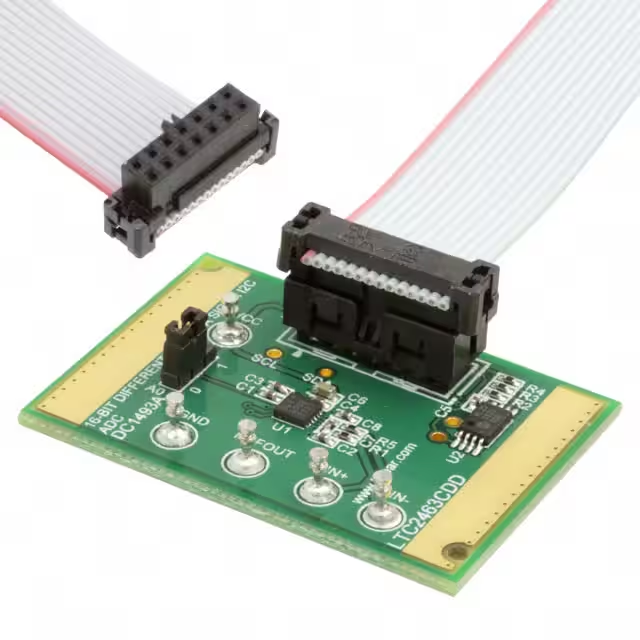
Analog Devices Inc. DC1493A
- Part No.:
- DC1493A
- Manufacturer:
- Analog Devices Inc.
- Package:
- Datasheet:
-
 DC1493A.pdf
- Description:
- BOARD DELTA SIGMA ADC LTC2463
- Quantity:
- Payment:

- Shipping:

Inventory:1,793
Please send an inquiry. Send us your inquiry, and we will respond immediately.
Product details
Overview
DC1493A from Analog Devices (formerly Linear Technology) is a fully assembled, ready-to-use demonstration board for the LTC2461 and LTC2463 ultra-tiny 16-bit I²C ΔΣ ADCs with integrated 1.25V precision reference. It supports both single-ended (LTC2461) and differential (LTC2463) configurations, operates from 2.7V to 5.5V, delivers 60 conversions per second, and achieves ≤2 LSB offset error and ±0.01% gain error - enabling high-accuracy sensor monitoring in space-constrained industrial and environmental systems.
For engineers reviewing the DC1493A datasheet, DC1493A pinout, DC1493A application, or DC1493A equivalent, this board provides immediate evaluation of low-power, no-latency I²C ADC performance - including internal reference stability (2 ppm/°C typ), 200 nA sleep current, and proprietary input sampling that reduces average input current to 50 nA - without requiring external clocking, calibration, or antialiasing filters.
Technical Context
The DC1493A implements the LTC2461/LTC2463 in MSOP-12 package with on-board 0.1 µF REFOUT and COMP decoupling, 10 µF VCC bulk capacitance, and pull-up resistors for SDA/SCL. It exposes all analog inputs (IN+, IN–/IN, REF–), digital control pins (A0), and power terminals to test points and headers, supporting direct connection to sensors, voltage sources, or microcontroller I²C buses.
This board leverages the LTC2461/LTC2463's internal oscillator, continuous offset/fullscale calibration, and single-conversion settling behavior - eliminating latency in multiplexed sensing. Its layout follows Linear Technology's recommended grounding and decoupling practices, with exposed-pad DFN variants supported via optional solder jumper configuration.
Key Specifications
| Parameter | Value and Actual Design Meaning |
|---|---|
| Supported ICs | LTC2461 (single-ended) and LTC2463 (differential) - both 16-bit, I²C ΔΣ ADCs with integrated 1.25V reference |
| Input Range | 0 V to 1.25 V (LTC2461); ±1.25 V differential (LTC2463) - full-scale defined by internal REFOUT |
| Conversion Rate | 60 conversions/second - fixed rate with no user-configurable oversampling ratio |
| Reference Performance | 1.25 V ±3 mV initial accuracy; 2 ppm/°C max drift (I-grade) - enables stable measurements across –40°C to +85°C |
| Power Modes | 1.5 mA active; 800 µA nap; 200 nA sleep - controlled via I²C register write to disable ADC and/or reference |
| I²C Interface | Standard/Fast-mode (up to 400 kHz); two hardware addresses (A0 = GND/VCC); global address sync support |
Availability
DC1493A is available at Aetrix Electronics and suitable for industrial sensor nodes, environmental data loggers, and embedded instrumentation requiring stable component supply, rapid prototyping capability, and validated signal chain performance with minimal design overhead.
Supply support for DC1493A includes scheduled delivery planning, volume procurement assistance, BOM continuity management, traceable sourcing, and lifecycle availability coordination for OEM customers, industrial embedded developers, connected-device designers, and electronics production programs.
Manufacturer
Analog Devices, Inc. (ADI) acquired Linear Technology in 2017 and maintains its legacy precision analog product lines, including high-performance delta-sigma ADCs, references, and signal conditioning solutions.
The DC1493A belongs to ADI's demonstration board portfolio for precision data acquisition ICs, designed specifically to accelerate evaluation and integration of ultra-low-power, high-resolution ADCs into compact, battery-operated, or thermally sensitive systems.
FAQ
What is the primary function of the DC1493A evaluation board?
The DC1493A evaluation board is a complete, factory-tested platform for evaluating the LTC2461 and LTC2463 16-bit I²C ΔΣ ADCs. It provides immediate access to all critical signals - including IN+, IN–/IN, REFOUT, COMP, SDA, SCL, and A0 - with proper decoupling, pull-ups, and test points. The DC1493A requires only a 2.7V–5.5V supply and an I²C master to demonstrate conversion accuracy, low sleep current (200 nA), and reference stability without any additional components or firmware setup.
Does the DC1493A support both LTC2461 and LTC2463 devices interchangeably?
Yes - the DC1493A is designed to accommodate either the LTC2461 (single-ended input) or LTC2463 (differential input) in the same MSOP-12 footprint. Pinout compatibility between the two devices allows direct socket replacement. The DC1493A's schematic and layout follow Linear Technology's recommended practices for both parts, including dedicated REF– routing and ground isolation for optimal noise performance in either configuration.
How does the DC1493A implement power management for low-energy operation?
The DC1493A enables full power-state control of the underlying LTC2461/LTC2463 via its I²C interface. Users can issue register writes to enter Nap mode (ADC powered down, reference active) or Sleep mode (both ADC and reference powered down), reducing current draw to 800 µA or 200 nA respectively. The DC1493A includes no additional quiescent load beyond the IC itself, preserving the datasheet-specified ultra-low sleep current - verified under actual operating conditions on the board.
Can the DC1493A be used to evaluate reference output stability over temperature?
Yes - the DC1493A exposes REFOUT and COMP pins with appropriate 0.1 µF ceramic capacitors, matching the configuration used in Linear Technology's production characterization. When paired with a temperature chamber and calibrated multimeter, the DC1493A allows direct measurement of REFOUT drift (≤2 ppm/°C typ for I-grade) and line/load regulation - confirming the 1.25 V ±3 mV initial tolerance and <10 ppm/°C max drift across –40°C to +85°C as specified in the LTC2461/LTC2463 datasheet.
Is external antialiasing filtering required when using the DC1493A?
No - the DC1493A demonstrates the inherent antialiasing relaxation enabled by the LTC2461/LTC2463's very high oversampling ratio. With 60 Hz output rate and built-in sinc filter, the effective cutoff is ~30 Hz, allowing simple RC filters (e.g., 1 kΩ + 0.1 µF = 1.6 kHz) to provide >60 dB rejection at Nyquist. The DC1493A includes no onboard antialiasing components, confirming that robust performance is achieved with minimal external parts - consistent with the datasheet's claim of "extremely relaxed antialiasing requirements."
DC1493A Specifications
- Product attributes
- Attribute value
- Manufacturer:
- Analog Devices Inc.
- Series:
- -
- Packaging:
- Box
- Product Status:
- Active
- Number of A/D Converters:
- 2
- Number of Bits:
- 16
- Sampling Rate (Per Second):
- 60
- Data Interface:
- I2C, Serial
- Input Range:
- ±1.25V
- Power (Typ) @ Conditions:
- -
- Utilized IC / Part:
- LTC2463
- Contents:
- Board(s)
DC1493A FAQ
1.How can I place an order for DC1493A through Aetrix?
Please submit a Request for Quotation (RFQ) for DC1493A on Aetrix. Our sales agent will provide a competitive quotation and guide you through the order confirmation once you accept the terms.
2.Are the price and stock information for DC1493A reliable?
The price and inventory of DC1493A are updated periodically and may fluctuate due to market conditions. Stock and pricing data are typically refreshed every 24 hours. Quotation validity for DC1493A is usually 5 days.
3.What payment methods are accepted for DC1493A?
We accept Wire Transfer, PayPal, Credit Card, Western Union, MoneyGram, and Escrow for DC1493A transactions.
Note: Certain payment methods may incur a processing fee.
4.How is shipping managed for DC1493A?
DC1493A orders can be shipped via leading logistics carriers, including DHL, UPS, FedEx, TNT, or Registered Mail.
Once your DC1493A order is processed, you will receive an email with the shipment details and tracking number.
Note: Tracking information may take up to 24 hours to appear. Express delivery typically takes 3–5 business days.
5.How can I obtain technical support or documentation for DC1493A?
For technical support, including DC1493A datasheets, pinout diagrams, or application guidance, please contact our engineering support team. They can provide detailed documentation and assistance for your DC1493A requirements.
6.How does Aetrix verify that DC1493A is sourced from the original manufacturer or authorized distributors?
All DC1493A products on Aetrix are procured from qualified distributors and authorized channels. Our dedicated quality assurance team conducts strict verification, including traceability checks and, if necessary, third-party testing. This ensures that DC1493A meets industry standards.
7.What is the process for return or replacement of DC1493A?
All DC1493A units undergo pre-shipment inspection (PSI). If there is an issue with DC1493A, returns or replacements are accepted under the following conditions:
1.Quantity discrepancies, incorrect items, or visible external defects (such as breakage or corrosion), acknowledged by Aetrix.
2.The issue is reported within 90 days of delivery.
3.The DC1493A part is unused and in its original packaging.
Return procedure for DC1493A:
1.Submit a request within 90 days.
2.Obtain a Return Material Authorization (RMA) from Aetrix.
DC1493A Tags
-
1083
Adafruit Industries LLC
-
1085
Adafruit Industries LLC
-
ADS7038Q1EVM-PDK
Texas Instruments
-
ADS8688EVM-PDK
Texas Instruments
-
EVAL-AD7606C18FMCZ
Analog Devices Inc.
-
ADS1232REF
Texas Instruments
-
EVAL-AD4134FMCZ
Analog Devices Inc.
-
EVAL-AD7768FMCZ
Analog Devices Inc.
-
ADC128S102EVM
Texas Instruments
-
ADS124S08EVM
Texas Instruments
-
ADC6140EVM-PDK
Texas Instruments
-
ADS7066EVM-PDK
Texas Instruments
Tech Hub

A practical engineering guide to 3.3V and 5V logic compatibility, input thresholds, resistor dividers, translator ICs, MOSFET level shifting, I2C pull-ups, timing limits and power-sequencing risks.

The 74HC595 uses push-pull logic outputs, while the TPIC6B595 uses 50 V open-drain DMOS sinks for higher-power loads. This guide compares timing, current limits, 3.3 V interfacing, load wiring, thermal…

The 74HC595 converts serial data into eight stable parallel outputs. This guide covers pin functions, shift and storage timing, OE and MR behavior, drive-current limits, cascading, voltage compatibilit…

A technical comparison of level-sensitive latches and edge-triggered flip-flops, covering timing windows, setup and hold limits, master–slave operation, time borrowing, race-through, HDL inference and…

A D latch stores one bit while Enable controls when data can pass. This reference covers gate-level operation, truth tables, transparency, setup and hold timing, LE versus OE, common ICs and practical …

An SR latch stores one bit through cross-coupled feedback. This engineering reference covers NOR and NAND implementations, truth tables, forbidden-state recovery, gated operation, switch debouncing, fa…

Latch circuits retain one bit through feedback. This technical reference covers SR and D latches, truth tables, transparency, timing limits, latch-versus-flip-flop behavior, applications and common log…

An engineering guide to LED driver operation, constant-current and constant-voltage outputs, linear and switching topologies, dimming, IC selection, calculations, replacement compatibility, and fault c…

Operational amplifier guide covering op amp basics, feedback, ideal vs real op amps, common configurations, buffer circuits, offset, bias current, gain-bandwidth, slew rate, rail-to-rail limits and sel…

Jumper cables guide covering safe connection order, red and black clamp placement, final ground connection, cable gauge, length, clamp quality, copper vs CCA cables, jump starter comparison and battery…


