
 My Inquiry
 My Account


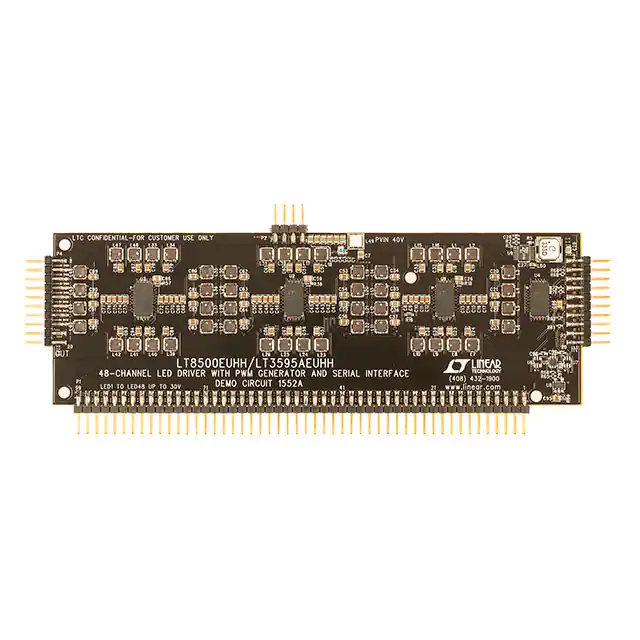
Analog Devices Inc. DC1552A
- Part No.:
- DC1552A
- Manufacturer:
- Analog Devices Inc.
- Category:
- LED Driver Evaluation Boards
- Package:
- Datasheet:
-
 DC1552A.pdf
- Description:
- EVAL BOARD FOR LT3595A LT8500
- Quantity:
- Payment:

- Shipping:

Inventory:1,001
Please send an inquiry. Send us your inquiry, and we will respond immediately.
Product details
Overview
DC1552A from Analog Devices is a 48-channel LED PWM generator IC designed for high-precision backlight and display control. It delivers 12-bit (4096-step) PWM resolution, 6-bit ±50% per-channel correction, and operates with 3V–5.5V supply across –40°C to 125°C. Its 50MHz cascadable serial interface and phase-shift capability make it ideal for large-screen LCD dynamic backlighting and multi-color LED signage.
For engineers reviewing the DC1552A datasheet, DC1552A pinout, DC1552A application, or DC1552A equivalent, this page provides verified technical context, real-world timing behavior, diagnostic flag handling, cascaded topology constraints, and validated alternative options for LED driver control systems.
Technical Context
The DC1552A implements a 584-bit shift register with MSB-first frame structure (48 × 12-bit PWM + 48 × 6-bit COR + 8-bit CMD), synchronized by independent SCKI (up to 50MHz) and PWMCK (up to 25MHz) clocks. Each PWM output is generated by comparing its PWMRSYNC register value against a free-running PWMCK counter.
It supports dual-mode LDIBLANK operation: sub-5µs pulses latch command/data (LDI function), while >50µs pulses blank all outputs and reset internal logic (BLANK function). Diagnostic reporting includes open-LED fault flags (NOL[48:1]) and synchronization error (SYC) status, both returned in every status frame via SDO/SCKO.
Key Specifications
| Parameter | Value and Actual Design Meaning |
|---|---|
| Channels | 48 independent PWM outputs with individual 12-bit registers and 6-bit correction registers |
| PWM Resolution | 12-bit (4096 steps); enables fine-grained brightness control for high-dynamic-range displays |
| Max Serial Clock | 50MHz SCKI; supports 11.7µs frame transmission time (584 bits + LDI), enabling 85.5kHz update rate |
| PWM Frequency | Up to 6.1kHz at 25MHz PWMCK; determined by 4096-cycle counter period |
| Phase Shift | Three 16-channel banks configurable 120° out-of-phase to reduce EMI and input current ripple |
| Diagnostic Flags | Synchronization error (SYC) and open-LED (NOL[48:1]) reported in every status frame via SDO |
| Supply Range | 3.0V to 5.5V; compatible with standard logic-level microcontrollers and FPGAs without level-shifting |
Pinout & Package
DC1552A is housed in a 56-lead plastic TLA QFN package (6mm × 6mm × 0.78mm) with exposed GND pad (Pin 57) requiring PCB soldering for thermal and electrical integrity.
| Pin/Terminal | Circuit Role | Design Meaning |
|---|---|---|
| PWM[48:1] | 48-channel PWM output terminals | Open-drain capable; each driven by comparison of PWMRSYNC[n] vs PWMCK counter; logic-high when counter < register value |
| SDI | Serial data input | MSB-first command frame entry point; feeds 584-bit shift register; requires setup/hold relative to SCKI |
| SCKI | Serial clock input | Independent 50MHz timing source for frame shifting and correction multiplier calculation; not tied to PWMCK |
| LDIBLANK | Dual-function control input | Rising edge terminates frames (LDI); >50µs high asserts BLANK-disables all PWMs and resets internal logic |
| PWMCK | PWM clock input | 25MHz max free-running clock driving 12-bit counter; defines PWM period and output timing granularity |
| OPENLED | Diagnostic status input | Wired-OR open-collector input with 100kΩ internal pull-up; captures open-LED faults from LT3595A drivers during self-test |
| SDO | Serial data output | Status frame output (584 bits); includes SYC, OLT, PHS, CRD, NOL[48:1], and COR[48:1] values |
| SCKO | Serial clock output | Buffered, skew-balanced pass-through of SCKI; enables daisy-chained 5-wire topology without global clock routing |
| VCC / GND | Power supply pins | VCC accepts 3.0–5.5V; exposed pad (Pin 57) is GND and must be soldered for thermal dissipation and noise immunity |
Key Features
| Feature | Design Value |
|---|---|
| 48-channel PWM generation | Enables single-chip control of three LT3595A 16-channel LED drivers without external logic or multiplexing |
| Per-channel 6-bit correction | ±50% programmable gain adjustment compensates for LED binning, aging, or thermal drift across 48 outputs |
| 5-wire cascadable interface | Eliminates global SCKI routing; SCKO/SDO skew balancing allows >10-device chains at 50MHz without external buffers |
| Real-time diagnostic reporting | SYC and NOL[48:1] flags returned in every status frame enable closed-loop fault detection without host polling overhead |
| Phase-shifted bank operation | Reduces peak input current by ~67% and system EMI by staggering 16-channel activation points within one PWM period |
Applications
| Large-Screen LCD Backlighting | Mono-/Full-Color LED Signage |
|---|---|
Use Scenario: Dynamic local dimming for 55″+ LCD panels using 48-zone LED backlight array. IC Role / Device Role / Timing Role: DC1552A generates synchronized, phase-shifted PWM signals to drive three LT3595A LED drivers, each controlling 16 strings. Use Value: Enables 12-bit grayscale precision and flicker-free dimming down to 0.02% brightness while reducing input capacitor stress via staggered switching. |
Use Scenario: Outdoor LED billboard with 48 individually addressable color segments (RGB or monochrome). IC Role / Device Role / Timing Role: DC1552A acts as central PWM controller, receiving commands from FPGA over 50MHz SCKI and returning open-string diagnostics via SDO. Use Value: Built-in OPENLED self-test (CMD = 0x5X) identifies failed LED strings in <1.5ms, eliminating manual continuity checks during field maintenance. |
| Automated Test Equipment (ATE) | Industrial Motor Control Interface |
Use Scenario: Precision LED stimulus generation in optical sensor calibration rigs requiring repeatable 0.1% duty cycle accuracy. IC Role / Device Role / Timing Role: DC1552A receives calibrated 12-bit intensity values from ARM Cortex-M7 MCU via SPI-compatible interface and outputs jitter-free PWM waveforms. Use Value: 2.75ns SCKO-to-SDO hold time and 15ns SCKI-to-SDO propagation delay ensure deterministic timing alignment across all 48 channels for synchronized optical pulse trains. |
Use Scenario: PWM-based speed and torque control for 48-channel stepper motor driver arrays in semiconductor wafer handling equipment. IC Role / Device Role / Timing Role: DC1552A replaces discrete timer ICs by delivering phase-aligned, variable-duty PWM to gate drivers, with diagnostic feedback on open-load conditions. Use Value: Open-LED flag reuse as open-coil indicator enables real-time coil continuity monitoring without adding sense resistors or ADC channels. |
Equivalent & Alternatives
The following parts are listed as comparable options for similar LED PWM control applications.
| Alternative Part | Technical Difference | Application Difference | Selection Advice |
|---|---|---|---|
| TLC5947 | 24-channel, 12-bit PWM with dot-correction; no phase-shift or cascaded clock forwarding; max 30MHz data clock | Limited to smaller displays or stacked configurations; lacks OPENLED diagnostic reporting and BLANK reset functionality | Choose when channel count ≤24 and diagnostic depth is secondary to cost |
| IS31FL3731 | 28-channel, 8-bit PWM with I²C interface; integrated current regulation; no serial cascade support or correction registers | Requires external current-setting resistors per channel; unsuitable for high-speed cascaded topologies or precision correction | Prefer for compact RGB matrix designs where I²C simplicity outweighs resolution and scalability needs |
Compared with TLC5947 and IS31FL3731, DC1552A uniquely combines 48-channel count, 12-bit resolution, hardware-accelerated per-channel correction, and full diagnostic visibility in a single cascadable device-making it the only option supporting large-scale, fault-aware LED systems without firmware-intensive workarounds.
Availability
DC1552A is available at Aetrix Electronics and suitable for large-screen display backlighting, outdoor LED signage, automated test equipment, and industrial motor control applications requiring stable component supply and long-term production continuity.
Supply support for DC1552A includes scheduled delivery planning, volume procurement assistance, BOM continuity management, traceable sourcing, and lifecycle availability coordination for OEM customers, industrial embedded developers, connected-device designers, and electronics production programs.
Manufacturer
Analog Devices is a global leader in high-performance analog, mixed-signal, and digital signal processing technologies, serving industrial, automotive, communications, and healthcare markets.
The DC1552A belongs to Analog Devices' LED driver control product line, engineered specifically for high-channel-count, high-resolution, and fault-resilient display and lighting systems demanding deterministic timing and real-time diagnostics.
FAQ
What is the maximum number of DC1552A devices that can be cascaded in a 5-wire topology?
The DC1552A supports up to 12 devices in series using the 5-wire topology (SCKI/SDI/LDIBLANK/SCKO/SDO) at 50MHz, limited by cumulative SCKI-to-SCKO duty cycle change (tDC-SCK ≤ ±0.2ns) and inter-device skew balance. Beyond 12 units, signal integrity validation is required per board layout; Analog Devices recommends simulation with IBIS models before finalizing chain length. The DC1552A's internal skew balancing eliminates need for external clock buffers in most configurations.
How does the DC1552A handle open-LED fault detection when used with LT3595A drivers?
The DC1552A monitors the OPENLED pin-a wired-OR node tied to all LT3595A OPENLED outputs-and reports its state in every status frame. During normal operation, it duplicates the pin state across all 48 NOL bits. When triggered by a diagnostic self-test frame (CMD = 0x5X), the DC1552A sequentially activates each PWM[1]–PWM[48] for 64 PWMCK cycles and captures OPENLED state per channel, returning precise fault location in the next status frame. This enables rapid identification of failed LED strings without external test equipment.
Can the DC1552A operate with a 3.3V supply while interfacing to a 5V microcontroller?
Yes, the DC1552A supports 3.0V–5.5V VCC and has TTL/CMOS-compatible inputs: VIH = 2.7V (min) at VCC = 3.3V and VIH = 4.0V (min) at VCC = 5V. When powered at 3.3V, its SDI, SCKI, LDIBLANK, and PWMCK inputs accept 5V-tolerant logic levels without damage or level-shifting. Output VOH is ≥2.7V at 3.3V VCC driving 3mA, ensuring reliable interface to 5V receivers when properly terminated.
What is the functional difference between the LDI and BLANK modes of the LDIBLANK pin?
The LDIBLANK pin performs two distinct functions based on pulse width: a rising edge followed by <5µs high duration executes LDI (latch data input), capturing the command field and updating registers; a high pulse >50µs asserts BLANK, which disables all 48 PWM outputs and resets the internal shift register and PWMCK counter. Pulses between 5µs and 50µs cause undefined behavior-Analog Devices explicitly warns against operating in this window. The DC1552A guarantees deterministic response only in the defined LDI and BLANK windows.
Does the DC1552A require external components for stable operation?
Yes-the DC1552A requires a minimum 1µF ceramic bypass capacitor between VCC and GND, placed within 3mm of Pins A26 (VCC) and 57 (exposed GND pad). The exposed pad must be soldered to a solid GND plane for thermal performance and noise immunity. No external pull-ups are needed on OPENLED (100kΩ internal) or SDO/SCKO (push-pull outputs), but series termination resistors (22–33Ω) are recommended on SDI/SCKI for >25MHz operation to suppress reflections in long traces.
DC1552A Specifications
- Product attributes
- Attribute value
- Manufacturer:
- Analog Devices Inc.
- Series:
- -
- Packaging:
- Box
- Product Status:
- Obsolete
- Current - Output / Channel:
- 30mA
- Outputs and Type:
- 48 Non-Isolated Outputs
- Voltage - Output:
- 32V
- Features:
- -
- Voltage - Input:
- 30V ~ 45V
- Contents:
- Board(s)
- Utilized IC / Part:
- LT3595A, LT8500
DC1552A FAQ
1.How can I place an order for DC1552A through Aetrix?
Please submit a Request for Quotation (RFQ) for DC1552A on Aetrix. Our sales agent will provide a competitive quotation and guide you through the order confirmation once you accept the terms.
2.Are the price and stock information for DC1552A reliable?
The price and inventory of DC1552A are updated periodically and may fluctuate due to market conditions. Stock and pricing data are typically refreshed every 24 hours. Quotation validity for DC1552A is usually 5 days.
3.What payment methods are accepted for DC1552A?
We accept Wire Transfer, PayPal, Credit Card, Western Union, MoneyGram, and Escrow for DC1552A transactions.
Note: Certain payment methods may incur a processing fee.
4.How is shipping managed for DC1552A?
DC1552A orders can be shipped via leading logistics carriers, including DHL, UPS, FedEx, TNT, or Registered Mail.
Once your DC1552A order is processed, you will receive an email with the shipment details and tracking number.
Note: Tracking information may take up to 24 hours to appear. Express delivery typically takes 3–5 business days.
5.How can I obtain technical support or documentation for DC1552A?
For technical support, including DC1552A datasheets, pinout diagrams, or application guidance, please contact our engineering support team. They can provide detailed documentation and assistance for your DC1552A requirements.
6.How does Aetrix verify that DC1552A is sourced from the original manufacturer or authorized distributors?
All DC1552A products on Aetrix are procured from qualified distributors and authorized channels. Our dedicated quality assurance team conducts strict verification, including traceability checks and, if necessary, third-party testing. This ensures that DC1552A meets industry standards.
7.What is the process for return or replacement of DC1552A?
All DC1552A units undergo pre-shipment inspection (PSI). If there is an issue with DC1552A, returns or replacements are accepted under the following conditions:
1.Quantity discrepancies, incorrect items, or visible external defects (such as breakage or corrosion), acknowledged by Aetrix.
2.The issue is reported within 90 days of delivery.
3.The DC1552A part is unused and in its original packaging.
Return procedure for DC1552A:
1.Submit a request within 90 days.
2.Obtain a Return Material Authorization (RMA) from Aetrix.
DC1552A Tags
-
COM-13716
SparkFun Electronics
-
B-G474E-DPOW1
STMicroelectronics

-
EVB81116-A2
Melexis Technologies NV
-
EVB81116-A3
Melexis Technologies NV
-
LP5036EVM
Texas Instruments
-
LP5813-12WCSPEVM
Texas Instruments
-
LP8863EVM
Texas Instruments
-
1455
Adafruit Industries LLC
-
1427
Adafruit Industries LLC
-
WIG-13279
SparkFun Electronics
-
5650
Adafruit Industries LLC
-
1429
Adafruit Industries LLC
Tech Hub

A practical engineering guide to 3.3V and 5V logic compatibility, input thresholds, resistor dividers, translator ICs, MOSFET level shifting, I2C pull-ups, timing limits and power-sequencing risks.

The 74HC595 uses push-pull logic outputs, while the TPIC6B595 uses 50 V open-drain DMOS sinks for higher-power loads. This guide compares timing, current limits, 3.3 V interfacing, load wiring, thermal…

The 74HC595 converts serial data into eight stable parallel outputs. This guide covers pin functions, shift and storage timing, OE and MR behavior, drive-current limits, cascading, voltage compatibilit…

A technical comparison of level-sensitive latches and edge-triggered flip-flops, covering timing windows, setup and hold limits, master–slave operation, time borrowing, race-through, HDL inference and…

A D latch stores one bit while Enable controls when data can pass. This reference covers gate-level operation, truth tables, transparency, setup and hold timing, LE versus OE, common ICs and practical …

An SR latch stores one bit through cross-coupled feedback. This engineering reference covers NOR and NAND implementations, truth tables, forbidden-state recovery, gated operation, switch debouncing, fa…

Latch circuits retain one bit through feedback. This technical reference covers SR and D latches, truth tables, transparency, timing limits, latch-versus-flip-flop behavior, applications and common log…

An engineering guide to LED driver operation, constant-current and constant-voltage outputs, linear and switching topologies, dimming, IC selection, calculations, replacement compatibility, and fault c…

Operational amplifier guide covering op amp basics, feedback, ideal vs real op amps, common configurations, buffer circuits, offset, bias current, gain-bandwidth, slew rate, rail-to-rail limits and sel…

Jumper cables guide covering safe connection order, red and black clamp placement, final ground connection, cable gauge, length, clamp quality, copper vs CCA cables, jump starter comparison and battery…


