
 My Inquiry
 My Account


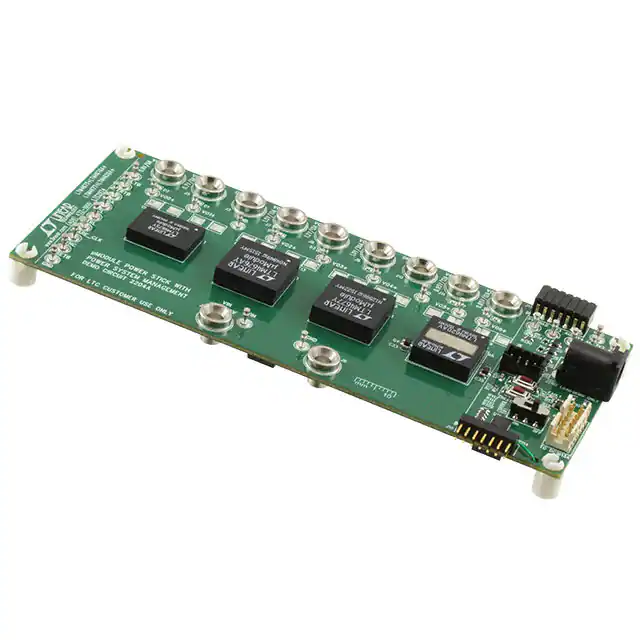
Analog Devices Inc. DC2204A
- Part No.:
- DC2204A
- Manufacturer:
- Analog Devices Inc.
- Package:
- Datasheet:
-
 DC2204A.pdf
- Description:
- EVAL BOARD FOR LTC2974 LTM4620A
- Quantity:
- Payment:

- Shipping:

Inventory:4,490
Please send an inquiry. Send us your inquiry, and we will respond immediately.
Product details
Overview
LTM4677 from Analog Devices is a dual 18A or single 36A µModule® step-down DC/DC regulator with digital power system management via PMBus. It integrates fast analog control loops, EEPROM, MOSFETs, inductors, and telemetry circuitry in a 16mm × 16mm × 5.01mm BGA package. Designed for high-density telecom and datacom power delivery, it delivers ±0.5% DC output voltage accuracy over temperature and supports real-time current/voltage/temperature readback.
For engineers reviewing the LTM4677 datasheet, LTM4677 pinout, LTM4677 application, or LTM4677 equivalent, this page provides verified technical context, confirmed pin functions, validated alternatives, and design-meaningful specifications - including 400kHz PMBus compliance, ±2.5% current readback accuracy, 40ms turn-on time, and dual-channel phase control for multi-module synchronization.
Technical Context
The LTM4677 implements constant-frequency current-mode control with integrated 16-bit ΔΣ ADCs for per-channel telemetry. Its dual-output architecture supports independent or paralleled operation, with programmable slew rates, sequencing delays, and digital soft-start/stop ramping via PMBus commands.
It features pin-strappable startup configuration (output voltage, switching frequency, phase angle), onboard fault logging with ECC, and configurable OV/UV/OT protection thresholds. The device operates across 4.5V–16V input and delivers 0.5V–1.8V outputs with ±0.5% DC regulation error and <50mV dynamic load deviation at 9A/µs.
Key Specifications
| Parameter | Value and Actual Design Meaning |
|---|---|
| Output Current | Dual 18A or single 36A continuous - enables high-power ASIC/FPGA core rail delivery without external current sharing components. |
| Input Voltage Range | 4.5V to 16V - compatible with standard 5V, 12V, and intermediate bus architectures in telecom/datacom systems. |
| Output Voltage Range | 0.5V to 1.8V - covers DDR memory, CPU/GPU core, and AI accelerator supply requirements with fine-grained digital margining. |
| DC Output Accuracy | ±0.5% over temperature - ensures stable logic-level compliance for sub-1V advanced nodes without external calibration. |
| PMBus Interface | 400kHz I²C-compatible - supports up to 125Hz telemetry polling for real-time thermal and load monitoring in production environments. |
| Turn-On Time | 40ms - meets fast-boot requirements in network switches and storage controllers with deterministic power-up sequencing. |
| Package | 16mm × 16mm × 5.01mm BGA - surface-mount module with integrated magnetics reduces PCB area vs discrete buck solutions by >40%. |
Pinout & Package
Package: 144-ball BGA (16mm × 16mm × 5.01mm), RoHS-compliant SAC305 or SnPb finish, MSL Level 4.
| Pin/Terminal | Circuit Role | Design Meaning |
|---|---|---|
| VIN0 / VIN1 | Primary input power pins for each channel | Accept 4.5V–16V input; support independent or common-bus configurations with internal current limiting. |
| VOUT0 / VOUT1 | Regulated output terminals | Deliver up to 18A each; differential sensing via VOSNS0+/VOSNS0− and VOSNS1/SGND enables accurate remote voltage regulation. |
| SCL / SDA | PMBus serial interface lines | Enable bidirectional communication for configuration, telemetry readback, and fault logging without additional level-shifting circuitry. |
| RUN0 / RUN1 | Channel enable inputs | Active-high logic control allows independent channel sequencing, soft-start timing, and fault-initiated shutdown propagation. |
| ALERT | Open-drain fault interrupt output | Asserts on OV/UV/OT/fault conditions; connects directly to system management controller for real-time event handling. |
| SYNC | External clock synchronization input | Enables precise phase alignment across multiple LTM4677 modules to reduce input ripple and EMI in parallel deployments. |
Key Features
| Feature | Design Value |
|---|---|
| Dual analog control loops with digital supervision | Combines fast transient response (<35µs settling) with PMBus-configurable margins, sequencing, and telemetry - eliminating need for external DACs or supervisors. |
| Onboard 16-bit ΔΣ ADC and EEPROM | Provides ±2.5% current readback accuracy and persistent fault logging with ECC; eliminates external ADC and nonvolatile storage components. |
| Programmable soft-start/stop ramping | Configurable slew rates and delay times per channel enable safe powering of sensitive loads like FPGAs without external RC networks. |
| Parallel and current-share capability | SHARE_CLK and SYNC pins allow up to 6 modules to share load equally with <±5% current imbalance - simplifying high-current (>100A) designs. |
| Pin compatibility with LTM4676A | Enables drop-in upgrade path from dual 13A to dual 18A without PCB redesign - critical for field-upgradable infrastructure equipment. |
Applications
| Telecom Line Cards | Datacenter Switch ASIC Rails |
|---|---|
Use Scenario: Powering multi-core packet processors and SerDes interfaces on carrier-grade line cards requiring tight voltage tolerance and telemetry. IC Role / Device Role / Timing Role: Dual-channel µModule delivering 1.0V @ 18A per rail with synchronized phase control to minimize input capacitor stress. Use Value: ±0.5% DC accuracy ensures reliable operation at 7nm/5nm process nodes; PMBus telemetry enables predictive maintenance via real-time junction temperature tracking. |
Use Scenario: Supplying core voltage to high-throughput switch ASICs in 100G+ Ethernet switches with dynamic load steps exceeding 9A/µs. IC Role / Device Role / Timing Role: Single 36A configured mode with digital servo engaged for sub-50mV load-step deviation and <35µs recovery. Use Value: Integrated current-mode control and 45ns minimum on-time support stable regulation under extreme transient loads without external compensation. |
| Enterprise Storage Controllers | AI Accelerator Boards |
Use Scenario: Providing tightly regulated 1.2V and 0.85V rails to NVMe SSD controllers and DRAM buffers in RAID systems. IC Role / Device Role / Timing Role: Dual independent outputs with separate RUN pins enabling staggered power-up to meet PCIe reset timing requirements. Use Value: Pin-strapped startup configuration eliminates boot firmware dependency; EEPROM stores custom sequencing and margining settings for repeatable field deployment. |
Use Scenario: Delivering scalable core power to heterogeneous AI accelerators with mixed-voltage domains (e.g., 0.75V GPU cores + 1.2V memory I/O). IC Role / Device Role / Timing Role: Parallel operation of two LTM4677 modules using SHARE_CLK for 72A total with automatic current balancing. Use Value: 125Hz telemetry polling captures thermal hotspots during inference workloads; fault log records uptime and peak temperatures for reliability analysis. |
Equivalent & Alternatives
The following parts are listed as comparable options for similar high-current digital power management applications.
| Alternative Part | Technical Difference | Application Difference | Selection Advice |
|---|---|---|---|
| LTM4676A | Dual 13A/Single 26A; identical pinout and feature set but lower current rating and no support for 36A single-rail mode. | Suitable for mid-range FPGA or SoC power where 18A/channel is sufficient; lacks LTM4677's extended current headroom and enhanced telemetry resolution. | Select LTM4676A when board space and cost optimization outweigh need for 36A single-rail capability or tighter current readback accuracy (±3.5% vs ±2.5%). |
| TPS546D24A | Single 40A buck converter with PMBus; 8mm × 6mm QFN package, no integrated inductors, requires external magnetics and compensation. | Better suited for space-constrained designs where module height is critical; lacks LTM4677's integrated telemetry ADC and EEPROM-based fault logging. | Choose TPS546D24A only if PCB layout flexibility exists for discrete magnetics and system-level telemetry processing is already implemented. |
Compared with LTM4676A and TPS546D24A, the LTM4677 uniquely combines highest integrated current density (36A single-rail), embedded telemetry with ECC-protected logging, and full pin compatibility with prior-generation modules - reducing design risk and time-to-market for next-gen infrastructure power systems.
Availability
LTM4677 is available at Aetrix Electronics and suitable for telecom line cards, datacenter switch ASIC rails, enterprise storage controllers, and AI accelerator boards requiring stable component supply, long-term lifecycle support, and traceable sourcing.
Supply support for LTM4677 includes scheduled delivery planning, volume procurement assistance, BOM continuity management, traceable sourcing, and lifecycle availability coordination for OEM customers, industrial embedded developers, connected-device designers, and electronics production programs.
Manufacturer
Analog Devices is a global leader in high-performance analog, mixed-signal, and digital signal processing technologies, serving industrial, automotive, communications, and healthcare markets since 1965.
The LTM4677 belongs to the µModule regulator product line, engineered for high-density, digitally managed power delivery in mission-critical infrastructure where reliability, telemetry, and rapid time-to-market are essential.
FAQ
What is the maximum output current capability of the LTM4677?
The LTM4677 supports dual 18A operation (18A per channel) or single 36A operation when both channels are paralleled. This is achieved through internal current-mode control and SHARE_CLK synchronization, enabling robust high-current delivery without external current-sharing resistors. The LTM4677 maintains ±0.5% DC output accuracy and <50mV dynamic load deviation even at full 36A output.
Does the LTM4677 require external components for basic operation?
No, the LTM4677 is a complete µModule regulator integrating power MOSFETs, inductors, DC/DC control circuitry, EEPROM, and telemetry ADCs. Only input/output capacitors, optional feedback resistors for pin-strapped startup, and a PMBus pull-up network are required. No external compensation, current-sense resistors, or supervisor ICs are needed - significantly reducing bill-of-materials and layout complexity.
How does the LTM4677 handle thermal monitoring and protection?
The LTM4677 provides per-channel temperature readback via dedicated TSNS pins with ±3°C accuracy and 0.0625°C resolution. It supports programmable overtemperature (OT) fault thresholds, automatic shutdown on OT events, and onboard EEPROM fault logging with ECC. Thermal telemetry updates at up to 125Hz, enabling real-time hotspot detection and predictive thermal management in dense compute platforms.
Can the LTM4677 be used without PMBus communication?
Yes, the LTM4677 supports full autonomous operation using pin-strapping resistors for output voltage, switching frequency, and phase configuration at startup. PMBus is optional for advanced features like telemetry, margining, sequencing, and fault logging. Default factory EEPROM settings ensure functional operation immediately after power-up without host controller intervention.
Is the LTM4677 pin-compatible with earlier Analog Devices µModule regulators?
Yes, the LTM4677 is pin-compatible with the LTM4676A (dual 13A), allowing direct replacement in existing layouts to upgrade current capacity without PCB revision. Both share identical 144-ball BGA footprint, pin functions, and thermal pad configuration. However, LTM4677 adds support for 36A single-rail mode and enhanced telemetry resolution not present in LTM4676A.
DC2204A Specifications
- Product attributes
- Attribute value
- Manufacturer:
- Analog Devices Inc.
- Series:
- µModule®
- Packaging:
- Tray
- Product Status:
- Obsolete
- Main Purpose:
- DC/DC Converter
- Outputs and Type:
- 7 Non-Isolated Outputs
- Voltage - Output:
- -
- Current - Output:
- 0.7V, 0.85V, 0.9V, 0.95V, 1V, 1.2V, 1.5V
- Voltage - Input:
- 36A, 13A, 13A, 13A, 13A, 9A, 9A
- Regulator Topology:
- 4.5V ~ 15V
- Frequency - Switching:
- -
- Contents:
- -
- Utilized IC / Part:
- Board(s)
- Power - Output:
- LTC2974, LTM4620A, LTM4675, LTM4676A, LTM4677
DC2204A FAQ
1.How can I place an order for DC2204A through Aetrix?
Please submit a Request for Quotation (RFQ) for DC2204A on Aetrix. Our sales agent will provide a competitive quotation and guide you through the order confirmation once you accept the terms.
2.Are the price and stock information for DC2204A reliable?
The price and inventory of DC2204A are updated periodically and may fluctuate due to market conditions. Stock and pricing data are typically refreshed every 24 hours. Quotation validity for DC2204A is usually 5 days.
3.What payment methods are accepted for DC2204A?
We accept Wire Transfer, PayPal, Credit Card, Western Union, MoneyGram, and Escrow for DC2204A transactions.
Note: Certain payment methods may incur a processing fee.
4.How is shipping managed for DC2204A?
DC2204A orders can be shipped via leading logistics carriers, including DHL, UPS, FedEx, TNT, or Registered Mail.
Once your DC2204A order is processed, you will receive an email with the shipment details and tracking number.
Note: Tracking information may take up to 24 hours to appear. Express delivery typically takes 3–5 business days.
5.How can I obtain technical support or documentation for DC2204A?
For technical support, including DC2204A datasheets, pinout diagrams, or application guidance, please contact our engineering support team. They can provide detailed documentation and assistance for your DC2204A requirements.
6.How does Aetrix verify that DC2204A is sourced from the original manufacturer or authorized distributors?
All DC2204A products on Aetrix are procured from qualified distributors and authorized channels. Our dedicated quality assurance team conducts strict verification, including traceability checks and, if necessary, third-party testing. This ensures that DC2204A meets industry standards.
7.What is the process for return or replacement of DC2204A?
All DC2204A units undergo pre-shipment inspection (PSI). If there is an issue with DC2204A, returns or replacements are accepted under the following conditions:
1.Quantity discrepancies, incorrect items, or visible external defects (such as breakage or corrosion), acknowledged by Aetrix.
2.The issue is reported within 90 days of delivery.
3.The DC2204A part is unused and in its original packaging.
Return procedure for DC2204A:
1.Submit a request within 90 days.
2.Obtain a Return Material Authorization (RMA) from Aetrix.
DC2204A Tags
-
DFR0571
DFRobot
-
DFR0379
DFRobot
-
DFR0205
DFRobot

-
1385
Adafruit Industries LLC
-
COM-15208
SparkFun Electronics
-
1944
Adafruit Industries LLC
-
2465
Adafruit Industries LLC
-
DC2468A
Analog Devices Inc.
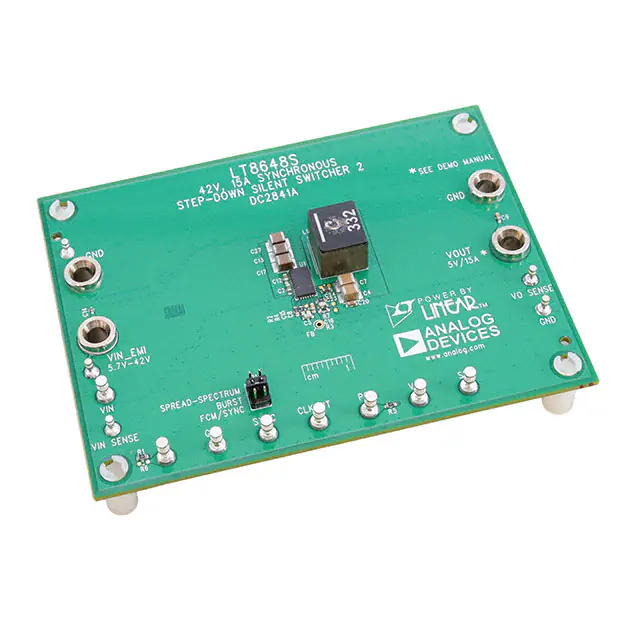
-
DC2841A
Analog Devices Inc.

-
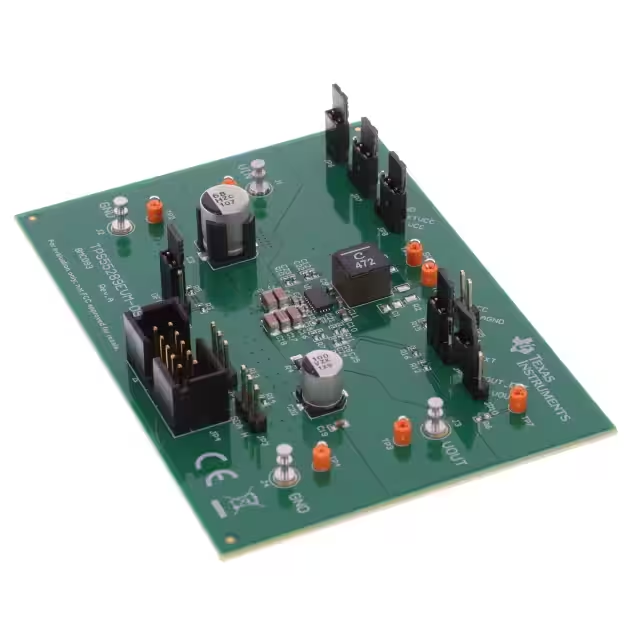
TPS552892EVM-111
Texas Instruments
-
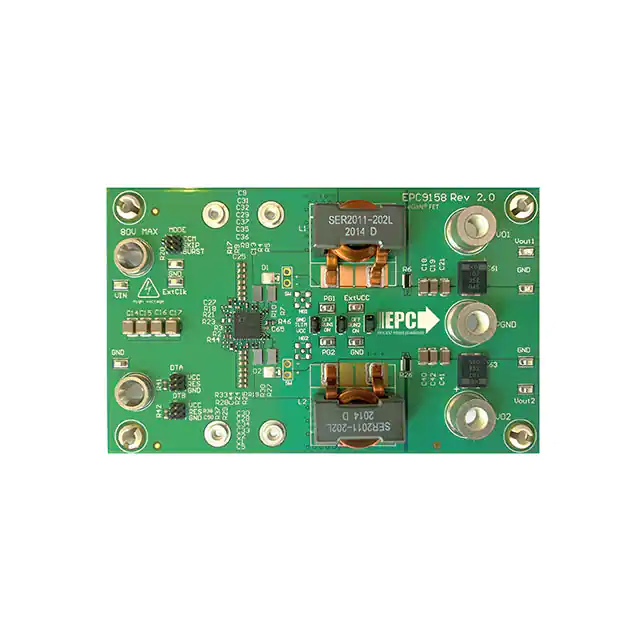
TPS55289EVM-093
Texas Instruments
-
EPC9158
EPC
Tech Hub

A practical engineering guide to 3.3V and 5V logic compatibility, input thresholds, resistor dividers, translator ICs, MOSFET level shifting, I2C pull-ups, timing limits and power-sequencing risks.

The 74HC595 uses push-pull logic outputs, while the TPIC6B595 uses 50 V open-drain DMOS sinks for higher-power loads. This guide compares timing, current limits, 3.3 V interfacing, load wiring, thermal…

The 74HC595 converts serial data into eight stable parallel outputs. This guide covers pin functions, shift and storage timing, OE and MR behavior, drive-current limits, cascading, voltage compatibilit…

A technical comparison of level-sensitive latches and edge-triggered flip-flops, covering timing windows, setup and hold limits, master–slave operation, time borrowing, race-through, HDL inference and…

A D latch stores one bit while Enable controls when data can pass. This reference covers gate-level operation, truth tables, transparency, setup and hold timing, LE versus OE, common ICs and practical …

An SR latch stores one bit through cross-coupled feedback. This engineering reference covers NOR and NAND implementations, truth tables, forbidden-state recovery, gated operation, switch debouncing, fa…

Latch circuits retain one bit through feedback. This technical reference covers SR and D latches, truth tables, transparency, timing limits, latch-versus-flip-flop behavior, applications and common log…

An engineering guide to LED driver operation, constant-current and constant-voltage outputs, linear and switching topologies, dimming, IC selection, calculations, replacement compatibility, and fault c…

Operational amplifier guide covering op amp basics, feedback, ideal vs real op amps, common configurations, buffer circuits, offset, bias current, gain-bandwidth, slew rate, rail-to-rail limits and sel…

Jumper cables guide covering safe connection order, red and black clamp placement, final ground connection, cable gauge, length, clamp quality, copper vs CCA cables, jump starter comparison and battery…


