
 My Inquiry
 My Account


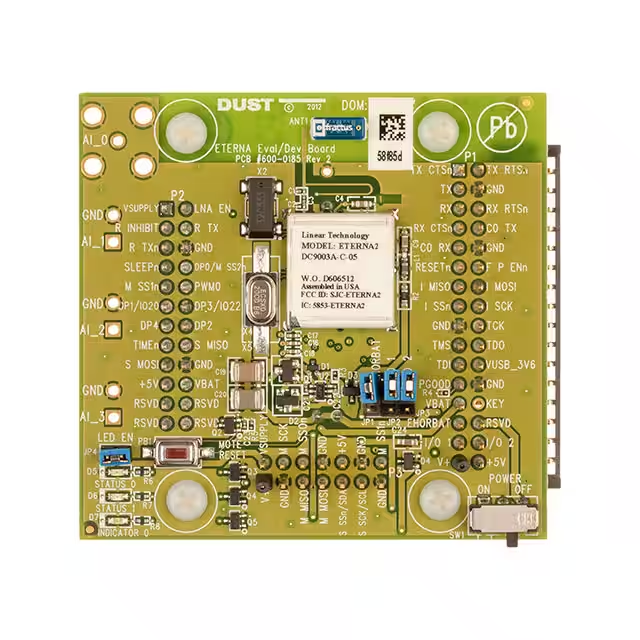
Analog Devices Inc. DC9003A-C
- Part No.:
- DC9003A-C
- Manufacturer:
- Analog Devices Inc.
- Category:
- RF, RFID, Wireless Evaluation Boards
- Package:
- Datasheet:
-
 DC9003A-C.pdf
- Description:
- BOARD DEMO WIRELESSHART
- Quantity:
- Payment:

- Shipping:

Inventory:3,676
Please send an inquiry. Send us your inquiry, and we will respond immediately.
Product details
Overview
LTP5900-WHM from Analog Devices (acquired Linear Technology) is a SmartMesh WirelessHART mote module integrating IEEE 802.15.4 radio, ARM Cortex-M3 microprocessor, and embedded WirelessHART networking stack. It operates in 2.400–2.4835 GHz band, delivers >99.999% network reliability, achieves sub-50 µA routing node current, and supports NIST-certified 128-bit AES encryption for industrial wireless sensor networks.
For engineers reviewing the LTP5900-WHM datasheet, LTP5900-WHM pinout, LTP5900-WHM application, or LTP5900-WHM equivalent, key selection criteria include time-synchronized mesh topology support, dual UART/serial interface modes (9600 bps Mode 1 or 115.2 kbps Mode 3), MMCX antenna interface, 22-pin PCB package, and compliance with IEC 62591 WirelessHART standard.
Technical Context
The LTP5900-WHM implements a time-synchronized, frequency-hopping mesh network using IEEE 802.15.4e MAC and PHY layers, with per-transmission channel hopping across 15 channels at 250 kbps raw data rate. Its embedded SmartMesh software handles network formation, self-healing, and spatially diverse redundant routing without external host intervention.
It integrates a voltage supervisor (1.5 V trip point), on-board temperature sensor (±7°C accuracy), and dual-mode serial interface controlled by MODE_PIN_B. Power management enables deep sleep with wake-on-RST and low-power operation down to 4.5 mA receive current and 5.4 mA transmit current (PA disabled).
Key Specifications
| Parameter | Value and Actual Design Meaning |
|---|---|
| Operating Frequency | 2.400–2.4835 GHz - Full ISM band coverage enabling global deployment in USA, Canada, EU. |
| Wireless Standard | IEEE 802.15.4e + IEC 62591 (WirelessHART) - Fully compliant, certified stack with time-synchronized scheduling. |
| Supply Voltage | 2.75 V to 3.76 V - Compatible with common industrial 3.3 V rails and battery-backed systems. |
| Receive Current | 4.5 mA - Enables multi-year battery life in routing nodes operating at sub-50 µA average current. |
| Transmit Current (PA enabled) | 9.7 mA @ 8 dBm - Supports 1200 m free-space range with 2 dBi antenna. |
| Operating Temp Range | –40°C to +85°C - Qualified for harsh industrial environments including pipeline monitoring and process control. |
| Security | NIST FIPS-197 certified 128-bit AES - Hardware-accelerated encryption meeting industrial cybersecurity requirements. |
Pinout & Package
22-pin PCB assembly (39 mm × 24.4 mm) with MMCX antenna connector, designed for surface-mount integration into industrial sensor enclosures. Pin functions are defined per IEEE 802.15.4E-compliant serial interface and power management logic.
| Pin/Terminal | Circuit Role | Design Meaning |
|---|---|---|
| VSS (Pin 1) | Ground reference | Primary power return path; must be low-impedance connection to system GND plane. |
| VDD (Pin 2) | Power supply input | Accepts 2.75–3.76 V; requires 6 µF total capacitance and 4.9 µH inductance for stable RF operation. |
| RX (Pin 4) | UART receive input | Asynchronous serial data from host MCU; TTL-level, 9600/115.2 kbps configurable. |
| TX (Pin 5) | UART transmit output | Drives host MCU RX; active-high logic; supports HDLC framing with 0x7E delimiters. |
| MT_RTS (Pin 7) | Mote-ready-to-send signal | Active-low wake-up signal to host MCU before packet transmission; essential for low-power host sleep coordination. |
| MT_CTS (Pin 8) | Host-clear-to-send output | Indicates mote readiness to accept host packets; de-asserted when network disconnected or buffer full. |
| SP_CTS (Pin 9) | Serial-peripheral clear-to-send input | Enables packet-level (Mode 1) or byte-level (Mode 3) flow control from host to prevent UART overrun. |
| TIME (Pin 10) | Timestamp trigger input | Falling-edge-activated; captures synchronized network time within ~1 ms; optional but improves timestamp accuracy vs. HDLC request. |
| MODE_PIN_B (Pin 11) | Interface mode select | Low = Mode 1 (9600 bps, 3–5 signal); High = Mode 3 (115.2 kbps, 5-signal with byte-level flow control). |
| RST (Pin 22) | Active-low hardware reset | Internally pulled up; assertion forces full boot sequence; recommended only after graceful disconnect command (0x07). |
Key Features
| Feature | Design Value |
|---|---|
| Self-healing time-synchronized mesh | Eliminates single-point failure; enables deterministic latency and >99.999% reliability in dynamic RF environments like refineries and plants. |
| Dual serial interface modes | Mode 1 (9600 bps) reduces pin count for resource-constrained hosts; Mode 3 (115.2 kbps) enables high-throughput diagnostics and firmware updates. |
| Onboard temperature sensor | Monitors internal die temperature (–40°C to +85°C, ±7°C) for thermal derating and environmental compensation without external components. |
| MMCX antenna interface | Supports field-replaceable antennas; requires VSWR ≤3:1; enables optimal placement outside metal enclosures per installation guidelines. |
| FIPS-197 certified AES-128 | Meets NIST security validation (cert #1437); provides end-to-end encryption for sensor data, configuration, and network management traffic. |
Applications
| Process Automation | Asset Health Monitoring |
|---|---|
Use Scenario: Wireless pressure, temperature, and flow sensing in hazardous-area refinery piping with no wired infrastructure. IC Role / Device Role / Timing Role: Self-organizing WirelessHART mote node performing time-synchronized data acquisition, local processing, and multi-hop routing to gateway. Use Value: Eliminates trenching and conduit costs; maintains >99.999% uptime despite RF interference from motors and variable-frequency drives. | Use Scenario: Battery-powered vibration and temperature monitoring on rotating equipment (pumps, compressors) in remote oilfield sites. IC Role / Device Role / Timing Role: Low-power routing node collecting sensor data, applying edge filtering, and forwarding time-stamped packets via redundant paths. Use Value: Achieves 10+ year battery life using sub-50 µA average current; enables predictive maintenance with synchronized timestamps across distributed assets. |
| Environmental Compliance Monitoring | Smart Building HVAC Optimization |
Use Scenario: Distributed air quality (CO₂, VOC, humidity) and leak detection sensors in chemical storage facilities requiring explosion-proof deployment. IC Role / Device Role / Timing Role: Certified WirelessHART endpoint executing secure, encrypted reporting with NIST-traceable timestamps for regulatory audit trails. Use Value: Meets IEC 62591 compliance out-of-box; supports mandatory data integrity logging without custom security implementation. | Use Scenario: Retrofitting legacy HVAC systems with wireless thermostats, valve actuators, and occupancy sensors in commercial buildings. IC Role / Device Role / Timing Role: Interoperable WirelessHART node integrating with existing SmartMesh manager for centralized BMS control and energy analytics. Use Value: Leverages existing WirelessHART infrastructure; enables rapid deployment without rewiring; supports time-coordinated demand-response events. |
Equivalent & Alternatives
The following parts are listed as comparable options for similar WirelessHART mote applications.
| Alternative Part | Technical Difference | Application Difference | Selection Advice |
|---|---|---|---|
| EM3581-RTR (Silicon Labs) | IEEE 802.15.4 SoC without integrated WirelessHART stack; requires external MCU and software porting. | Higher design effort for WirelessHART certification; suitable for custom protocol extensions beyond standard profile. | Select when full stack customization or multi-protocol support (Zigbee, Thread) is required. |
| CC2652RB (Texas Instruments) | Integrated crystal-less BAW resonator; lower RF BOM cost; lacks pre-certified WirelessHART firmware image. | Requires TI's SimpleLink WirelessMCU SDK and third-party WirelessHART stack licensing; longer time-to-certification. | Select for cost-sensitive volume deployments where RF layout simplification outweighs certification timeline impact. |
Compared with EM3581-RTR and CC2652RB, the LTP5900-WHM delivers immediate WirelessHART compliance with zero stack integration effort, validated NIST security, and guaranteed industrial temperature operation - reducing time-to-market for certified industrial sensor nodes by 6–9 months.
Availability
LTP5900-WHM is available at Aetrix Electronics and suitable for process automation, asset health monitoring, environmental compliance reporting, and smart building HVAC optimization requiring stable component supply, long-term lifecycle support, and regulatory-certified wireless connectivity.
Supply support for LTP5900-WHM includes scheduled delivery planning, volume procurement assistance, BOM continuity management, traceable sourcing, and lifecycle availability coordination for OEM customers, industrial embedded developers, connected-device designers, and electronics production programs.
Manufacturer
Analog Devices acquired Linear Technology in 2017 and continues development of its high-reliability industrial IC portfolio, including precision analog, power management, and wireless solutions.
The LTP5900-WHM belongs to the Eterna® family of low-power IEEE 802.15.4 radio SoCs, engineered specifically for self-healing, time-synchronized industrial mesh networks under the SmartMesh WirelessHART standard.
FAQ
What is the primary function of the LTP5900-WHM in an industrial wireless sensor network?
The LTP5900-WHM serves as a fully integrated WirelessHART mote node, combining radio transceiver, ARM Cortex-M3 processor, and certified SmartMesh networking software. It forms self-healing, time-synchronized mesh networks for reliable sensor data collection in harsh environments. The LTP5900-WHM handles routing, timing synchronization, security, and protocol compliance without external host intervention - making it a turnkey solution for industrial IoT deployments.
Does the LTP5900-WHM require external programming before use?
Yes, the LTP5900-WHM ships with flash memory erased and requires firmware programming during manufacturing. Analog Devices provides the DC9010 in-circuit programmer and SmartMesh software images via MyLinear portal after registration. The LTP5900-WHM cannot operate without loaded WirelessHART stack and application firmware; no factory-default operational mode exists.
How does the LTP5900-WHM achieve >99.999% network reliability?
The LTP5900-WHM achieves ultra-high reliability through three coordinated mechanisms: time-synchronized network-wide scheduling eliminates collisions; per-packet frequency hopping across 15 channels mitigates narrowband interference; and spatially diverse redundant topologies automatically reroute around failed links. These features are implemented in the embedded SmartMesh software and validated per IEC 62591. The LTP5900-WHM demonstrates this reliability in live refinery and power plant deployments.
Can the LTP5900-WHM operate without an external antenna?
No - the LTP5900-WHM requires an external 50 Ω antenna connected via its onboard MMCX female connector. The module has no integrated antenna; RF performance depends entirely on antenna selection and placement. The datasheet specifies maximum VSWR of 3:1 and mandates vertical orientation with radiating element protruding from metal enclosures. Operating without an antenna violates absolute maximum ratings and risks permanent damage to the RF front-end.
What are the key differences between Mode 1 and Mode 3 serial interfaces on the LTP5900-WHM?
Mode 1 uses 9600 bps with optional 3–5 signal UART (RX/TX/MT_RTS/MT_CTS/SP_CTS) and packet-level flow control - ideal for low-pin-count, ultra-low-power hosts. Mode 3 uses 115.2 kbps with mandatory 5-signal UART and adds byte-level SP_CTS flow control for high-throughput diagnostics. Selection is controlled by MODE_PIN_B (low = Mode 1, high = Mode 3). Both modes support TIME-triggered timestamps and HDLC framing, but only Mode 3 enables real-time firmware updates over serial.
DC9003A-C Specifications
- Product attributes
- Attribute value
- Manufacturer:
- Analog Devices Inc.
- Series:
- Dust Networks®, SmartMesh®, WirelessHART
- Packaging:
- Bulk
- Product Status:
- Active
- Type:
- 802.15.4
- Frequency:
- 2.4GHz
- Contents:
- Board(s)
- Utilized IC / Part:
- LTC5800
DC9003A-C FAQ
1.How can I place an order for DC9003A-C through Aetrix?
Please submit a Request for Quotation (RFQ) for DC9003A-C on Aetrix. Our sales agent will provide a competitive quotation and guide you through the order confirmation once you accept the terms.
2.Are the price and stock information for DC9003A-C reliable?
The price and inventory of DC9003A-C are updated periodically and may fluctuate due to market conditions. Stock and pricing data are typically refreshed every 24 hours. Quotation validity for DC9003A-C is usually 5 days.
3.What payment methods are accepted for DC9003A-C?
We accept Wire Transfer, PayPal, Credit Card, Western Union, MoneyGram, and Escrow for DC9003A-C transactions.
Note: Certain payment methods may incur a processing fee.
4.How is shipping managed for DC9003A-C?
DC9003A-C orders can be shipped via leading logistics carriers, including DHL, UPS, FedEx, TNT, or Registered Mail.
Once your DC9003A-C order is processed, you will receive an email with the shipment details and tracking number.
Note: Tracking information may take up to 24 hours to appear. Express delivery typically takes 3–5 business days.
5.How can I obtain technical support or documentation for DC9003A-C?
For technical support, including DC9003A-C datasheets, pinout diagrams, or application guidance, please contact our engineering support team. They can provide detailed documentation and assistance for your DC9003A-C requirements.
6.How does Aetrix verify that DC9003A-C is sourced from the original manufacturer or authorized distributors?
All DC9003A-C products on Aetrix are procured from qualified distributors and authorized channels. Our dedicated quality assurance team conducts strict verification, including traceability checks and, if necessary, third-party testing. This ensures that DC9003A-C meets industry standards.
7.What is the process for return or replacement of DC9003A-C?
All DC9003A-C units undergo pre-shipment inspection (PSI). If there is an issue with DC9003A-C, returns or replacements are accepted under the following conditions:
1.Quantity discrepancies, incorrect items, or visible external defects (such as breakage or corrosion), acknowledged by Aetrix.
2.The issue is reported within 90 days of delivery.
3.The DC9003A-C part is unused and in its original packaging.
Return procedure for DC9003A-C:
1.Submit a request within 90 days.
2.Obtain a Return Material Authorization (RMA) from Aetrix.
DC9003A-C Tags
-
113991054
Seeed Technology Co., Ltd
-
SC0918
Raspberry Pi

-
113991114
Seeed Technology Co., Ltd
-
ESP32-C6-DEVKITM-1-N4
Espressif Systems
-
ESP32-DEVKITM-1
Espressif Systems
-
C008
M5Stack Technology Co., Ltd.
-
ESP32-C3-DEVKITC-02
Espressif Systems
-
ESP32-C6-DEVKITC-1-N8
Espressif Systems
-
DFR0478
DFRobot
-
102010448
Seeed Technology Co., Ltd
-
ESP32-DEVKITC-32E
Espressif Systems
-
ESP32-DEVKITC-32UE
Espressif Systems
Tech Hub

A practical engineering guide to 3.3V and 5V logic compatibility, input thresholds, resistor dividers, translator ICs, MOSFET level shifting, I2C pull-ups, timing limits and power-sequencing risks.

The 74HC595 uses push-pull logic outputs, while the TPIC6B595 uses 50 V open-drain DMOS sinks for higher-power loads. This guide compares timing, current limits, 3.3 V interfacing, load wiring, thermal…

The 74HC595 converts serial data into eight stable parallel outputs. This guide covers pin functions, shift and storage timing, OE and MR behavior, drive-current limits, cascading, voltage compatibilit…

A technical comparison of level-sensitive latches and edge-triggered flip-flops, covering timing windows, setup and hold limits, master–slave operation, time borrowing, race-through, HDL inference and…

A D latch stores one bit while Enable controls when data can pass. This reference covers gate-level operation, truth tables, transparency, setup and hold timing, LE versus OE, common ICs and practical …

An SR latch stores one bit through cross-coupled feedback. This engineering reference covers NOR and NAND implementations, truth tables, forbidden-state recovery, gated operation, switch debouncing, fa…

Latch circuits retain one bit through feedback. This technical reference covers SR and D latches, truth tables, transparency, timing limits, latch-versus-flip-flop behavior, applications and common log…

An engineering guide to LED driver operation, constant-current and constant-voltage outputs, linear and switching topologies, dimming, IC selection, calculations, replacement compatibility, and fault c…

Operational amplifier guide covering op amp basics, feedback, ideal vs real op amps, common configurations, buffer circuits, offset, bias current, gain-bandwidth, slew rate, rail-to-rail limits and sel…

Jumper cables guide covering safe connection order, red and black clamp placement, final ground connection, cable gauge, length, clamp quality, copper vs CCA cables, jump starter comparison and battery…


