
 My Inquiry
 My Account


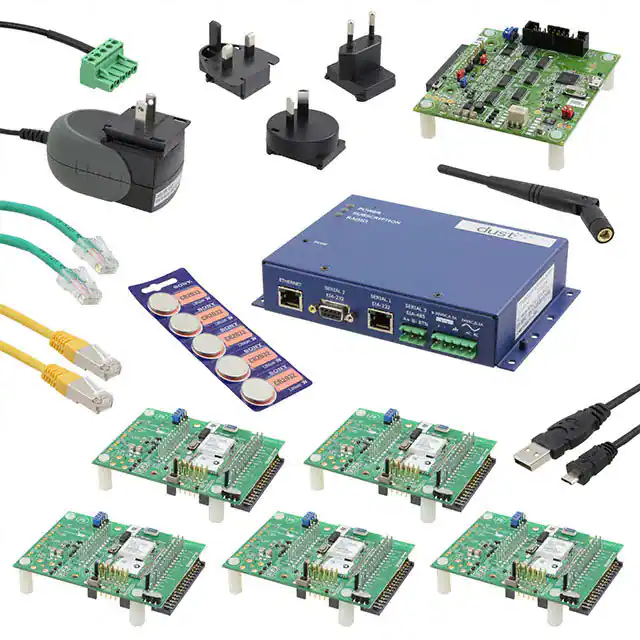
Analog Devices Inc. DC9022A
- Part No.:
- DC9022A
- Manufacturer:
- Analog Devices Inc.
- Category:
- RF, RFID, Wireless Evaluation Boards
- Package:
- Datasheet:
-
 DC9022A.pdf
- Description:
- KIT START SMARTMESH WIRELESSHART
- Quantity:
- Payment:

- Shipping:

Inventory:1,472
Please send an inquiry. Send us your inquiry, and we will respond immediately.
Product details
Overview
LTP5903-WHR from Analog Devices (formerly Linear Technology/Dust Networks) is a SmartMesh® WirelessHART embedded network manager PCB assembly designed for line-powered gateways and controllers. It implements full WirelessHART (IEC 62591) protocol stack, supports up to 500 nodes (LTP5903-WHRC variant), delivers >99.999% network reliability in industrial RF environments, and provides Ethernet and dual UART interfaces for data ingress/egress in process automation systems.
For engineers reviewing the LTP5903-WHR datasheet, LTP5903-WHR pinout, LTP5903-WHR application, or LTP5903-WHR equivalent, this page details its role as a standards-compliant, time-synchronized mesh network coordinator with deterministic power management, NIST-certified security, and field-proven sub-50 µA routing node compatibility.
Technical Context
The LTP5903-WHR integrates an IEEE 802.15.4 DSSS radio (2.4–2.4835 GHz, 250 kbps raw rate, –92.5 dBm sensitivity), a Linux-based embedded processor, and Dust's SmartMesh WirelessHART networking software. It performs real-time dynamic network optimization using mote-reported link quality metrics and enforces time-synchronized, frequency-hopping TDMA scheduling across spatially diverse topologies.
Its hardware interfaces include 10/100Base-T Ethernet (RX/TX differential pairs, nACT/nLINK LEDs), two LVTTL UARTs (Serial 1 at 115.2 kbps, Serial 2 with RTS/CTS), SD card interface, and battery-backed RTC (5–7 yr typical lifetime). All I/O operates at 3.3 V LVTTL levels with defined VIH/VIL thresholds and ±5 µA leakage.
Key Specifications
| Parameter | Value and Actual Design Meaning |
|---|---|
| Wireless Standard | Compliant with IEC 62591 WirelessHART; enables interoperable, certified industrial wireless sensor networks. |
| Max Network Size | Up to 500 nodes (LTP5903-WHRC); scales infrastructure for large-scale process monitoring without gateway stacking. |
| Radio Frequency | 2.4000–2.4835 GHz ISM band; supports 15 channels with 5 MHz separation and 2.7 MHz occupied bandwidth. |
| Receiver Sensitivity | –92.5 dBm at 50% packet error rate; ensures robust link budget in noisy industrial environments. |
| Power Input | +5V_IN supply: 4.0–5.5 VDC, 150–225 mA avg current; supports direct connection to industrial 5 V DC power rails. |
| 3.3 V Output | +3V3 regulated output: 3.13–3.47 V, up to 100 mA; powers external isolation or signal conditioning circuitry. |
| Operating Temp | –40 °C to +85 °C; qualified for deployment inside control cabinets and hazardous area boundary enclosures. |
Pinout & Package
Package: PCB assembly with two 40-pin FCI/Berg 61083-042400LF board-to-board connectors (J10 and J6); no IC-style package - it is a functional module requiring mounting and interconnect.
| Pin/Terminal | Circuit Role | Design Meaning |
|---|---|---|
| J10 Pin 3 (RX_P) | Ethernet Receive Positive | Differential input for 10/100Base-T; requires external magnetics and RJ-45 connector for PHY compliance. |
| J10 Pin 17 (S1_TX) | Serial 1 Transmit | LVTTL Type 1 output (VOH ≥ 2.6 V, IOL = 8 mA); used for embedded controller configuration via 115.2 kbps UART. |
| J6 Pin 28 (nRESET_IN) | Active-Low Reset Input | LVTTL Type 5 input (VIL ≤ 0.8 V); initiates cold boot; restore function active only within first 20 s after release. |
| J10 Pin 11/12/25 (+3V3) | Regulated 3.3 V Output | Three dedicated 3.3 V outputs (±5% tolerance, 100 mA total); powers user peripherals without loading main supply. |
| J6 Pin 32/34/36 (+5V_IN) | Main Power Input | Three parallel 5 V inputs (4.0–5.5 VDC); reduces trace impedance and improves supply stability under peak load. |
Key Features
| Feature | Design Value |
|---|---|
| Time-Synchronized Mesh Scheduling | Enables deterministic latency and collision-free channel access across all motes; eliminates retransmission overhead. |
| NIST-Certified Security | Meets FIPS 140-2 requirements for encryption key management and secure over-the-air provisioning (OTAP). |
| Dynamic Network Optimization | Automatically adjusts routing paths and slot assignments based on real-time link quality reports from motes. |
| Deterministic Power Management | Balances traffic load to extend battery life of field motes beyond 10 years; prevents hotspot formation in dense deployments. |
| XML API & Admin Toolset | Web-based and RPC-driven interfaces enable remote configuration, log retrieval, firmware updates, and NTP synchronization. |
Applications
| Process Automation Gateway | Industrial Asset Monitoring Hub |
|---|---|
|
Use Scenario: Integration into a DCS or PLC rack as primary WirelessHART gateway, aggregating temperature, pressure, and valve position data from 300+ field devices. IC Role / Device Role / Timing Role: Acts as network manager and time master - synchronizes all motes to UTC via NTP and distributes TDMA schedule slots. Use Value: Eliminates wired I/O modules and conduit runs; maintains >99.999% uptime even during EMI events near VFDs or welding equipment. |
Use Scenario: Mounted in explosion-proof enclosure at refinery perimeter to monitor tank level, corrosion sensors, and flare stack emissions. IC Role / Device Role / Timing Role: Serves as secure, certified ingress/egress point - terminates WirelessHART traffic and forwards encrypted data via Ethernet to cloud SCADA. Use Value: Meets IEC 62591 and ATEX/IECEx zone requirements; enables predictive maintenance without exposing legacy control systems to wireless traffic. |
| Smart Grid Substation Controller | Water/Wastewater SCADA Node |
|
Use Scenario: Deployed in outdoor substation cabinet to collect breaker status, transformer oil temp, and partial discharge readings from wireless sensors. IC Role / Device Role / Timing Role: Functions as hardened edge coordinator - manages mote sleep cycles, enforces AES-128 encryption per packet, and logs UTC-stamped events locally on SD card. Use Value: Operates reliably at –40 °C to +85 °C; SD interface enables offline datalogging during cellular backhaul outages. |
Use Scenario: Installed in municipal water pump station to coordinate pH, turbidity, flow, and chlorine residual sensors across multiple wells and tanks. IC Role / Device Role / Timing Role: Provides bidirectional command capability - sends setpoints to smart actuators and receives confirmation ACKs via deterministic routing. Use Value: Dual UARTs allow simultaneous connection to legacy RTU (Serial 1) and local HMI (Serial 2); reduces integration effort vs. custom gateway development. |
Availability
LTP5903-WHR is available at Aetrix Electronics and suitable for process automation gateways, industrial asset monitoring hubs, smart grid substations, water/wastewater SCADA nodes, and hazardous-area wireless infrastructure requiring stable component supply and long-term lifecycle support.
Supply support for LTP5903-WHR includes scheduled delivery planning, volume procurement assistance, BOM continuity management, traceable sourcing, and lifecycle availability coordination for OEM customers, industrial embedded developers, connected-device designers, and electronics production programs.
Manufacturer
Analog Devices acquired Linear Technology in 2017 and Dust Networks in 2011, integrating ultra-low-power wireless mesh technology into its industrial connectivity portfolio.
The LTP5903-WHR belongs to Analog Devices' SmartMesh WirelessHART product line, engineered specifically for mission-critical industrial process monitoring where deterministic timing, NIST-grade security, and carrier-class reliability are non-negotiable.
FAQ
What is the maximum number of nodes supported by the LTP5903-WHR?
The LTP5903-WHR supports up to 500 nodes in the WHRC variant and up to 250 nodes in the WHRB variant. This capacity is achieved through optimized TDMA slot allocation and dynamic route discovery within the SmartMesh WirelessHART stack. The LTP5903-WHR itself does not impose software licensing limits - node count is constrained by radio channel utilization and memory footprint of the embedded Linux runtime. For deployments exceeding 500 nodes, multiple LTP5903-WHR units can be deployed in hierarchical network topologies.
Does the LTP5903-WHR require an external antenna, and what are the specifications?
Yes, the LTP5903-WHR requires an external 2.4–2.4835 GHz antenna connected via MMCX jack. Per specification, the antenna must have 50 Ω impedance, ≤ +2 dBi gain, omni-directional pattern, and ≤ 3:1 VSWR. Pre-approved antennas are listed in section 10.1.2 of the official datasheet. Mounting must allow vertical orientation and protrusion outside any metal enclosure to maintain free-space radiation performance - internal PCB antennas or chip antennas are not supported.
Can the LTP5903-WHR operate without Ethernet, using only UART interfaces?
Yes, the LTP5903-WHR fully supports headless operation via Serial 1 or Serial 2 UARTs. Serial 1 (5-pin, 115.2 kbps) provides full XML API access for configuration and data exchange; Serial 2 (9-pin, 115.2 kbps with RTS/CTS) supports CLI for diagnostics and troubleshooting. Ethernet is optional but required for Admin Toolset web interface and NTP synchronization. All core WirelessHART management functions remain active regardless of Ethernet presence.
What is the purpose of the +3V3 output pins on the LTP5903-WHR?
The +3V3 output pins (J10 Pins 11, 12, 25 and J6 Pins 20, 21) deliver a regulated 3.3 V ±5% supply capable of sourcing up to 100 mA total. This rail is intended to power external circuitry such as isolated RS-485 transceivers, analog signal conditioners, or optocouplers - eliminating need for separate DC-DC converters. Current drawn from +3V3 increases load on the main +5V_IN supply, so total system power budget must account for both rails.
How is factory reset performed on the LTP5903-WHR, and what settings are restored?
Factory reset is triggered by asserting the Restore Switch input (J10 Pin 20) within 20 seconds after releasing nRESET_IN (J6 Pin 28). This action restores IP address, PPP settings, serial port parameters, username/password, wireless network ID, join key, ACL, logs, OTAP files, and mote list - effectively returning the LTP5903-WHR to out-of-box state. The debounce circuit on the Restore Switch input allows direct connection to a momentary push button without external filtering.
DC9022A Specifications
- Product attributes
- Attribute value
- Manufacturer:
- Analog Devices Inc.
- Series:
- Dust Networks®, SmartMesh®, WirelessHART
- Packaging:
- Bulk
- Product Status:
- Active
- Type:
- 802.15.4
- Frequency:
- 2.4GHz
- Contents:
- Board(s), Cable(s)
- Utilized IC / Part:
- LTP5901, LTP5903
DC9022A FAQ
1.How can I place an order for DC9022A through Aetrix?
Please submit a Request for Quotation (RFQ) for DC9022A on Aetrix. Our sales agent will provide a competitive quotation and guide you through the order confirmation once you accept the terms.
2.Are the price and stock information for DC9022A reliable?
The price and inventory of DC9022A are updated periodically and may fluctuate due to market conditions. Stock and pricing data are typically refreshed every 24 hours. Quotation validity for DC9022A is usually 5 days.
3.What payment methods are accepted for DC9022A?
We accept Wire Transfer, PayPal, Credit Card, Western Union, MoneyGram, and Escrow for DC9022A transactions.
Note: Certain payment methods may incur a processing fee.
4.How is shipping managed for DC9022A?
DC9022A orders can be shipped via leading logistics carriers, including DHL, UPS, FedEx, TNT, or Registered Mail.
Once your DC9022A order is processed, you will receive an email with the shipment details and tracking number.
Note: Tracking information may take up to 24 hours to appear. Express delivery typically takes 3–5 business days.
5.How can I obtain technical support or documentation for DC9022A?
For technical support, including DC9022A datasheets, pinout diagrams, or application guidance, please contact our engineering support team. They can provide detailed documentation and assistance for your DC9022A requirements.
6.How does Aetrix verify that DC9022A is sourced from the original manufacturer or authorized distributors?
All DC9022A products on Aetrix are procured from qualified distributors and authorized channels. Our dedicated quality assurance team conducts strict verification, including traceability checks and, if necessary, third-party testing. This ensures that DC9022A meets industry standards.
7.What is the process for return or replacement of DC9022A?
All DC9022A units undergo pre-shipment inspection (PSI). If there is an issue with DC9022A, returns or replacements are accepted under the following conditions:
1.Quantity discrepancies, incorrect items, or visible external defects (such as breakage or corrosion), acknowledged by Aetrix.
2.The issue is reported within 90 days of delivery.
3.The DC9022A part is unused and in its original packaging.
Return procedure for DC9022A:
1.Submit a request within 90 days.
2.Obtain a Return Material Authorization (RMA) from Aetrix.
DC9022A Tags
-
113991054
Seeed Technology Co., Ltd
-
SC0918
Raspberry Pi

-
113991114
Seeed Technology Co., Ltd
-
ESP32-C6-DEVKITM-1-N4
Espressif Systems
-
ESP32-DEVKITM-1
Espressif Systems
-
C008
M5Stack Technology Co., Ltd.
-
ESP32-C3-DEVKITC-02
Espressif Systems
-
ESP32-C6-DEVKITC-1-N8
Espressif Systems
-
DFR0478
DFRobot
-
102010448
Seeed Technology Co., Ltd
-
ESP32-DEVKITC-32E
Espressif Systems
-
ESP32-DEVKITC-32UE
Espressif Systems
Tech Hub

A practical engineering guide to 3.3V and 5V logic compatibility, input thresholds, resistor dividers, translator ICs, MOSFET level shifting, I2C pull-ups, timing limits and power-sequencing risks.

The 74HC595 uses push-pull logic outputs, while the TPIC6B595 uses 50 V open-drain DMOS sinks for higher-power loads. This guide compares timing, current limits, 3.3 V interfacing, load wiring, thermal…

The 74HC595 converts serial data into eight stable parallel outputs. This guide covers pin functions, shift and storage timing, OE and MR behavior, drive-current limits, cascading, voltage compatibilit…

A technical comparison of level-sensitive latches and edge-triggered flip-flops, covering timing windows, setup and hold limits, master–slave operation, time borrowing, race-through, HDL inference and…

A D latch stores one bit while Enable controls when data can pass. This reference covers gate-level operation, truth tables, transparency, setup and hold timing, LE versus OE, common ICs and practical …

An SR latch stores one bit through cross-coupled feedback. This engineering reference covers NOR and NAND implementations, truth tables, forbidden-state recovery, gated operation, switch debouncing, fa…

Latch circuits retain one bit through feedback. This technical reference covers SR and D latches, truth tables, transparency, timing limits, latch-versus-flip-flop behavior, applications and common log…

An engineering guide to LED driver operation, constant-current and constant-voltage outputs, linear and switching topologies, dimming, IC selection, calculations, replacement compatibility, and fault c…

Operational amplifier guide covering op amp basics, feedback, ideal vs real op amps, common configurations, buffer circuits, offset, bias current, gain-bandwidth, slew rate, rail-to-rail limits and sel…

Jumper cables guide covering safe connection order, red and black clamp placement, final ground connection, cable gauge, length, clamp quality, copper vs CCA cables, jump starter comparison and battery…


