
 My Inquiry
 My Account


Texas Instruments DP83TC812RRHARQ1
- Part No.:
- DP83TC812RRHARQ1
- Manufacturer:
- Texas Instruments
- Category:
- Drivers, Receivers, Transceivers
- Package:
- 36-VFQFN Exposed Pad
- Datasheet:
-
 DP83TC812RRHARQ1.pdf
- Description:
- IC TXRX FULL/HALF 4/4 36VQFN
- Quantity:
- Payment:

- Shipping:

Inventory:6,456
Please send an inquiry. Send us your inquiry, and we will respond immediately.
Product details
Overview
DP83TC812RRHARQ1 from Texas Instruments is an AEC-Q100 Grade 1 automotive Ethernet PHY transceiver compliant with IEEE 802.3bw (100BASE-T1) and Open Alliance TC-10, supporting MII/RMII/RGMII MAC interfaces, operating from –40°C to +125°C, and consuming <230 mW in active mode for ADAS and gateway applications.
For engineers reviewing the DP83TC812RRHARQ1 datasheet, DP83TC812RRHARQ1 pinout, DP83TC812RRHARQ1 application, or DP83TC812RRHARQ1 equivalent, this page delivers verified technical context, real-world interface behavior, diagnostic capability details, and validated alternative options for automotive Ethernet system design.
Technical Context
The DP83TC812RRHARQ1 implements a full 100BASE-T1 physical layer with integrated low-pass filter on the MDI side for Level IV emissions compliance and supports TC-10 sleep mode with <20 µA quiescent current. It integrates IEEE 1588 SFD detection and 802.3br frame pre-emption for TSN timing-critical networks.
Its flexible xMII interface supports MII, RMII, RGMII, and SGMII with configurable I/O voltages (1.8V/2.5V/3.3V), optional separate VDDMAC rail, and programmable strap/register control of LED/GPIO/CLKOUT functions across all operational modes.
Key Specifications
| Parameter | Value and Actual Design Meaning |
|---|---|
| Standard Compliance | IEEE 802.3bw 100BASE-T1 and Open Alliance TC-10 - enables single-pair automotive Ethernet with wake-on-frame and ultra-low sleep current. |
| Operating Temperature | –40°C to +125°C ambient - qualified per AEC-Q100 Grade 1 for under-hood and domain controller deployment. |
| Power Consumption | <230 mW active - reduces thermal load in densely packed ECUs without compromising link robustness. |
| EMC Performance | SAE J2962-3 compliant and passes Open Alliance Level IV emissions - eliminates need for external common-mode chokes in most layouts. |
| ESD Robustness | ±8 kV HBM on pins 12/13, IEC61000-4-2 Level 4 contact discharge - ensures reliability in high-noise vehicle environments. |
| Diagnostic Tools | Integrated SQI, TDR, ESD event counter, voltage sensor, PRBS BIST, and loopbacks - enables in-field link health monitoring without external test equipment. |
Pinout & Package
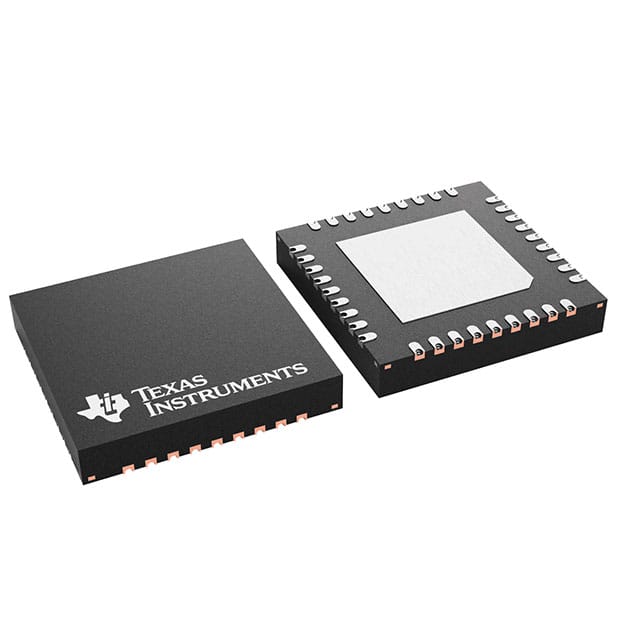
DP83TC812RRHARQ1 uses a 36-pin VQFN wettable flank package (6.00 mm × 6.00 mm) with exposed thermal pad (DAP) requiring direct connection to power ground. Ground escape pins (GND_ESC, Pins 17/18) support optimized PCB layout but are not substitutes for DAP grounding.
| Pin/Terminal | Circuit Role | Design Meaning |
|---|---|---|
| TRD_P / TRD_M (Pins 12/13) | Differential MDI interface | 100BASE-T1 transmit/receive pair - bidirectional, IEEE 802.3bw-compliant, referenced to VDDA; requires no external magnetics. |
| VDDA (Pin 11) | Analog core supply | 3.3 V regulated supply for PHY analog circuitry - decoupling with 0.47 µF + 0.01 µF ceramics mandatory for jitter and EMI control. |
| VDDIO (Pin 34) | General I/O supply | Configurable 1.8 V / 2.5 V / 3.3 V rail for MDIO, MDC, GPIOs, and LEDs - sets voltage domain for Pins 1, 2, 3, 4, 5, 6, 35, 36. |
| VDDMAC (Pin 22) | MAC interface supply | Independent 1.8 V / 2.5 V / 3.3 V rail for xMII signals (RX_D[3:0], TX_D[3:0], RX_CLK, TX_CLK, etc.) - enables mixed-voltage SoC interfacing. |
| WAKE (Pin 8) | TC-10 wake input/output | Active-HIGH input to exit TC-10 sleep; also supports wake forwarding to other PHYs - internal 455 kΩ pulldown prevents spurious wake events. |
| INH (Pin 10) | TC-10 inhibit output | Active-HIGH open-drain status indicator - Hi-Z during TC-10 sleep, HIGH otherwise; requires external 2–10 kΩ pull-down for TC-10 circuit compliance. |
Key Features
| Feature | Design Value |
|---|---|
| TC-10 Sleep Mode | <20 µA sleep current with full wake-on-frame capability - meets OEM requirements for always-on network nodes with minimal battery drain. |
| Integrated Diagnostic Toolkit | Real-time ESD event counter, TDR-based cable fault location, SQI link quality metric, and PRBS BIST - replaces external test hardware for production validation and field diagnostics. |
| xMII Interface Flexibility | Hardware-strappable MII/RMII/RGMII/SGMII support with independent VDDMAC - allows reuse of same PHY across multiple SoC platforms without redesign. |
| Functional Safety Capability | Documentation package available for ISO 26262 ASIL-B system integration - includes FIT rate data, failure mode analysis, and safety mechanism coverage reports. |
| EMI-Optimized MDI Design | On-die low-pass filter meeting Open Alliance Level IV emissions - eliminates discrete LC filters and reduces BOM cost and board area. |
Applications
| ADAS Sensor Fusion Hub | Central Gateway ECU |
|---|---|
|
Use Scenario: Aggregating camera, radar, and ultrasonic sensor data over lightweight twisted-pair cabling in front-end ADAS domain controllers. IC Role / Device Role / Timing Role: 100BASE-T1 PHY providing deterministic low-latency link layer bridging between sensors and central processor. Use Value: Enables TC-10 wake-on-event operation to maintain sensor readiness while drawing <20 µA during idle - critical for parking-assist and surround-view systems. |
Use Scenario: Interconnecting zonal ECUs, telematics units, and infotainment systems via automotive Ethernet backbone. IC Role / Device Role / Timing Role: High-integrity 100BASE-T1 transceiver supporting TSN frame pre-emption (802.3br) for time-synchronized control traffic. Use Value: Delivers sub-1 µs timestamp resolution via IEEE 1588 SFD detection and integrated diagnostics for continuous network health monitoring. |
| Body Control Module (BCM) | Automotive Telematics Unit |
|
Use Scenario: Replacing legacy LIN/CAN clusters with Ethernet-connected lighting, HVAC, and door modules in next-gen body electronics. IC Role / Device Role / Timing Role: Low-power PHY enabling partial networking where only select modules remain awake for remote command response. Use Value: Achieves <230 mW active power and AEC-Q100 Grade 1 operation - sustains reliable communication in high-temperature cabin environments. |
Use Scenario: Secure OTA update delivery and cloud connectivity via cellular-to-Ethernet bridging in vehicle telematics gateways. IC Role / Device Role / Timing Role: Robust 100BASE-T1 interface with SAE J2962-3 EMC compliance for noisy RF-rich under-dash locations. Use Value: Integrated ESD sensor and voltage monitoring provide real-time fault logging during wireless firmware updates - improving update success rate. |
Equivalent & Alternatives
The following parts are listed as comparable options for similar automotive 100BASE-T1 PHY applications.
| Alternative Part | Technical Difference | Application Difference | Selection Advice |
|---|---|---|---|
| DP83TC811RQ1 | No SGMII support; identical pinout and footprint; lacks IEEE 1588 SFD and TSN pre-emption. | Suitable for non-TSN basic ADAS links where SGMII is unused and lower cost is prioritized. | Select when SGMII interface and frame pre-emption are unnecessary - reduces software complexity and BOM cost. |
| DP83TC814SRQ1 | Includes SGMII and enhanced diagnostic features; same VQFN-36 package; higher active power (~260 mW). | Better suited for high-throughput gateway applications requiring SGMII uplink to switch fabric. | Choose when SGMII connectivity to Ethernet switches or multi-gigabit backplanes is required - maintains layout compatibility. |
Compared with DP83TC811RQ1, DP83TC812RRHARQ1 adds SGMII and TSN capabilities at minimal layout impact; versus DP83TC814SRQ1, it trades minor power efficiency for identical footprint and lower cost - making it optimal for mid-tier automotive Ethernet nodes.
Availability
DP83TC812RRHARQ1 is available at Aetrix Electronics and suitable for ADAS sensor fusion hubs, central gateway ECUs, and automotive telematics units requiring stable component supply, long-term automotive lifecycle support, and traceable sourcing.
Supply support for DP83TC812RRHARQ1 includes scheduled delivery planning, volume procurement assistance, BOM continuity management, traceable sourcing, and lifecycle availability coordination for OEM customers, industrial embedded developers, connected-device designers, and electronics production programs.
Manufacturer
Texas Instruments is a global semiconductor leader specializing in analog, embedded processing, and automotive ICs, with decades of automotive qualification expertise and functional safety infrastructure.
The DP83TC812RRHARQ1 belongs to TI's PHYTER™ automotive Ethernet portfolio, designed specifically for deterministic, low-power, and EMC-robust 100BASE-T1 networking in safety-critical vehicle domains.
FAQ
What is the primary Ethernet standard supported by DP83TC812RRHARQ1?
DP83TC812RRHARQ1 supports IEEE 802.3bw 100BASE-T1, the foundational automotive Ethernet standard for 100 Mbps over unshielded single twisted-pair cabling. It is fully compliant with Open Alliance specifications including TC-10 sleep/wake and Level IV emissions - ensuring interoperability across Tier 1 suppliers and OEM platforms. The DP83TC812RRHARQ1 does not support 1000BASE-T1 or 10BASE-T1S.
Does DP83TC812RRHARQ1 support SGMII interface?
No, DP83TC812RRHARQ1 does not support SGMII. It supports MII, RMII, and RGMII MAC interfaces only. This is confirmed in the device comparison table (Section 4 of SNLS654D), which explicitly lists "No" for SGMII support in the DP83TC812R-Q1 variant. The DP83TC812S-Q1 variant supports SGMII, but DP83TC812RRHARQ1 corresponds to the "R" suffix and therefore excludes SGMII functionality.
What is the maximum allowable junction temperature for DP83TC812RRHARQ1?
The absolute maximum junction temperature (TJ) for DP83TC812RRHARQ1 is 150°C, as specified in Section 6.1 of the official datasheet (SNLS654D). This rating applies across its full AEC-Q100 Grade 1 operating range (–40°C to +125°C ambient), and thermal design must ensure sustained operation remains within this limit using appropriate PCB copper area, thermal vias, and DAP grounding.
How does DP83TC812RRHARQ1 achieve TC-10 compliance?
DP83TC812RRHARQ1 achieves TC-10 compliance through hardware-enforced ultra-low sleep current (<20 µA), dedicated WAKE and INH pins with defined electrical behavior, and guaranteed wake-on-frame detection. Its TC-10 state transitions are validated per Open Alliance TC-10 v2.0, and the device enters and exits sleep without host CPU intervention - enabling autonomous network node operation in modern vehicle architectures.
Can DP83TC812RRHARQ1 be used in designs requiring ISO 26262 functional safety certification?
Yes, DP83TC812RRHARQ1 is functional safety-capable: TI provides a dedicated functional safety documentation package including FMEDA reports, safety analysis summaries, and FIT rate data to support ISO 26262 ASIL-B system-level development. While the DP83TC812RRHARQ1 itself is not ASIL-certified, its documented safety mechanisms and failure modes enable integration into ASIL-B compliant automotive systems.
DP83TC812RRHARQ1 Specifications
- Product attributes
- Attribute value
- Manufacturer:
- Texas Instruments
- Series:
- -
- Package/Case:
- 36-VFQFN Exposed Pad
- Packaging:
- Tape & Reel (TR)
- Product Status:
- Active
- Type:
- Transceiver
- Protocol:
- Ethernet
- Number of Drivers/Receivers:
- 4/4
- Duplex:
- Full, Half
- Receiver Hysteresis:
- -
- Data Rate:
- -
- Voltage - Supply:
- 2.97V ~ 3.63V
- Operating Temperature:
- -40°C ~ 125°C (TA)
- Grade:
- Automotive
- Qualification:
- AEC-Q100
- Mounting Type:
- Surface Mount, Wettable Flank
- Supplier Device Package:
- 36-VQFN (6x6)
DP83TC812RRHARQ1 FAQ
1.How can I place an order for DP83TC812RRHARQ1 through Aetrix?
Please submit a Request for Quotation (RFQ) for DP83TC812RRHARQ1 on Aetrix. Our sales agent will provide a competitive quotation and guide you through the order confirmation once you accept the terms.
2.Are the price and stock information for DP83TC812RRHARQ1 reliable?
The price and inventory of DP83TC812RRHARQ1 are updated periodically and may fluctuate due to market conditions. Stock and pricing data are typically refreshed every 24 hours. Quotation validity for DP83TC812RRHARQ1 is usually 5 days.
3.What payment methods are accepted for DP83TC812RRHARQ1?
We accept Wire Transfer, PayPal, Credit Card, Western Union, MoneyGram, and Escrow for DP83TC812RRHARQ1 transactions.
Note: Certain payment methods may incur a processing fee.
4.How is shipping managed for DP83TC812RRHARQ1?
DP83TC812RRHARQ1 orders can be shipped via leading logistics carriers, including DHL, UPS, FedEx, TNT, or Registered Mail.
Once your DP83TC812RRHARQ1 order is processed, you will receive an email with the shipment details and tracking number.
Note: Tracking information may take up to 24 hours to appear. Express delivery typically takes 3–5 business days.
5.How can I obtain technical support or documentation for DP83TC812RRHARQ1?
For technical support, including DP83TC812RRHARQ1 datasheets, pinout diagrams, or application guidance, please contact our engineering support team. They can provide detailed documentation and assistance for your DP83TC812RRHARQ1 requirements.
6.How does Aetrix verify that DP83TC812RRHARQ1 is sourced from the original manufacturer or authorized distributors?
All DP83TC812RRHARQ1 products on Aetrix are procured from qualified distributors and authorized channels. Our dedicated quality assurance team conducts strict verification, including traceability checks and, if necessary, third-party testing. This ensures that DP83TC812RRHARQ1 meets industry standards.
7.What is the process for return or replacement of DP83TC812RRHARQ1?
All DP83TC812RRHARQ1 units undergo pre-shipment inspection (PSI). If there is an issue with DP83TC812RRHARQ1, returns or replacements are accepted under the following conditions:
1.Quantity discrepancies, incorrect items, or visible external defects (such as breakage or corrosion), acknowledged by Aetrix.
2.The issue is reported within 90 days of delivery.
3.The DP83TC812RRHARQ1 part is unused and in its original packaging.
Return procedure for DP83TC812RRHARQ1:
1.Submit a request within 90 days.
2.Obtain a Return Material Authorization (RMA) from Aetrix.
DP83TC812RRHARQ1 Tags

-
ATA6561-GAQW-N
Microchip Technology
-
ATA6561-GBQW-N
Microchip Technology
-
AM26LS32ACDR
Texas Instruments

-
SP485CN-L/TR
MaxLinear, Inc.
-
SP485EN-L/TR
MaxLinear, Inc.
-
SP485EEN-L/TR
MaxLinear, Inc.
-
SP485ECN-L/TR
MaxLinear, Inc.
-
THVD1400DR
Texas Instruments
-
AM26C31IDR
Texas Instruments

-
TLIN1021ADRQ1
Texas Instruments
-
MAX232IDR
Texas Instruments
-
AM26C32IDR
Texas Instruments
Tech Hub

A practical engineering guide to 3.3V and 5V logic compatibility, input thresholds, resistor dividers, translator ICs, MOSFET level shifting, I2C pull-ups, timing limits and power-sequencing risks.

The 74HC595 uses push-pull logic outputs, while the TPIC6B595 uses 50 V open-drain DMOS sinks for higher-power loads. This guide compares timing, current limits, 3.3 V interfacing, load wiring, thermal…

The 74HC595 converts serial data into eight stable parallel outputs. This guide covers pin functions, shift and storage timing, OE and MR behavior, drive-current limits, cascading, voltage compatibilit…

A technical comparison of level-sensitive latches and edge-triggered flip-flops, covering timing windows, setup and hold limits, master–slave operation, time borrowing, race-through, HDL inference and…

A D latch stores one bit while Enable controls when data can pass. This reference covers gate-level operation, truth tables, transparency, setup and hold timing, LE versus OE, common ICs and practical …

An SR latch stores one bit through cross-coupled feedback. This engineering reference covers NOR and NAND implementations, truth tables, forbidden-state recovery, gated operation, switch debouncing, fa…

Latch circuits retain one bit through feedback. This technical reference covers SR and D latches, truth tables, transparency, timing limits, latch-versus-flip-flop behavior, applications and common log…

An engineering guide to LED driver operation, constant-current and constant-voltage outputs, linear and switching topologies, dimming, IC selection, calculations, replacement compatibility, and fault c…

Operational amplifier guide covering op amp basics, feedback, ideal vs real op amps, common configurations, buffer circuits, offset, bias current, gain-bandwidth, slew rate, rail-to-rail limits and sel…

Jumper cables guide covering safe connection order, red and black clamp placement, final ground connection, cable gauge, length, clamp quality, copper vs CCA cables, jump starter comparison and battery…


