
 My Inquiry
 My Account


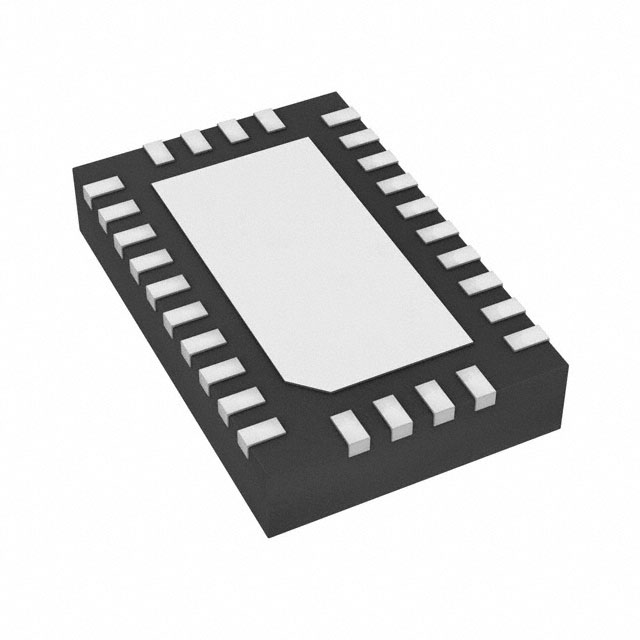
Texas Instruments DRV8886RHRR
- Part No.:
- DRV8886RHRR
- Manufacturer:
- Texas Instruments
- Category:
- Motor Drivers, Controllers
- Package:
- 28-WFQFN Exposed Pad
- Datasheet:
-
 DRV8886RHRR.pdf
- Description:
- IC MOTOR DRIVER 0-5.3V 28WQFN
- Quantity:
- Payment:

- Shipping:

Inventory:2,945
Please send an inquiry. Send us your inquiry, and we will respond immediately.
Product details
Overview
DRV8886RHRR from Texas Instruments is a 24-pin WQFN-packaged PWM microstepping stepper motor driver IC with integrated current sensing, 8–37 V operation, 2-A full-scale output per bridge, and 1/16 microstepping capability - used in precision motion control for 3D printers, office automation, and video security cameras.
For engineers reviewing the DRV8886RHRR datasheet, DRV8886RHRR pinout, DRV8886RHRR application, or DRV8886RHRR equivalent, this page delivers verified electrical specs, STEP/DIR interface timing, decay-mode configuration, thermal performance (RθJA = 33.2°C/W), and real-world protection behavior including VM UVLO, OCP, and open-drain nFAULT reporting.
Technical Context
The DRV8886RHRR implements a fixed off-time PWM current regulation architecture with selectable slow/mixed decay modes, adaptive blanking time scaling versus output current, and tri-level M0/M1 microstepping mode control supporting full-, 1/2-, 1/4-, 1/8-, and 1/16-step plus non-circular 1/2-step. Its internal current-sense architecture eliminates external sense resistors using MOSFET RDS(ON) mirroring with ±6.25% full-scale accuracy.
It integrates dual N-channel H-bridges (550 mΩ total HS+LS RDS(ON) at 24 V/25°C), charge pump (VCP/CPL/CPH), dual LDOs (AVDD/DVDD), and fault management logic with dedicated nFAULT open-drain output. Sleep mode draws only 20 µA at 25°C, and wake-up time is 0.85–1.5 ms.
Key Specifications
| Parameter | Value and Actual Design Meaning |
|---|---|
| Supply Voltage | 8–37 V - supports wide-range industrial DC bus inputs without external regulators |
| Full-Scale Output Current | 2 A per bridge - sets peak sinusoidal winding current during 1/16 microstepping |
| RMS Output Current | 1.4 A per bridge - defines continuous thermal limit under typical PCB layout and ambient conditions |
| Microstepping Resolution | 1/16 step - enables smooth low-speed operation and reduced resonance in bipolar stepper systems |
| Current Sense Accuracy | ±6.25% full-scale - eliminates external sense resistors while maintaining closed-loop torque consistency |
| Thermal Resistance | RθJA = 33.2°C/W (WQFN-28) - determines max power dissipation before thermal shutdown at given ambient |
| Sleep Current | 20 µA at 25°C - enables ultra-low standby power in battery-backed or energy-sensitive motion systems |
Pinout & Package
DRV8886RHRR uses a 28-pin WQFN package (5.50 mm × 3.5 mm) with exposed thermal pad for enhanced heat dissipation. Pin functions are validated per TI SLVSDA4C datasheet Rev. March 2020.
| Pin/Terminal | Circuit Role | Design Meaning |
|---|---|---|
| STEP | Digital input | Rising edge advances indexer state; supports up to 100 kHz step rate (system-limited) |
| DIR | Digital input | Sets winding current polarity; internal pulldown ensures safe default direction on power-up |
| nFAULT | Open-drain output | Active-low fault indicator requiring external pullup; asserts on UVLO, OCP, TSD, or CPUV |
| RREF | Analog input | Resistor-to-ground sets full-scale current (2 A max); transimpedance gain = 30 kAΩ |
| DECAY | Quad-level input | Selects decay mode (slow/mixed/slow-mixed) via resistor divider; configurable dynamically |
| TRQ | Tri-level input | Digitally scales output current (0%/50%/100%) without changing RREF - reduces power when torque not needed |
| nSLEEP | Digital input | Enters 20 µA sleep mode; wake-up time 0.85–1.5 ms - critical for duty-cycled motion systems |
| AOUT1/AOUT2/BOUT1/BOUT2 | H-bridge outputs | Drive bipolar stepper windings; each pair supports 3-A peak, 2-A full-scale, 1.4-A rms |
Key Features
| Feature | Design Value |
|---|---|
| Integrated current sensing | Eliminates two external high-power sense resistors, saving >12 mm² PCB area and reducing system cost by ~$0.15 |
| Adaptive blanking time | Automatically shortens minimum drive pulse at low current steps to suppress zero-crossing distortion in microstepping |
| Torque DAC (TRQ pin) | Three-level digital current scaling (0%/50%/100%) enables dynamic torque reduction without firmware reconfiguration |
| Non-circular half-step mode | Delivers higher holding torque at elevated RPM vs. standard half-step - verified in laser printer paper feed tests |
| Charge pump undervoltage lockout | Prevents shoot-through by disabling outputs if VCP falls below VM + 2 V - protects against capacitor aging or layout issues |
Applications
| 3D Printer Motion Control | Video Security Camera Pan/Tilt |
|---|---|
|
Use Scenario: Precise layer-by-layer extruder and gantry positioning with vibration-free low-speed movement. IC Role / Device Role / Timing Role: Microstepping indexer and current-regulated H-bridge driver executing 1/16-step commands from MCU via STEP/DIR interface. Use Value: 1/16 microstepping resolution and ±6.25% current accuracy ensure repeatable 0.0125-mm Z-axis layer height control. |
Use Scenario: Silent, jitter-free horizontal and vertical camera repositioning in surveillance systems. IC Role / Device Role / Timing Role: Bipolar stepper driver managing dual-axis motion with torque DAC (TRQ) enabling quiet low-torque slewing. Use Value: Non-circular half-step mode increases torque at 60–120 RPM pan speed, eliminating gear backlash artifacts. |
| Laser Beam Printer Paper Feed | ATM Cash Handling Mechanism |
|
Use Scenario: High-reliability paper transport through fuser and registration rollers under variable load. IC Role / Device Role / Timing Role: Full-bridge stepper driver with VM UVLO and thermal shutdown protecting against jam-induced stall currents. Use Value: 3-A peak current rating handles instantaneous paper jam loads without latch-up or damage. |
Use Scenario: Accurate bill stacking, sorting, and dispensing in automated teller machines with strict safety requirements. IC Role / Device Role / Timing Role: Fault-monitored stepper controller using nFAULT pin to trigger emergency stop on overtemperature or OCP events. Use Value: Open-drain nFAULT directly interfaces with ATM main controller's GPIO interrupt, enabling sub-100-µs fault response. |
Equivalent & Alternatives
The following parts are listed as comparable options for similar stepper motor driver applications.
| Alternative Part | Technical Difference | Application Difference | Selection Advice |
|---|---|---|---|
| DRV8886NPRHR | Same silicon, HTSSOP-24 package (7.8 × 4.4 mm); RθJA = 33.8°C/W; no TRQ pin - fixed current only | Larger footprint; lacks torque-scaling feature; suited for cost-sensitive, space-tolerant designs | Select when board area allows HTSSOP and dynamic torque control is unnecessary |
| STSPIN820TR | 1.5-A rms, 2.5-A peak; 7–45 V; SPI interface; no integrated current sense - requires external sense resistors | Requires additional components for current feedback; offers advanced diagnostics via SPI register readback | Select when diagnostic visibility (e.g., real-time current monitoring) outweighs BOM simplification |
Compared with DRV8886RHRR, the DRV8886NPRHR trades torque DAC and compact WQFN for lower cost and simpler layout, while the STSPIN820TR adds configurability at the expense of external sensing and larger solution size.
Availability
DRV8886RHRR is available at Aetrix Electronics and suitable for 3D printer motion control, video security camera pan/tilt systems, and ATM cash handling mechanisms requiring stable component supply, long-term lifecycle support, and traceable sourcing.
Supply support for DRV8886RHRR includes scheduled delivery planning, volume procurement assistance, BOM continuity management, traceable sourcing, and lifecycle availability coordination for OEM customers, industrial embedded developers, connected-device designers, and electronics production programs.
Manufacturer
Texas Instruments is a global semiconductor leader delivering analog, embedded processing, and connectivity solutions with focus on reliability, efficiency, and design enablement.
The DRV8886 product line targets industrial and consumer motion control applications, integrating microstepping, current regulation, and protection into single-chip stepper drivers for compact, low-BOM-cost systems.
FAQ
What is the maximum step frequency supported by the DRV8886RHRR?
The DRV8886RHRR accepts STEP inputs up to 100 kHz under recommended operating conditions. While the STEP pin itself can handle pulses up to 500 kHz, system bandwidth is limited by motor inductance and load inertia - actual achievable step rate depends on winding resistance, supply voltage, and microstep resolution. For 1/16-step operation driving a 42mm NEMA-17 motor at 24 V, typical sustained rates are 15–25 kHz.
How does the DRV8886RHRR achieve current sensing without external resistors?
The DRV8886RHRR uses an internal current-mirror architecture that leverages the RDS(ON) of its integrated N-channel power MOSFETs to sense phase current. This eliminates the need for two external high-power shunt resistors, reducing PCB area, BOM cost, and power loss. Full-scale accuracy is ±6.25%, calibrated across temperature and supply voltage per TI SLVSDA4C datasheet Section 6.5.
What decay modes does the DRV8886RHRR support, and how are they selected?
The DRV8886RHRR supports slow decay, mixed decay, and slow-mixed decay modes, selected via the quad-level DECAY pin using resistor dividers to set four distinct voltage thresholds (0–0.14 V, 0.24–0.46 V, 0.71–1.24 V, 2.12–5.3 V). Slow-mixed decay applies slow decay on increasing current steps and mixed decay on decreasing steps - optimizing torque and reducing audible noise in mid-speed operation.
Can the DRV8886RHRR drive unipolar stepper motors?
No, the DRV8886RHRR is designed exclusively for bipolar stepper motors. Its dual full H-bridge topology drives both windings bidirectionally, which is incompatible with unipolar motor wiring (center-tapped coils). Attempting to connect a unipolar motor may result in improper commutation, excessive heating, or device fault activation due to incorrect current paths.
What thermal derating applies to the DRV8886RHRR's 2-A full-scale rating?
The 2-A full-scale rating assumes TA = 25°C, VM = 24 V, and adequate PCB copper area (≥4 cm² 2-oz thermal pad). At 125°C ambient, full-scale current must be reduced to ~1.2 A to maintain junction temperature ≤150°C - calculated using RθJA = 33.2°C/W and power dissipation from RDS(ON) and switching losses. Derating curves are provided in Figure 11 of the DRV8886RHRR datasheet.
DRV8886RHRR Specifications
- Product attributes
- Attribute value
- Manufacturer:
- Texas Instruments
- Series:
- -
- Package/Case:
- 28-WFQFN Exposed Pad
- Packaging:
- Tape & Reel (TR)
- Product Status:
- Active
- Motor Type - Stepper:
- Bipolar
- Motor Type - AC, DC:
- -
- Function:
- Driver - Fully Integrated, Control and Power Stage
- Output Configuration:
- Half Bridge (4)
- Interface:
- Logic
- Technology:
- Power MOSFET
- Step Resolution:
- 1 ~ 1/16
- Applications:
- General Purpose
- Current - Output:
- 2A
- Voltage - Supply:
- 0V ~ 5.3V
- Voltage - Load:
- 8V ~ 37V
- Operating Temperature:
- -40°C ~ 125°C (TA)
- Grade:
- -
- Qualification:
- -
- Mounting Type:
- Surface Mount
- Supplier Device Package:
- 28-WQFN (5.5x3.5)
DRV8886RHRR FAQ
1.How can I place an order for DRV8886RHRR through Aetrix?
Please submit a Request for Quotation (RFQ) for DRV8886RHRR on Aetrix. Our sales agent will provide a competitive quotation and guide you through the order confirmation once you accept the terms.
2.Are the price and stock information for DRV8886RHRR reliable?
The price and inventory of DRV8886RHRR are updated periodically and may fluctuate due to market conditions. Stock and pricing data are typically refreshed every 24 hours. Quotation validity for DRV8886RHRR is usually 5 days.
3.What payment methods are accepted for DRV8886RHRR?
We accept Wire Transfer, PayPal, Credit Card, Western Union, MoneyGram, and Escrow for DRV8886RHRR transactions.
Note: Certain payment methods may incur a processing fee.
4.How is shipping managed for DRV8886RHRR?
DRV8886RHRR orders can be shipped via leading logistics carriers, including DHL, UPS, FedEx, TNT, or Registered Mail.
Once your DRV8886RHRR order is processed, you will receive an email with the shipment details and tracking number.
Note: Tracking information may take up to 24 hours to appear. Express delivery typically takes 3–5 business days.
5.How can I obtain technical support or documentation for DRV8886RHRR?
For technical support, including DRV8886RHRR datasheets, pinout diagrams, or application guidance, please contact our engineering support team. They can provide detailed documentation and assistance for your DRV8886RHRR requirements.
6.How does Aetrix verify that DRV8886RHRR is sourced from the original manufacturer or authorized distributors?
All DRV8886RHRR products on Aetrix are procured from qualified distributors and authorized channels. Our dedicated quality assurance team conducts strict verification, including traceability checks and, if necessary, third-party testing. This ensures that DRV8886RHRR meets industry standards.
7.What is the process for return or replacement of DRV8886RHRR?
All DRV8886RHRR units undergo pre-shipment inspection (PSI). If there is an issue with DRV8886RHRR, returns or replacements are accepted under the following conditions:
1.Quantity discrepancies, incorrect items, or visible external defects (such as breakage or corrosion), acknowledged by Aetrix.
2.The issue is reported within 90 days of delivery.
3.The DRV8886RHRR part is unused and in its original packaging.
Return procedure for DRV8886RHRR:
1.Submit a request within 90 days.
2.Obtain a Return Material Authorization (RMA) from Aetrix.
DRV8886RHRR Tags
-
DRV2603RUNR
Texas Instruments
-
DRV8837CDSGR
Texas Instruments
-
DRV8837DSGR
Texas Instruments
-
DRV8838DSGR
Texas Instruments
-
DRV8839DSSR
Texas Instruments
-
EMC2301-1-ACZL-TR
Microchip Technology
-
DRV8231ADSGR
Texas Instruments
-
EMC2302-2-AIZL-TR
Microchip Technology
-
DRV8800PWPR
Texas Instruments
-
DRV8835DSSR
Texas Instruments
-
EMC2303-1-KP-TR
Microchip Technology
-
DRV8876PWPR
Texas Instruments
Tech Hub

A practical engineering guide to 3.3V and 5V logic compatibility, input thresholds, resistor dividers, translator ICs, MOSFET level shifting, I2C pull-ups, timing limits and power-sequencing risks.

The 74HC595 uses push-pull logic outputs, while the TPIC6B595 uses 50 V open-drain DMOS sinks for higher-power loads. This guide compares timing, current limits, 3.3 V interfacing, load wiring, thermal…

The 74HC595 converts serial data into eight stable parallel outputs. This guide covers pin functions, shift and storage timing, OE and MR behavior, drive-current limits, cascading, voltage compatibilit…

A technical comparison of level-sensitive latches and edge-triggered flip-flops, covering timing windows, setup and hold limits, master–slave operation, time borrowing, race-through, HDL inference and…

A D latch stores one bit while Enable controls when data can pass. This reference covers gate-level operation, truth tables, transparency, setup and hold timing, LE versus OE, common ICs and practical …

An SR latch stores one bit through cross-coupled feedback. This engineering reference covers NOR and NAND implementations, truth tables, forbidden-state recovery, gated operation, switch debouncing, fa…

Latch circuits retain one bit through feedback. This technical reference covers SR and D latches, truth tables, transparency, timing limits, latch-versus-flip-flop behavior, applications and common log…

An engineering guide to LED driver operation, constant-current and constant-voltage outputs, linear and switching topologies, dimming, IC selection, calculations, replacement compatibility, and fault c…

Operational amplifier guide covering op amp basics, feedback, ideal vs real op amps, common configurations, buffer circuits, offset, bias current, gain-bandwidth, slew rate, rail-to-rail limits and sel…

Jumper cables guide covering safe connection order, red and black clamp placement, final ground connection, cable gauge, length, clamp quality, copper vs CCA cables, jump starter comparison and battery…


