
 My Inquiry
 My Account


UMW DS18B20
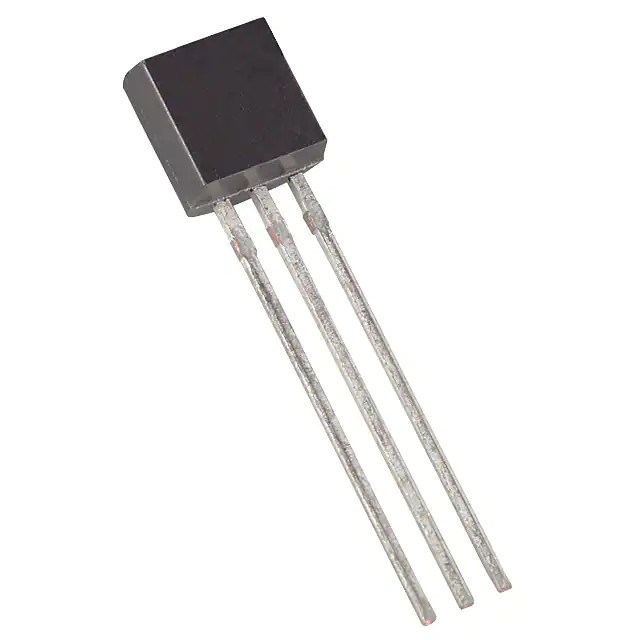
- Part No.:
- DS18B20
- Manufacturer:
- UMW
- Category:
- Analog and Digital Output
- Package:
- TO-226-3, TO-92-3 (TO-226AA)
- Datasheet:
-
 DS18B20.pdf
- Description:
- 11 B -55 ~ 125C 1-WIRE DIGITAL,
- Quantity:
- Payment:

- Shipping:

Inventory:1,658
Please send an inquiry. Send us your inquiry, and we will respond immediately.
Product details
Overview
DS18B20 from Maxim Integrated is a programmable-resolution 1-Wire digital thermometer with ±0.5°C accuracy from −10°C to +85°C, −55°C to +125°C operating range, and parasite-power capability requiring only DQ and GND pins. It delivers 9–12-bit temperature data over a single-wire bus and enables distributed thermal monitoring in HVAC control systems.
For engineers reviewing the DS18B20 datasheet, DS18B20 pinout, DS18B20 application, or DS18B20 equivalent, key selection considerations include parasitic vs. VDD-powered operation, 1-Wire multidrop topology support, resolution–conversion time tradeoff (750 ms at 12-bit), alarm trigger register persistence, and TO-92/SO/µSOP package compatibility with legacy thermal sensor footprints.
Technical Context
The DS18B20 implements a fully integrated 1-Wire interface with open-drain DQ pin, internal 64-bit ROM for device addressing, and scratchpad memory containing temperature register, TH/TL alarm thresholds, and configuration byte. Its 1-Wire protocol uses precise timing slots (tSLOT = 60–120 µs) and presence detection (tRSTL/tRSTH ≥ 480 µs) to coordinate master–slave communication without clock lines.
Temperature measurement relies on a calibrated silicon bandgap sensor with user-configurable resolution (9–12 bits), where each bit step corresponds to 0.5°C, 0.25°C, 0.125°C, or 0.0625°C. Alarm functionality compares converted values against nonvolatile EEPROM-stored TH/TL registers, and supports Alarm Search [ECh] to identify out-of-range nodes on shared buses.
Key Specifications
| Parameter | Value and Actual Design Meaning |
|---|---|
| Operating Range | −55°C to +125°C - supports industrial freezer, engine bay, and boiler monitoring without external conditioning. |
| Accuracy | ±0.5°C from −10°C to +85°C - meets Class B RTD tolerance for HVAC thermostatic control. |
| Resolution | 9–12-bit programmable - selectable via config register; 12-bit default yields 0.0625°C steps for precision calibration. |
| Conversion Time | 93.75 ms (9-bit) to 750 ms (12-bit) - longer times require strong pullup during parasite power mode. |
| Power Modes | VDD-supplied or parasite-powered - VDD grounded in parasite mode; DQ supplies all current via 4.7 kΩ pullup. |
| Interface | 1-Wire (single data line + GND) - eliminates UART/I²C routing complexity and enables >100-node daisy chains. |
| Unique ID | 64-bit laser-trimmed ROM - enables plug-and-play node identification and firmware-agnostic bus enumeration. |
Pinout & Package
DS18B20 is available in three industry-standard packages: 3-pin TO-92 (through-hole), 8-pin SO (150 mil), and 8-pin µSOP (surface-mount). Pin functions are identical across variants; N.C. pins are internally unconnected and must remain floating or grounded per layout guidelines.
| Pin/Terminal | Circuit Role | Design Meaning |
|---|---|---|
| GND (Pin 1, TO-92; Pin 5, SO/µSOP) | Reference ground | Common return path for DQ signaling and internal circuitry; must be low-impedance for stable parasite power operation. |
| DQ (Pin 2, TO-92; Pin 4, SO; Pin 1, µSOP) | 1-Wire bidirectional I/O | Open-drain data line carrying commands, temperature data, and parasitic power; requires external 4.7 kΩ pullup. |
| VDD (Pin 3, TO-92; Pin 3, SO; Pin 8, µSOP) | Optional supply input | Must be connected to 3.0–5.5 V for local power mode; tied to GND for parasite power operation. |
| N.C. (Pins 1,2,6,7,8 in SO; 2,3,5,6,7 in µSOP) | No connection | Internally unconnected; no routing or soldering required; avoid PCB traces to prevent noise coupling. |
Key Features
| Feature | Design Value |
|---|---|
| Parasite power operation | Eliminates VDD trace and decoupling capacitor - reduces BOM count and board area in space-constrained sensor nodes. |
| Nonvolatile alarm registers | TH/TL and config register retain settings across power cycles - enables field-deployed devices to maintain setpoints without host reprogramming. |
| 1-Wire multidrop capability | Single microcontroller GPIO can monitor >50 DS18B20s on one bus - simplifies wiring in building automation and server rack thermal mapping. |
| Programmable conversion resolution | Trade resolution for speed: 9-bit (93.75 ms) for fast ambient checks; 12-bit (750 ms) for calibration-grade measurements. |
| Integrated CRC validation | Scratchpad byte 8 and ROM CRC ensure data integrity - prevents erroneous temperature reads due to EMI or marginal timing. |
Applications
| Building HVAC Monitoring | Industrial Equipment Thermal Protection |
|---|---|
|
Use Scenario: Distributed temperature sensing across ductwork, chillers, and air handlers in commercial buildings. IC Role / Device Role / Timing Role: 1-Wire digital thermometer providing calibrated Celsius readings to HVAC controller via shared bus. Use Value: Single-wire topology cuts installation labor by >60% versus analog sensors; unique IDs eliminate manual address configuration. |
Use Scenario: Real-time hotspot detection inside motor drives, PLC cabinets, and transformer enclosures. IC Role / Device Role / Timing Role: Standalone thermal watchdog triggering shutdown if local temperature exceeds 105°C threshold. Use Value: Parasite power enables retrofit into legacy equipment without adding power wiring; alarm search identifies fault location automatically. |
| Consumer Appliance Temperature Control | Environmental Data Loggers |
|
Use Scenario: Precision oven cavity and refrigerator compartment sensing in smart kitchen appliances. IC Role / Device Role / Timing Role: High-accuracy (±0.5°C) digital sensor feeding closed-loop PID control algorithm in MCU. Use Value: Factory-calibrated accuracy removes need for system-level calibration; 12-bit resolution supports fine-tuned cooking profiles. |
Use Scenario: Long-term ambient temperature logging in greenhouses, cold-chain shipments, and museum storage. IC Role / Device Role / Timing Role: Low-quiescent-current (750 nA standby) node storing timestamped readings in external EEPROM. Use Value: Battery life extended to >2 years using parasite power + sleep-mode polling; CRC ensures data trustworthiness over months. |
Equivalent & Alternatives
The following parts are listed as comparable options for similar digital thermometer applications.
| Alternative Part | Technical Difference | Application Difference | Selection Advice |
|---|---|---|---|
| MAX31820 | Same 1-Wire interface and TO-92/SO packages; improved ±0.25°C accuracy from −10°C to +85°C; higher 1.5 mA active current. | Preferred for medical-grade or metrology applications requiring tighter tolerance; less suitable for ultra-low-power battery nodes. | Select MAX31820 when absolute accuracy outweighs power budget constraints and existing DS18B20 firmware can accommodate updated timing specs. |
| DS1822 | Lower-cost variant with same 1-Wire protocol and −55°C to +125°C range; reduced EEPROM endurance (10k vs. 50k writes); no parasite power support. | Suitable for cost-sensitive consumer goods where external VDD is guaranteed and alarm persistence is noncritical. | Choose DS1822 only when VDD is always present and TH/TL reprogramming frequency is <100x lifetime; not drop-in for parasite-power designs. |
Compared with DS18B20, MAX31820 offers higher accuracy at increased power cost, while DS1822 sacrifices EEPROM reliability and parasite power to reduce unit price - neither is pin-compatible without verifying VDD routing and firmware timing margins.
Availability
DS18B20 is available at Aetrix Electronics and suitable for HVAC environmental controls, industrial equipment thermal protection, and consumer appliance temperature regulation requiring stable component supply across multi-year production cycles.
Supply support for DS18B20 includes scheduled delivery planning, volume procurement assistance, BOM continuity management, traceable sourcing, and lifecycle availability coordination for OEM customers, industrial embedded developers, connected-device designers, and electronics production programs.
Manufacturer
Maxim Integrated (now part of Analog Devices) designs high-performance analog and mixed-signal ICs for industrial, communications, and computing markets, with emphasis on integration, reliability, and low-power operation.
The DS18B20 belongs to Maxim's 1-Wire sensor family, engineered specifically for distributed, low-wiring-count temperature monitoring in harsh or space-constrained environments - not general-purpose microcontrollers or analog front-ends.
FAQ
What is the maximum number of DS18B20 sensors that can operate on a single 1-Wire bus?
The DS18B20 uses a unique 64-bit ROM address, enabling theoretically unlimited devices on one bus. In practice, signal integrity limits reliable operation to ~50–100 units depending on cable length, pullup strength, and noise. For robust deployment beyond 30 nodes, use active repeaters or segment the bus with DS2409 dual-channel couplers. The DS18B20 itself imposes no software or hardware limit on node count.
Does DS18B20 support both parasite power and external VDD modes simultaneously?
No - the DS18B20 operates exclusively in one power mode at a time. When VDD is connected to a valid 3.0–5.5 V supply, parasite power is disabled. When VDD is grounded, the device draws all operating current from the DQ line via the 4.7 kΩ pullup. Mixing modes risks undefined behavior or damage; the DS18B20 does not auto-detect or switch between them.
How does resolution setting affect DS18B20 conversion time and accuracy?
DS18B20 conversion time scales linearly with resolution: 93.75 ms at 9-bit, 187.5 ms at 10-bit, 375 ms at 11-bit, and 750 ms at 12-bit. Accuracy remains ±0.5°C (−10°C to +85°C) regardless of resolution - higher bit depth improves quantization granularity (0.0625°C step at 12-bit) but does not enhance sensor intrinsic error.
Can DS18B20 alarm registers be written and read over the 1-Wire bus?
Yes - TH and TL alarm thresholds are stored in bytes 2 and 3 of the scratchpad and persist in EEPROM after issuing Copy Scratchpad [48h]. They are accessed via standard 1-Wire commands: Write Scratchpad [4Eh] to load values, Read Scratchpad [BEh] to verify, and Recall E2 [B8h] to reload from EEPROM. Alarm Search [ECh] then identifies devices exceeding these thresholds.
Is DS18B20 compatible with modern microcontrollers lacking native 1-Wire peripherals?
Yes - the DS18B20's 1-Wire protocol is bit-banged in firmware using any GPIO with precise timing control (e.g., ARM Cortex-M SysTick, ESP32 RMT, PIC PWM modules). Libraries exist for Arduino, PlatformIO, and Zephyr; critical timing parameters (tSLOT = 60–120 µs, tRSTL ≥ 480 µs) are achievable on MCUs running ≥1 MHz. No dedicated hardware peripheral is required.
DS18B20 Specifications
- Product attributes
- Attribute value
- Manufacturer:
- UMW
- Series:
- UMW DS18B20
- Package/Case:
- TO-226-3, TO-92-3 (TO-226AA)
- Packaging:
- Bulk
- Product Status:
- Active
- Sensor Type:
- Digital, Local
- Sensing Temperature - Local:
- -55°C ~ 125°C
- Sensing Temperature - Remote:
- -
- Output Type:
- 1-Wire®
- Voltage - Supply:
- 2.5V ~ 5.5V
- Resolution:
- 9 b, 10 b, 11 b, 12 b
- Features:
- Standby Mode
- Accuracy - Highest (Lowest):
- ±0.4°C
- Test Condition:
- -10°C ~ 70°C
- Operating Temperature:
- -55°C ~ 125°C
- Mounting Type:
- Through Hole
- Grade:
- -
- Qualification:
- -
- Supplier Device Package:
- TO-92
DS18B20 FAQ
1.How can I place an order for DS18B20 through Aetrix?
Please submit a Request for Quotation (RFQ) for DS18B20 on Aetrix. Our sales agent will provide a competitive quotation and guide you through the order confirmation once you accept the terms.
2.Are the price and stock information for DS18B20 reliable?
The price and inventory of DS18B20 are updated periodically and may fluctuate due to market conditions. Stock and pricing data are typically refreshed every 24 hours. Quotation validity for DS18B20 is usually 5 days.
3.What payment methods are accepted for DS18B20?
We accept Wire Transfer, PayPal, Credit Card, Western Union, MoneyGram, and Escrow for DS18B20 transactions.
Note: Certain payment methods may incur a processing fee.
4.How is shipping managed for DS18B20?
DS18B20 orders can be shipped via leading logistics carriers, including DHL, UPS, FedEx, TNT, or Registered Mail.
Once your DS18B20 order is processed, you will receive an email with the shipment details and tracking number.
Note: Tracking information may take up to 24 hours to appear. Express delivery typically takes 3–5 business days.
5.How can I obtain technical support or documentation for DS18B20?
For technical support, including DS18B20 datasheets, pinout diagrams, or application guidance, please contact our engineering support team. They can provide detailed documentation and assistance for your DS18B20 requirements.
6.How does Aetrix verify that DS18B20 is sourced from the original manufacturer or authorized distributors?
All DS18B20 products on Aetrix are procured from qualified distributors and authorized channels. Our dedicated quality assurance team conducts strict verification, including traceability checks and, if necessary, third-party testing. This ensures that DS18B20 meets industry standards.
7.What is the process for return or replacement of DS18B20?
All DS18B20 units undergo pre-shipment inspection (PSI). If there is an issue with DS18B20, returns or replacements are accepted under the following conditions:
1.Quantity discrepancies, incorrect items, or visible external defects (such as breakage or corrosion), acknowledged by Aetrix.
2.The issue is reported within 90 days of delivery.
3.The DS18B20 part is unused and in its original packaging.
Return procedure for DS18B20:
1.Submit a request within 90 days.
2.Obtain a Return Material Authorization (RMA) from Aetrix.
DS18B20 Tags
-
MCP9700T-E/TT
Microchip Technology
-
MCP9700T-E/LT
Microchip Technology
-
MCP9701T-E/TT
Microchip Technology
-
MCP9701T-E/LT
Microchip Technology
-
TMP235A4DBZR
Texas Instruments
-
MCP9700AT-E/TT
Microchip Technology
-
MCP9700AT-E/LT
Microchip Technology
-
MCP9701AT-E/LT
Microchip Technology
-
MCP9701AT-E/TT
Microchip Technology
,TO-226_straightlead.jpg)
-
LM335Z
STMicroelectronics
-
TMP1075NDRLR
Texas Instruments
-
TMP1075DGKR
Texas Instruments
Tech Hub

An engineering guide to LED driver operation, constant-current and constant-voltage outputs, linear and switching topologies, dimming, IC selection, calculations, replacement compatibility, and fault c…

Operational amplifier guide covering op amp basics, feedback, ideal vs real op amps, common configurations, buffer circuits, offset, bias current, gain-bandwidth, slew rate, rail-to-rail limits and sel…

Jumper cables guide covering safe connection order, red and black clamp placement, final ground connection, cable gauge, length, clamp quality, copper vs CCA cables, jump starter comparison and battery…

LDO regulator guide covering low dropout voltage, power dissipation, thermal design, PSRR, output noise, capacitor stability, adjustable LDO circuits, LDO vs buck converter and datasheet selection chec…

Conditional Access Module guide covering CAM meaning, CI/CI+ interface, smart card authorization, DVB security workflow, TV and set-top box compatibility, internal electronics, ESD protection, connecto…

Guide to electronic component obsolescence covering EOL risk, PCN/PDN notices, last-time buy planning, replacement options, form-fit-function validation, counterfeit risk and BOM lifecycle management.

18650 battery guide covering lithium-ion cell basics, 3.6V/3.7V voltage, 4.2V charging, mAh and Wh capacity, protected cells, chargers, BMS, series-parallel packs, holders, welding and sourcing checks.…

Hall effect sensor guide covering working principle, linear and digital sensors, Arduino circuits, current sensing, speed detection, automotive applications, A3144 examples, signal filtering and datash…

Product Change Notification guide for electronic components, covering PCN meaning, PCN vs PDN/EOL, common change types, risk levels, form-fit-function review, engineering validation, BOM control, LTB/L…

A practical guide to blend door actuators, covering HVAC function, symptoms, location, AC and heater issues, reset and calibration, replacement cost, electrical diagnosis, compatibility checks, and rep…


