
 My Inquiry
 My Account


Analog Devices Inc./Maxim Integrated DS2250-32-16+
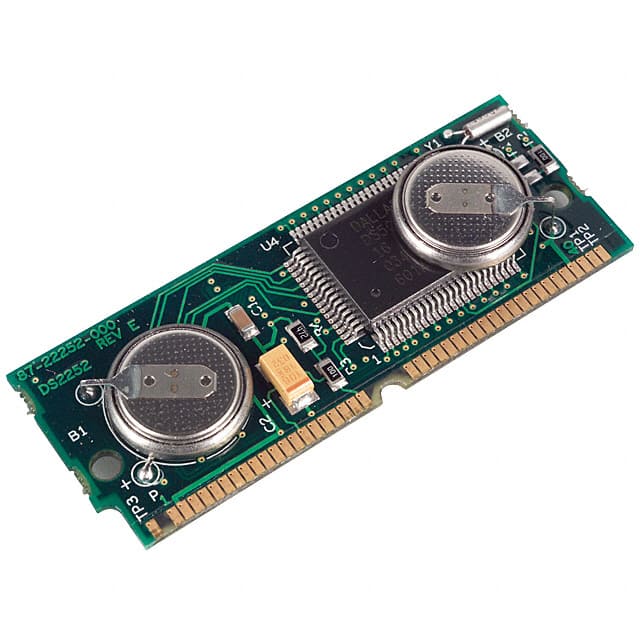
- Part No.:
- DS2250-32-16+
- Manufacturer:
- Analog Devices Inc./Maxim Integrated
- Category:
- Microcontrollers
- Package:
- 40-SIMM
- Datasheet:
-
 DS2250-32-16+.pdf
- Description:
- IC MCU 8BIT 32KB NVSRAM 40SIMM
- Quantity:
- Payment:

- Shipping:

Inventory:4,628
Please send an inquiry. Send us your inquiry, and we will respond immediately.
Product details
Overview
DS2250-32-16+ from Maxim Integrated is an 8-bit 8051-compatible soft microcontroller module with 32kB nonvolatile SRAM, 16MHz max crystal speed, and no integrated real-time clock. It operates across 0°C to +70°C, supports serial bootstrap loading and in-system program modification, and delivers 48mA typical operating current at 16MHz for embedded control applications requiring persistent memory retention without backup power.
For engineers reviewing the DS2250-32-16+ datasheet, DS2250-32-16+ pinout, DS2250-32-16+ application, or DS2250-32-16+ equivalent, key selection considerations include nonvolatile RAM size, absence of RTC, RoHS-compliant 40-pin SIMM package, and compatibility with standard 8051 development tools and Intel HEX programming workflows.
Technical Context
The DS2250-32-16+ implements a fully 8051-object-code-compatible CPU core with on-chip nonvolatile SRAM configured as both program and data memory. Its memory map supports separate 64kB program and data address spaces, with internal 32kB NV RAM partitioned via MCON register settings to allocate banks for code or data use.
It features dual timer/event counters, full-duplex UART (P3.0/P3.1), 32 parallel I/O lines across Ports 0–3, and hardware-assisted power-fail detection with early-warning interrupt and reset. Serial bootstrap loading operates at 300–9600 bps using ASCII CR commands, while parallel programming uses 87C51H-timing-compatible cycles with VPP = 13V.
Key Specifications
| Parameter | Value and Actual Design Meaning |
|---|---|
| Core Architecture | 8051-compatible 8-bit CPU; executes standard 8051 object code and supports existing cross-assemblers, C compilers, and debuggers. |
| Nonvolatile Memory | 32kB CMOS SRAM retains program/data for ≥10 years at room temperature without VCC; no battery or capacitor required. |
| Max Clock Speed | 16MHz crystal oscillator; supports external clock drive with min 15ns high/low times at 16MHz. |
| Operating Voltage | 4.05V–4.65V minimum VCC; power-fail warning triggers at VPFW = 4.15–4.75V to enable graceful shutdown. |
| I/O Capability | 32 general-purpose I/O lines: Port 0 (open-drain, requires pullups), Ports 1–3 (quasi-bidirectional); supports expanded bus mode with ALE/PSEN/WR/RD. |
| Serial Interface | Full-duplex UART on P3.0 (RXD) and P3.1 (TXD); Mode 0 timing defined with 12tCLK cycle time; compatible with RS232C via level shifter. |
| Power Consumption | 48mA typical ICC at 16MHz; 6.2mA in idle mode at 8MHz; 80µA stop mode current enables ultra-low-power retention. |
Pinout & Package
DS2250-32-16+ is housed in a 40-pin SIMM (Single In-line Memory Module) package with 2.65″ × 2.385″ footprint, 0.050″ lead pitch, and RoHS-compliant lead-free finish.
| Pin/Terminal | Circuit Role | Design Meaning |
|---|---|---|
| 1,3,5,7,9,11,13,15 | P1.0–P1.7 | Quasi-bidirectional I/O port; no external pullups needed; usable for general control or peripheral interfacing. |
| 17 | RST | Active-high reset input; internally pulled down; eliminates need for external RC reset circuit. |
| 19,21 | P3.0 (RXD), P3.1 (TXD) | Full-duplex UART interface; requires level translation for direct PC COM port connection. |
| 23,25 | P3.2 (INT0), P3.3 (INT1) | Active-low external interrupt inputs; support edge-triggered or level-sensitive wake-up events. |
| 27,29 | P3.4 (T0), P3.5 (T1) | Timer/counter external input pins; accept TTL-level pulses for event counting or gated timing. |
| 31,33 | P3.6 (WR), P3.7 (RD) | Expanded bus strobes; enable external memory write/read cycles when EA = VCC and ALE active. |
| 35,37 | XTAL2, XTAL1 | Crystal oscillator connections; XTAL1 is inverter input, XTAL2 is output; supports 1–16MHz crystals. |
| 39 | GND | Digital logic ground reference; must be connected to system common ground plane. |
| 2,4,6,8,10,12,14,16,18,20,22,24,26,28,30,32,34,36,38,40 | VCC, P0.0–P0.7, P2.0–P2.7, EA, ALE, PSEN | VCC = +5V supply; Port 0 = open-drain multiplexed address/data bus (requires pullups); Port 2 = upper address byte in expanded mode; EA = external access control; ALE = address latch enable; PSEN = program store enable for external ROM or bootstrap loader activation. |
Key Features
| Feature | Design Value |
|---|---|
| Nonvolatile Program/Data Memory | 32kB embedded NV SRAM retains firmware and configuration across power cycles-no EEPROM emulation or external flash required. |
| In-System Programmability | Serial bootstrap loader accepts Intel HEX over UART at 300–9600 bps; enables final-stage programming in end equipment without dedicated programmers. |
| Self-Modifying Code Support | CPU can execute instructions from and write to its own NV RAM-enables dynamic firmware updates, field calibration, and adaptive control logic. |
| Hardware Power-Fail Management | Dedicated VPFW comparator generates early-warning interrupt before reset; allows critical data save and state preservation within guaranteed hold time. |
| 8051 Development Compatibility | Uses identical instruction set and memory map conventions; integrates seamlessly with Keil, IAR, and SDCC toolchains without porting effort. |
Applications
| Industrial Data Logger | Secure Metering Terminal |
|---|---|
Use Scenario: Standalone environmental sensor node logging temperature, humidity, and voltage readings every 5 minutes to local NV memory, transmitting batches hourly via RS485. IC Role / Device Role / Timing Role: Primary controller executing data acquisition, timestamping (via software counter), NV storage management, and serial protocol handling. Use Value: 32kB nonvolatile SRAM stores >100,000 records without battery; power-fail interrupt ensures no loss during brownout; 8051 compatibility accelerates firmware reuse from legacy meter designs. | Use Scenario: Electricity meter with tamper detection, consumption accumulation, and secure firmware update capability deployed in unattended outdoor cabinets. IC Role / Device Role / Timing Role: Secure host MCU managing metrology IC interface, encryption key storage, and authenticated firmware loading via isolated UART. Use Value: Self-modifying code enables field-deployable security patches; 10-year NV RAM data retention meets utility-grade longevity requirements; RoHS-compliant package satisfies regional compliance mandates. |
| Medical Diagnostic Handheld | Factory Automation Controller |
Use Scenario: Portable ECG analyzer capturing waveform data, performing real-time QRS detection, and storing session reports for later USB upload. IC Role / Device Role / Timing Role: Real-time signal processor and data manager-handles ADC interface, digital filtering, and NV buffer management. Use Value: 48mA operating current at 16MHz sustains continuous acquisition; serial loader permits post-manufacture calibration upload; open-drain Port 0 simplifies connection to diverse sensor interfaces. | Use Scenario: PLC I/O module controlling solenoid valves and reading limit switches in automotive assembly line stations with frequent power cycling. IC Role / Device Role / Timing Role: Deterministic I/O coordinator executing ladder logic interpreter and managing discrete input/output states. Use Value: Power-fail reset and early-warning interrupt guarantee safe valve de-energization during line voltage sag; 32 I/O lines eliminate need for port expanders; 8051 toolchain support reduces validation overhead. |
Equivalent & Alternatives
The following parts are listed as comparable options for similar soft microcontroller applications.
| Alternative Part | Technical Difference | Application Difference | Selection Advice |
|---|---|---|---|
| DS2250-8-16+ | 8kB nonvolatile SRAM instead of 32kB; same 16MHz speed, RoHS SIMM package, and feature set. | Suitable only for minimal firmware footprints (<8kB); insufficient for complex protocols or large lookup tables. | Select when BOM cost sensitivity outweighs memory scalability needs and application code fits within 8kB. |
| DS2250T-32-16+ | Includes permanently powered real-time clock with on-board crystal; otherwise identical memory, speed, and package. | Required where hardware timestamping, alarm scheduling, or calendar-based operations are mandatory. | Choose DS2250T-32-16+ if RTC functionality is essential; otherwise DS2250-32-16+ reduces component count and cost. |
Compared with DS2250-8-16+, DS2250-32-16+ provides 4× more nonvolatile memory for larger firmware or data buffers without changing PCB layout; compared with DS2250T-32-16+, it omits the RTC subsystem-reducing power budget and eliminating crystal placement, making it optimal for cost-constrained, time-agnostic control nodes.
Availability
DS2250-32-16+ is available at Aetrix Electronics and suitable for industrial data loggers, secure metering terminals, medical handheld diagnostics, factory automation controllers, and embedded telemetry systems requiring stable component supply across extended product lifecycles.
Supply support for DS2250-32-16+ includes scheduled delivery planning, volume procurement assistance, BOM continuity management, traceable sourcing, and lifecycle availability coordination for OEM customers, industrial embedded developers, connected-device designers, and electronics production programs.
Manufacturer
Maxim Integrated (now part of Analog Devices) designs precision analog, mixed-signal, and embedded processing solutions for industrial, medical, and communications markets.
The DS2250(T) product line delivers secure, nonvolatile 8051-based microcontrollers optimized for applications demanding firmware persistence, in-field programmability, and deterministic power-fail response without external support components.
FAQ
What is the maximum crystal frequency supported by DS2250-32-16+?
The DS2250-32-16+ supports a maximum crystal frequency of 16MHz, as confirmed in the Ordering Information table and AC Characteristics section. At this speed, it achieves 48mA typical operating current and meets all expanded bus timing specifications including tCLK = 62.5ns. Crystals above 16MHz are not supported and may cause timing violations or oscillator instability.
Does DS2250-32-16+ include a real-time clock (RTC)?
No, DS2250-32-16+ does not include a real-time clock. The "+" suffix denotes RoHS compliance, not RTC inclusion. Only DS2250T-xx-xx variants (e.g., DS2250T-32-16+) integrate the permanently powered RTC with on-board crystal. DS2250-32-16+ relies on software timers or external RTC ICs for timekeeping functions.
How is program memory loaded into DS2250-32-16+?
DS2250-32-16+ supports two loading methods: serial bootstrap loading via UART (P3.0/P3.1) at 300–9600 bps using Intel HEX format and ASCII carriage return initiation, or parallel programming using 87C51H-compatible cycles with VPP = 13V applied to the EA pin. Both methods allow in-system programming without removing the device from the target board.
What is the nonvolatile memory retention period for DS2250-32-16+?
The DS2250-32-16+ guarantees nonvolatile memory retention of ≥10 years at room temperature (25°C) with no applied VCC. This applies to all 32kB of embedded SRAM, internal data registers, and configuration registers. Retention time decreases at elevated temperatures per Arrhenius model but remains validated per manufacturer specification under specified conditions.
Is DS2250-32-16+ pin-compatible with other DS2250(T) variants?
Yes, DS2250-32-16+ is pin-compatible with all DS2250(T) family members in the 40-pin SIMM package-including DS2250-8-16+, DS2250-64-16+, DS2250T-32-16+, and DS2250T-64-16+. Pin assignments, electrical characteristics, and timing parameters are identical across variants; only memory size and RTC presence differ, controlled by internal configuration bits and not pin function.
DS2250-32-16+ Specifications
- Product attributes
- Attribute value
- Manufacturer:
- Analog Devices Inc./Maxim Integrated
- Package/Case:
- 40-SIMM
- Series:
- DS225x
- Packaging:
- Tray
- Product Status:
- Obsolete
- Programmable:
- Not Verified
- Core Processor:
- 8051
- Core Size:
- 8-Bit
- Speed:
- 16MHz
- Connectivity:
- SIO, UART/USART
- Peripherals:
- Power-Fail Reset, WDT
- Number of I/O:
- 32
- Program Memory Size:
- 32KB (32K x 8)
- Program Memory Type:
- NVSRAM
- EEPROM Size:
- -
- RAM Size:
- -
- Voltage - Supply (Vcc/Vdd):
- 4.75V ~ 5.25V
- Data Converters:
- -
- Oscillator Type:
- External
- Operating Temperature:
- 0°C ~ 70°C (TA)
- Grade:
- -
- Qualification:
- -
- Mounting Type:
- Surface Mount
- Supplier Device Package:
DS2250-32-16+ FAQ
1.How can I place an order for DS2250-32-16+ through Aetrix?
Please submit a Request for Quotation (RFQ) for DS2250-32-16+ on Aetrix. Our sales agent will provide a competitive quotation and guide you through the order confirmation once you accept the terms.
2.Are the price and stock information for DS2250-32-16+ reliable?
The price and inventory of DS2250-32-16+ are updated periodically and may fluctuate due to market conditions. Stock and pricing data are typically refreshed every 24 hours. Quotation validity for DS2250-32-16+ is usually 5 days.
3.What payment methods are accepted for DS2250-32-16+?
We accept Wire Transfer, PayPal, Credit Card, Western Union, MoneyGram, and Escrow for DS2250-32-16+ transactions.
Note: Certain payment methods may incur a processing fee.
4.How is shipping managed for DS2250-32-16+?
DS2250-32-16+ orders can be shipped via leading logistics carriers, including DHL, UPS, FedEx, TNT, or Registered Mail.
Once your DS2250-32-16+ order is processed, you will receive an email with the shipment details and tracking number.
Note: Tracking information may take up to 24 hours to appear. Express delivery typically takes 3–5 business days.
5.How can I obtain technical support or documentation for DS2250-32-16+?
For technical support, including DS2250-32-16+ datasheets, pinout diagrams, or application guidance, please contact our engineering support team. They can provide detailed documentation and assistance for your DS2250-32-16+ requirements.
6.How does Aetrix verify that DS2250-32-16+ is sourced from the original manufacturer or authorized distributors?
All DS2250-32-16+ products on Aetrix are procured from qualified distributors and authorized channels. Our dedicated quality assurance team conducts strict verification, including traceability checks and, if necessary, third-party testing. This ensures that DS2250-32-16+ meets industry standards.
7.What is the process for return or replacement of DS2250-32-16+?
All DS2250-32-16+ units undergo pre-shipment inspection (PSI). If there is an issue with DS2250-32-16+, returns or replacements are accepted under the following conditions:
1.Quantity discrepancies, incorrect items, or visible external defects (such as breakage or corrosion), acknowledged by Aetrix.
2.The issue is reported within 90 days of delivery.
3.The DS2250-32-16+ part is unused and in its original packaging.
Return procedure for DS2250-32-16+:
1.Submit a request within 90 days.
2.Obtain a Return Material Authorization (RMA) from Aetrix.
DS2250-32-16+ Tags

-
ATTINY4-TSHR
Microchip Technology
-
ATTINY10-TSHR
Microchip Technology
-
ATTINY10-TS8R
Microchip Technology

-
ATTINY202-SSNR
Microchip Technology
-
ATTINY202-SSFR
Microchip Technology
-
ATTINY402-SSNR
Microchip Technology

-
PIC16F15213T-I/MF
Microchip Technology
-
PIC16F15213-E/MF
Microchip Technology

-
PIC10F200T-I/OT
Microchip Technology
-
ATTINY412-SSNR
Microchip Technology
-
PIC10F202T-I/OT
Microchip Technology

-
ATTINY404-SSNR
Microchip Technology
Tech Hub

A practical engineering guide to 3.3V and 5V logic compatibility, input thresholds, resistor dividers, translator ICs, MOSFET level shifting, I2C pull-ups, timing limits and power-sequencing risks.

The 74HC595 uses push-pull logic outputs, while the TPIC6B595 uses 50 V open-drain DMOS sinks for higher-power loads. This guide compares timing, current limits, 3.3 V interfacing, load wiring, thermal…

The 74HC595 converts serial data into eight stable parallel outputs. This guide covers pin functions, shift and storage timing, OE and MR behavior, drive-current limits, cascading, voltage compatibilit…

A technical comparison of level-sensitive latches and edge-triggered flip-flops, covering timing windows, setup and hold limits, master–slave operation, time borrowing, race-through, HDL inference and…

A D latch stores one bit while Enable controls when data can pass. This reference covers gate-level operation, truth tables, transparency, setup and hold timing, LE versus OE, common ICs and practical …

An SR latch stores one bit through cross-coupled feedback. This engineering reference covers NOR and NAND implementations, truth tables, forbidden-state recovery, gated operation, switch debouncing, fa…

Latch circuits retain one bit through feedback. This technical reference covers SR and D latches, truth tables, transparency, timing limits, latch-versus-flip-flop behavior, applications and common log…

An engineering guide to LED driver operation, constant-current and constant-voltage outputs, linear and switching topologies, dimming, IC selection, calculations, replacement compatibility, and fault c…

Operational amplifier guide covering op amp basics, feedback, ideal vs real op amps, common configurations, buffer circuits, offset, bias current, gain-bandwidth, slew rate, rail-to-rail limits and sel…

Jumper cables guide covering safe connection order, red and black clamp placement, final ground connection, cable gauge, length, clamp quality, copper vs CCA cables, jump starter comparison and battery…


